Crypto Enters Extreme Fear Zone as Global Trade Tensions and Policy Shifts Weigh on Prices

bitcoinistPublished on 2026-02-24Last updated on 2026-02-24

Abstract

Cryptocurrency markets plunged into extreme fear, with BTC briefly falling below $65,000, erasing weekend gains. The sell-off was driven by heightened geopolitical risks, new U.S. tariff policies, and concerns over persistent inflation and slower global growth. Total market cap dropped 3–5%, approaching $2.2 trillion. Over $460 million in leveraged positions were liquidated, with long traders bearing the brunt. Rising whale selling and thin liquidity exacerbated the decline. Investors are now closely watching upcoming economic data and Fed policy decisions for direction, though short-term volatility is expected to persist amid macroeconomic uncertainty.

The market tumbled sharply on Monday, with BTC briefly slipping below $65,000, as traders reacted to a mix of U.S. trade policy shifts, geopolitical risks, and looming economic data. The sudden losses erased weekend gains and pushed the market deeper into extreme fear, currently at 5.

Total crypto market capitalization fell roughly 3–5% within a day, sliding toward the $2.2 trillion mark. The downturn coincided with rising geopolitical risks and sweeping tariff measures announced by U.S. President Donald Trump, which unsettled broader financial markets and reduced appetite for risk assets.
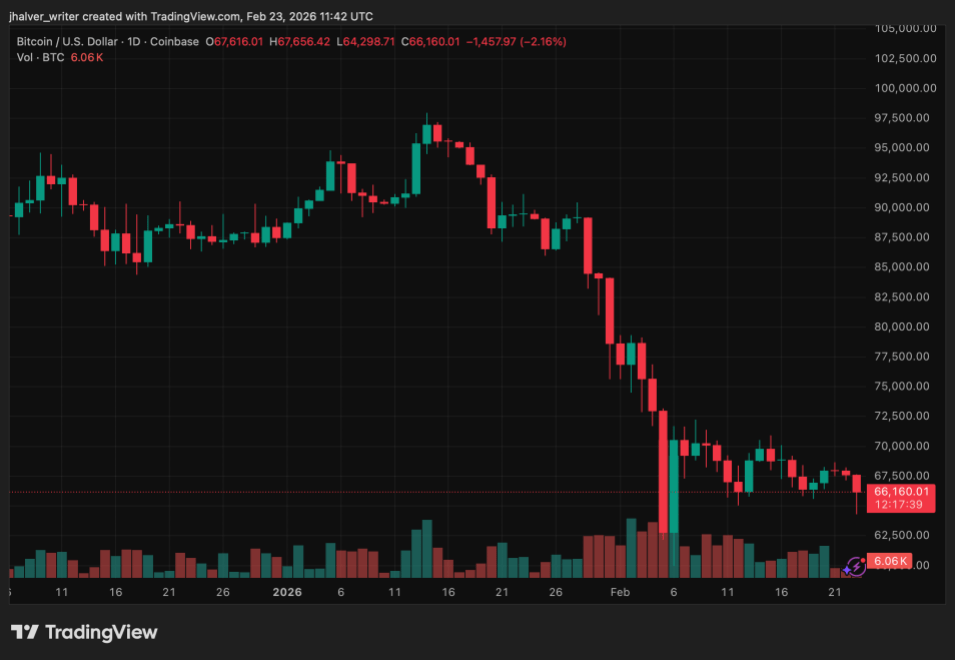
BTC's price trends to the downside on the daily chart. Source: BTCUSD on Tradingview

Trade Tensions and Macro Risks Drive Sell-Off

Market volatility intensified after the Supreme Court of the United States ruled that parts of earlier tariff programs exceeded presidential authority. Shortly after, Trump introduced new global tariffs of up to 15% under separate trade powers, raising concerns about slower global growth and persistent inflation.

Escalating tensions between the United States and Iran added another layer of uncertainty, pushing investors toward traditional safe-haven assets such as gold. Crypto assets, which had previously benefited from a “digital gold” narrative, instead behaved more like high-risk investments during the latest market stress.

Large-holder selling also contributed to downside pressure, with increased transfers from whale wallets to exchanges signaling potential liquidation activity. Analysts noted that thin liquidity and weak conviction among buyers amplified price swings.

Economic Data And Policy Decisions in Focus

Investors are now watching upcoming economic indicators closely. Consumer confidence data, jobless claims, and producer price inflation figures are expected to shape expectations around interest rates. Recent inflation readings above forecasts have reduced hopes for near-term monetary easing by the Federal Reserve.

Meanwhile, the central bank is scheduled to inject roughly $14.6 billion into financial markets, a move some analysts believe could provide temporary support for speculative assets, though not equivalent to full stimulus measures.

Technology earnings are also on the radar, particularly results from Nvidia, whose performance often influences sentiment across both tech equities and crypto markets.

Liquidations Rise as Fear Dominates Sentiment

Market data shows more than $460 million in leveraged positions were wiped out during the latest decline, with long traders accounting for the majority of losses. Institutional flows have weakened as well, with exchange-traded crypto funds recording notable outflows.

Additional supply pressure emerged after mining firm Bitdeer sold its entire weekly production, while public commentary from industry figures, including Michael Saylor, suggested long-term optimism remains despite short-term weakness.

The Crypto Fear and Greed Index has dropped into extreme fear territory, reflecting cautious positioning across the market. Until macroeconomic clarity improves, analysts expect volatility to remain elevated as traders weigh policy risks against longer-term adoption trends.

Cover image from ChatGPT, BTCUSD chart from Tradingview

Related Questions

QWhat caused the crypto market to tumble sharply on Monday, pushing it into extreme fear?

AThe market decline was driven by a combination of U.S. trade policy shifts, including new global tariffs announced by former President Trump, rising geopolitical risks such as tensions with Iran, and looming economic data that reduced risk appetite.

QHow much did the total crypto market capitalization fall within a day, and what level did it approaching?

ATotal crypto market capitalization fell roughly 3–5% within a day, sliding toward the $2.2 trillion mark.

QWhat role did large-holder selling play in the market downturn?

ALarge-holder selling contributed to downside pressure, with increased transfers from whale wallets to exchanges signaling potential liquidation activity, which amplified price swings due to thin liquidity and weak buyer conviction.

QWhich upcoming economic indicators are investors closely watching to shape interest rate expectations?

AInvestors are closely watching consumer confidence data, jobless claims, and producer price inflation figures to shape expectations around interest rates.

QHow much in leveraged positions were wiped out during the market decline, and what was the primary type of trader affected?

AMore than $460 million in leveraged positions were wiped out, with long traders accounting for the majority of the losses.

Related Reads

Casper Network Publishes the Casper Manifest, a Multi-Year Roadmap to Power Regulated Real-World Assets and the Machine Economy

The Casper Association has published "The Casper Manifest," a multi-year technical roadmap for Casper Network. Introduced at the Digital Finance Forum in Bermuda, the roadmap outlines nine coordinated initiatives designed to position the layer-1 blockchain as the infrastructure for regulated real-world asset (RWA) tokenization and the machine-to-machine economy. Key initiatives focus on: 1. **Developer Access:** Adding full Ethereum Virtual Machine (EVM) compatibility alongside its existing WebAssembly (Wasm) execution layer. 2. **User Experience:** Implementing gasless transactions, batch operations, and smart accounts with biometric authentication. 3. **Institutional Compliance & Privacy:** Building compliant security tokens aligned with the ERC-3643 standard and a multi-phase roadmap for confidential transactions with built-in audit tools. 4. **Machine Economy:** Implementing the X402 open payment standard to enable AI agents and machines to make autonomous, programmatic micropayments. 5. **Token Infrastructure:** Creating a Native Token Registry to give all tokens protocol-level status with fixed, predictable costs. 6. **Quantum Safety:** Developing hybrid accounts with both classical and quantum-resistant keys. The first initiative, X402 micropayments, is expected within weeks. Subsequent releases through 2026 and 2027 will include EVM compatibility, compliant security tokens, the Native Token Registry, gasless transactions, and quantum-safe features. The goal is to create a blockchain that is frictionless for users, trusted by institutions, and native for machines.

TheNewsCrypto32m ago

Casper Network Publishes the Casper Manifest, a Multi-Year Roadmap to Power Regulated Real-World Assets and the Machine Economy

TheNewsCrypto32m ago

TechFlow Intelligence: Trump-Linked Companies Transfer $12 Million in Assets Before China Visit, 'The Big Short' Protagonist Warns of Stock Market Bubble Again

The article reports multiple developments across tech, crypto, and finance. In AI, Mozilla used AI for large-scale code review, Google confirmed hackers used AI to find zero-day exploits, and OpenAI deployed GPT-5.5 to find errors in math benchmarks. A court ruled Anthropic's scanning and destroying books for AI training as fair use, while its Claude platform launched on AWS. Google's new video model 'Omni' was leaked. In crypto/Web3, Trump-linked companies transferred $12M in crypto assets before a China visit. BlackRock chose Ethereum for tokenized funds, and a hacker stole $174k via a malicious NFT that tricked an AI. Jack Dorsey's first tweet NFT plummeted from $2.9M to under $5. In chips/hardware, TSMC approved an additional $20B for its Arizona plant. Apple's Tim Cook and Elon Musk will accompany Trump to China, while Nvidia's Jensen Huang is notably absent. For markets, Michael Burry warned of parabolic stock rises and suggested near-total sell-offs, with online discussions comparing current sentiment to the 1999 bubble. Other notes include WTI oil surpassing $100, a 20% price hike for Beijing-Shanghai high-speed rail, and new products like Unitree's $26.9k humanoid robot. The underlying theme suggests AI is becoming infrastructure, creating pressure on old systems while a new order is not yet ready, leaving investors anxious.

marsbit1h ago

TechFlow Intelligence: Trump-Linked Companies Transfer $12 Million in Assets Before China Visit, 'The Big Short' Protagonist Warns of Stock Market Bubble Again

marsbit1h ago

Trading

Spot
Futures
活动图片