Crypto Credit Crisis Deepens As BlockFills Files For Bankruptcy

bitcoinistPublished on 2026-03-16Last updated on 2026-03-16

Abstract

Crypto lender BlockFills and three related entities under parent firm Reliz LTD have filed for Chapter 11 bankruptcy protection. The filing comes after the company halted customer withdrawals last month, citing a sharp Bitcoin selloff as the reason. Prior to the bankruptcy, a Delaware court had already ordered 71 Bitcoin frozen due to a customer fund dispute. Chapter 11 allows the company to continue operating while it restructures its finances and negotiates a repayment plan with creditors. Customers with balances on the platform are considered unsecured creditors, meaning they will be last in line for repayment. The amount and timing of any recovery depend on the company's assets and may take months or years to resolve. This situation mirrors previous crypto lending failures, such as Celsius and Voyager, where customers faced long waits for partial repayments. BlockFills has not disclosed its total liabilities or the number of affected customers.

A Delaware court had already ordered 71 Bitcoin frozen over a customer fund dispute before crypto lender BlockFills formally declared it could no longer operate.

That freeze — tied to a legal battle with creditors over how client money was handled — cast a shadow over the company well before it filed for Chapter 11 protection this week.

Customers Locked Out As Withdrawals Halt

BlockFills stopped letting customers move their money last month. The company pointed to a sharp Bitcoin selloff — the coin dropped from above $97,000 to below $64,000 between mid-January and early February — as the reason it needed to protect both itself and its clients.

Deposits and withdrawals went dark. No timeline for restoration was given.

Now the company and three related entities, all operating under parent firm Reliz LTD, have taken their case to federal bankruptcy court in Delaware.

The filing seeks a Chapter 11 restructuring, which allows a company to keep running while it works out a repayment plan with the people it owes money to.
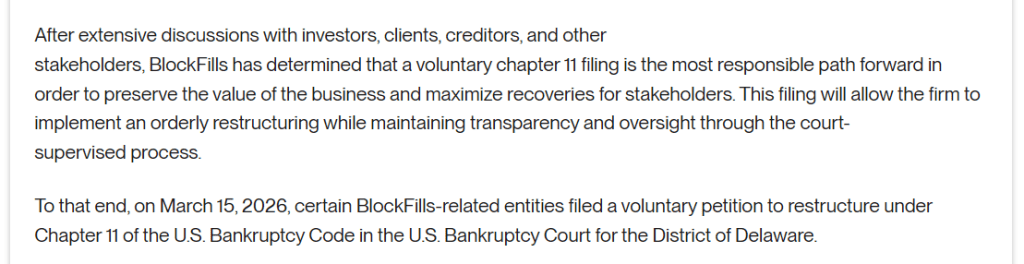
BlockFills' statement on company updates and Chapter 11 bankruptcy filing.

In a statement, BlockFills said the decision came after talks with investors, clients, and creditors. The company said it believes the court process will give it the time and structure needed to stabilize operations, find additional sources of cash, and look at possible deals with outside parties.

Officials said the goal is a consensual restructuring — meaning one that creditors agree to rather than one forced on them by a judge.

What Chapter 11 Means For Those Owed Money

Chapter 11 is not a wind-down. It is a legal system that provides a company with a moratorium to restructure its finances during which an automatic stay prevents creditors from collecting their debts.

BTCUSD now trading at $73,450. Chart: TradingView

As for customers who have balances on the platform, the situation is not so straightforward. They would be considered unsecured creditors in a bankruptcy case, which means they would be last in line after secured creditors and expenses approved by the court.

The amount they will get back and when that will happen is dependent on what assets BlockFills actually owns. That process can take months or, in complex cases, years.

BTCUSD trading at $73,240 on the 24-hour chart: TradingView

Bankruptcy Filing Caps A Difficult Period For The Firm

BlockFills has been under pressure from multiple directions. The frozen Bitcoin order involving Dominion Capital pointed to deeper disputes over whether customer funds were properly segregated — a question that goes beyond market timing.

Reports indicate the company had been in talks with stakeholders for an extended period before concluding that a court-supervised restructuring was the only viable path forward.

The collapse follows a pattern seen in earlier crypto lending failures. Companies including Celsius, Voyager, and BlockFi all suspended withdrawals before filing for bankruptcy during the 2022 market downturn. In each case, customers waited — sometimes years — for partial repayment.

BlockFills has not disclosed total liabilities, the number of affected customers, or the full value of assets under its control. This is a developing situation, and more details are expected to emerge as court documents become public.

Featured image from Unsplash, chart from TradingView

Related Questions

QWhat was the primary reason cited by BlockFills for halting customer withdrawals last month?

ABlockFills cited a sharp Bitcoin selloff, where the coin dropped from above $97,000 to below $64,000 between mid-January and early February, as the reason it needed to protect both itself and its clients.

QWhat type of bankruptcy protection did BlockFills and its related entities file for?

ABlockFills and three related entities filed for Chapter 11 bankruptcy protection, which allows a company to continue operating while it works out a repayment plan with its creditors.

QHow are customers with balances on the BlockFills platform classified in the bankruptcy case?

ACustomers with balances on the platform are considered unsecured creditors, meaning they are last in line for repayment after secured creditors and court-approved expenses.

QWhat significant event involving customer funds occurred before the formal bankruptcy filing?

AA Delaware court had already ordered 71 Bitcoin to be frozen due to a customer fund dispute, which was tied to a legal battle with creditors over how client money was handled.

QWhich other crypto companies does the article mention as having followed a similar pattern of suspending withdrawals before filing for bankruptcy in 2022?

AThe article mentions Celsius, Voyager, and BlockFi as companies that suspended withdrawals before filing for bankruptcy during the 2022 market downturn.

Related Reads

Casper Network Publishes the Casper Manifest, a Multi-Year Roadmap to Power Regulated Real-World Assets and the Machine Economy

The Casper Association has published "The Casper Manifest," a multi-year technical roadmap for Casper Network. Introduced at the Digital Finance Forum in Bermuda, the roadmap outlines nine coordinated initiatives designed to position the layer-1 blockchain as the infrastructure for regulated real-world asset (RWA) tokenization and the machine-to-machine economy. Key initiatives focus on: 1. **Developer Access:** Adding full Ethereum Virtual Machine (EVM) compatibility alongside its existing WebAssembly (Wasm) execution layer. 2. **User Experience:** Implementing gasless transactions, batch operations, and smart accounts with biometric authentication. 3. **Institutional Compliance & Privacy:** Building compliant security tokens aligned with the ERC-3643 standard and a multi-phase roadmap for confidential transactions with built-in audit tools. 4. **Machine Economy:** Implementing the X402 open payment standard to enable AI agents and machines to make autonomous, programmatic micropayments. 5. **Token Infrastructure:** Creating a Native Token Registry to give all tokens protocol-level status with fixed, predictable costs. 6. **Quantum Safety:** Developing hybrid accounts with both classical and quantum-resistant keys. The first initiative, X402 micropayments, is expected within weeks. Subsequent releases through 2026 and 2027 will include EVM compatibility, compliant security tokens, the Native Token Registry, gasless transactions, and quantum-safe features. The goal is to create a blockchain that is frictionless for users, trusted by institutions, and native for machines.

TheNewsCrypto48m ago

Casper Network Publishes the Casper Manifest, a Multi-Year Roadmap to Power Regulated Real-World Assets and the Machine Economy

TheNewsCrypto48m ago

TechFlow Intelligence: Trump-Linked Companies Transfer $12 Million in Assets Before China Visit, 'The Big Short' Protagonist Warns of Stock Market Bubble Again

The article reports multiple developments across tech, crypto, and finance. In AI, Mozilla used AI for large-scale code review, Google confirmed hackers used AI to find zero-day exploits, and OpenAI deployed GPT-5.5 to find errors in math benchmarks. A court ruled Anthropic's scanning and destroying books for AI training as fair use, while its Claude platform launched on AWS. Google's new video model 'Omni' was leaked. In crypto/Web3, Trump-linked companies transferred $12M in crypto assets before a China visit. BlackRock chose Ethereum for tokenized funds, and a hacker stole $174k via a malicious NFT that tricked an AI. Jack Dorsey's first tweet NFT plummeted from $2.9M to under $5. In chips/hardware, TSMC approved an additional $20B for its Arizona plant. Apple's Tim Cook and Elon Musk will accompany Trump to China, while Nvidia's Jensen Huang is notably absent. For markets, Michael Burry warned of parabolic stock rises and suggested near-total sell-offs, with online discussions comparing current sentiment to the 1999 bubble. Other notes include WTI oil surpassing $100, a 20% price hike for Beijing-Shanghai high-speed rail, and new products like Unitree's $26.9k humanoid robot. The underlying theme suggests AI is becoming infrastructure, creating pressure on old systems while a new order is not yet ready, leaving investors anxious.

marsbit1h ago

TechFlow Intelligence: Trump-Linked Companies Transfer $12 Million in Assets Before China Visit, 'The Big Short' Protagonist Warns of Stock Market Bubble Again

marsbit1h ago

Trading

Spot
Futures
活动图片





