Crypto could rally in Q2: But tensions rise, as do real-world risks

ambcryptoPublished on 2026-03-20Last updated on 2026-03-20

Abstract

Based on historical trends, there is potential for a bullish Q2 in the crypto market, as seen in 2025 when the total market cap surged 23.4% and Bitcoin gained 30% following a Q1 correction. This year's 20% Q1 drop has already been exceeded, indicating the market's ability to rebound quickly. However, currently down 18%, faces rising real-world risks. Geopolitical tensions, such as the West Asia crisis, and hotter-than-expected inflation data have triggered risk-off sentiment, causing significant sell-offs. Additionally, political uncertainty, including a high probability of a U.S. presidential impeachment, reflects broader economic weaknesses. These macro factors are increasingly influencing crypto, making a strong Q2 rally far less certain than before.

Is it still too early to project a bullish Q2 for the crypto market?

The discussion is certainly worth exploring, especially when we consider historical trends. Looking back at the 2025 cycle, Q2 clearly emerged as the most bullish quarter of the year.

During this period, the total crypto market cap increased by 23.4%, which translated into roughly $640 billion in fresh inflows.

Bitcoin [BTC] mirrored this momentum, closing the quarter up 30% and achieving the highest ROI of the year.

However, the main takeaway? This surge followed BTC’s roughly 12% correction in Q1, and the market has already outpaced that pullback with this year’s roughly 20% drop so far, showing how quickly it can rebound and adapt.
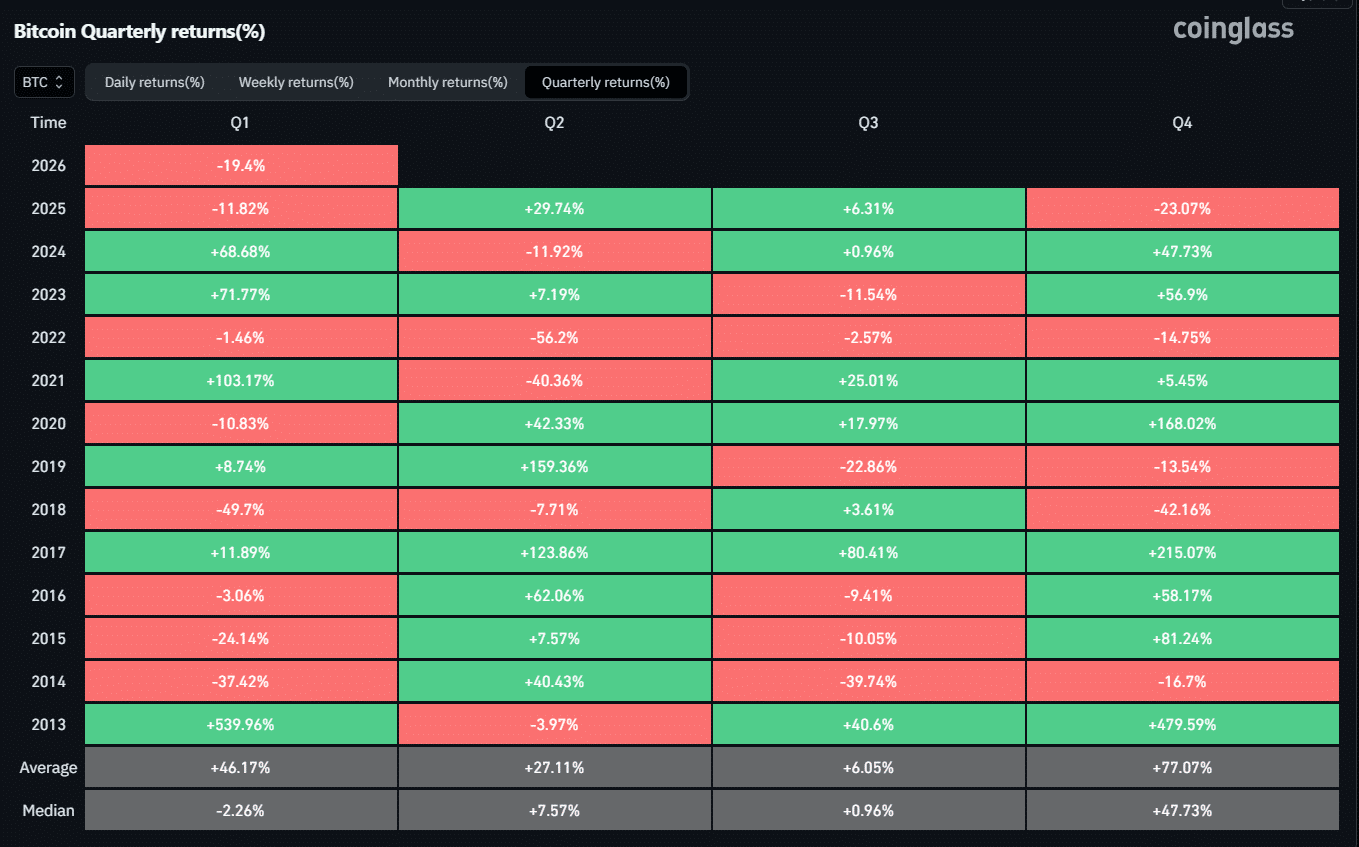
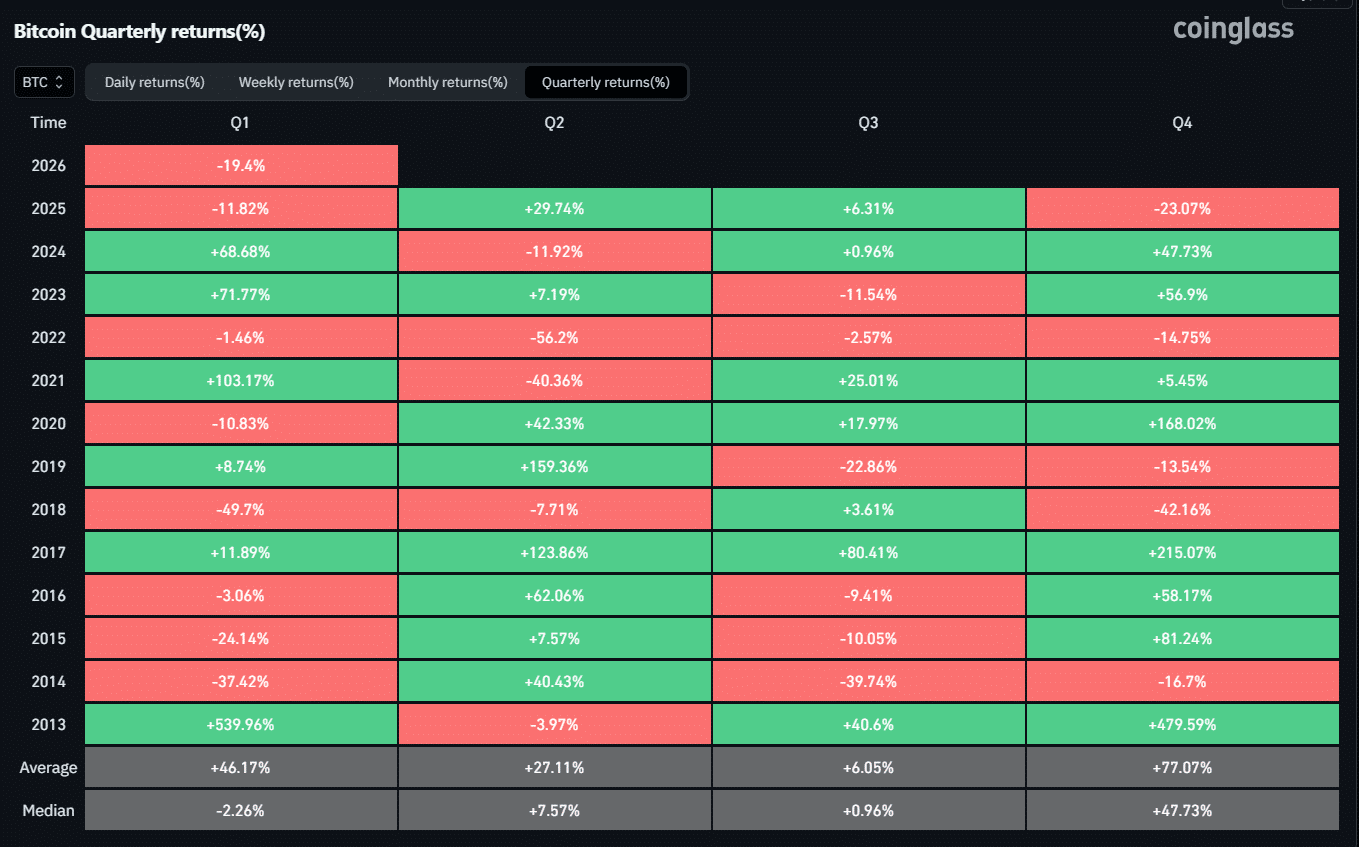
Source: CoinGlass

Against this backdrop, we cannot dismiss the possibility of a repeat run for crypto as overly optimistic.

In fact, it becomes even more compelling when we consider how the market has so far shrugged off the FUD stemming from the West Asia crisis, despite surging oil prices. Meanwhile, traditional safe havens have been under pressure, with gold posting nearly twice the weekly losses of Bitcoin.

Taken together, this suggests that the crypto market could be setting the stage for another strong rally. However, when we step back and look at the bigger picture, the total crypto market cap is still down roughly 18%, a stark contrast to the S&P 500’s 3.23% quarterly decline.

Naturally, the key question becomes: Can crypto’s relative strength hold up against a double-digit pullback and still power a bullish Q2?

The crypto market faces a real-world test

The crypto market stumbled on fresh macro data, sparking another wave of risk-off activity.

As AMBCrypto flagged, the latest PPI report came in hotter than expected, showing that inflation concerns continue to keep the Federal Reserve hawkish on interest rates. Still, the market had mostly priced this in, with nearly 99% expecting rates to remain unchanged.

And yet, crypto closed the session down 3.24%, reminding investors that even priced-in data can shake sentiment.

This naturally puts the spotlight on recent prediction market data, which highlights that the probability of U.S. President Donald Trump being impeached before 2028 has risen to 72%, trending steadily higher over the past few months.
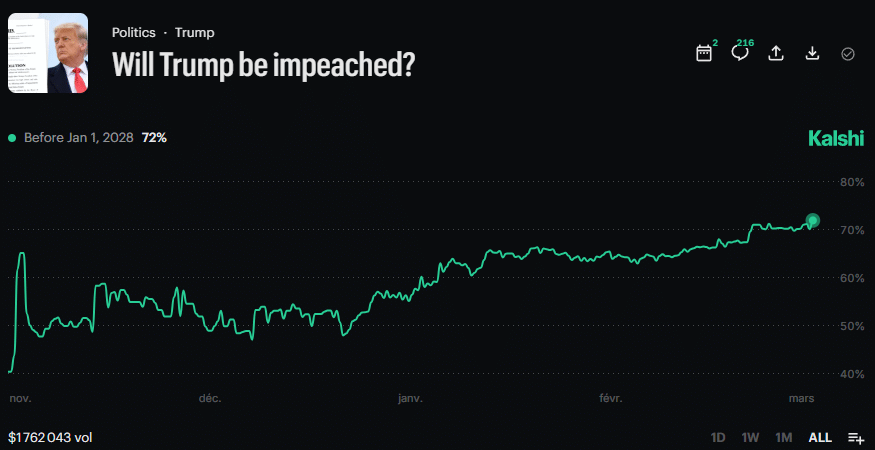
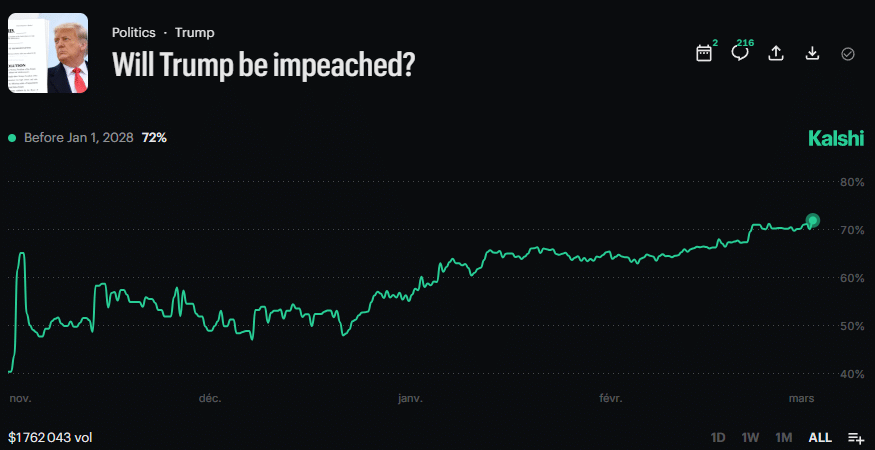
Source: Kalshi

Most importantly, this isn’t a one-off signal. The data also reflects a weakening U.S. economy across multiple sectors, from unemployment to GDP, underscoring that the impeachment prediction is supported by broader economic trends.

In this context, the recent PPI report represents just one piece of a much larger picture, highlighting ongoing inflation pressures and the challenges policymakers face. Against this backdrop, it’s no surprise that the market reacted.

After Israel struck Iran’s critical energy infrastructure, crypto lost billions, with Bitcoin falling more than 2%. This shows that real-world events are starting to feed into investor sentiment, testing the crypto market’s recent resilience.

This in turn makes the odds of a bullish Q2 highly unlikely, as macro FUD now plays a larger role in shaping investor expectations than it did earlier this year.


Final Summary

  • Historical trends suggest Q2 could be bullish, as BTC and the overall crypto market have rebounded strongly after Q1 pullbacks.
  • Macro and geopolitical risks are beginning to influence investor sentiment, making a repeat Q2 rally far from guaranteed.


Related Reads

Within Strategy's Framework, STRC's Dividend Yield Remains at 12% as Share Price Stays Below Par Value

Michael Saylor, Executive Chairman of Strategy (MSTR), confirmed that the dividend rate for its STRC perpetual preferred shares will remain at 12.00% through August 2026. The rate has increased from 9% at its July 2025 launch to the current high via a "ratchet" mechanism, which permanently raises the rate by 0.5% whenever the share price falls below $95. This mechanism is intended to push the price back toward its $100 par value and support Strategy's "at-the-market" (ATM) program for issuing new shares to fund Bitcoin purchases. However, the mechanism has not worked as intended. STRC shares closed at $89.46 on July 31, remaining about 10-11% below par value despite the record-high dividend. Competition from rival Strive's higher-yielding SATA securities has pressured demand. The persistent discount has forced Strategy to suspend new STRC issuances via its ATM program, limiting this funding channel for Bitcoin acquisitions. STRC's struggles reflect Bitcoin's own volatility, as the preferred shares historically move in tandem. Analysts have warned the ratchet structure carries long-term, one-way risk. A law firm is investigating Strategy's ability to maintain dividend payments if Bitcoin's price stays low. Retail investors own roughly 83% of outstanding STRC shares, a group seen as prone to panic selling during downturns. In response, Strategy has established financial reserves, including a liquidity cushion covering about 26 months of dividend/interest obligations, and a $2 billion share buyback program alongside a Bitcoin monetization framework, though the company emphasized it is not obligated to sell any Bitcoin.

cryptonews.ru41m ago

Within Strategy's Framework, STRC's Dividend Yield Remains at 12% as Share Price Stays Below Par Value

cryptonews.ru41m ago

Analyst: Bitcoin's Price Will Drop to $60k in August, Then Rebound to $70k

Financial analyst Andrey Poroshin has provided a new forecast for Bitcoin's price dynamics in August. Poroshin, an analyst at the Bitbanker exchange, expects the cryptocurrency market to experience a downturn this month, with prices retesting the $60,000 level due to a lack of supportive macroeconomic catalysts. He noted that the recent US Federal Reserve decision to hold interest rates did not significantly impact the market, while inflation remains above the 2% target. Poroshin stated that Bitcoin is ending July under pressure from moderate volatility and a lack of new macroeconomic stimuli, leading to continued market caution. According to his base scenario, Bitcoin will drop to a range of $60,000 to $62,000 before recovering to $70,000. He pointed out that even $70,000 remains below the cost of mining in the US, which has prompted some miners to shift towards AI data center operations. Poroshin cited the winding down of BitMEX's operations as a potential catalyst for a price rebound, suggesting the exit of weaker players often coincides with market reversals and reduced short-term selling pressure. He believes Bitcoin is currently less susceptible to geopolitical shocks, such as the Iran-US conflict, and does not expect significant market changes in August related to the pending CLARITY Act. Looking ahead, Poroshin forecasts that September will bring more active price fluctuations driven by potential Fed rate decisions and possible discussions or approval of the CLARITY Act.

cryptonews.ru41m ago

Analyst: Bitcoin's Price Will Drop to $60k in August, Then Rebound to $70k

cryptonews.ru41m ago

Trading

Spot
活动图片



