Original|Odaily Planet Daily(@OdailyChina)
Author|Wenser(@wenser 2010 )

Recently, Amundi, Europe's largest asset manager with assets under management (AUM) of $2.9 trillion, disclosed that it increased its holdings of Strategy shares by 148%, now holding 1.32 million shares worth $127.7 million. Looking back at recent data, despite ongoing fluctuations in BTC and lackluster price performance of many crypto-related stocks, several institutions have chosen to increase their holdings against the trend, waiting for market rebounds to generate profits.
Currently, narratives such as "the DAT model is bankrupt" and "institutional crypto faith has collapsed" are rampant. However, the 13F filings, which the U.S. SEC mandates quarterly, reveal a different timing-based truth—a group of investment institutions with AUM ranging from hundreds of billions to trillions of dollars are quietly adding to their positions at their own pace. Odaily Planet Daily will briefly outline the relevant targets and some representative investment institutions in this article.
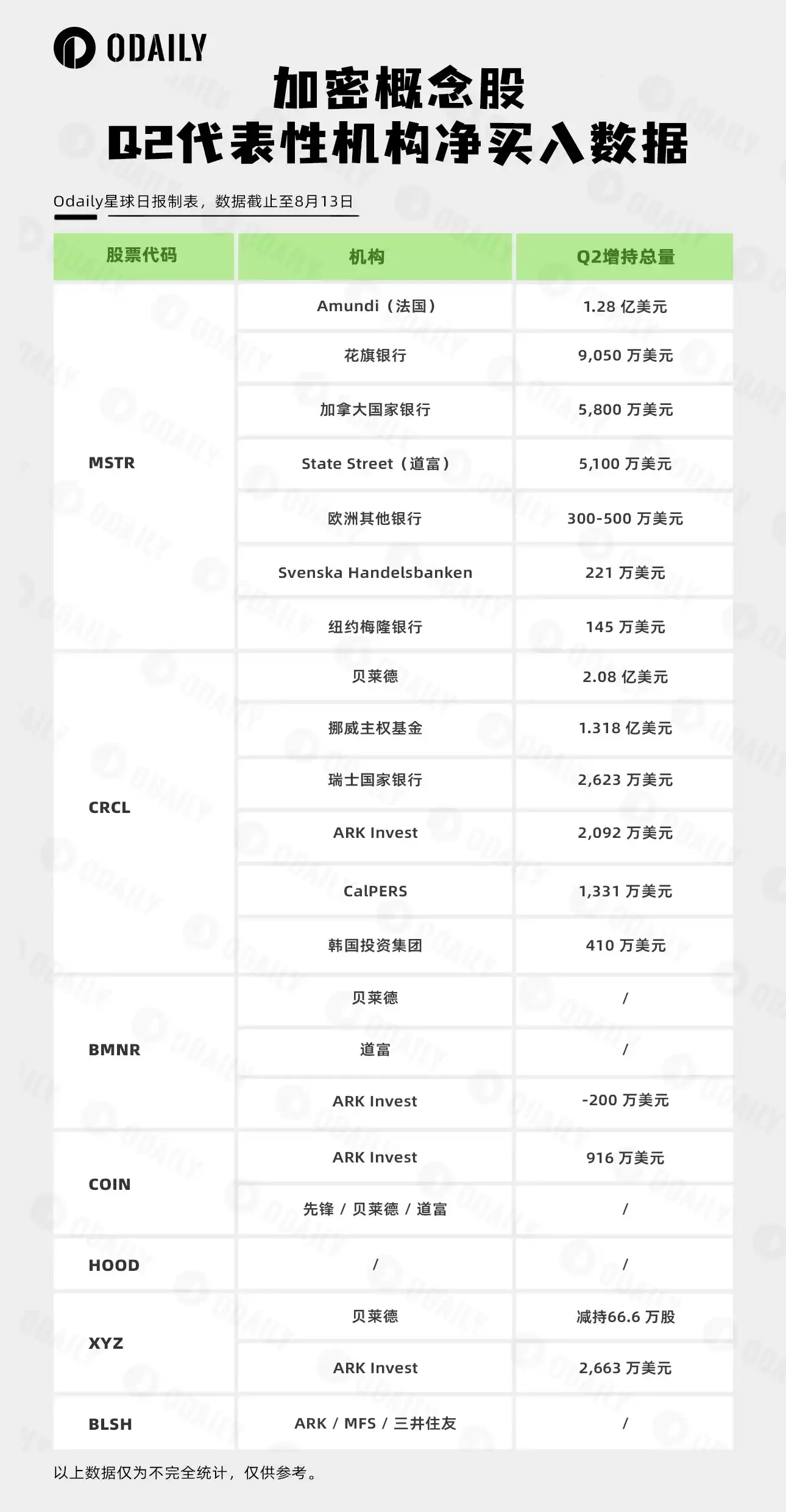
Strategy (MSTR): Asset Management Giants and Public Funds Adding
MSTR is the most solid performer in this round of institutional accumulation, with buyers covering asset management companies, large banks, public funds, and various other institutions.
The approximately 1.32 million share position held by Amundi mentioned at the beginning of the article is not the result of sustained one-way buying. In Q1 of this year, it slashed its Strategy stock position by nearly 90%. The Q2 accumulation was a replenishment from a low base position of about 530,000 shares, considering the crypto market's performance in Q1 was quite dismal, requiring prudent trading from asset management giants.
The Vanguard Group's VOE fund announced on July 20 that it increased its holdings of MSTR by 83,093 shares, valued at $8.16 million, raising its total position to 2.12 million shares worth $209 million. On July 27, its VTSAX fund added 529,100 shares of MSTR, valued at $50 million, bringing its total position to 10.5 million shares worth $994 million.
The world's fourth-largest asset manager, State Street Corporation, recently disclosed that it increased its holdings of MSTR by 506,635 shares, involving approximately $51 million, bringing its total position to 7.52 million shares valued at about $758 million, representing a 7.2% increase in position size.
The world's largest active fund manager, Capital Group, with AUM of $3.3 trillion, disclosed in July that its Growth ETF (CGGR) increased its MSTR holdings by 80,240 shares, valued at $7.78 million, raising its total position to 1.66 million shares worth $161.39 million.
The Netherlands' fifth-largest asset manager, Robeco, disclosed in July that its MSTR holdings increased by 11%, reaching a total of 133,755 shares valued at $13.1 million.
Korean asset managers are also major accumulators of MSTR. South Korea's second-largest asset manager, Mirae Asset Global Investments (AUM $845 billion), disclosed in July an increase of 25,573 MSTR shares, valued at $2.42 million, raising its total position to 135,951 shares worth $12.87 million.
Beyond asset management institutions, accumulation by banks and public funds is also noteworthy.
Among large banks, Sweden's second-largest bank, Svenska Handelsbanken AB (assets $132.5 billion), previously increased its MSTR holdings by 23,829 shares valued at $2.21 million, bringing its total position to 106,522 shares worth $9.92 million. Sweden's third-largest bank, Swedbank AB, added 8,278 Strategy shares, bringing its total to 90,590 shares valued at $8.81 million. BNY Mellon recently disclosed an increase of 14,630 Strategy shares valued at $1.45 million, raising its total position to 1.02 million shares worth $102.4 million. Canada's National Bank nearly doubled its MSTR holdings to 1.2 million shares, valued at $116 million. Citigroup increased its holdings by 238,538 shares, bringing the position value to $90.5 million. European banking giants like Nordea and Raiffeisen Bank International also increased their MSTR holdings by amounts ranging from hundreds of thousands to a few million dollars.
Regarding public funds, the Michigan Retirement System (AUM over $100 billion) recently disclosed that its MSTR position increased from about 5,800 shares to 14,000 shares, a 141% increase, with a market value of about $1.22 million. The Louisiana State Employees' Retirement Fund increased its MSTR holdings to 21,300 shares valued at $2.13 million. The New Jersey Police and Firemen's Retirement Fund's MSTR holdings recently grew to 49,055 shares valued at $4.66 million.
Although the absolute amounts of these increased positions are not large, the willingness of these public pension funds, which prioritize fiduciary duty, to expand their BTC asset risk exposure carries greater signaling significance than the capital itself.
Bitmine (BMNR): From Hedge Funds to Asset Management Giants Buying
As the leading treasury stock for Ethereum, BMNR's market performance has been less than stellar.
After attracting over $100 million in accumulation from quant funds Citadel Advisors and Susquehanna International in Q1, the main accumulation forces in Q2 gradually shifted to mainstream asset management giants and index funds.
BlackRock is currently the largest institutional shareholder of BMNR, holding 27,297,100 shares as of the end of June this year.
State Street Corp. held 8.74 million BMNR shares at the end of Q2, strongly entering the list of top 10 shareholders.
Cathie Wood's Ark Invest held 5.7 million shares at the end of Q2 but sold approximately 121,000 Bitmine shares worth $2 million in late July.
The most noteworthy aspect in Q2 was Bitmine's inclusion in the Russell index, which triggered mandatory large-scale purchases by numerous passive index funds and ETFs managed by giants. For now, this can hardly be viewed as "asset management giants actively deciding to buy."
Circle (CRCL): Public Funds, Asset Management Giants, International Banks, and Cathie Wood Are All Taking Action
On the CRCL front, two types of capital are in motion.
CalPERS, the California Public Employees' Retirement System, initiated a new position in Circle during Q2, buying 139,507 shares for approximately $13.31 million. The scale is in the tens of millions, conservative in direction but clear in stance.
Many funds were also positioning in Q1. According to recently disclosed quarterly data: Southpoint Capital Advisors previously increased its holdings by 175%, about 2.1 million shares valued at approximately $200 million; Jane Street increased its holdings more than tenfold, about 1.94 million shares valued at approximately $185 million; Morgan Stanley increased its holdings by 241%, about 3.52 million shares valued at approximately $336 million.
Moving into Q2, despite sluggish progress on the CLARITY Act, more institutions chose to buy into Circle's "crypto bank and payments giant narrative."
Norway's sovereign wealth fund spent $131.8 million to buy 2,105,378 shares.
The Swiss National Bank holds approximately 418,900 shares, valued at about $26.23 million.
Korea Investment CORP also bought 65,443 shares, valued at approximately $4.1 million.
BlackRock directly increased its holdings by 65.35%, raising its total position to 8.4 million shares.
ARK Invest has also been active with this stock. Its most recent operation was on August 7, when its ARKK fund bought 313,764 Circle shares. At $66.67 per share, this was valued at approximately $20.92 million. Previous statistics show that as of July 31, ARK Innovation ETF's top ten holdings included 3.82% in Circle stock, ranking 8th.
Coinbase (COIN): Vanguard Buys Passively, Ark Invest Buys on Dips and Trades Actively
The largest institutional shareholder of COIN is currently Vanguard Group, with its position size consistently maintained at tens of millions of shares worth billions of dollars. The source of such positions is relatively clear: COIN is already included in mainstream indices like the S&P 500. Vanguard's managed index funds and ETFs will buy passively according to weightings, with the scale following changes in market capitalization. This does not represent fund managers actively deciding "now is the time to add."
BlackRock and State Street are also consistently at the top of COIN's shareholder list, with similar logic to Vanguard. Currently, accumulation with active decision-making色彩 comes more from sector rotation within thematic funds like ARK, rather than new buying from traditional large asset managers.
Ark Invest's choice is to buy COIN on dips and occasionally trade actively. Its most recent operation occurred on August 7, spending approximately $9.16 million to buy 59,668 Coinbase shares at $153.6 per share. As of July 31, ARK Innovation ETF's top ten holdings included 4.54% in Coinbase stock, ranking 5th.
Robinhood (HOOD): Pension Funds Accumulate Sporadically, Institutional Ownership Exceeds 90%
HOOD's institutional ownership ratio has already exceeded 93%, making it the most institutionalized among these targets.
Q1 13F data this year shows that the Illinois Municipal Retirement Fund increased its position by 19.3%, raising its holdings to 74,000 shares valued at approximately $5.14 million. Empowered Funds increased its position by 46.7%, holding about 50,000 shares. While these individual amounts are not large, the breadth is more telling—a large number of small to medium-sized pension funds and bank-affiliated asset managers are simultaneously making small increases. This indicates that HOOD has entered the regular allocation pool for these conservative funds, rather than being an alternative target requiring special approval.
ARK also increased its HOOD position by about 1.19 million shares in Q1. According to reliable statistics, as of July 31, ARK Innovation ETF's top ten holdings also included 3.54% in Robinhood stock, ranking 9th.
Block (XYZ): BlackRock Slightly Reduced in Q2, Cathie Wood Builds Position Actively
Regarding Block stock, the most noteworthy action is BlackRock's move in Q2—according to the latest disclosure, BlackRock holds approximately 41,573,031 Block shares valued at about $3.1596 billion. Compared to Q1, it actually slightly reduced its Block holdings by 665,843 shares.
Cathie Wood shows a characteristic tendency towards this stock: Trading records from mid-July show ARK bought approximately 72,000 Block shares valued at about $5.63 million. On August 6, Ark Invest again disclosed buying 267,676 Block shares valued at about $21 million. Notably, Ark Invest will appropriately reduce and sell its position when the market declines, demonstrating flexible operations.
Bullish (BLSH): Cathie Wood Leads, Asset Managers Follow
BLSH hasn't been listed for long, with institutional position-building mostly concentrated in the last two quarters.
Cathie Wood's Ark Invest is one of the earliest and most clear-cut buyers, with a Q1 position-building scale exceeding $160 million.
Massachusetts Financial Services (MFS) and Sumitomo Mitsui Trust Bank also each initiated new positions close to $100 million, aligning with ARK's direction.
Not Many Options in the Sector, Choose the Leaders
Synthesizing the above information, most investment institutions, due to risk management, stable returns, and fund passive holding requirements, have mostly adopted an investment strategy combining "leading stocks + a few optional choices."
Observable patterns are:
- Accumulation with genuine active decision-making色彩 is concentrated in thematic funds like ARK and some hedge funds. Their position adjustments are frequent, direction clear, and they are willing to continue buying during declines.
- Index fund giants like Vanguard, BlackRock, and State Street appear in the shareholder lists of almost every target, but this is more about passive buying following index weightings. It should not be simplistically interpreted as "institutions are bullish."
- While pension fund actions are not large in individual amounts, their coverage is expanding. Public funds from Michigan, Illinois, California, etc., almost simultaneously appear on the accumulation lists for crypto stocks. This indicates that crypto assets are being accepted as configurable targets by more institutions with extremely low risk appetites and conservative investment styles.
For retail investors, 13F filings have a 45-day disclosure delay. Institutional position adjustments are extremely flexible and variable. Previous holding information can only serve as an investment reference and should not be directly "copied." This is especially true for active traders like Cathie Wood who act opportunistically and trade frequently.
More worthy of consideration is the signal conveyed by the combined movements of various institutional funds—in judging market bottoms and sector options, institutions have more solid and敏锐 insights than retail investors. (If there are any errors or omissions in the specific data or a need for more detailed explanations, feedback from readers is welcome.)