Crypto activity in Brazil rises 43% with average investment surpassing $1,000: Report

cointelegraphPublished on 2025-12-21Last updated on 2025-12-21

Abstract

Cryptocurrency activity in Brazil surged by 43% in 2025, with the average investment per user exceeding $1,000 (around 5,700 BRL), according to a Mercado Bitcoin report. The market is shifting from speculation to structured investing, with 18% of users diversifying across multiple assets. Bitcoin remained the most-traded asset, followed by USDT, ETH, and SOL. Stablecoins saw triple the previous year’s transactions as investors sought lower volatility. Lower-risk digital fixed-income products grew 108%, with $325 million distributed to investors. Younger investors (under 24) increased by 56%, and participation expanded beyond major cities. Itaú Asset Management recommended a 1–3% Bitcoin allocation due to geopolitical and monetary risks.

Crypto activity in Brazil expanded sharply in 2025, with total transaction volume climbing 43% year over year as average investment per user crossed the $1,000 mark, according to a new report from crypto platform Mercado Bitcoin.

The report, titled “Raio-X do Investidor em Ativos Digitais 2025,” claimed that the Brazilian crypto market is no longer driven purely by speculation but increasingly shaped by structured investing and portfolio planning. The data was based on activity across Mercado Bitcoin’s platform, the largest digital asset exchange in Latin America.

Per the report, the average amount invested per person reached roughly 5,700 Brazilian reais, equivalent to more than $1,000. At the same time, 18% of investors allocated funds across more than one crypto asset, indicating a gradual shift toward diversification rather than single-asset bets.

Bitcoin (BTC) remained the most traded asset, followed by the US dollar-pegged stablecoin USDt (USDT), Ether (ETH) and Solana (SOL), the report showed. Stablecoins also stood out as a key on-ramp for new and existing investors, accounting for roughly three times more transactions than in the prior year, as users sought lower volatility amid uncertain macro conditions.
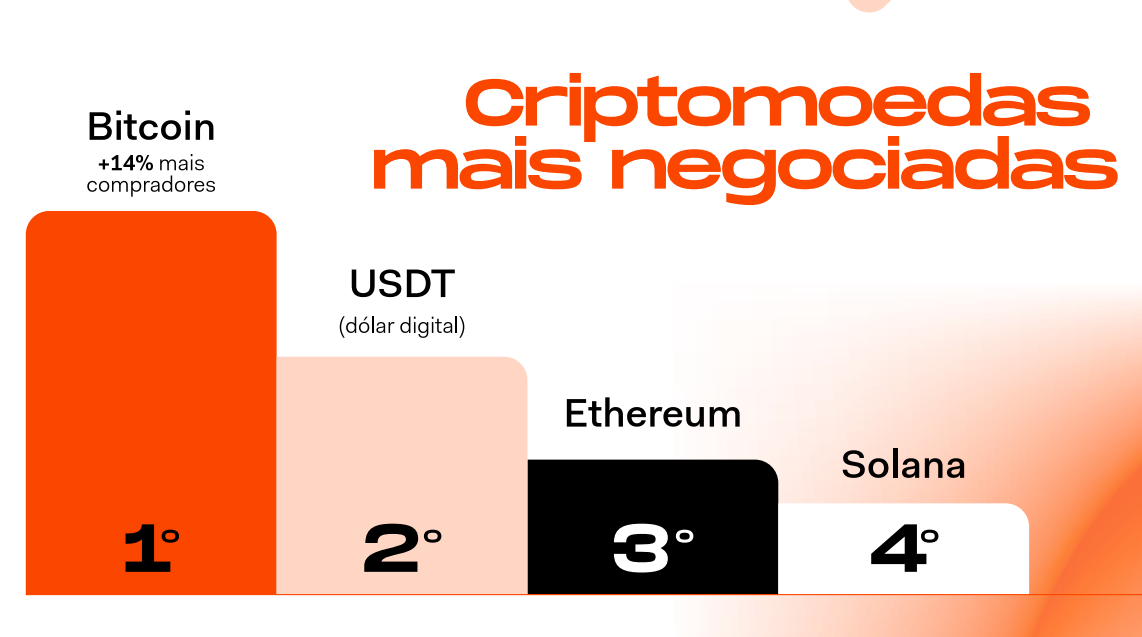
Bitcoin remains most-traded asset in Brazil. Source: Mercado Bitcoin

Related: Brazilian stock exchange to launch tokenization platform and stablecoin

Brazil’s low-risk crypto products see 108% growth

The report revealed that lower-risk crypto products gained momentum in 2025. Digital fixed-income offerings, known locally as Renda Fixa Digital (RFD), recorded a 108% increase in investment volume, with Mercado Bitcoin distributing about $325 million to investors in 2025.

Demographics also shifted. Investors aged 24 and under posted a 56% increase year over year. However, Mercado Bitcoin noted that demand expanded across all age groups, including high-net-worth and institutional profiles.

Regionally, Brazil’s Southeast and South remained dominant by transaction volume, led by São Paulo and Rio de Janeiro, while states in the Central-West and Northeast gained visibility as crypto participation spread geographically.

Related: Solana enters Brazil’s main exchange as Valour expands regulated crypto access

Itaú Asset advises 1%–3% Bitcoin allocation

As Cointelegraph reported, Itaú Asset Management has recommended that investors allocate between 1% and 3% of their portfolios to Bitcoin, citing rising geopolitical risks, shifting monetary policy and ongoing currency volatility.

In a research note, strategist Renato Eid described Bitcoin as a distinct asset with its own return profile and a potential hedging role due to its global and decentralized nature, despite sharp price swings throughout 2025.

Magazine: 2026 is the year of pragmatic privacy in crypto — Canton, Zcash and more

Related Questions

QWhat was the percentage increase in crypto transaction volume in Brazil in 2025, according to the Mercado Bitcoin report?

ACrypto transaction volume in Brazil increased by 43% year over year in 2025.

QWhat was the average amount invested per person in Brazilian reais, and what was its approximate equivalent in US dollars?

AThe average amount invested per person was roughly 5,700 Brazilian reais, which is equivalent to more than $1,000.

QWhich four crypto assets were reported as the most traded in Brazil, listed in order?

AThe most traded assets were Bitcoin (BTC), followed by the stablecoin USDt (USDT), Ether (ETH), and Solana (SOL).

QWhat was the reported growth percentage for lower-risk crypto products like Digital Fixed-Income (RFD) in 2025?

ALower-risk crypto products, specifically Digital Fixed-Income offerings (RFD), recorded a 108% increase in investment volume.

QWhat Bitcoin allocation range did Itaú Asset Management recommend for investors' portfolios and what reasons did they cite?

AItaú Asset Management recommended an allocation of between 1% and 3% to Bitcoin, citing rising geopolitical risks, shifting monetary policy, and ongoing currency volatility.

Related Reads

OpenAI Post-Training Engineer Weng Jiayi Proposes a New Paradigm Hypothesis for Agentic AI

OpenAI engineer Weng Jiayi's "Heuristic Learning" experiments propose a new paradigm for Agentic AI, suggesting that intelligent agents can improve not just by training neural networks, but also by autonomously writing and refining code based on environmental feedback. In the experiment, a coding agent (powered by Codex) was tasked with developing and maintaining a programmatic strategy for the Atari game Breakout. Starting from a basic prompt, the agent iteratively wrote code, ran the game, analyzed logs and video replays to identify failures, and then modified the code. Through this engineering loop of "code-run-debug-update," it evolved a pure Python heuristic strategy that achieved a perfect score of 864 in Breakout and performed competitively with deep reinforcement learning (RL) algorithms in MuJoCo control tasks like Ant and HalfCheetah. This approach, termed Heuristic Learning (HL), contrasts with Deep RL. In HL, experience is captured in readable, modifiable code, tests, logs, and configurations—a software system—rather than being encoded solely into opaque neural network weights. This offers potential advantages in explainability, auditability for safety-critical applications, easier integration of regression tests to combat catastrophic forgetting, and more efficient sample use in early learning stages, as demonstrated in broader tests on 57 Atari games. However, the blog acknowledges clear limitations. Programmatic strategies struggle with tasks requiring long-horizon planning or complex perception (e.g., Montezuma's Revenge), areas where neural networks excel. The future vision is a hybrid architecture: specialized neural networks for fast perception (System 1), HL systems for rules, safety, and local recovery (also System 1), and LLM agents providing high-level feedback and learning from the HL system's data (System 2). The core proposition is that in the era of capable coding agents, a significant portion of an AI's learned experience could be maintained as an auditable, evolving software system.

marsbit31m ago

OpenAI Post-Training Engineer Weng Jiayi Proposes a New Paradigm Hypothesis for Agentic AI

marsbit31m ago

Your Claude Will Dream Tonight, Don't Disturb It

This article explores the recent phenomenon of AI companies increasingly using anthropomorphic language—like "thinking," "memory," "hallucination," and now "dreaming"—to describe machine learning processes. Focusing on Anthropic's newly announced "Dreaming" feature for its Claude Agent platform, the piece explains that this function is essentially an automated, offline batch processing of an agent's operational logs. It analyzes past task sessions to identify patterns, optimize future actions, and consolidate learnings into a persistent memory system, akin to a form of reinforcement learning and self-correction. The article draws parallels to similar features in other AI agent systems like Hermes Agent and OpenClaw, which also implement mechanisms for reviewing historical data, extracting reusable "skills," and strengthening long-term memory. It notes a key difference from human dreaming: these AI "dreams" still consume computational resources and user tokens. Further context is provided by discussing the technical challenges of managing AI "memory" or context, highlighting the computational expense of large context windows and innovations like Subquadratic's new model claiming drastically longer contexts. The core critique argues that this strategic use of human-centric vocabulary does more than market products; it subtly reshapes user perception. By framing algorithms with terms associated with consciousness, companies blur the line between tool and autonomous entity. This linguistic shift can influence user expectations, tolerance for errors, and even perceptions of responsibility when systems fail, potentially diverting scrutiny from the companies and engineers behind the technology. The article concludes by speculating that terms like "daydreaming" for predictive task simulation might be next, continuing this trend of embedding the idea of an "inner life" into computational processes.

marsbit33m ago

Your Claude Will Dream Tonight, Don't Disturb It

marsbit33m ago

Trading

Spot
Futures
活动图片





