Original|Odaily Planet Daily (@OdailyChina)
Author|Wenser(@wenser2010)
When TradFi becomes a must-have for the crypto industry, no project can stand apart. However, some choose to start with asset types, while others set their sights on the various companies and institutions behind the assets.
Last month, the cross-chain bridging protocol LI.FI officially and prominently announced the launch of its intent-based execution architecture, LI.FI Intents. This product will serve as the underlying execution layer providing stablecoin payments, RWA, and compliant on-chain liquidity, targeting services for fintech companies, neobanks, wallets, and regulated financial institutions.
Amidst the current trend of stablecoin payments, RWA assets, and compliant assets converging with the on-chain ecosystem, Li.Fi is no longer content with being just a "liquidity transfer protocol." Instead, it is proactively seeking breakthroughs and role upgrades in areas such as new assets, new customers, and new operating systems.
When Industry Liquidity Tightens, Cross-Chain Bridge Protocols Actively Adapt
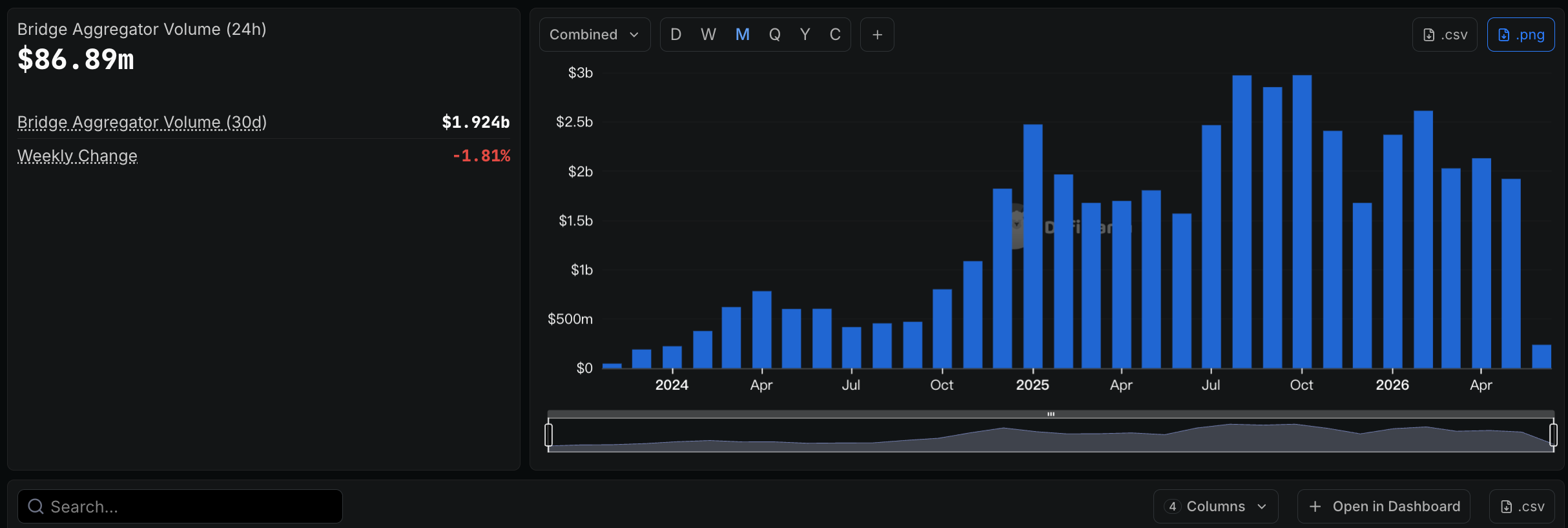
According to DefiLlama data, cross-chain bridge aggregated trading volume over the past 30 days was approximately $1.92 billion, with a weekly decline of about 1.81%. Since reaching a high of $2.974 billion in October last year, the monthly trading volume of cross-chain bridges has shown a slow downward trend. The trading volume in May dropped to around $1.9 billion, representing a decline of nearly 34% compared to the peak.
On the other hand, the overall crypto market is in a fluctuating downward trend, with BTC spot trading volume having fallen by as much as 81% from last year's highs; on-chain liquidity has further tightened as a result.
Faced with this situation, Li.Fi, as a cross-chain bridge protocol, did not wait passively like most crypto projects. Instead, it actively explored new business areas, seeking new application scenarios and service targets to ensure its long-term development.
In December last year, LI.FI announced the completion of a $29 million funding round led by Multicoin and CoinFund, bringing its total funding raised to $52 million. At that time, the project stated it planned to use this latest funding to expand its business into different trading domains, including perpetual futures, yield opportunities, prediction markets, and lending markets.
Ample funding gave Li.Fi the confidence to explore and build new products while maintaining its core business.
In April this year, LI.FI announced the launch of a new product, LI.FI Earn, providing on-chain yield functionality for enterprises with digital asset strategies. It supports accessing strategies from over 20 vault protocols through a single integration and features built-in cross-chain execution capabilities across more than 60 chains.
In May, the intent execution architecture LI.FI Intents was released, marking Li.Fi's official entry into the enterprise services sector. It empowers a range of B2B clients with the underlying operational capabilities for stablecoin payments, RWA assets, and compliant liquidity.
In the current convergence of TradFi assets and crypto assets, Li.Fi's new direction for upgrades is to lower user barriers, improve liquidity operation efficiency, and open channels for tokenized asset exchange from the operational execution layer. Compared to cross-chain protocols limited to the crypto market, providing financial services to global fintech companies, neobanks, wallets, and regulated financial institutions is undoubtedly a cash cow business with a much higher ceiling.
In terms of user experience, Li.Fi Intents provides users with a more streamlined execution solution, ready to use. It is reported that it primarily offers market-maker-level execution through a solver network, supporting precise output cross-chain swaps between stablecoins like USDC and USDT without requiring users to manage Gas tokens or handle complex underlying blockchain steps. Simultaneously, the architecture allows applications to integrate multiple tokenized asset issuers through a unified interface.
Regarding entry barriers, LI.FI Intents is already live on applications and wallets like Jumper and Rabby. Moreover, with LI.FI Intents, enterprise users do not need to interact with any wallet, which will significantly lower the cognitive barrier for enterprises in areas like transfer payments and asset movements, reducing many cumbersome operational steps.
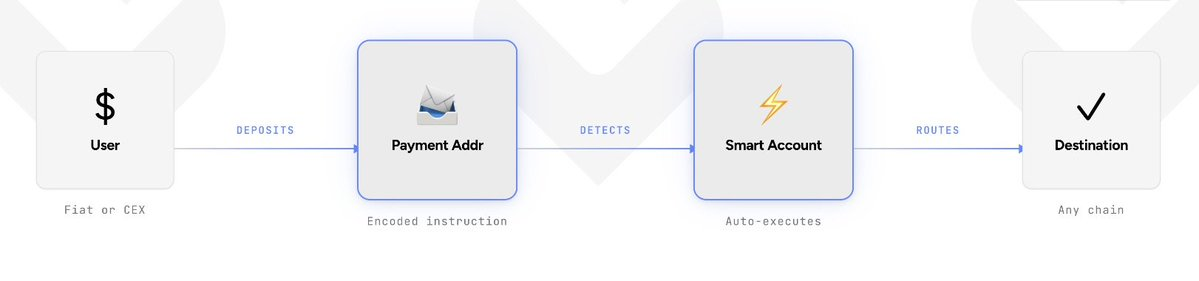
In terms of compliance, the network built by LI.FI Intents consists of verified legitimate entities. Enterprises can review and approve corresponding orders one by one before the trading processing system handles them, precisely choosing the trading processing systems they trust. This ensures orders flow within a compliant approval system. All wallets interacting with this system are subject to OFAC (U.S. Department of the Treasury's Office of Foreign Assets Control) screening, which can be considered the final layer of "compliance insurance."
Regarding ecosystem coverage, LI.FI Intents covers mainstream blockchain networks, including the EVM ecosystem, Solana network, and Tron network. It achieves a certain level of adaptation in ecosystem usability and broad coverage, avoiding potential security risks or single points of failure caused by high dependence on a single blockchain network.
Conclusion: Efficient Automated Services Behind Intent Execution
If tokenized U.S. stocks and RWA assets solve the problems of asset type updates and traditional finance entry barriers, then what Li.FI Intents targets is how to introduce stablecoin payments, RWA assets, and compliant on-chain liquidity into the ecosystems of enterprise users in a better and faster way, improving their operational efficiency and capital utilization.
More importantly, the Li.FI Intents system serves intent execution. Like destination navigation in autonomous driving, enterprise users only need to set the goal; all intermediate execution steps are outsourced and handled by the system.
In today's world of extremely rich asset types, the value of efficient operations will be further amplified, and Li.Fi has already taken the most crucial step.





