Countdown to the CLARITY Act: 25 Days Left—What Will Happen to the Crypto Market if It Fails to Pass Before the August Recess?

marsbitPublished on 2026-07-03Last updated on 2026-07-03

Abstract

"The CLARITY Act, a key US crypto market structure bill, faces a tight deadline with only 25 working days left before the Senate's August 10 recess. The bill aims to clarify SEC/CFTC jurisdiction and establish a non-security path for decentralized tokens. Despite passing the House in 2025 and a Senate committee in May 2026, final negotiations have stalled over ethics and law enforcement provisions, jeopardizing the 60 Senate votes needed. If the bill fails to pass before the recess, its chances in 2026 drop significantly, with prediction markets giving only a 40% probability. Analyst Galaxy Digital has lowered its 2026 passage odds to 50%. Failure would likely lead to continued 'slow bleeding' in crypto markets, as seen in June's record $4.5 billion net outflow from US Bitcoin ETFs. XRP, which stands to gain permanent commodity status from the bill, could lose its 'regulatory premium.' Bitcoin and Ethereum, already classified as commodities via a joint agency interpretation, would face less direct impact but broader regulatory uncertainty would persist, delaying institutional capital and DeFi innovation. The path forward includes: 1) Passage before August (a major catalyst), 2) Delay to 2027 (extending market uncertainty), or 3) Failure, requiring the bill to be reintroduced in the next Congress. While delay is a setback, the bill's progress indicates the US is closer than ever to resolving crypto regulatory ambiguity."

Original | Odaily Planet Daily (@OdailyChina)

Author | Qin Xiaofeng (@QinXiaofeng 888 )

The much-anticipated Clarity for American Digital Assets Act (CLARITY Act) has unsurprisingly been delayed again. Senator Cynthia Lummis previously stated that negotiators expected to finalize the compromise text around July 4th (U.S. Independence Day) and "advance in July," but progress has clearly lagged.

Now, with the Senate's August 10th recess approaching, the window of opportunity is shrinking fast. The bill must achieve the 60-vote threshold in the Senate (requiring at least 7 Democratic defections), coordinate with the Senate Agriculture Committee's text, merge with the House bill, and receive the President's signature—all within the next 25 working days. The timeline is extremely tight.

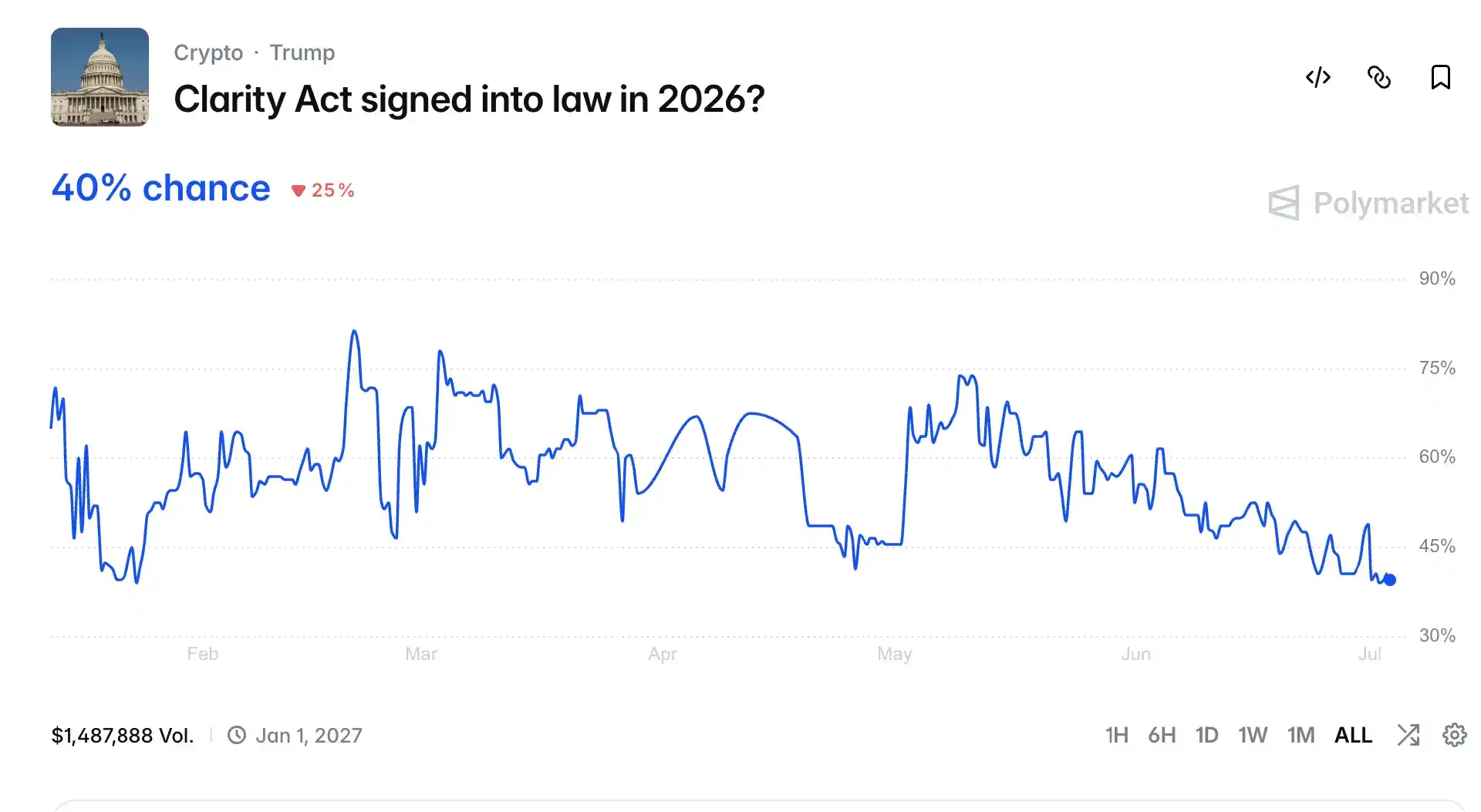
If the bill misses the pre-recess window, the probability of the CLARITY Act passing this year will drop further. Indeed, data from the prediction market Polymarket shows the bill's chance of passage this year is only 40%; Galaxy Digital has also lowered its 2026 passage probability to 50%.
I. A Recap of the Latest Developments in the CLARITY Act

The CLARITY Act is landmark crypto market structure legislation being advanced by the U.S. Congress, aiming to clarify the regulatory boundaries between the SEC and CFTC, provide a non-security pathway for decentralized tokens, and require registration and AML obligations for digital commodity intermediaries.

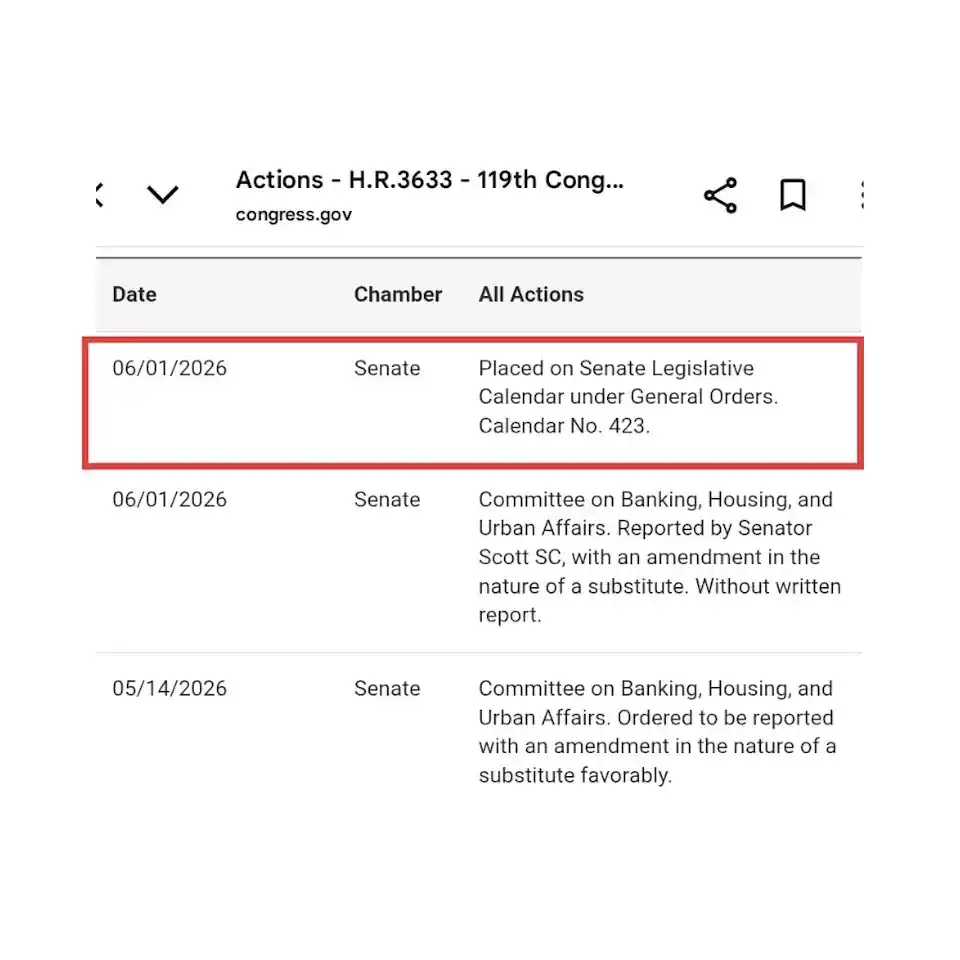
On July 17, 2025, the House of Representatives passed the HR 3633 bill proposed by French Hill with a vote of 294 in favor and 134 opposed, with over 70 Democratic votes. On May 14, 2026, the Senate Banking Committee advanced and passed the bill with a 15-9 vote (supported by 13 Republicans and 2 Democrats). On June 1, 2026, the CLARITY Act was officially placed on the Senate legislative calendar (Calendar No. 423), qualifying for full floor consideration.
However, progress on the CLARITY Act throughout June was not smooth. On June 9, negotiations over ethics clauses related to presidential crypto holdings broke down, directly leading some Democratic senators to soften their stance or impose additional conditions, slowing the bill's pace towards floor debate. On June 10, the White House met with police and prosecutor groups. Subsequently, the enforcement battle over Section 604 (the developer protection clause) in the Blockchain Regulatory Certainty Act reached an impasse; without resolution, law enforcement groups might lobby against it, and Democratic senators might also vote 'no' for perceived "insufficient consumer protection/crime-fighting."

Simply put, the former is a "political/ethics threshold," and the latter is an "enforcement/security red line." Together, they constitute the final two major obstacles before the CLARITY Act can "clear" the Senate. If unresolved, it will be difficult to gather 60 votes and finalize the text, preventing completion of the legislative process before the August 10th recess. These two negotiations directly hindered the final advancement of the CLARITY Act, becoming the key "stumbling blocks" that caused the July 4th target to be missed and overall progress to stall. Negotiations are still attempting to break the ice, but time is extremely tight.

Brian Gardner, Chief Washington Policy Strategist at Stifel Financial, stated that for the bill to pass in 2026, "it likely needs to pass the Senate by the end of July, preferably in June," warning that if the Senate misses the recess deadline, the outlook would deteriorate significantly.
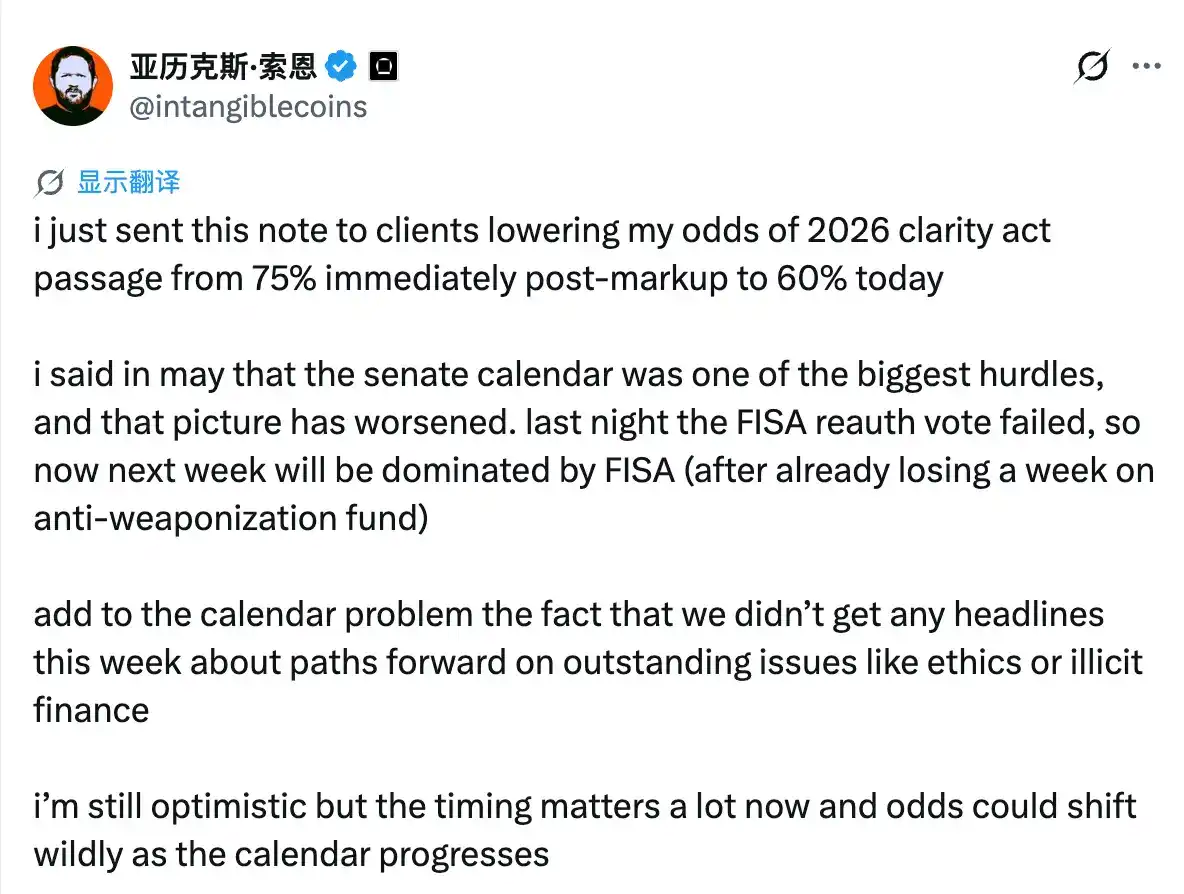
However, the market is not very hopeful about the bill passing this year. Alex Thorn, Head of Galaxy Research, lowered his 2026 passage prediction for the bill from 75% to 60% on June 5, citing the Senate's increasingly crowded agenda. Data from the prediction market Polymarket shows the bill's chance of passage this year is only 40%.

II. What Happens to Crypto if the CLARITY Act Fails to Pass on Schedule?

According to CCN's analysis, if the CLARITY Act fails to pass before the August recess, the most likely market reaction is not a crash but a "slow bleed through premium products." In fact, crypto's poor performance throughout June already indicates the market has begun repricing for legislative uncertainty. (Odaily Note: Here, "premium products" mainly refer to various spot ETFs.)

Data shows that throughout June, U.S. Bitcoin spot ETFs saw cumulative net outflows of approximately $4.5 billion, equivalent to about 77,000 BTC redeemed. This is the largest monthly net outflow since the product's launch in January 2024, exceeding the previous record from February 2025 (~$3.56 billion) and setting the worst monthly record yet.

In fact, XRP might be one of the assets most directly and significantly impacted by the bill, as it would permanently cement its commodity classification, eliminating the risk of reversible agency interpretation. If delayed long-term or fails, XRP could lose some of its "regulatory tailwind premium."

Geoffrey Kendrick, Global Head of Digital Assets Research at Standard Chartered, projects an XRP price target of $8, contingent on the Senate fully passing the relevant bill and $4-8 billion of ETF inflows. JPMorgan predicts that if the bill passes, XRP ETFs could see $4.3-$8.4 billion inflows in the first year. Data shows that since the launch of XRP spot ETFs in November 2025, cumulative net inflows are about $1.41 billion, with 84% from retail; institutional inflows still await clear regulatory signals.

For Bitcoin, which was classified as a commodity via the joint SEC-CFTC interpretation in March 2026, the CLARITY Act's main role is to codify this reversible decision into permanent federal law. Even if the bill fails or is long delayed, Bitcoin's "digital gold" narrative is relatively robust, facing less direct impact.

The impact on ETH is similar to Bitcoin, as Ethereum was also classified as a commodity via joint interpretation. Bill failure could leave DeFi protocols facing prolonged compliance ambiguity longer, dampening innovation and capital inflows. Standard Chartered's Geoffrey Kendrick projects a year-end 2026 ETH target of $7,500 (later revised to $4,000), contingent on the relevant bill's passage.

Kristin Smith, President of the Solana Foundation Policy Institute, stated that many asset allocators are actively exploring digital asset investments but are holding back capital due to unclear regulatory guidelines. The same logic applies to institutional DeFi; currently, DeFi projects are also on hold awaiting the outcome of Section 604.

III. Where Do We Go From Here?

Time is running short for the CLARITY Act to break through. The following scenarios are possible:

  • First, Passage Before the August Recess: The biggest catalyst, potentially triggering a significant price rebound, especially for XRP and related ETFs.
  • Second, Postponement to 2027: The scenario the market least wants to see, extending the "slow bleed" process and keeping institutional capital on the sidelines.
  • Third, Failure and Pushing to the Next Congress: The CLARITY Act is currently in the 119th Congress. If it fails to complete Senate floor vote, reconciliation, and final passage before the August 2026 recess, the entire process cannot conclude within this Congress. When the new Congress (120th, 2027-2028) begins, the bill must be reintroduced and go through the entire committee review, floor debate, etc., process again.

The CLARITY Act is currently at a critical "on the brink but stuck" stage—technically on the Senate calendar, but political negotiations, time windows, and bipartisan support remain the biggest obstacles.

However, as Vincent Chok, CEO of First Digital, stated: "The CLARITY Act reaching the Senate floor vote itself shows the U.S. is closer than ever to resolving regulatory ambiguity... A successful vote would accelerate this process, but failure won't necessarily stop it. In fact, delays in the U.S. framework could create urgency and extend the time window for setting global standards, with the U.S. potentially becoming the de facto global digital asset hub."


Related Questions

QWhat are the two main obstacles currently preventing the CLARITY Act from being passed before the August Senate recess, according to the article?

AAccording to the article, the two main obstacles are: 1) Negotiations around ethics provisions concerning presidential crypto holdings, which collapsed on June 9th. 2) A stalemate over the law enforcement conflict involving Section 604 (the developer protection clause) of the Blockchain Regulatory Certainty Act, which if unresolved, could lead law enforcement groups and Democratic senators to oppose the bill.

QWhat is the specific deadline mentioned in the article for the CLARITY Act to pass the Senate to avoid a significantly worse outlook?

AThe article states that the Senate must pass the CLARITY Act before its recess begins on August 10th. Stifel's Brian Gardner warns that if the Senate misses this recess deadline, the prospects for the bill will 'deteriorate significantly.'

QHow did the performance of US Bitcoin spot ETFs in June reflect market sentiment towards the CLARITY Act's uncertainty?

AIn June, US Bitcoin spot ETFs saw a net outflow of approximately $4.5 billion, the largest monthly net outflow since their launch in January 2024. The article interprets this as the market 're-pricing for legislative uncertainty' and beginning a process of 'slow bleed through premium products.'

QWhy is XRP considered the asset most directly and significantly impacted by the potential failure or delay of the CLARITY Act?

AXRP is considered most impacted because the CLARITY Act would permanently codify its classification as a commodity into federal law, eliminating the risk of a reversible agency interpretation. A long delay or failure of the bill could cause XRP to lose some of its 'regulatory premium.' Analysts' price targets and ETF inflow predictions for XRP are also contingent on the bill's passage.

QWhat happens to the CLARITY Act legislative process if it fails to pass before the end of the current 119th Congress?

AIf the CLARITY Act fails to complete the Senate floor vote, reconciliation with the House bill, and final passage before the end of the 119th Congress (specifically before the August 2026 recess), the entire legislative process must restart from the beginning in the new 120th Congress (2027-2028). The bill would need to be reintroduced and go through committee reviews and floor debates all over again.

Related Reads

MSTR Discloses Sale of 3,588 Bitcoins, Stock Price Drops Over 5% at One Point During Trading

MicroStrategy, the world's largest corporate holder of Bitcoin, has significantly shifted its business model. Between June 29 and July 5, the company sold 3,588 bitcoins for approximately $216 million to fund quarterly dividends for its preferred stock. This marks its largest-ever Bitcoin sale and signals a strategic pivot: Bitcoin is transitioning from a "buy-and-hold" reserve asset to a liquidity management tool for the company. This move follows a recent authorization allowing Bitcoin sales when equity fundraising is less attractive. The announcement contributed to a more than 5% intraday drop in MicroStrategy's stock price, while Bitcoin fell to around $61,800—below the company's average holding cost of roughly $75,700. The sale represents a major departure from MicroStrategy's long-standing "never sell" commitment, which saw its first minor breach in May with a $2.5 million sale. The latest, hundred-times-larger transaction underscores growing financial pressures. Analysts note the company faces about $1.5 billion in annual preferred dividend obligations, far exceeding cash flow from its software business. As of July 5, MicroStrategy holds 843,775 bitcoins. Its current operational logic involves buying Bitcoin during favorable financing conditions and selling portions to cover dividends when needed, creating a flexible capital management cycle amidst a challenging market environment.

华尔街日报2h ago

MSTR Discloses Sale of 3,588 Bitcoins, Stock Price Drops Over 5% at One Point During Trading

华尔街日报2h ago

Q-Day Countdown: Will Quantum Computing End Cryptocurrencies?

Quantum Computing's Threat to Cryptocurrency: A Countdown to Q-Day Quantum computing, specifically Shor's algorithm, poses a fundamental threat to the public-key cryptography (e.g., ECDSA, RSA) that secures blockchain networks like Bitcoin and Ethereum. This critical juncture, known as Q-Day, is estimated to occur potentially within the next 5-15 years. The core vulnerability stems from the public and immutable nature of blockchains. Assets in addresses where the public key is already exposed on-chain (e.g., spent outputs) are at direct risk, as a sufficiently powerful quantum computer could derive the private key. This threatens the very trust model of cryptocurrencies. The response lies in Post-Quantum Cryptography (PQC)—algorithms like lattice-based ML-DSA and hash-based SLH-DSA, which are resistant to quantum attacks. NIST has standardized key PQC algorithms (FIPS 203, 204, 205), providing a migration path. However, the primary challenge is not technical but socio-economic and involves complex governance: * **Bitcoin's** path is constrained by its conservative ethos. Migrating requires a soft-fork to new address types, facing hurdles like significantly larger signature sizes and, most critically, the divisive governance question of how to handle at-risk legacy UTXOs without violating core principles. * **Ethereum** is pursuing a "cryptographic agility" strategy, with a multi-layered roadmap. It leverages account abstraction for user accounts and is developing compressed hash-based signatures (e.g., leanXMSS) for its consensus layer, aiming for a full-stack upgrade over time. In conclusion, quantum computing does not spell an instant end for cryptocurrency but initiates a critical countdown. The industry has a limited "engineering comfort window" to orchestrate a coordinated, ecosystem-wide migration to PQC. The ultimate bottlenecks are the immense coordination efforts and governance decisions required for this foundational transition.

marsbit3h ago

Q-Day Countdown: Will Quantum Computing End Cryptocurrencies?

marsbit3h ago

Trump, the President Who Knows Best How to 'Trade Stocks'

Former US President Donald Trump reported a record-breaking $2.2 billion in personal income for 2025, the highest annual income ever disclosed by a sitting president. This figure, from a 927-page government ethics filing, represented a 3.5-fold increase from his $600 million income in 2024 and boosted his net worth to $6.5 billion. The primary drivers were cryptocurrency (64% of income, approximately $1.4 billion) and real estate (26%, approximately $575 million). His crypto earnings stemmed largely from the launch of his personal meme coin, $TRUMP, generating over $600 million in licensing fees, and substantial profits from the WLFI token and its parent company. Despite a sluggish property market, his Mar-a-Lago resort and associated golf clubs saw revenue surges of 50% and 27%, respectively, attributed to their use as venues for presidential events. Trump's financial disclosure also revealed an unprecedented level of stock market activity, with over 22,000 trades executed in 2025, averaging 87 trades per market day. Media analyses noted several instances where significant trading coincided with major policy announcements, such as proposed tariffs, raising questions about potential conflicts of interest. While the White House stated these trades were handled by a family-managed trust fund and not Trump directly, critics highlighted this as a departure from the blind trusts traditionally used by presidents post-Watergate. The report has intensified debate over the commercialization of the presidency. Supporters view it as a success story of a businessman-president, while critics argue it demonstrates an unprecedented conversion of public influence into private wealth, with policy decisions potentially linked to personal financial gains. The controversy centers on whether Trump's earnings represent innovative entrepreneurship or a fundamental conflict of interest, sparking renewed calls for stricter ethics reforms in US governance.

marsbit4h ago

Trump, the President Who Knows Best How to 'Trade Stocks'

marsbit4h ago

Countdown to Q-Day: Will Quantum Computing End Cryptocurrencies?

The article explores the existential threat quantum computing poses to cryptocurrencies and the urgent need for "post-quantum" migration. It outlines that quantum computers, through Shor's algorithm, could break the elliptic-curve cryptography (ECC) underlying blockchain security, potentially allowing private keys to be derived from public keys. The core challenge is not a lack of post-quantum cryptography (PQC) standards—like NIST's ML-KEM and ML-DSA—but the immense complexity of upgrading entire ecosystems before "Q-Day" (when quantum computers become capable of such attacks, estimated around 2035-2045). Key points include: * **Bitcoin's** risk is concentrated in legacy UTXOs with exposed public keys (e.g., early P2PK outputs). Migration faces massive hurdles: PQC signatures are much larger, increasing transaction size and cost, and the governance dilemma of handling un-migrated assets threatens its "code is law" ethos. * **Ethereum's** strategy focuses on "cryptographic agility," using Account Abstraction for user accounts and developing compressed hash-based signatures (like leanXMSS with SNARK aggregation) for consensus. Its migration is a complex, full-stack overhaul of execution, consensus, and data layers. * The "security debt" is enormous. The comfortable engineering window for a coordinated, ecosystem-wide upgrade is only 5-8 years. High-value infrastructure (exchanges, bridges) may face pressure before mainnet protocols. In conclusion, quantum computing is not an instant "doomsday" event but a forcing function for systemic change. Bitcoin's ultimate test is social consensus and property rights governance, while Ethereum's is technical complexity. Failure to migrate in time could lead to a fundamental re-pricing of crypto assets.

链捕手4h ago

Countdown to Q-Day: Will Quantum Computing End Cryptocurrencies?

链捕手4h ago

Trading

Spot
活动图片