Could A Bitcoin Price Crash Below $10,000 Wipe Out Strategy? Saylor Shares What To Expect

bitcoinistPublished on 2026-02-18Last updated on 2026-02-18

Abstract

MicroStrategy, now operating as Strategy, has become a major corporate holder of Bitcoin, though its current BTC investments are in the red. Concerns have been raised about the company's ability to survive a severe market downturn. In response, Michael Saylor shared that the company could withstand a Bitcoin price drop to as low as $8,000—an 88% decline—and still fully cover its $6.0 billion net debt. The firm holds 714,644 BTC, valued at nearly $49 billion at current prices. Even if BTC fell to $8,000, its holdings would still be worth approximately $6.0 billion, matching its debt obligations. Strategy’s that its debt consists of low-interest convertible notes with maturities between 2027 and 2032, not margin loans subject to liquidation calls. This structure allows the company to avoid forced selling during price drops. Despite recent market volatility, Strategy continues to buy Bitcoin, with a recent purchase of 1,142 BTC for $90 million in early February. Saylor reiterated the company’s plan to continue accumulating BTC regularly. While a crash to $10,000 would severely impact equity value, Strategy claims it has structured its finances to endure extreme scenarios.

MicroStrategy, now operating as Strategy, has become synonymous with corporate Bitcoin accumulation. However, the company’s returns on BTC are currently negative, and there are concerns about how it would fare in a more severe downturn and when its Bitcoin position would be finally wiped out.

Michael Saylor has now responded directly, reposting a statement from Strategy claiming the company can withstand a drop in BTC to $8,000 and still fully cover its debt.

Strategy Says It Can Survive An 88% Bitcoin Crash

Michael Saylor is still bullish on Bitcoin, and according to him, Strategy could continue meeting its obligations even if BTC’s price dropped to $8,000, with the plan being to equitize convertible debt over the next 3 to 6 years.

At the time of writing, Strategy is holding 714,644 BTC in its Bitcoin reserve. Based on the current Bitcoin price of around $69,000, those holdings are valued just under $49 billion. According to recent details shared by Strategy, the firm reports around $6.0 billion in net debt, giving it an 8.3x BTC asset coverage ratio under present conditions.
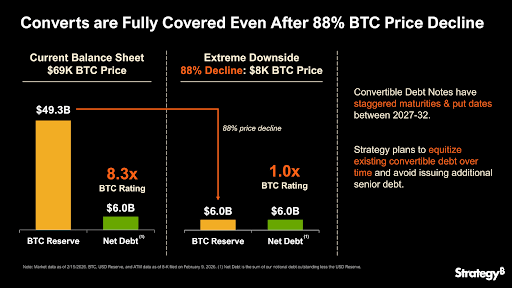
Source: Chart from Michael Saylor on X

The interesting part of the disclosure is the downside scenario. The company modeled an 88% price decline in Bitcoin, which would push BTC down to around $8,000. Under that assumption, its Bitcoin reserve would fall to roughly $6.0 billion. That figure still matches or slightly exceeds its net debt position, resulting in a 1.0x coverage ratio.

This means that even if BTC’s price were to suffer an 88% collapse from current levels, Strategy’s Bitcoin holdings would theoretically still be sufficient to cover its outstanding debt obligations on paper.

No Immediate Liquidation Risks For Strategy

Strategy’s borrowings are primarily low-interest convertible notes with staggered maturities and put dates stretching between 2027 and 2032. These are not margin loans secured by BTC that trigger automatic liquidations if BTC falls.

Since there are no margin calls associated directly with BTC price fluctuations, Strategy would not be forced to sell its BTC holdings in a sudden downturn. Instead, the company noted that it plans to equitize existing convertible debt over time. That means converting debt into company shares and avoiding issuing new senior secured debt.

Strategy is still in the business of purchasing huge amounts of Bitcoin, despite the recent price crash below $70,000. The most recent purchase was an additional 1,142 BTC for approximately $90 million in early February. Saylor even recently reiterated that Strategy plans to continue buying Bitcoin on a regular basis.

A BTC collapse to $10,000 would represent an extreme crash of 85% to 90% from recent levels. Although Strategy’s model suggests it could technically cover its net debt at $8,000 per BTC, such a scenario would dramatically shrink the value of its equity from $48.5 billion to less than $6 billion.

BTC trading at $67,856 on the 1D chart | Source: BTCUSDT on Tradingview.com

Related Questions

QAccording to the article, what is the lowest Bitcoin price that Strategy (formerly MicroStrategy) claims it can withstand and still cover its debt?

AStrategy claims it can withstand a Bitcoin price drop to $8,000 and still fully cover its net debt obligations.

QWhat type of debt does Strategy hold, and why does this structure protect it from immediate liquidation in a Bitcoin price crash?

AStrategy's borrowings are primarily low-interest convertible notes with staggered maturities. They are not margin loans secured by BTC, so there are no automatic liquidation triggers or margin calls associated directly with BTC price fluctuations.

QWhat is the current BTC asset coverage ratio for Strategy, as mentioned in the article?

AUnder present conditions, with a Bitcoin price of around $69,000, Strategy has an 8.3x BTC asset coverage ratio.

QWhat is Michael Saylor's and Strategy's stated plan for their existing convertible debt?

AThe plan is to equitize the convertible debt over the next 3 to 6 years, which involves converting the debt into company shares and avoiding issuing new senior secured debt.

QDespite recent market conditions, what has Strategy continued to do regarding Bitcoin?

AStrategy has continued to purchase huge amounts of Bitcoin on a regular basis, with its most recent purchase being an additional 1,142 BTC for approximately $90 million in early February.

Related Reads

In Jinjiang, Fujian, a Storage Super Unicorn Lies Quiet

In Fujian's Jinjiang, a city known for sportswear, lies a quiet semiconductor giant: Fujian Jinhua Integrated Circuit Co. (JHICC). Once a promising domestic DRAM manufacturer alongside Yangtze Memory and ChangXin Memory Technologies (CXMT), its journey was derailed in 2018 when the U.S. placed it on an Entity List and filed criminal charges for alleged trade secret theft. This halted production for years. A turning point came in February 2024 when a U.S. federal court found JHICC not guilty. However, it had lost crucial time. While CXMT soared to become a top-valued A-share company in 2024, JHICC, with an estimated valuation of 80 billion RMB, was just restarting. Its current output is primarily customized DDR4 chips, not the advanced DDR5/HBM demanded for AI, but it still benefits from the broader memory chip upcycle. JHICC's story is tied to Chen Zhengkun, a veteran engineer who left Micron to lead the venture. Founded in 2016 with state-backed funding, JHICC partnered with Taiwan's UMC to develop DRAM technology. Rapid progress was cut short by the U.S. actions, which Micron initiated, partly due to its heavy reliance on the Chinese market. Post-sanctions, Chen's team worked to rebuild the production line with reduced reliance on U.S. technology. According to its records, JHICC achieved small-scale production and revenue growth under immense pressure. It now focuses on the stable "niche" DRAM market (e.g., TVs, routers) with a monthly capacity of ~40,000 wafers, aiming for 60,000 by 2026. It holds over 1,000 patents but remains on the Entity List. For Jinjiang, investing in JHICC was a bold industrial leap. The local government provided unwavering financial and logistical support during the crisis, helping the company survive. JHICC has become the anchor for a growing local semiconductor cluster. Though its scale lags behind domestic peers, JHICC's persistence symbolizes a hard-won foothold in a global market long dominated by Samsung, SK Hynix, and Micron. Having missed one boom, it seeks a place in the new AI-driven memory supercycle.

marsbit1h ago

In Jinjiang, Fujian, a Storage Super Unicorn Lies Quiet

marsbit1h ago

Trading

Spot
活动图片





