Consumer Confidence Hits Bottom, Macro Correlations Simultaneously Break Down: How Much Longer Can the U.S. Stock Market's Solo Rally Last?

marsbitPublished on 2026-05-28Last updated on 2026-05-28

Abstract

The U.S. stock market is exhibiting a rare divergence: while consumer confidence hits historic lows and traditional macro asset correlations break down, major indices like the Nasdaq 100 and S&P 500 continue reaching record highs, fueled primarily by AI and semiconductor momentum. The rally is now highly concentrated, with strength rotating from giants like Nvidia to higher-beta plays within semiconductors, particularly memory chips. This surge occurs despite a significant split between pessimistic consumer sentiment and still-resilient actual spending behavior, partially supported by fiscal stimulus. Goldman Sachs traders highlight a critical structural fissure: correlations between the S&P 500 and key macro assets (rates, gold, VIX, oil) have deviated extremely from long-term historical norms. Concurrently, the market is in a negative Gamma regime, making it more sensitive to price moves, and hedge fund positioning in momentum and semiconductors is at crowded levels. The sustainability of this "solo rally" faces three main constraints: 1) Oil price volatility linked to Middle East geopolitical risks, 2) Extreme crowding in semiconductor and momentum trades, increasing vulnerability to disappointments, and 3) The breakdown of traditional macro correlations, suggesting the rally reflects a specific mix of factors rather than broad-based risk appetite. The key question is not if indices can rise further, but which variable—oil, rates, or semiconductor momentum—might trigger ...

Author: Li Jia

Source: Wall Street News

The U.S. stock market is currently displaying a rare split: on one side, consumer confidence has fallen to historic lows and correlations between macro assets have become completely distorted; on the other side, major stock indices continue to set new all-time highs driven by the AI and semiconductor rally. What the market is truly worried about is no longer whether the uptrend can continue, but how long this highly concentrated AI-driven rally can withstand the shocks from oil prices, interest rates, and crowded positioning.

Spurred by rising expectations for U.S.-Iran talks and a surge in the semiconductor sector, U.S. stocks hit new record highs again on Tuesday. The Nasdaq 100 Index surpassed 30,000 points for the first time, and the S&P 500 rose about 0.5%; meanwhile, a decline in oil prices led to lower U.S. Treasury yields, while a rebound in the dollar pressured the performance of gold and Bitcoin.

Semiconductors remain the core driver of this rally. After UBS Group significantly raised its target price for Micron Technology, trading sentiment for memory chips heated up rapidly, with the semiconductor sector rising 14% over the past five days. However, Nvidia has begun to underperform the overall semiconductor index, indicating that funds are shifting from the leader towards sectors with higher elasticity.

Nelson Armbrust, a Goldman Sachs trader, warned that the current correlations between the S&P 500 and interest rates, gold, the VIX, and oil prices have all deviated from their 20-year historical averages and entered extreme ranges. "One side of the market has to give," he said. "The stock indices are not reflecting the full reality of the market."
AI Theme Remains, But Driving Forces Rotate

The strongest driving force in the stock market currently comes from semiconductors, especially the memory chip segment. Goldman Sachs trader Pete Callahan pointed out that the semiconductor index has outperformed Nvidia by about 16.5 percentage points over the past five trading days, marking the largest five-day advantage for the SOX relative to Nvidia since 2018.

Notably, this rally is not being driven by a broad-based surge in mega-cap tech stocks. Large-cap tech stocks overall showed relative weakness, with Nvidia slightly lagging, indicating funds are rotating from the AI leader towards more elastic trading plays within the semiconductor sector. Memory chip-related stocks opened sharply higher, with DRAM ETF nominal trading volume reaching about $30 billion for the day, and Goldman Sachs' Meme-Stocks basket also rose noticeably.

AI remains the market's main theme. AI semiconductors, Agentic AI, and AI data center stocks led the market gains. Goldman Sachs noted that the strength in the momentum factor that day was almost entirely driven by long positions, with the best-performing stocks over the past 12 months continuing to significantly outperform.

Meanwhile, increasingly extreme structural signals are also appearing in the options market. SpotGamma data shows aggressive negative Delta flows in 0-DTE options, primarily driven by selling call options; and the combination of "rising volatility and rising spot prices" persists. This means the current rally is not a typical low-volatility expansion of risk appetite but is increasingly being driven by positioning squeezes and options trading structures.

Consumer Confidence Bottoms, But Behavior and Sentiment Diverge

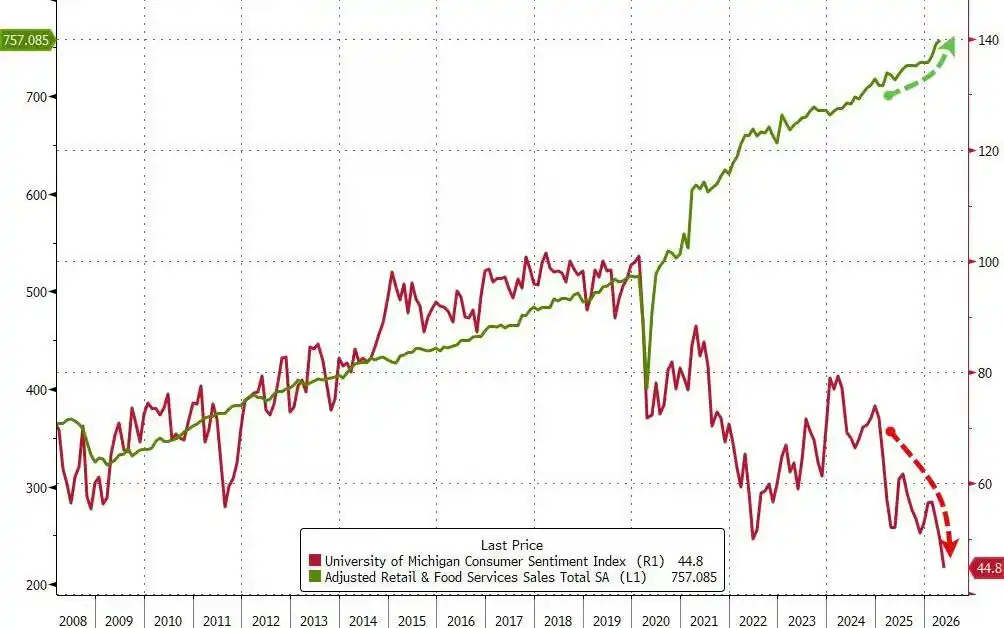
Goldman Sachs trader Chris Hussey pointed out that many are puzzled: why are U.S. stocks still hitting new record highs when consumer confidence indicators have fallen to historic lows? His explanation is that what consumers "feel" and what they "actually do" are inconsistent. In other words, sentiment is pessimistic, but consumer behavior has not deteriorated in sync.

Meanwhile, fiscal stimulus is still supporting household cash flow. Chris Hussey mentioned that tax relief from the budget bill last July is improving household balance sheets, partially offsetting the pressure from rising gasoline prices.

U.S. macro data also shows clear divergence. The Chicago Fed National Activity Index rebounded sharply, the Conference Board Consumer Confidence Index beat expectations, and the Dallas Fed Manufacturing Index held steady; while the S&P CoreLogic Case-Shiller Home Price Index weakened and the Philadelphia Fed Manufacturing Index missed expectations. Overall, U.S. economic data maintains a state of "slightly stronger than expected."

This also explains the market's current contradiction: consumer sentiment is extremely weak, but economic data has not significantly deteriorated yet, and actual consumer behavior has not shown a synchronous decline. However, the AAII Bull-Bear Spread remains negative, indicating investor sentiment has not truly turned optimistic alongside the new stock market highs.

Macro Correlations Fail, Negative Gamma Intensifies: Goldman Sachs Warns of Structural Cracks in U.S. Stocks

Goldman Sachs trader Nelson Armbrust warned that current U.S. stock indices do not reflect the full reality of the market. Correlations between the S&P 500 and key macro assets have comprehensively deviated from long-term averages: correlation with interest rates is at a decade low, correlation with gold is at a decade high, correlation with the VIX is at a two-year high, and correlation with oil prices is at a decade low.

These are extremely rare levels even when viewed across a 20-year historical dimension. In other words, while U.S. stocks are still rising, their traditional联动 relationships with interest rates, volatility, commodities, and safe-haven assets are breaking down. For investors relying on historical correlations for asset allocation, hedging, and risk budgeting, this means model stability is declining.

Meanwhile, Gamma has turned negative. In a negative Gamma environment, the market becomes more sensitive to price fluctuations, and the state of "spot prices rising while volatility simultaneously increases" also means the current market action is not a typical low-volatility one-sided bull market, but increasingly driven by positioning and options structures.

Goldman Sachs HF Trend Monitor data shows hedge funds' current allocation to the momentum factor has risen to the 90th percentile, semiconductor positioning has reached a record 10%, while software positioning has fallen to its lowest since 2019. Highly crowded positioning implies that the rally may still continue upward in the short term driven by chasing funds, but once a reversal occurs, the pullback could also be more severe.

How Far Can U.S. Stocks Go? It Depends on Three Constraints

The first constraint comes from oil prices. Diplomatic progress can quickly depress geopolitical risk premiums, but cannot immediately repair the buffer capacity of shipping, insurance, refineries, and real supply chains. As long as uncertainty remains around the Strait of Hormuz situation and the prospects for a U.S.-Iran ceasefire, oil prices may fluctuate repeatedly between optimistic expectations and tail risks.

The second constraint comes from semiconductor positioning. The current U.S. stock rally relies increasingly on AI and semiconductors, especially memory chips and momentum long trades. If funds continue chasing this direction, indices may maintain strength; but the more crowded the positioning, the higher the market's sensitivity to earnings, guidance, or fund flow changes—any slight disappointment could be rapidly amplified.

The third constraint comes from correlation breakdowns. The simultaneous deviation of the S&P 500's relationship with interest rates, gold, the VIX, and oil prices from long-term averages means the current rally does not equate to a comprehensive easing of macro risks. More accurately, it is the result of a combination of declining geopolitical risk premiums, falling U.S. Treasury yields, AI/semiconductor momentum, and positioning squeezes.

Therefore, the U.S. stock market's "solo party" may continue, but the stability of the rally is declining. What truly matters is not whether the indices can set new highs, but which variables will force a repricing of this trading logic—whether oil prices will rise again, whether interest rates will re-ascend, whether semiconductor momentum will cool, and when those distorted correlations will revert.


Related Questions

QWhat is the main contradiction in the current U.S. stock market as described in the article?

AThe main contradiction is that while consumer confidence is at a historical low and traditional macro correlations have broken down, major stock indices like the Nasdaq 100 and S&P 500 continue to hit record highs, driven primarily by a highly concentrated AI and semiconductor rally.

QWhich sector is identified as the core driving force of the current market rally, and what shift within it is observed?

AThe semiconductor sector is the core driving force. A shift is observed where capital is moving from the AI leader, Nvidia, towards more elastic segments within semiconductors, particularly memory chips, as evidenced by the outperformance of the broader semiconductor index.

QWhat warning does Goldman Sachs trader Nelson Armbrust issue regarding market correlations?

ANelson Armbrust warns that the correlations between the S&P 500 and key macro assets (interest rates, gold, VIX, and oil) have deviated to extreme levels from their 20-year historical averages. This means the market is not reflecting the full reality, and traditional models for asset allocation and hedging are losing stability.

QAccording to the article, what three main constraints could limit the continuation of the U.S. stock market's 'solo celebration'?

AThe three main constraints are: 1) Oil price volatility, influenced by geopolitical risks like the Strait of Hormuz situation and U.S.-Iran negotiations. 2) Overcrowded positioning in the semiconductor sector, making it vulnerable to any negative news. 3) The breakdown of traditional macro correlations, indicating the current rally's foundation is fragile and dependent on a specific mix of factors.

QHow does the article explain the divergence between low consumer confidence and strong stock market performance?

AThe article explains this divergence by highlighting a split between what consumers 'feel' and what they 'actually do.' While sentiment is pessimistic, actual consumer behavior has not deteriorated in sync, partly supported by fiscal stimuli like tax credits, and economic data remains 'slightly stronger than expected.'

Related Reads

ETH Bull and Bear Views Compilation: Can Ethereum's Value Flow Back to ETH?

Titled "ETH Bull and Bear Views: Can Ethereum's Value Flow Back to ETH?", this article synthesizes the current heated debate around Ethereum's native token, ETH, following Bankless co-founder David Hoffman's decision to sell his entire ETH holdings. The **bullish case**, represented by figures like Tom Lee (BitMine CEO) and Raoul Pal, argues that ETH's core thesis remains intact. They contend Ethereum is the essential, secure, and neutral foundational layer for future finance—encompassing stablecoins, RWA, DeFi, L2s, and Agentic AI. Bulls bet on ETH's long-term revaluation as institutional adoption of on-chain finance grows, with significant buying activity from entities like BitMine and Consensys cited as evidence. Conversely, the **bearish perspective**, led by Hoffman and analysts like Markus Thielen, questions ETH's value capture mechanism. They acknowledge Ethereum's network success but argue that the value created by L2s, DeFi, and applications does not sufficiently accrue to the ETH token itself. Bears point to ETH's prolonged underperformance versus the broader crypto market, lack of traditional cash flows, weakening "ultrasound money" narrative, and apparent institutional retreat (e.g., Harvard Management Company exiting its ETH ETF position) as key concerns. The debate highlights a pivotal shift: ETH is no longer just a community belief asset. The central question is whether ETH can transition from being a "**used infrastructure**" to a "**continuously bought and held core asset**" as more value enters the Ethereum ecosystem. The market is now critically examining the direct link between network growth and ETH's value.

marsbit37m ago

ETH Bull and Bear Views Compilation: Can Ethereum's Value Flow Back to ETH?

marsbit37m ago

Crypto is dead, Perps are forever

The crypto industry is shifting from a focus on creating native assets (like altcoins and protocol tokens) to becoming a "global asset pipeline." Native cryptocurrencies, except for Bitcoin, are seen as failing in their value storage and utility promises, with demand driven largely by speculation. Attention and liquidity are now moving toward real-world assets (RWAs) like U.S. stocks, bonds, gold, and oil traded on-chain via perpetual contracts (Perps). Stablecoins like USDT and USDC set the precedent, proving blockchain's core strength is efficient global settlement and transfer, not inventing new monetary systems. Meanwhile, assets like Ethereum and many DeFi tokens struggle as their narratives weaken against tangible traditional assets and the rapid real-world progress of AI. Perpetual contracts have emerged as a pivotal innovation. They simplify trading by offering pure price exposure to any asset, bypassing complexities of ownership, custody, and traditional market hours. Projects like Hyperliquid gained traction by combining CEX-like efficiency with on-chain transparency, capitalizing on post-FTX distrust, macroeconomic volatility, and the surge in demand for 24/7 stock trading. In conclusion, while the era of speculative native "crypto assets" may be over, perpetual contracts persist as the industry's most potent financial instrument—transforming all assets into globally accessible, constantly tradable instruments centered on price speculation.

marsbit43m ago

Crypto is dead, Perps are forever

marsbit43m ago

Tencent, Alibaba, ByteDance in a Battle for the Skill Store

Skill is becoming a key concept in the AI field, essentially serving as a structured "instruction manual" for AI Agents that specifies tool calls, decision logic, and output standards. This allows Agents to execute predefined tasks. As the number of Skills grows, distribution platforms have emerged. Major tech companies are swiftly entering this space. In March, Tencent, Alibaba, and ByteDance launched Skill stores within their respective Agent platforms. Subsequently, players like Zhipu AI, Meituan, and Xiaohongshu joined the fray. This competition for the "Skill store" is fundamentally a battle for the AI-era user entry point; whoever controls distribution controls the users. While ByteDance's Coze has experimented with paid Skills, most platforms offer them for free. The real value lies not in the stores themselves but in using them to attract and retain users within an ecosystem, driving revenue from services like cloud computing, model calls, or advertising. The landscape features three main player types: 1) **Internet giants** (e.g., Alibaba, ByteDance, Tencent, Meituan), leveraging Skills to drive traffic and monetize through their broader ecosystems (cloud services, transactions, ads). 2) **Large model companies** (e.g., Zhipu AI, Moonshot AI), using Skill stores to increase user engagement and monetize model API calls. 3) **Content platforms** (e.g., Xiaohongshu), treating Skills as a new content format to generate traffic and ad revenue. However, transforming Skill stores into a sustainable business faces significant hurdles. Key challenges include: the **difficulty in pricing Skills** due to inconsistent outputs across different models and contexts; **lack of cost transparency** (varying token consumption); **security risks** like Skill poisoning; and the **absence of standardized protocols** for development and evaluation. Unlike standardized mobile apps, Skills are often personalized workflows resistant to uniformity, which hinders the establishment of a reliable review and monetization system akin to the App Store. While there is genuine user demand for paid Skills—particularly in enterprise (e.g., contract review) and certain personal productivity scenarios—current platforms offer developers limited and unpredictable distribution. The future of Skill stores depends on overcoming these standardization, evaluation, and safety challenges to make acquiring a Skill as straightforward as downloading an app. For now, the stores function more as display shelves than robust marketplaces.

marsbit43m ago

Tencent, Alibaba, ByteDance in a Battle for the Skill Store

marsbit43m ago

The Crypto Scene Is Dead, Perpetual Swaps Are Eternal

The crypto industry is undergoing a fundamental shift. The era defined by minting novel, native digital assets (altcoins) is fading. These assets, lacking real-world cash flows or clear value, are losing relevance as attention and capital flow elsewhere. Two powerful external forces are reshaping the space. First, traditional assets like U.S. stocks, bonds, gold, and oil are being tokenized and traded on-chain. Second, the explosive growth of AI, with its tangible products, has overshadowed crypto's once-dominant "future narrative." This marks a critical pivot: crypto is transitioning from being a "factory for new assets" to becoming a "global conduit for existing assets." Its validated utility is not complex financial reinvention but efficient global settlement, transfer, and trading—the original promise of blockchain. Stablecoins like USDT and USDC exemplify this, offering faster dollar movement rather than replacing it. Consequently, native ecosystems like Ethereum face profound challenges. While still crucial infrastructure, ETH struggles to capture value as users interact with Layer 2s or trade traditional assets without needing to hold it. DeFi's grand narrative of rebuilding finance has narrowed to core needs like cheap transfers and deep liquidity. The true breakout innovation is the perpetual contract (Perp). It brilliantly bypasses the complexities of direct asset ownership (custody, compliance, dividends) by creating pure price exposure. Users can speculate on the price movement of *any* asset—NVIDIA, gold, oil—24/7, globally, and with leverage. This "price casino" model, while risky and ethically fraught, delivers unmatched liquidity and accessibility. Projects like Hyperliquid succeeded not by inventing new mechanics but by perfecting the timing and execution of this model. Key drivers included making on-chain Perps feel like centralized exchanges, post-FTX trust migration towards transparency, and rising demand to trade macro assets and equities round-the-clock. In conclusion, the crypto world's most enduring successes are the dollar (via stablecoins), Bitcoin, and trading. Its new frontier is not creating alternative assets but providing a seamless, perpetual trading layer—a new API—for the world's existing financial system. The age of native altcoins is over; the age of perpetual synthetic exposure has begun.

Odaily星球日报52m ago

The Crypto Scene Is Dead, Perpetual Swaps Are Eternal

Odaily星球日报52m ago

Trading

Spot
Futures
活动图片




