Confirmed: GPT-5.5 "Brain Drain" Exposed, OpenAI's Own Documentation Admits It

marsbitPublished on 2026-05-27Last updated on 2026-05-27

Abstract

Summary: Evidence emerges that OpenAI's GPT-5.5 may be "silently" switching to a less capable model during use. Users report that after roughly two hours, the GPT-5.5 Extended Thinking model begins responding instantly with significantly degraded output quality, while the interface continues to display the premium model's label. Complaints on developer forums describe a loss of instruction-following ability and poor code quality, with even the highest "xhigh" tier affected. This is corroborated by an OpenAI help document stating that after Plus users exceed 160 messages per 3 hours, the system "silently" switches to a "mini" model without any user notification. Pro users also report "heavy thinking" modes being throttled during high server loads. Trace commands from earlier incidents have shown users requesting GPT-5.3 Codex but receiving GPT-5.2 outputs. OpenAI acknowledged performance degradation in mid-May, marking it resolved, but user reports surged again in late May. The pattern mirrors past controversies with GPT-5, 5.2, 5.3, and 5.4 releases, where each update was followed by user complaints of reduced capability. The article suggests cost-cutting on compute may be a factor, noting that while GPT-5.5 users struggle, GPT-5.6 is already being tested internally.

[Introduction] GPT-5.5 exposed for "fake thinking," secretly switched to 'mini' after two hours of use. $200 monthly fee buys you a "Schrödinger's brain." Trace command provides concrete evidence, official documentation personally acknowledges. Users are flocking to complain: OpenAI, who are you trying to fool?

ChatGPT has been caught "dumbing down" again!

Just in the last couple of days, it blew up on X first.

User Lisan al Gaib discovered that after using GPT-5.5 for an hour or two, it suddenly became stupid, with every request answered instantly and quality plummeting off a cliff.

Yet the interface still displayed "GPT-5.5 Extended Thinking."

In other words, the thinking label was still there, but the thinking itself had vanished.
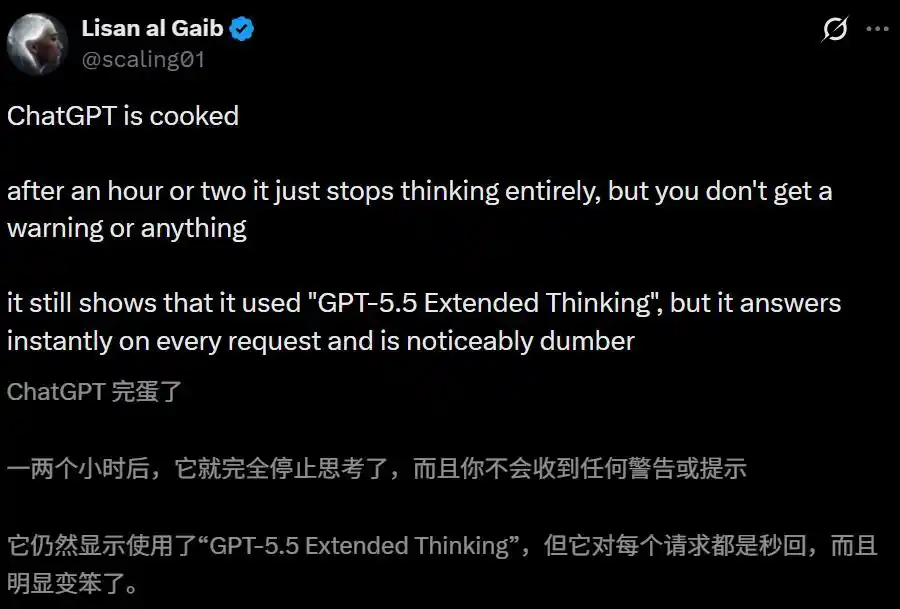
$200/month for a "Schrödinger's Model"

On the OpenAI developer forum, a complaint post blew up simultaneously.

Agentify.sh stated that GPT-5.5 would suddenly lose its ability to follow instructions during use.

Watching it excitedly announce it was "fixed," only to produce code so poor it triggered a mass rollback.

UI tasks that the previous 5.5-med could handle easily now couldn't even manage the simplest changes.

Upgrading to 5.5-high didn't work. Upgrading again to xhigh, still no luck.

And xhigh, which used to run for several hours, now clearly lasted a shorter time.
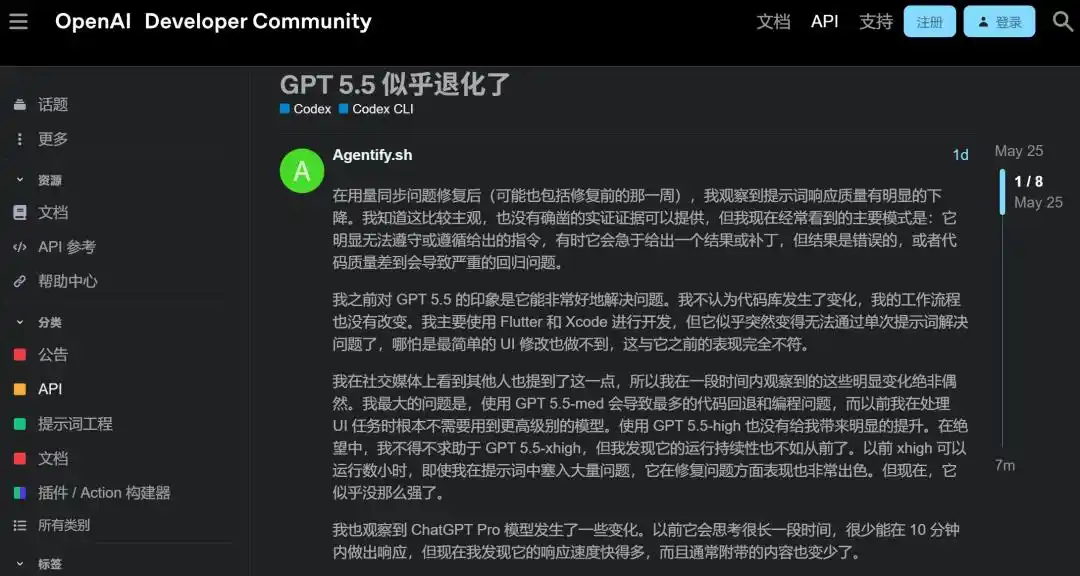
As soon as the post went up, the replies exploded.

Some directly reverted to 5.4.

One used the highest tier, xhigh, but found it "clearly worse than last week, frequent errors on long tasks, not following the workflow at all."

One reported an even more bizarre situation: "Simple queries also take ages to process, and if you interrupt to correct its direction, it completely ignores you and continues with its previous incorrect plan."

That's right, everyone was describing the same phenomenon—GPT's brain had been swapped out at some unknown point.

GPT-5.5's current performance is on par with 5.3, no exaggeration. It was amazing the first few days, but now you can't find a trace of that original model.

Not an illusion, OpenAI spells it out in black and white

To verify, Lisan al Gaib conducted a comparative test.

Same account, Extended Thinking on the ChatGPT side produced garbage, but switching to xhigh on the Codex side immediately restored normal performance.

In his own words, Codex was "literally 4 billion times smarter than this thing."

Developer Andrew Curran came up with a clever trick—directly asking the model, "What is the cutoff date for your training data?"

The model answered: August 2025.

The problem? The cutoff date for GPT-5.5 Thinking is December. August is the cutoff date for the Instant version!

In other words, he selected Thinking, but the system actually ran Instant for him.

Not a single word of the model label on the interface changed, but the model behind it had been secretly swapped......

The funny thing is, this time OpenAI itself nailed the coffin shut for users in its own help documentation.

According to the official explanation in the OpenAI Help Center, Plus users can send a maximum of 160 GPT-5.5 messages every 3 hours.

After that quota is used up, the system will silently switch to the mini model until the quota resets.

Note the word "silently."

No pop-up notification, no change in the model label, no visual feedback whatsoever.

You still think you're using the flagship model, while on the other end it has quietly been replaced with mini.

Pro users, don't celebrate too soon either.

Heavy thinking mode, the top reasoning tier exclusive to Pro users, is also subject to capacity throttling when server load is high. Again, without any warning.

In other words, a $200/month Pro subscription buys you a service that can be "switched out" at any moment.
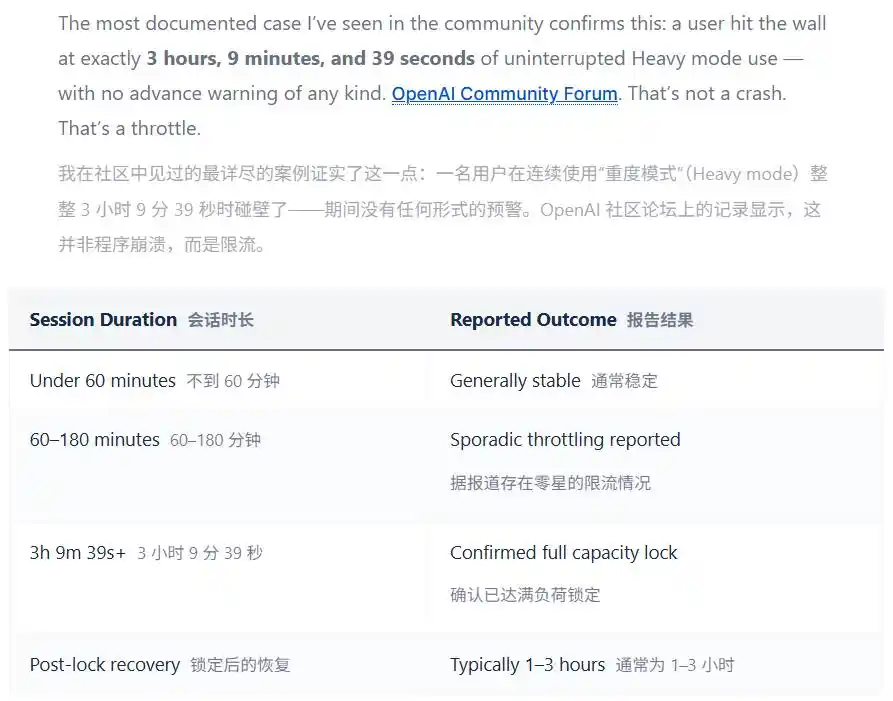
This kind of "label unchanged, brain swapped" operation was caught even earlier on the Codex side.

In February this year, an issue appeared on GitHub where a Pro user used a trace command to discover that they were requesting GPT-5.3 Codex, but the actual model returned was GPT-5.2.

Not even 5.2 Codex, but the lower-tier base 5.2.
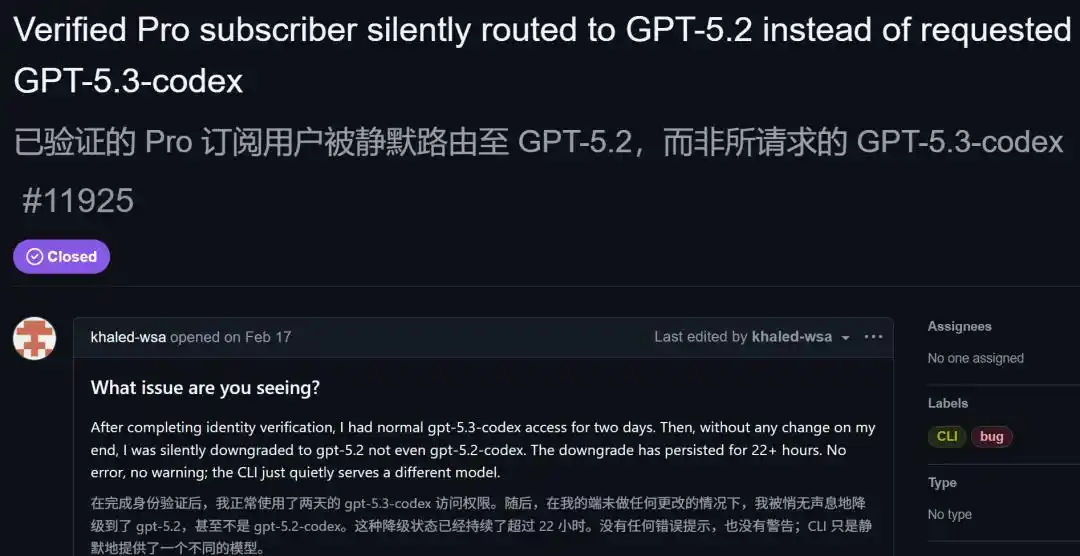
He posted the reproduction command:

  • RUST_LOG='codex_api::sse::responses=trace' codex exec --skip-git-repo-check -s read-only -m 'gpt-5.3-codex' 'hi' 2>&1 >/dev/null | rg -o --replace '$1' '"model":"([^"]+)"' | head -n1
  • Output: gpt-5.2-2025-12-11
  • Expected: gpt-5.3-codex

Multiple Pro users confirmed the same downgrade under the same issue.

And this kind of downgrade is "sticky," it doesn't revert on its own, and there's no explanation.

Even on the day GPT-5.5 was released in April, there were user reports that the speed of Fast mode was similar to Standard, but billing was still at the Fast rate.

A simple task took 7 minutes and 49 seconds, when normally it should be 5-6 minutes.

OpenAI admitted it, and then... nothing

On May 15, a record appeared on OpenAI's status page.

GPT5.5 Performance Degradation, We are investigating reports of performance degradation for GPT-5.5 from some users.

On May 17, the status was updated to "Resolved."

But judging from the timeline of forum posts, complaints about "brain drain" from May 24-26 were even more intense than the wave on May 15.

Either the "resolved" problem came back, or it was never truly solved in the first place.

Every upgrade comes with a "brain drain controversy"

While all companies face complaints about their models "getting dumber," OpenAI hasn't missed a single one with every update from GPT-5 to GPT-5.5.

Every time OpenAI says it's investigating, every time it says it's resolved, and then continues with the next version.

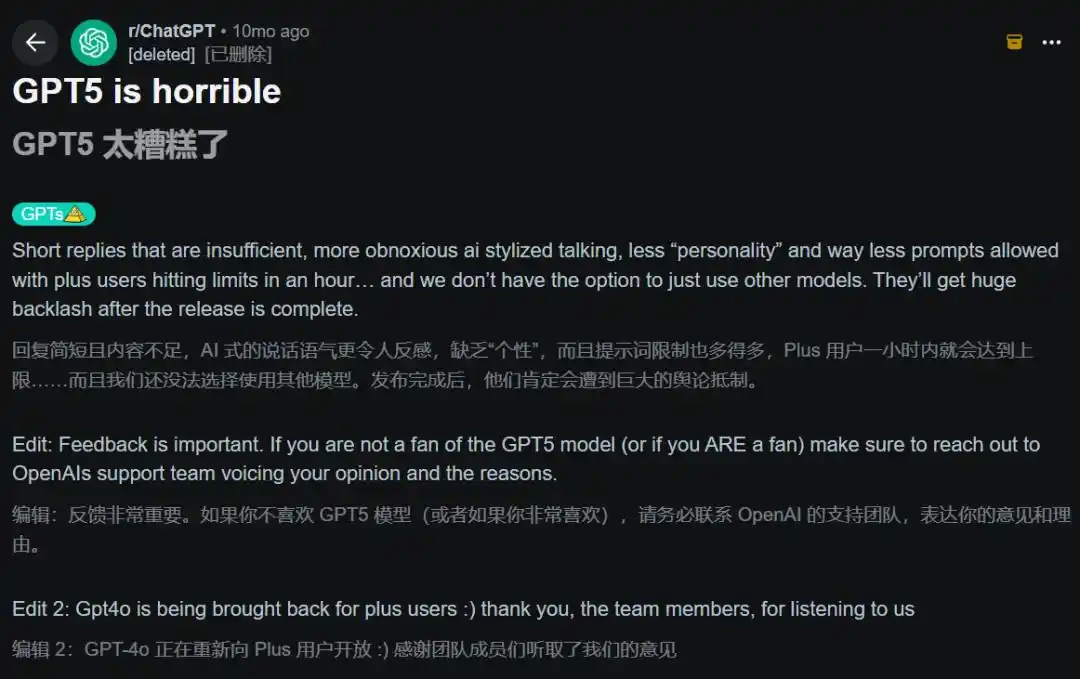
August 2025, GPT-5's debut. The hot post on Reddit was titled directly "GPT-5 is so bad." Users complained about short replies, more refusals, less personality.

OpenAI was forced to urgently restore the GPT-4o option. Altman personally admitted in a Reddit AMA, "bumpier than we expected."
December 2025, GPT-5.2. Translation quality regressed, fabricated non-existent APIs, refused to execute style instructions that 5.1 could easily handle.

February 2026, GPT-5.3-Codex. Pro users silently downgraded to 5.2, trace command confirmed.

March 2026, GPT-5.4. A post titled "GPT-5.4 has clearly regressed in Codex" appeared on the OpenAI community forum, with all replies confirming.

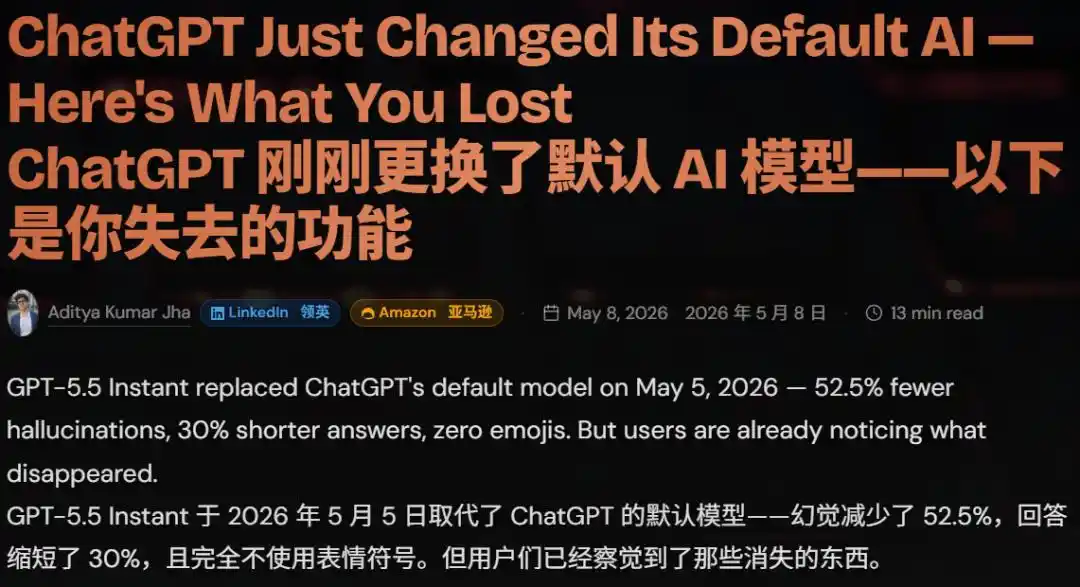
Early May 2026, GPT-5.5 Instant launched. Reply length shortened by 30%, emojis almost disappeared. User summary: Accuracy improved, but warmth vanished.
Late May 2026, now. Complaints about Thinking mode "brain drain" erupted again.

Lisan al Gaib revealed that since he led the fight for ChatGPT Plus quotas during GPT-5's release, "I receive DMs like this every week."

The latest one was someone asking him to help get their xhigh/heavy thinking back.

The day it benchmarks strongest is launch day

chatgptdisaster.com compiled 1087 verified user complaints, one frequently mentioned scenario is "routing layer failure," where the UI shows GPT-5.5 Pro, but the output is completely from another tier.

Users describe a reproducible pattern: after a long session, the model starts "completely ignoring what you say," but the top-tier label is still hanging on the model selector.

The most absurd footnote is that the mechanism for Plus users automatically switching to mini after using 160 messages/3 hours is described as a "feature" in OpenAI's official documentation.

Why is this happening? Lisan al Gaib's analysis suggests the answer is two words: cost-saving.

The crunch on compute power and profitability is affecting everyone. Cutting corners everywhere, not missing any opportunity to save a buck.

Yet, in the same week GPT-5.5 users were collectively complaining, traces of GPT-5.6 had already appeared in Codex backend logs.

Internal codename iris-alpha, 1.5 million token context, Polymarket gave an over 85% probability for a June release.

On one side, 5.5 users can't even secure a basic experience; on the other, 5.6 is already quietly running real traffic in the background.

This is the 2026 ASI race.

The speed of creating new models is getting faster and faster, but making an old model run a single session properly is getting harder and harder.

The day it benchmarks strongest is always launch day, and every day after is Schrödinger's GPT.

Reference: https://x.com/scaling01/status/2058643470357590058?s=20

This article is from the WeChat public account "AI Era," author: ASI Apocalypse; Editor: Moses

Related Questions

QWhat is the main issue reported by users regarding GPT-5.5?

AUsers report that after using GPT-5.5 for a short period, its performance degrades significantly, with responses becoming instant and of much lower quality, while the interface still shows the 'GPT-5.5 Extended Thinking' label, indicating a silent model switch.

QAccording to the article, what does OpenAI's official documentation reveal about user limits?

AOpenAI's official Help Center documentation states that Plus users are limited to 160 GPT-5.5 messages every 3 hours. Once this limit is reached, the system silently switches to a mini model until the quota resets, with no visual indication to the user.

QHow did developers verify that they were receiving a different model than selected?

ADevelopers used methods like comparing outputs between ChatGPT and Codex endpoints, asking the model for its training data cutoff date (which revealed an instant model date when thinking was selected), and using trace commands that showed the actual model returned was a lower-tier version than requested.

QWhat pattern does the article describe regarding OpenAI's model updates?

AThe article describes a recurring pattern where each major model update (GPT-5, 5.2, 5.3, 5.4, 5.5) is followed by widespread user complaints about performance degradation. OpenAI typically acknowledges and investigates the issue, but complaints resurface with subsequent releases.

QWhat reason does the article suggest is behind these performance issues and silent model switches?

AThe article suggests the primary reason is cost-saving. It cites an analysis stating that 'compute and profitability constraints are affecting everyone,' leading OpenAI to silently downgrade models to manage costs, even for users paying high subscription fees.

Related Reads

Another Corporate Bitcoin Treasury Strategy Ends: From High-Profile Entry to Liquidation at a Massive Loss in 11 Months

French semiconductor company Sequans Communications has sold off its bitcoin holdings and terminated its corporate bitcoin treasury strategy less than a year after launching it, sustaining heavy losses. Facing delisting from the New York Stock Exchange in mid-2025 due to low market capitalization, Sequans announced a plan to hold over 3,000 bitcoin as a long-term reserve asset. The strategy was executed with Swan Bitcoin and backed by a $384 million private financing round. At its peak in October 2025, the company held 3,234 bitcoin with an average cost of approximately $116,643 per coin. However, the plan quickly unraveled. With bitcoin's price falling, Sequans sold 970 bitcoin in late 2025 to repay debt, contradicting the core "hold" philosophy of such corporate strategies. The company has now sold more bitcoin to fully repay its convertible notes and announced the termination of its bitcoin reserve strategy. It plans to liquidate its remaining 658 bitcoin. The venture resulted in significant financial damage. The company reported an unrealized loss of $67.4 million on its bitcoin holdings in 2025, contributing to a total net loss of $109.3 million for the year. Sequans' stock (SQNS) has plummeted over 80% since the strategy's launch and is down 77% year-to-date. CEO Georges Karam, who previously championed bitcoin's long-term value, now states the company will refocus entirely on its core IoT semiconductor business. The failed experiment highlights the risks for companies adopting volatile digital assets as treasury reserves.

marsbit18m ago

Another Corporate Bitcoin Treasury Strategy Ends: From High-Profile Entry to Liquidation at a Massive Loss in 11 Months

marsbit18m ago

BIS Latest Research: The Future of Stablecoins and the Global Monetary Landscape

BIS Working Paper No. 170, released in May 2026, analyzes the impact of stablecoins on the global monetary system. The market has grown exponentially since 2014, with over 300 active stablecoins exceeding $300 billion in market capitalization. It is highly concentrated, dominated by USD-linked stablecoins (98% by market cap, mainly USDT and USDC), which function as new forms of private offshore dollar claims on blockchain. Currently, stablecoin use remains largely within crypto ecosystems for trading and DeFi collateral. Real-economy adoption, such as in cross-border payments, is nascent but growing in emerging markets and developing economies (EMDEs) facing high inflation and volatile currencies, where they facilitate capital flight and "digital dollarization." The paper assesses impacts using the Cohen-Kennen framework. For private-sector functions, stablecoins most directly affect value storage (as a dollar-denominated safe haven in EMDEs) and the medium of exchange (enhancing cross-border payment efficiency, further entrenching dollar use). Impacts on the unit of account and official-sector functions are currently limited but could indirectly constrain monetary policy autonomy and capital controls. The report outlines three potential future scenarios: 1) **Niche adoption**, where stablecoins remain crypto-centric with minimal systemic impact; 2) **Digital dollarization**, a high-risk scenario where USD stablecoins become de facto standards in EMDEs, eroding monetary sovereignty; and 3) **Local currency stablecoin integration**, an ideal but challenging scenario where regulated domestic stablecoins linked to CBDCs enhance efficiency without foreign currency substitution. Key policy recommendations emphasize global coordination: establishing uniform regulatory standards (e.g., for reserves and disclosure), strengthening cross-border supervisory cooperation, enhancing domestic defenses in EMDEs (via macroeconomic stability, improved payment systems, and CBDCs), and combating illicit activities. The paper concludes that stablecoins are a structural force reinforcing dollar dominance in the near term, posing significant risks to EMDEs' financial stability and policy autonomy. Their long-term trajectory depends on regulatory responses, adoption patterns, and the co-evolution with public digital currencies.

marsbit26m ago

BIS Latest Research: The Future of Stablecoins and the Global Monetary Landscape

marsbit26m ago

BIS Latest Research: Stablecoins and the Future of the Global Monetary Landscape

The Bank for International Settlements (BIS) Working Paper No. 170 analyzes the rise of stablecoins and their impact on the global monetary system. Stablecoins, privately issued digital tokens pegged to fiat currencies, have grown exponentially since 2014, with a market dominated by USD-pegged variants like USDT and USDC. Their core function remains within the crypto ecosystem, though use in cross-border payments and as a store of value in high-inflation emerging markets is increasing. The report identifies stablecoins as a new form of offshore dollar claims, extending dollar liquidity via blockchain. Their stability depends entirely on reserve quality and market arbitrage, lacking traditional banking safeguards. In the short term, stablecoins reinforce the US dollar's dominance, posing risks to monetary sovereignty in emerging market and developing economies (EMDEs) by facilitating "digital dollarization," which can undermine local currency deposits, capital controls, and monetary policy effectiveness. The BIS outlines three potential future scenarios: 1) Niche adoption within crypto (baseline), 2) Widespread "digital dollarization" in EMDEs (high-risk), and 3) Integration of domestic currency stablecoins (ideal but challenging). Effective global regulatory coordination is crucial to manage risks like reserve transparency, cross-border spillovers, and illicit activities. The report concludes that stablecoins represent a structural force reshaping international monetary hierarchies, presenting both opportunities for payment efficiency and significant risks to financial stability and autonomy, necessitating robust policy responses.

链捕手32m ago

BIS Latest Research: Stablecoins and the Future of the Global Monetary Landscape

链捕手32m ago

Solo Company Craze: Some Earn Millions Annually, Others See Incomes Shrink by 90%

The Rise of the "One-Person Company" (OPC): AI Fuels a Solo Entrepreneurship Wave The concept of the "One-Person Company" (OPC)—where an individual leverages AI tools to start and run a business—is gaining significant traction, hailed by some as ushering in a "golden age" for solo entrepreneurship. While success stories abound, the reality is a mixed picture of high earnings and significant struggles. The article profiles several OPC founders across different industries: * A game developer created 6 bullet-chat (danmaku) games in a year using an AI-powered workflow, earning approximately 1 million RMB. AI handled around 70% of art and 99% of coding tasks, slashing development cycles from months to about 15 days per game. * A materials researcher in Japan, using AI for tasks from translation to legal advice, earns roughly triple the salary of a local white-collar worker. * A biotech entrepreneur uses AI Agents to automate 80% of repetitive work like data analysis, doubling their previous income while gaining time freedom. * Conversely, a former tech executive turned cross-border e-commerce founder in Latin America reports a 90% drop in income compared to their previous corporate job, cautioning against blindly following the trend. Key insights from these cases include: AI dramatically lowers barriers to entry and operational costs, but does not guarantee success. It excels at automating repetitive tasks but cannot replace core human skills like creativity, project management, judgment, and client acquisition. Industry experience and existing client/resources remain critical advantages. The model suits self-starters with specific expertise but poses challenges in areas like sales, compliance, and scaling. Ultimately, while AI empowers solo ventures, entrepreneurship's inherent risks and demands persist.

marsbit38m ago

Solo Company Craze: Some Earn Millions Annually, Others See Incomes Shrink by 90%

marsbit38m ago

Trading

Spot
Futures
活动图片





