Compliant Stablecoin Competition Heats Up as Tether Launches USAT to Enter the US Market

Odaily星球日报Published on 2026-01-28Last updated on 2026-01-28

Abstract

Tether, the dominant stablecoin issuer, has launched a new regulated dollar-pegged stablecoin called USAT, specifically designed for the U.S. market under the GENIUS Act framework. USAT is issued through the federally chartered Anchorage Digital Bank, with Cantor Fitzgerald serving as the custodian and primary dealer. Initially launched on Ethereum with a supply of $20 million, it is supported by exchanges including Bybit, Crypto.com, Kraken, OKX, and MoonPay—notably excluding Binance and Coinbase, which have ties to competing stablecoins. Tether will pursue a dual-track strategy: USAT will focus on compliant competition within the U.S., while USDT continues to serve as the global liquidity benchmark in offshore markets. USAT enters a highly competitive landscape, challenging incumbents like Circle’s USDC, World Liberty Financial’s USD1 (backed by the Trump family), PayPal’s PYUSD, and BlackRock’s USDtb. While Tether has substantial financial resources, it remains uncertain whether it will adopt aggressive incentive strategies to spur adoption, as the company has historically opposed yield-bearing models. The success of USAT will depend on Tether’s ability to compete as a regulated latecomer in a crowded market.

Original | Odaily Planet Daily (@OdailyChina)

Author | Azuma (@azuma_eth)
On January 27, stablecoin giant Tether officially announced that its new USD stablecoin, USAT, designed specifically for the US market and tailored to the GENIUS regulatory framework, has officially launched.

The promotion of USAT has been in the works for a long time. As early as when the GENIUS bill was being pushed through last year, Tether had already decided to launch a new USD stablecoin alongside USDT to compete directly with other stablecoins in the US market under a compliant system. Subsequently, Tether disclosed the development progress and design details of USAT several times. It was previously rumored to launch before the end of 2025 but was officially released in January this year.

USAT: A More Compliant USDT

With the official launch of USAT, the veil has been completely lifted on this new stablecoin.

According to Tether's official statement, USAT is tailor-made for the US market, and its design will fully comply with the new federal stablecoin regulatory framework established by the GENIUS bill (you can simply think of it as a compliant version of USDT). Specifically, Tether will issue USAT through the US federal chartered bank Anchorage Digital Bank, with Cantor Fitzgerald designated as the custodian of USAT's reserve funds and the preferred primary dealer. Bo Hines, former executive director of the White House Cryptocurrency Committee, will serve as CEO to directly oversee USAT's operations.

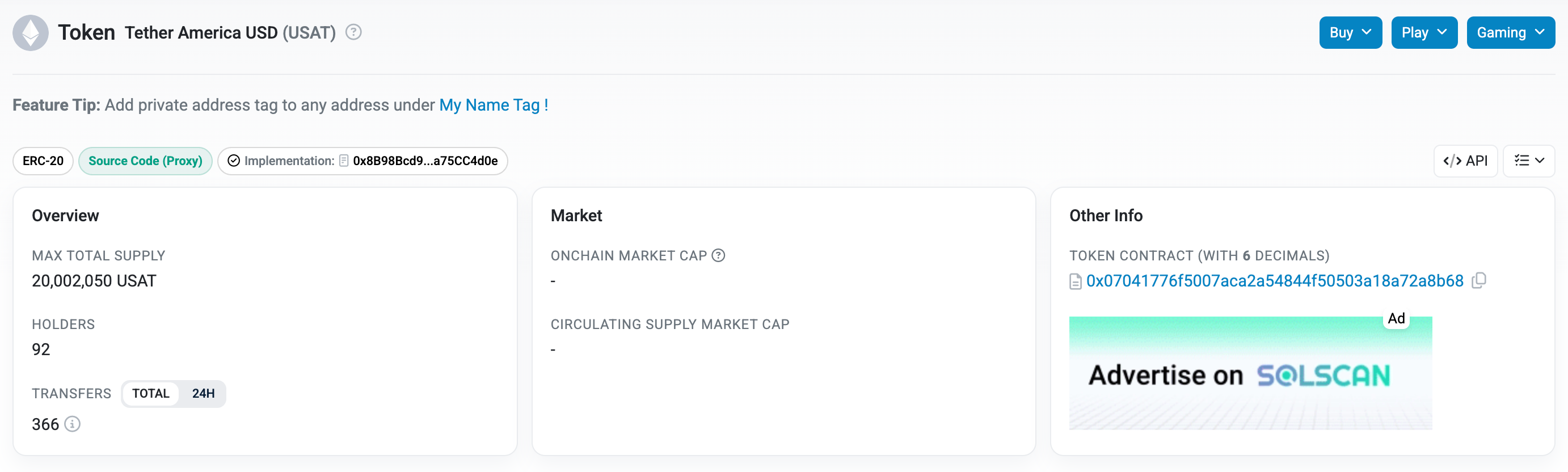
At the initial stage, USAT will only be issued on the Ethereum mainnet, with an initial issuance size of $20 million. The official contract address is 0x07041776f5007aca2a54844f50503a18a72a8b68.
In terms of distribution, Bybit, Crypto.com, Kraken, OKX, and Moonpay will become the first platforms to support USAT, with each platform having successively announced the launch of USAT. It is worth noting that Binance and Coinbase are not among the first batch of platforms. The former is currently flirting with World Liberty Financial (USD1), while the latter has long had interests tied to Circle (USDC). Choosing not to support USAT for now may involve certain strategic considerations.

Tether's Future: Dual-Track Parallel Development

The launch of USAT does not mean that USDT's position will be replaced.

In fact, Tether has repeatedly stated its stance on USDT and USAT, emphasizing that it will adopt a development model of two stablecoins operating in parallel in the future —— USAT will focus on the US market, competing directly with rivals like USDC within the compliant system to capture institutional clients in the traditional financial market; USDT will focus on offshore markets, continuing to serve as the liquidity cornerstone of the cryptocurrency market.

In yesterday's announcement about the issuance of USAT, Tether also mentioned USDT's gradual compliance strategy again: "USDT will continue to operate globally and lead the market as the most widely adopted stablecoin, while gradually moving towards compliance with the GENIUS bill."

In the short term, USDT will still be Tether's main business focus. It will be difficult for USAT to replace the former in terms of scale, but it is expected that Tether will allocate certain resources to USAT to boost the early growth of this stablecoin.

From First Mover to Latecomer, How Will Tether Break Through This Time?

After USAT enters the market, the competitive landscape of the stablecoin market in the US is destined to heat up again.

Considering the current development trends, Circle's (USDC) temporary leading position is not secure. The king of the global stablecoin market, Tether (USAT), World Liberty Financial (USD1) backed by the Trump family, internet giant representative Paypal (PYUSD), BlackRock-backed USDtb... various competitors are launching fierce attacks.

A typical case is that since Binance and USD1 launched a joint subsidy activity (including the ended current account financial management and the ongoing airdrop subsidies) on December 24 last year, USD1's supply scale has grown by more than $2 billion, while USDC's supply scale has shrunk by over $5 billion during the same period —— there is likely some correlation in this ebb and flow.
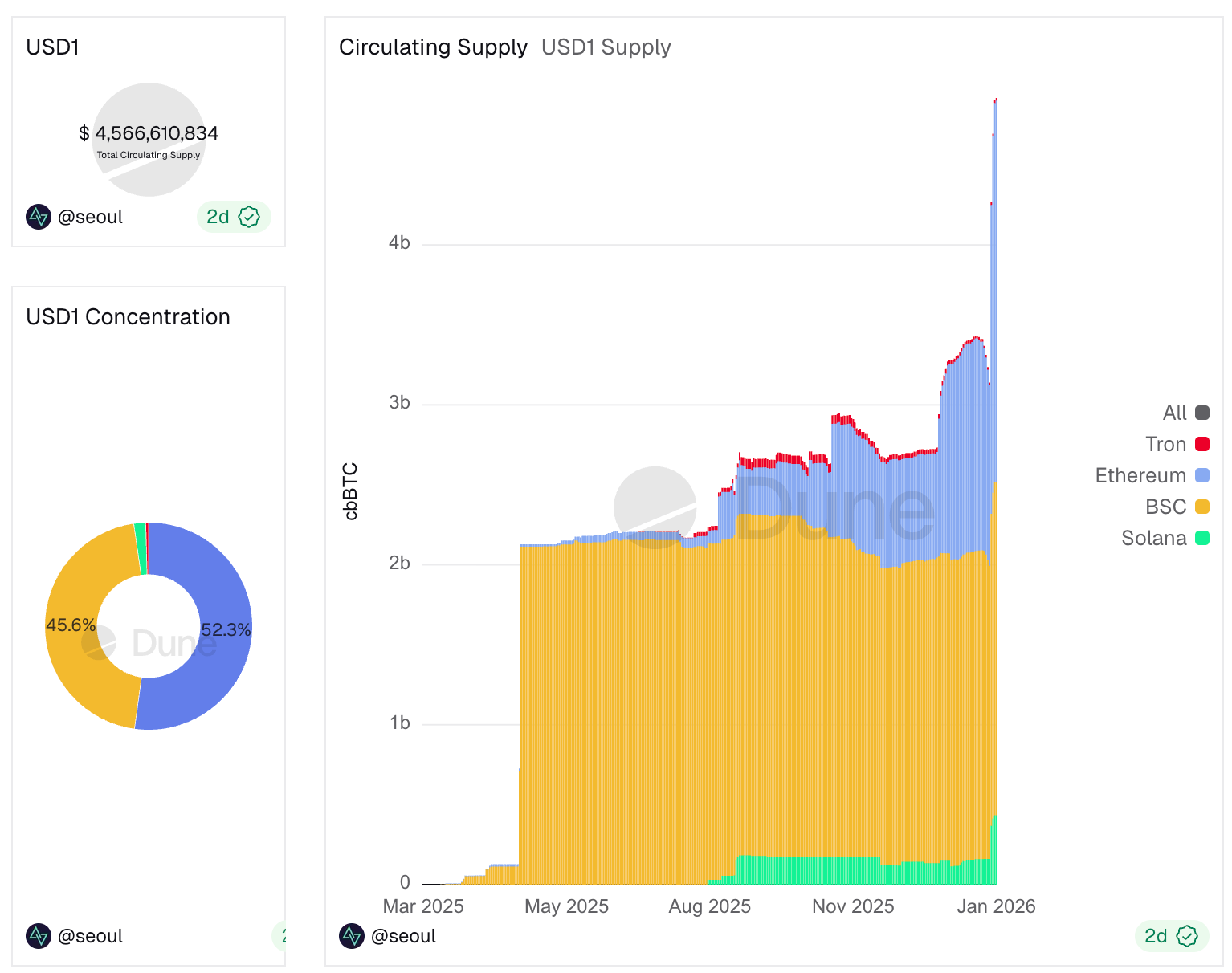
A similar case could also happen with USAT. As a latecomer stablecoin, if Tether wants to stimulate the growth of its supply, subsidies would obviously be the most efficient measure. As ordinary users, we naturally hope to see major stablecoins engage in incentive wars.

Tether's financial strength is undeniable. In 2025, Tether achieved profits of tens of billions of dollars in just three quarters. However, the problem here is that Tether has long been opposed to profit subsidies. Tether CEO Paolo Ardoino clearly expressed his disdain last year for the industry's pursuit of interest-bearing stablecoins, bluntly stating it was a "bad idea." Therefore, it remains unknown whether Tether will adopt a growth strategy similar to USD1 for USAT in the future.

This is an unresolved question for Tether —— in the development history of stablecoins, Tether used USDT to fully exploit first-mover advantages. This time, as a latecomer chasing the competition, Tether's strategy to break through is worth anticipating.


Related Questions

QWhat is the name of the new stablecoin launched by Tether for the US market, and what regulatory framework is it designed to comply with?

AThe new stablecoin is called USAT, and it is designed to comply with the GENIUS regulatory framework.

QWhich institutions are involved in the issuance and custody of USAT's reserve funds?

AUSAT is issued through the US federal chartered bank Anchorage Digital Bank, and Cantor Fitzgerald is the designated custodian of the reserve funds and the preferred primary dealer.

QWhich major cryptocurrency exchanges are notably absent from the first batch of platforms supporting USAT, and what are their potential strategic reasons?

ABinance and Coinbase are notably absent from the first batch. Binance is reportedly involved with World Liberty Financial (USD1), and Coinbase has long-term interests tied to Circle (USDC), which are likely strategic reasons for not initially supporting USAT.

QHow does Tether plan to position USAT and USDT in the market moving forward?

ATether plans a dual-track development model: USAT will focus on the US market and compete with other stablecoins within the compliant system, while USDT will focus on offshore markets and continue to serve as the liquidity cornerstone of the cryptocurrency market.

QWhat challenge does Tether face as a latecomer with USAT in the competitive US stablecoin market, according to the article?

AThe challenge is whether Tether will adopt subsidy strategies, similar to its competitors like USD1, to stimulate the growth of USAT's supply, given that Tether's CEO has historically been opposed to the idea of yield-bearing subsidies for stablecoins.

Related Reads

U.S. Government Bans Foreign Nationals from Using Fable 5, Anthropic Issues Rebuttal

U.S. Government Bans Foreign Access to Fable 5, Anthropic Issues Rebuttal On June 12th, the U.S. government ordered AI company Anthropic to immediately suspend all foreign access—including foreign nationals within the U.S. and Anthropic's own foreign employees—to its newly released Fable 5 and Mythos 5 AI models, citing national security concerns. This forced Anthropic to temporarily disable access to both models for all users globally, as it cannot technically differentiate user nationality at scale. The models, released just three days prior, represent Anthropic's highest public capability tier. Fable 5 is the first publicly available model from the advanced "Mythos" family, while Mythos 5 is a less-restricted version for approved cybersecurity and critical infrastructure partners. The government's directive was reportedly triggered by claims from another company that it could "jailbreak" Mythos 5, raising alarm within the Trump administration. Anthropic, in a detailed public statement, strongly challenged this rationale. The company argues the demonstrated "jailbreak" is a narrow, non-generalized technique that merely involves identifying minor, known software vulnerabilities—a capability common to other publicly available models like OpenAI's GPT-5.5 and routinely used by cybersecurity defenders. Anthropic stated it has complied with the order but disagrees with the government's standard, warning that applying it industry-wide would halt all new frontier model deployments. The company criticized the lack of a transparent, fact-based legal process and expressed confidence the situation stems from a misunderstanding. It is working to restore access and will release more technical details within 24 hours. Other Anthropic models remain unaffected.

链捕手14m ago

U.S. Government Bans Foreign Nationals from Using Fable 5, Anthropic Issues Rebuttal

链捕手14m ago

The Revelation from the Raydium Theft Incident: New DeFi Vulnerabilities Lurking in Forgotten Old Contracts

**Raydium Exploit Reveals DeFi's Hidden Risk: Forgotten "Zombie" Contracts** A recent attack on Raydium's deprecated V3 AMM pools resulted in a loss of approximately $1.34 million. The hacker exploited pools that were no longer supported by Raydium's current UI or SDK but remained fully functional and accessible on-chain. This incident highlights a critical, often overlooked category of risk in DeFi: inactive or legacy smart contracts that projects fail to properly decommission. Since March 2025, there have been at least 8 publicly reported attacks targeting such abandoned contracts, with total losses around $10.8 million. Including older pools and deprecated features, the count rises to 10 incidents with roughly $22.5 million in losses. These "zombie contracts" represent a lifecycle management failure rather than a code vulnerability, yet they are typically misclassified under general "code bug" categories in security reports, masking the true scale of the problem. The root cause is that projects often merely document a contract as "deprecated" without taking essential technical steps to secure it: withdrawing remaining assets, disabling external call functions, and implementing ongoing monitoring. These forgotten, under-monitored components become prime targets for attackers. To address this, the industry needs to recognize "zombie contracts" as a distinct risk category and establish standardized decommissioning protocols. Essential steps should include: 1) a formal retirement announcement, 2) removal of all front-end integrations, 3) withdrawal of locked assets, 4) disabling key contract functions, 5) ongoing security monitoring, 6) clear user communication, and 7) a post-mortem analysis. The value of a DeFi project lies not only in its current TVL but also in the security of its historical codebase, which has now become a new attack surface.

Foresight News2h ago

The Revelation from the Raydium Theft Incident: New DeFi Vulnerabilities Lurking in Forgotten Old Contracts

Foresight News2h ago

Robots Begin to 'Consume Data': The Hidden Production Chain from Indian Data Factories to Billion-Dollar Humanoid Robots

Robots have started to 'consume data,' driving the formation of a new industrial supply chain focused on producing training data for embodied AI. Unlike large language models, which are trained on vast internet text corpora, embodied AI models face a 'data desert' in the physical world. This has created a massive demand for first-person perspective video data (Ego Data), captured by workers wearing cameras in places like Indian garment factories. Companies like Neocambrian AI are establishing 'data factories' where workers perform standardized tasks (e.g., sorting clothes, kitchen organization) to generate thousands of hours of video. Research, such as NVIDIA's EgoScale, demonstrates that scaling this human demonstration data predictably improves robot performance, particularly for dexterous manipulation. This has validated a training path combining large-scale human data for pre-training with smaller amounts of robot-specific data for fine-tuning. The value of different data types varies significantly, forming a 'data pyramid.' The base consists of low-cost, large-scale internet and Ego Data. Higher layers include more expensive motion-capture data (e.g., from data gloves), simulation/synthetic data, and the most costly and scarce layer: real robot teleoperation data. This demand has spawned a layered ecosystem of data suppliers: low-cost data factories, motion capture and alignment specialists, robot-native teleoperation service providers, simulation data companies, and platforms aiming for data standardization. Robot companies themselves are adopting a 'layered procurement' strategy: outsourcing generic Ego Data while building in-house capabilities for robot-specific adaptation data and the critical deployment/failure data generated in real-world applications. The industry is shifting focus from hardware and basic mobility to the data pipelines required for general-purpose capability. While parallels exist to data labeling companies like Scale AI in the LLM boom, the physical complexity of robot data—involving action success ambiguity and sim-to-real gaps—requires more integrated solutions for data collection, annotation, and a continuous feedback loop. The race is on to build the data engines that will teach robots to operate reliably in the unstructured real world.

marsbit4h ago

Robots Begin to 'Consume Data': The Hidden Production Chain from Indian Data Factories to Billion-Dollar Humanoid Robots

marsbit4h ago

Trading

Spot
Futures
活动图片




