Commodities Surge, Equities Steady, Crypto Falls Behind In 2025 Market Showdown

bitcoinistPublished on 2025-12-22Last updated on 2025-12-22

Abstract

The investment landscape of 2025 has delivered an unexpected outcome, with traditional commodities emerging as the clear winners while cryptocurrencies fell to the bottom of performance rankings. Data reveals a strong divergence between asset classes: silver leads with a 130% year-to-date gain, followed by gold (65%) and copper (35%). Equity indices like the Nasdaq and S&P 500 also posted positive returns. In stark contrast, the crypto market is the worst-performing asset class. Bitcoin is down 6%, Ethereum has declined 12%, and altcoins (excluding Ethereum) have plummeted approximately 42%. This marks a dramatic reversal from the mid-year rally, where Bitcoin, Ethereum, and XRP reached new all-time highs. The downturn began with a flash crash in October, leading to Bitcoin's worst Q4 performance in seven years, ultimately erasing earlier gains and cementing crypto's position at the bottom of the 2025 market.

The investment landscape in 2025 has delivered an unusual outcome that few would have anticipated at the start of the year. Assets traditionally viewed as slow movers have risen as the clear winners, while the cryptocurrency market has quietly slipped to the bottom of the performance rankings.

As the year draws to a close, data from across commodities, equities, and digital assets shows an imbalance in returns, revealing that cryptocurrencies now sit behind every major asset class in year-to-date performance.

Clear Split Between Traditional Assets And Crypto

The performance data for 2025 reveals a strong divergence between traditional markets and digital assets, with the gap widening as the year progressed. According to the figures revealed on the social media platform X by ‘Bull Theory,’ silver is the top-performing asset for 2025, posting gains of about 130% year-to-date. Gold is the second-best-performing asset of 2025, with an increase of about 65%, while copper has climbed close to 35%. These numbers reflect sustained strength across the commodities sector.

Equity markets are also currently trading in positive territory. The Nasdaq is up around 20% on the year, the S&P 500 has gained approximately 16%, and the Russell 2000 is higher by about 13%.

The only negative numbers are from the crypto industry. In contrast, the crypto market sits at the bottom of the performance rankings. Bitcoin is currently down by about 6% from its 2025 opening price, Ethereum has declined around 12%, and the entire altcoin market (removing Ethereum) has suffered a much deeper drawdown of about 42%. Therefore, the crypto market is now officially the worst-performing asset class in 2025.
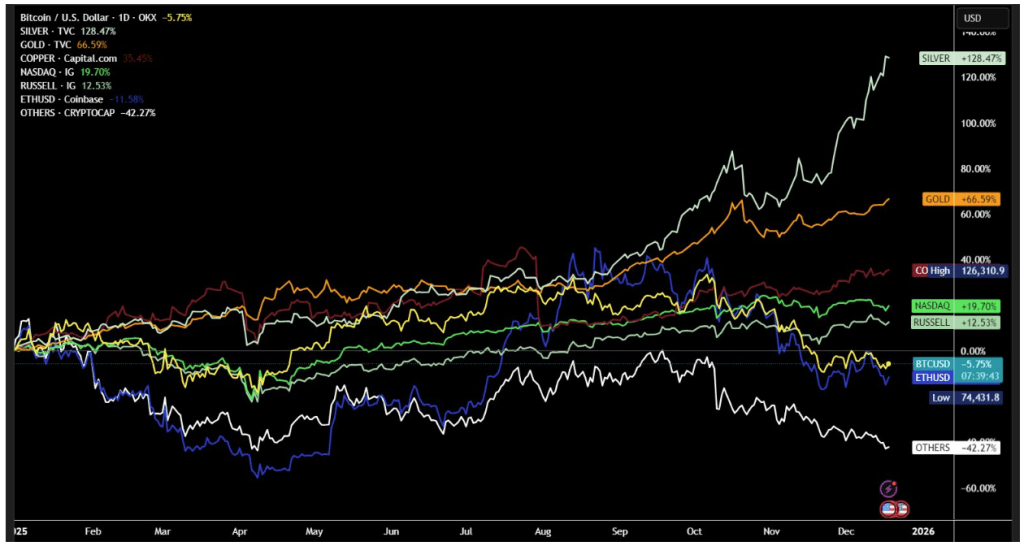
Chart Image From X. Source: @BullTheoryio

From Mid-Year Rally To Q4 Breakdown

The current weakness of the crypto market is very different from the optimism that dominated the beginning and middle of 2025. During that period, the crypto market experienced a powerful recovery that reignited bullish sentiment across the board. Bitcoin, Ethereum, XRP, and several large-cap tokens pushed to new all-time highs.

Bitcoin’s rally peaked in October, when it set its standing record of $126,000 after months of steady accumulation and strong momentum. Ethereum, on the other hand, registered a new all-time high of $4,946 in August, while XRP’s all-time high came earlier in July. XRP’s record price of $3.65 was the most notable, as it was its first time breaking into a new all-time high since 2018.

Total crypto market cap currently at $2.98 trillion. Chart: TradingView

That bullish trend began to unravel as the fourth quarter got underway, starting with the crypto market flash crash on October 10. The decline has extended since then, and Bitcoin and the broader crypto market have now fallen into negative territory from their 2025 opening levels.

Quarterly returns data shows that Bitcoin just recorded its worst fourth-quarter performance in seven years. The result is a year in which digital assets, despite a powerful mid-year rally, are closing out as the worst-performing major asset class.
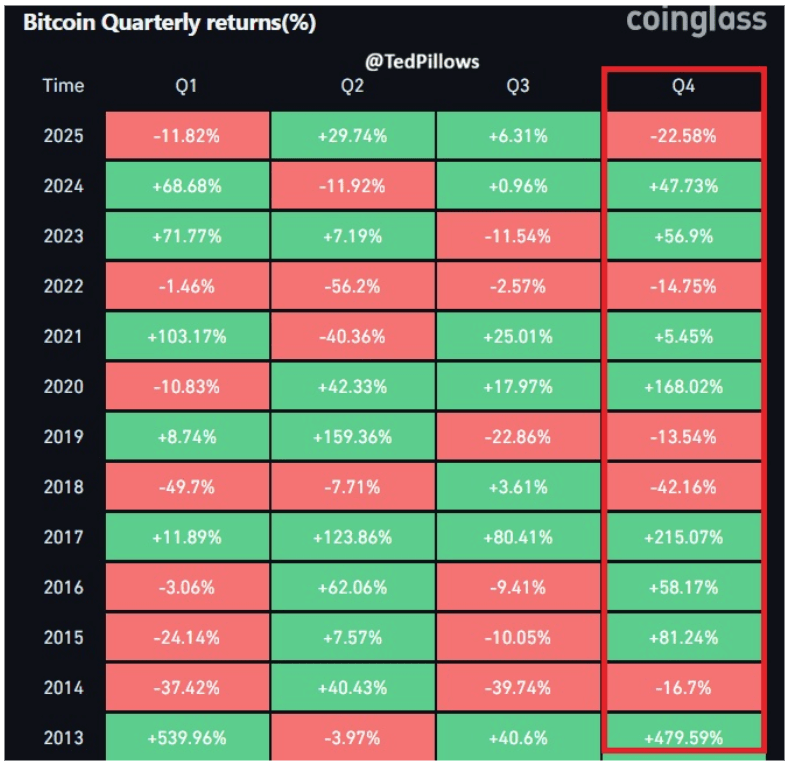
Bitcoin Quarterly Returns. Source: @TedPillows On X

Featured image from Unsplash, chart from TradingView

Related Questions

QWhich asset class was the top performer in 2025 according to the data from 'Bull Theory'?

ACommodities, specifically silver, was the top-performing asset, posting gains of about 130% year-to-date.

QWhat are the year-to-date performance figures for Bitcoin and Ethereum in 2025 as described in the article?

ABitcoin is down by about 6% from its 2025 opening price, and Ethereum has declined around 12%.

QWhat significant event on October 10, 2025, contributed to the crypto market's decline in Q4?

AThe crypto market experienced a flash crash on October 10, which marked the beginning of the extended decline into negative territory for the year.

QWhat were the peak prices reached by Bitcoin and Ethereum during their 2025 rallies?

ABitcoin reached a peak of $126,000 in October, and Ethereum reached a new all-time high of $4,946 in August.

QHow does the performance of the entire altcoin market (excluding Ethereum) compare to the major cryptocurrencies in 2025?

AThe entire altcoin market (removing Ethereum) suffered a much deeper drawdown of about 42%, performing worse than both Bitcoin and Ethereum.

Related Reads

13 Business Lines Surpass $100 Million in Annualized Revenue, Robinhood Moves Toward a 'Super Financial App'

Robinhood Q2 2026 Earnings: Record Revenue and a Push Towards a "Super Financial App" Robinhood (HOOD) reported strong Q2 2026 results, with net revenue reaching $1.308 billion, up 32% year-over-year, and net income hitting $561 million, a 45% increase. The company now has 13 distinct business lines each generating over $100 million in annualized revenue. Key drivers included a 44% surge in transaction-based revenue to $776 million, led by a more than 10x growth in "event contracts" (prediction markets) and strong performance in stocks and options. User metrics also grew, with funded accounts rising to 28.4 million and total assets under custody reaching $369 billion. The Robinhood Gold subscription service hit a record 4.8 million users. The report highlights a strategic shift for Robinhood. Moving beyond its core as a zero-commission trading platform for retail investors, it is actively building a broader financial ecosystem. This includes expanding into wealth management (Robinhood Strategies), payments (Robinhood Credit Card), and next-generation infrastructure like AI-powered "Agentic Trading" and its own Ethereum Layer 2 blockchain, Robinhood Chain. The company's goal is to evolve from a trading app into a comprehensive "super financial app," offering a one-stop shop for investing, cash management, and future on-chain finance.

Odaily星球日报18m ago

13 Business Lines Surpass $100 Million in Annualized Revenue, Robinhood Moves Toward a 'Super Financial App'

Odaily星球日报18m ago

13 Business Lines Surpass $100 Million in Annualized Revenue, Robinhood Advances Toward a 'Super Financial App'

On July 30th, Robinhood (HOOD) reported its Q2 2026 financial results, showcasing significant growth with record revenue and profits. The company achieved a net revenue of $1.308 billion, a 32% year-over-year (YoY) increase, and a net income of $561 million, up 45% YoY. This strong performance was driven by robust trading activity and expansion into new financial services. A key highlight was the surge in transaction-based revenue, which rose 44% YoY to $776 million. Notably, income from event contracts (prediction markets) skyrocketed over 10x to $156 million, emerging as a major new growth driver alongside strong gains in stock and options trading. However, crypto trading revenue declined by 38%. Beyond trading, Robinhood is successfully diversifying its revenue streams. User assets grew 32% to $369 billion, and the subscription service Robinhood Gold reached a record 4.8 million users. The company revealed that 13 of its business lines now generate over $100 million in annualized revenue, including its new credit card, prediction markets, and Gold subscriptions. Looking forward, Robinhood is strategically investing in AI and blockchain to build a comprehensive financial ecosystem. It has launched AI-powered "Agentic Trading" and the "Robinhood Chain," a layer-2 blockchain network. The company's vision is evolving from a retail trading platform into a "super financial app" that integrates trading, wealth management, payments, and next-generation digital asset services, though regulatory hurdles remain for some new ventures.

marsbit18m ago

13 Business Lines Surpass $100 Million in Annualized Revenue, Robinhood Advances Toward a 'Super Financial App'

marsbit18m ago

After R&D Investment Catches Up with the U.S., Is the Sino-U.S. Chip Competition Still Just About Money?

The article examines the significance of recent data showing China's total R&D expenditure, measured by purchasing power parity (PPP), catching up to or slightly surpassing that of the United States in 2024. It argues that while this milestone reflects China's immense capacity to mobilize research resources, the competition in semiconductors now extends far beyond sheer financial input. The analysis highlights key differences: China's R&D is heavily skewed towards experimental development (over 80%), focusing on product engineering and industrialization, whereas the U.S. allocates a proportionally larger share (about 15%) to basic research. Furthermore, leading U.S. semiconductor firms reinvest a significant portion of their substantial global sales revenue into R&D, creating a sustainable commercial innovation cycle that is difficult to replicate. The article emphasizes that semiconductor progress depends on converting R&D into commercially viable products that pass rigorous customer validation and achieve repeat orders, not just on spending levels. It concludes that as China enters the top tier of R&D spenders, the critical challenges shift to improving resource allocation efficiency, fostering long-term basic research, and building effective mechanisms to bridge the gap between laboratory discoveries and reliable, market-ready industrial capabilities.

marsbit1h ago

After R&D Investment Catches Up with the U.S., Is the Sino-U.S. Chip Competition Still Just About Money?

marsbit1h ago

Trading

Spot
活动图片