Coinbase to Launch Stock Futures, Why This Is Big For Crypto

bitcoinistPublished on 2026-03-21Last updated on 2026-03-21

Abstract

Coinbase, a major US cryptocurrency exchange, has announced the launch of stock perpetual futures for non-US traders. This expansion is a significant step in its "Everything Exchange" strategy, moving beyond crypto into traditional assets like stocks and ETFs. The new derivatives allow eligible traders to speculate on the price of major tech stocks (Apple, Microsoft, etc.) and index ETFs (SPY, QQQ) with up to 10x and 20x leverage, respectively, all settled in USDC. These contracts never expire, enabling 24/7 trading. This launch integrates traditional assets with crypto on a single platform, offering new trading and hedging opportunities but also introducing higher risks of volatility and liquidations.

Coinbase, one of the largest cryptocurrency centralized exchanges (CEX) in the United States, has just announced the launching of stock perpetual futures for non-US traders.

Coinbase Expands Beyond All Borders

The CEX’s expansion, announced today in a blog post on its official website, isn’t just about stepping beyond U.S. borders to give global traders ongoing leveraged exposure via perpetual futures. It also marks Coinbase’s push beyond crypto into traditional assets, turning this rollout into a fresh bet on the growing trend toward tokenized stocks and 24/7 markets, driven by both TradFi and DeFi players. Recently, Europe’s largest asset manager Amundi announced the launching of a tokenized fund on Ethereum and Stellar, as covered by Bitcoinist just today.

Coinbase frames this launch as part of its broader “Everything Exchange” strategy, aiming to bring crypto, traditional assets, and new tokenized products into one venue.

Today, Coinbase expands its global derivatives offering with the launch of stock perpetual futures, becoming one of the first major centralized venues to offer this product. This launch strengthens Coinbase’s position in international derivatives and advances our long-term strategy of building the Everything Exchange where traders can access crypto, traditional, and emerging assets side by side.

Over the past year, Coinbase has laid the regulatory and product runway for this leap. It first rolled out crypto perpetual futures to U.S. retail traders under CFTC oversight in mid‐2025, then pushed derivatives into Europe via a MiFID II license obtained through its Bux acquisition, reaching 26 countries in an earlier March 2026 expansion that landed alongside its stock index futures debut.

A 24/7 US stock market

The CEX itself describes perpetual futures as “a type of derivative contract that enables traders to speculate on the price of an asset (...) without needing to buy or own the underlying asset itself.” Unlike standard futures, never expire, so traders can keep positions open indefinitely as long as they meet the margin requirements.

At launch, contracts cover the “Magnificent Seven” tech stocks: Apple, Microsoft, Alphabet, Amazon, NVIDIA, Meta Platforms, and Tesla. In certain permitted jurisdictions, perpetual futures on benchmark ETFs tracking, the S&P 500 (SPY) and the tech‐heavy Nasdaq‐100 (QQQ), are also available.

Leverage goes up to 10x on individual stock perpetuals and up to 20x on ETF perpetuals. All contracts are settled in USDC, Coinbase’s preferred stablecoin. The platform uses unified margin across perpetual and spot positions, allowing more capital-efficient portfolio management and risk offsets.

What This Means For Traders

Coinbase is methodically weaving spot, futures, and now stock‐linked perpetuals into a single, always‐on risk platform that changes how both retail and institutions express views across markets. For traders, that unlocks new basis trades between spot stocks and perpetuals, tighter cross‐asset plays between crypto and U.S. equities, and more complex hedging around macro events and earnings.

The flip side is obvious: deeper leverage stacks mean a higher risk of cascading liquidations and sharper, event‐driven volatility when the Fed speaks, data prints hit, or Big Tech reports.
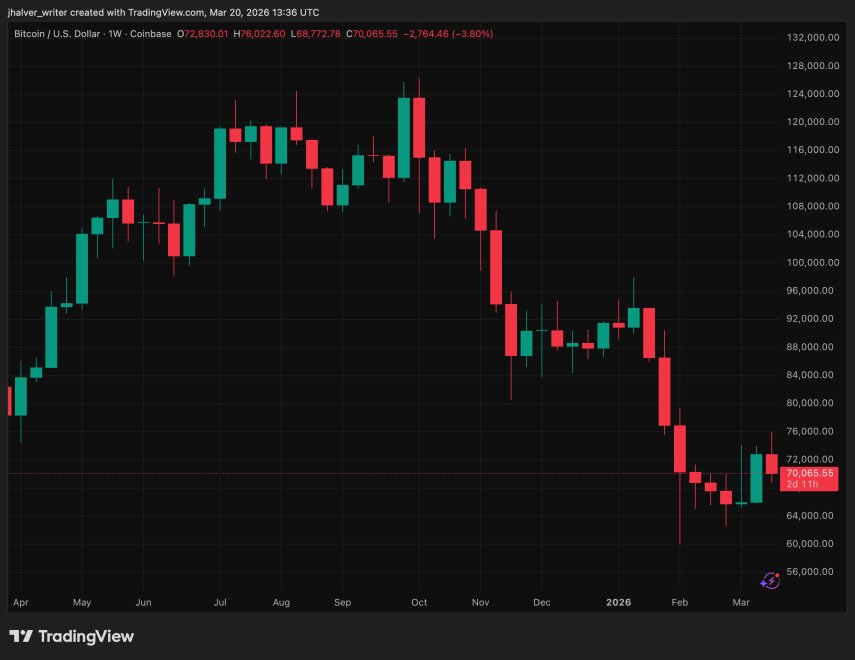
At the moment of writing, BTC trades barely above the $70k level on the daily chart, marking a downside trend. Source: BTCUSD on Tradingview

Cover image from Perplexity, BTCUSD chart from Tradingview

Related Questions

QWhat new product has Coinbase announced for non-US traders?

ACoinbase has announced the launch of stock perpetual futures for non-US traders.

QWhich major tech stocks are covered by the new perpetual futures contracts?

AThe contracts cover the 'Magnificent Seven' tech stocks: Apple, Microsoft, Alphabet, Amazon, NVIDIA, Meta Platforms, and Tesla.

QWhat is the maximum leverage offered on individual stock perpetual futures?

ALeverage goes up to 10x on individual stock perpetual futures.

QIn what currency are all the new perpetual futures contracts settled?

AAll contracts are settled in USDC, which is Coinbase's preferred stablecoin.

QHow does Coinbase describe the broader strategy that this launch is a part of?

ACoinbase frames this launch as part of its broader 'Everything Exchange' strategy, aiming to bring crypto, traditional assets, and new tokenized products into one venue.

Related Reads

Gensyn AI: Don't Let AI Repeat the Mistakes of the Internet

In recent months, the rapid growth of the AI industry has attracted significant talent from the crypto sector. A persistent question among researchers intersecting both fields is whether blockchain can become a foundational part of AI infrastructure. While many previous AI and Crypto projects focused on application layers (like AI Agents, on-chain reasoning, data markets, and compute rentals), few achieved viable commercial models. Gensyn differentiates itself by targeting the most critical and expensive layer of AI: model training. Gensyn aims to organize globally distributed GPU resources into an open AI training network. Developers can submit training tasks, nodes provide computational power, and the network verifies results while distributing incentives. The core issue addressed is not decentralization for its own sake, but the increasing centralization of compute power among tech giants. In the era of large models, access to GPUs (like the H100) has become a decisive bottleneck, dictating the pace of AI development. Major AI companies are heavily dependent on large cloud providers for compute resources. Gensyn's approach is significant for several reasons: 1) It operates at the core infrastructure layer (model training), the most resource-intensive and technically demanding part of the AI value chain. 2) It proposes a more open, collaborative model for compute, potentially increasing resource utilization by dynamically pooling idle GPUs, similar to early cloud computing logic. 3) Its technical moat lies in solving complex challenges like verifying training results, ensuring node honesty, and maintaining reliability in a distributed environment—making it more of a deep-tech infrastructure company. 4) It targets a validated, high-growth market with genuine demand, rather than pursuing blockchain integration without purpose. Ultimately, the boundaries between Crypto and AI are blurring. AI requires global resource coordination, incentive mechanisms, and collaborative systems—areas where crypto-native solutions excel. Gensyn represents a step toward making advanced training capabilities more accessible and collaborative, moving beyond a niche controlled by a few giants. If successful, it could evolve into a fundamental piece of AI infrastructure, where the most enduring value in the AI era is often created.

marsbit10h ago

Gensyn AI: Don't Let AI Repeat the Mistakes of the Internet

marsbit10h ago

Why is China's AI Developing So Fast? The Answer Lies Inside the Labs

A US researcher's visit to China's top AI labs reveals distinct cultural and organizational factors driving China's rapid AI development. While talent, data, and compute are similar to the West, Chinese labs excel through a pragmatic, execution-focused culture: less emphasis on individual stardom and conceptual debate, and more on teamwork, engineering optimization, and mastering the full tech stack. A key advantage is the integration of young students and researchers who approach model-building with fresh perspectives and low ego, prioritizing collective progress over personal credit. This contrasts with the US culture of self-promotion and "star scientist" narratives. Chinese labs also exhibit a strong "build, don't buy" mentality, preferring to develop core capabilities—like data pipelines and environments—in-house rather than relying on external services. The ecosystem feels more collaborative than tribal, with mutual respect among labs. While government support exists, its scale is unclear, and technical decisions appear driven by labs, not state mandates. Chinese companies across sectors, from platforms to consumer tech, are building their own foundational models to control their tech destiny, reflecting a broader cultural drive for technological sovereignty. Demand for AI is emerging, with spending patterns potentially mirroring cloud infrastructure more than traditional SaaS. Despite challenges like a less mature data industry and GPU shortages, Chinese labs are propelled by vast talent, rapid iteration, and deep integration with the open-source community. The competition is evolving beyond a pure model race into a contest of organizational execution, developer ecosystems, and industrial pragmatism.

marsbit11h ago

Why is China's AI Developing So Fast? The Answer Lies Inside the Labs

marsbit11h ago

3 Years, 5 Times: The Rebirth of a Century-Old Glass Factory

Corning, a 175-year-old glass company, is experiencing a dramatic revival as a key player in AI infrastructure, driven by surging demand for high-performance optical fiber in data centers. AI data centers require vastly more fiber than traditional ones—5 to 10 times as much per rack—to handle high-speed data transmission between GPUs. This structural demand shift, coupled with supply constraints from the lengthy expansion cycle for fiber preforms, has created a significant supply-demand gap. Nvidia has invested in Corning, along with Lumentum and Coherent, in a $4.5 billion total commitment to secure the optical supply chain for AI. Corning's competitive edge lies in its expertise in producing ultra-low-loss, high-density, and bend-resistant specialty fiber, which is critical for 800G+ and future 1.6T data rates. Its deep involvement in co-packaged optics (CPO) with partners like Nvidia further solidifies its position. While not the largest fiber manufacturer globally, Corning's revenue from enterprise/data center clients now exceeds 40% of its optical communications sales, and it has secured multi-year supply agreements with major hyperscalers including Meta and Nvidia. Financially, Corning's optical communications revenue has surged, doubling from $1.3 billion in 2023 to over $3 billion in 2025. Its stock price has risen nearly 6-fold since late 2023. Key future catalysts include the rollout of Nvidia's CPO products and the scale of undisclosed customer agreements. However, risks include high current valuations and potential disruption from next-generation technologies like hollow-core fiber. The company's long-term bet on light over electricity, maintained even through the telecom bubble crash, is now being validated by the AI boom.

marsbit12h ago

3 Years, 5 Times: The Rebirth of a Century-Old Glass Factory

marsbit12h ago

Trading

Spot
Futures

Hot Articles

How to Buy ONE

Welcome to HTX.com! We've made purchasing Harmony (ONE) simple and convenient. Follow our step-by-step guide to embark on your crypto journey.Step 1: Create Your HTX AccountUse your email or phone number to sign up for a free account on HTX. Experience a hassle-free registration journey and unlock all features.Get My AccountStep 2: Go to Buy Crypto and Choose Your Payment MethodCredit/Debit Card: Use your Visa or Mastercard to buy Harmony (ONE) instantly.Balance: Use funds from your HTX account balance to trade seamlessly.Third Parties: We've added popular payment methods such as Google Pay and Apple Pay to enhance convenience.P2P: Trade directly with other users on HTX.Over-the-Counter (OTC): We offer tailor-made services and competitive exchange rates for traders.Step 3: Store Your Harmony (ONE)After purchasing your Harmony (ONE), store it in your HTX account. Alternatively, you can send it elsewhere via blockchain transfer or use it to trade other cryptocurrencies.Step 4: Trade Harmony (ONE)Easily trade Harmony (ONE) on HTX's spot market. Simply access your account, select your trading pair, execute your trades, and monitor in real-time. We offer a user-friendly experience for both beginners and seasoned traders.

3.4k Total ViewsPublished 2024.03.29Updated 2025.06.04

How to Buy ONE

Discussions

Welcome to the HTX Community. Here, you can stay informed about the latest platform developments and gain access to professional market insights. Users' opinions on the price of ONE (ONE) are presented below.

活动图片