Coinbase to Launch Stock Futures, Why This Is Big For Crypto

bitcoinistPublished on 2026-03-21Last updated on 2026-03-21

Abstract

Coinbase, a major US cryptocurrency exchange, has announced the launch of stock perpetual futures for non-US traders. This expansion is a significant step in its "Everything Exchange" strategy, moving beyond crypto into traditional assets like stocks and ETFs. The new derivatives allow eligible traders to speculate on the price of major tech stocks (Apple, Microsoft, etc.) and index ETFs (SPY, QQQ) with up to 10x and 20x leverage, respectively, all settled in USDC. These contracts never expire, enabling 24/7 trading. This launch integrates traditional assets with crypto on a single platform, offering new trading and hedging opportunities but also introducing higher risks of volatility and liquidations.

Coinbase, one of the largest cryptocurrency centralized exchanges (CEX) in the United States, has just announced the launching of stock perpetual futures for non-US traders.

Coinbase Expands Beyond All Borders

The CEX’s expansion, announced today in a blog post on its official website, isn’t just about stepping beyond U.S. borders to give global traders ongoing leveraged exposure via perpetual futures. It also marks Coinbase’s push beyond crypto into traditional assets, turning this rollout into a fresh bet on the growing trend toward tokenized stocks and 24/7 markets, driven by both TradFi and DeFi players. Recently, Europe’s largest asset manager Amundi announced the launching of a tokenized fund on Ethereum and Stellar, as covered by Bitcoinist just today.

Coinbase frames this launch as part of its broader “Everything Exchange” strategy, aiming to bring crypto, traditional assets, and new tokenized products into one venue.

Today, Coinbase expands its global derivatives offering with the launch of stock perpetual futures, becoming one of the first major centralized venues to offer this product. This launch strengthens Coinbase’s position in international derivatives and advances our long-term strategy of building the Everything Exchange where traders can access crypto, traditional, and emerging assets side by side.

Over the past year, Coinbase has laid the regulatory and product runway for this leap. It first rolled out crypto perpetual futures to U.S. retail traders under CFTC oversight in mid‐2025, then pushed derivatives into Europe via a MiFID II license obtained through its Bux acquisition, reaching 26 countries in an earlier March 2026 expansion that landed alongside its stock index futures debut.

A 24/7 US stock market

The CEX itself describes perpetual futures as “a type of derivative contract that enables traders to speculate on the price of an asset (...) without needing to buy or own the underlying asset itself.” Unlike standard futures, never expire, so traders can keep positions open indefinitely as long as they meet the margin requirements.

At launch, contracts cover the “Magnificent Seven” tech stocks: Apple, Microsoft, Alphabet, Amazon, NVIDIA, Meta Platforms, and Tesla. In certain permitted jurisdictions, perpetual futures on benchmark ETFs tracking, the S&P 500 (SPY) and the tech‐heavy Nasdaq‐100 (QQQ), are also available.

Leverage goes up to 10x on individual stock perpetuals and up to 20x on ETF perpetuals. All contracts are settled in USDC, Coinbase’s preferred stablecoin. The platform uses unified margin across perpetual and spot positions, allowing more capital-efficient portfolio management and risk offsets.

What This Means For Traders

Coinbase is methodically weaving spot, futures, and now stock‐linked perpetuals into a single, always‐on risk platform that changes how both retail and institutions express views across markets. For traders, that unlocks new basis trades between spot stocks and perpetuals, tighter cross‐asset plays between crypto and U.S. equities, and more complex hedging around macro events and earnings.

The flip side is obvious: deeper leverage stacks mean a higher risk of cascading liquidations and sharper, event‐driven volatility when the Fed speaks, data prints hit, or Big Tech reports.
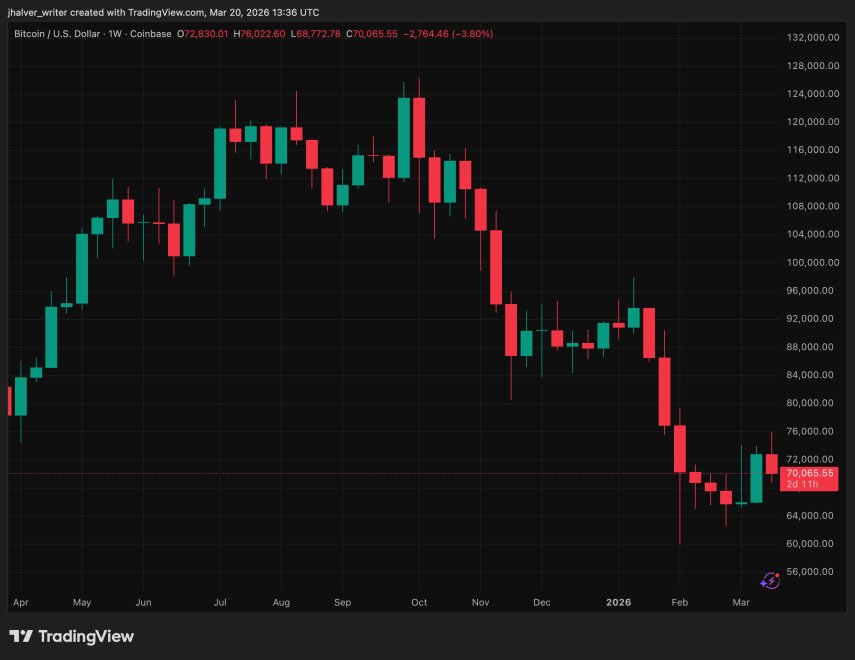
At the moment of writing, BTC trades barely above the $70k level on the daily chart, marking a downside trend. Source: BTCUSD on Tradingview

Cover image from Perplexity, BTCUSD chart from Tradingview

Related Questions

QWhat new product has Coinbase announced for non-US traders?

ACoinbase has announced the launch of stock perpetual futures for non-US traders.

QWhich major tech stocks are covered by the new perpetual futures contracts?

AThe contracts cover the 'Magnificent Seven' tech stocks: Apple, Microsoft, Alphabet, Amazon, NVIDIA, Meta Platforms, and Tesla.

QWhat is the maximum leverage offered on individual stock perpetual futures?

ALeverage goes up to 10x on individual stock perpetual futures.

QIn what currency are all the new perpetual futures contracts settled?

AAll contracts are settled in USDC, which is Coinbase's preferred stablecoin.

QHow does Coinbase describe the broader strategy that this launch is a part of?

ACoinbase frames this launch as part of its broader 'Everything Exchange' strategy, aiming to bring crypto, traditional assets, and new tokenized products into one venue.

Related Reads

From Theft to Re-entry: How Was $292 Million "Laundered"?

A sophisticated crypto laundering operation was executed following the $292 million hack of Kelp DAO on April 18. The attack, attributed to the North Korean Lazarus group, began with anonymous infrastructure preparation using Tornado Cash to fund wallets untraceably. The hacker exploited a vulnerability in Kelp’s cross-chain bridge, stealing 116,500 rsETH. To avoid crashing the market, the attacker used Aave and Compound as laundering tools—depositing the stolen rsETH as collateral to borrow $190 million in clean, liquid ETH. This move triggered a bank run on Aave, causing an $8 billion drop in TVL. After consolidating funds, the attacker fragmented them across hundreds of wallets to evade detection. A major breakpoint was THORChain, where over $460 million in volume—30 times its usual activity—was processed in 24 hours, converting ETH into Bitcoin. This shift to Bitcoin’s UTXO model exponentially increased tracing complexity by shattering funds into countless untraceable fragments. The final destination was Tron-based USDT, the primary channel for illicit crypto flows. From there, funds were cashed out via OTC brokers in China and Southeast Asia, using unlicensed underground banks and UnionPay networks outside Western sanctions scope. Ultimately, the laundered money supports North Korea’s weapons programs, which rely heavily on crypto hacking for foreign currency. The incident underscores structural challenges in DeFi: its openness, composability, and lack of central control make such laundering not just possible, but inherently difficult to prevent.

marsbit51m ago

From Theft to Re-entry: How Was $292 Million "Laundered"?

marsbit51m ago

Google and Amazon Simultaneously Invest Heavily in a Competitor: The Most Absurd Business Logic of the AI Era Is Becoming Reality

In a span of four days, Amazon announced an additional $25 billion investment, and Google pledged up to $40 billion—both direct competitors pouring over $65 billion into the same AI startup, Anthropic. Rather than a typical venture capital move, this signals the latest escalation in the cloud wars. The core of the deal is not equity but compute pre-orders: Anthropic must spend the majority of these funds on AWS and Google Cloud services and chips, effectively locking in massive future compute consumption. This reflects a shift in cloud market dynamics—enterprises now choose cloud providers based on which hosts the best AI models, not just price or stability. With OpenAI deeply tied to Microsoft, Anthropic’s Claude has become the only viable strategic asset for Google and Amazon to remain competitive. Anthropic’s annualized revenue has surged to $30 billion, and it is expanding into verticals like biotech, positioning itself as a cross-industry AI infrastructure layer. However, this funding comes with constraints: Anthropic’s independence is challenged as it balances two rival investors, its safety-first narrative faces pressure from regulatory scrutiny, and its path to IPO introduces new financial pressures. Globally, this accelerates a "tri-polar" closed-loop structure in AI infrastructure, with Microsoft-OpenAI, Google-Anthropic, and Amazon-Anthropic forming exclusive model-cloud alliances. In contrast, China’s landscape differs—investments like Alibaba and Tencent backing open-source model firm DeepSeek reflect a more decoupled approach, though closed-source models from major cloud providers still dominate. The $65 billion bet is ultimately about securing a seat at the table in an AI-defined future—where missing the model layer means losing the cloud war.

marsbit6h ago

Google and Amazon Simultaneously Invest Heavily in a Competitor: The Most Absurd Business Logic of the AI Era Is Becoming Reality

marsbit6h ago

Trading

Spot
Futures

Hot Articles

How to Buy ONE

Welcome to HTX.com! We've made purchasing Harmony (ONE) simple and convenient. Follow our step-by-step guide to embark on your crypto journey.Step 1: Create Your HTX AccountUse your email or phone number to sign up for a free account on HTX. Experience a hassle-free registration journey and unlock all features.Get My AccountStep 2: Go to Buy Crypto and Choose Your Payment MethodCredit/Debit Card: Use your Visa or Mastercard to buy Harmony (ONE) instantly.Balance: Use funds from your HTX account balance to trade seamlessly.Third Parties: We've added popular payment methods such as Google Pay and Apple Pay to enhance convenience.P2P: Trade directly with other users on HTX.Over-the-Counter (OTC): We offer tailor-made services and competitive exchange rates for traders.Step 3: Store Your Harmony (ONE)After purchasing your Harmony (ONE), store it in your HTX account. Alternatively, you can send it elsewhere via blockchain transfer or use it to trade other cryptocurrencies.Step 4: Trade Harmony (ONE)Easily trade Harmony (ONE) on HTX's spot market. Simply access your account, select your trading pair, execute your trades, and monitor in real-time. We offer a user-friendly experience for both beginners and seasoned traders.

3.3k Total ViewsPublished 2024.03.29Updated 2025.06.04

How to Buy ONE

Discussions

Welcome to the HTX Community. Here, you can stay informed about the latest platform developments and gain access to professional market insights. Users' opinions on the price of ONE (ONE) are presented below.

活动图片