Coinbase Launches Crypto-Backed USDC Loans For UK Users In Latest Expansion

bitcoinistPublished on 2026-04-21Last updated on 2026-04-21

Abstract

Coinbase has expanded its crypto-backed USDC lending service to UK residents, allowing them to use Bitcoin (BTC), Ethereum (ETH), and Coinbase Wrapped Staked Ether (cbETH) as collateral. Powered by the on-chain protocol Morpho on the Base network, the service enables users to borrow up to $5 million in USDC without selling their crypto holdings. Collateral is locked in a smart contract until the loan is repaid, with liquidation triggered if the loan-to-value ratio exceeds a threshold. This follows the service’s successful US launch, where originations surpassed $2.17 billion. The move is part of Coinbase’s broader expansion in the UK, including savings accounts and DEX trading, and aligns with its efforts to integrate crypto into traditional finance, such as recently offering crypto-backed mortgages.

Building on its US success, crypto exchange Coinbase has rolled out crypto-backed USDC loans for UK residents, using Bitcoin (BTC) and Ethereum (ETH) as collateral. This expands the exchange’s growing suite of financial services in the region.

Crypto-Backed Loans Cross The Pond

On Monday, Coinbase, the largest crypto exchange in the US, announced that it has expanded its Borrow product to UK residents, unlocking more liquidity for users without having to sell their crypto holdings.

UK customers can now instantly borrow USDC using their Bitcoin, Ethereum, and Coinbase Wrapped Staked Ether (cbETH) as collateral, powered by Morpho, an on-chain protocol on the Base network.

Notably, Coinbase users will be able to borrow up to $5 million in USDC for Bitcoin-backed loans, depending on the amount of BTC pledged as collateral, the announcement explained.

The crypto exchange stated that collateral will be locked in a Morpho smart contract until the loan is fully repaid, and there is no fixed repayment schedule. However, it will be liquidated to repay the loan if the loan-to-value ratio exceeds a certain threshold, and Morpho will charge a liquidation penalty fee.

According to the Monday announcement, the launch expands access to the exchange’s crypto-backed lending service, which has seen multi-billion-dollar demand since launch in the US last year.

Providing access to crypto-backed loans in the UK is the first step in Coinbase’s ongoing efforts to expand following the launch of this offering in the US in January 2025. Initial interest in the service in the US has been substantial with total loan originations through Coinbase on Morpho growing to over $2.17B USDC as of April 14, 2026. Coinbase plans to continue expanding access to crypto-backed loans in more countries in the near future.

It also marks another step in Coinbase’s efforts to build a broader lineup of financial products in the country, following its successful registration as a crypto service provider by the Financial Conduct Authority (FCA) in February 2025. The exchange also launched savings accounts in the UK and DEX trading in November 2025 and April 2026, respectively.

Coinbase Expansion Continues

Coinbase’s latest launch also follows the company’s recent push to expand crypto-backed lending in traditional finance use cases. As reported by Bitcoinist, the exchange and Better Home & Finance launched a joint mortgage product for prospective home buyers to use their crypto holdings as collateral to fund their down payments on a Fannie Mae‐backed loan.

Per the announcement, the product aims to create a “direct pathway from digital wealth to homeownership” by allowing users to pledge Bitcoin and USDC held in a Coinbase account to secure a separate loan for their down payment.

Earlier this month, the exchange also achieved a crucial milestone in the US after receiving key approval that may unlock a broader market for the company. On April 2, Coinbase secured conditional approval from the Office of the Comptroller of the Currency (OCC), the main banking regulator, to charter Coinbase National Trust Company.

Although the company will not become a commercial bank and will not take retail deposits or engage in fractional reserve banking, the exchange noted the conditional approval marked a major step toward becoming a federally regulated crypto custodian, as it will allow Coinbase to “build the next chapter of finance,” boosted by the regulatory confidence.
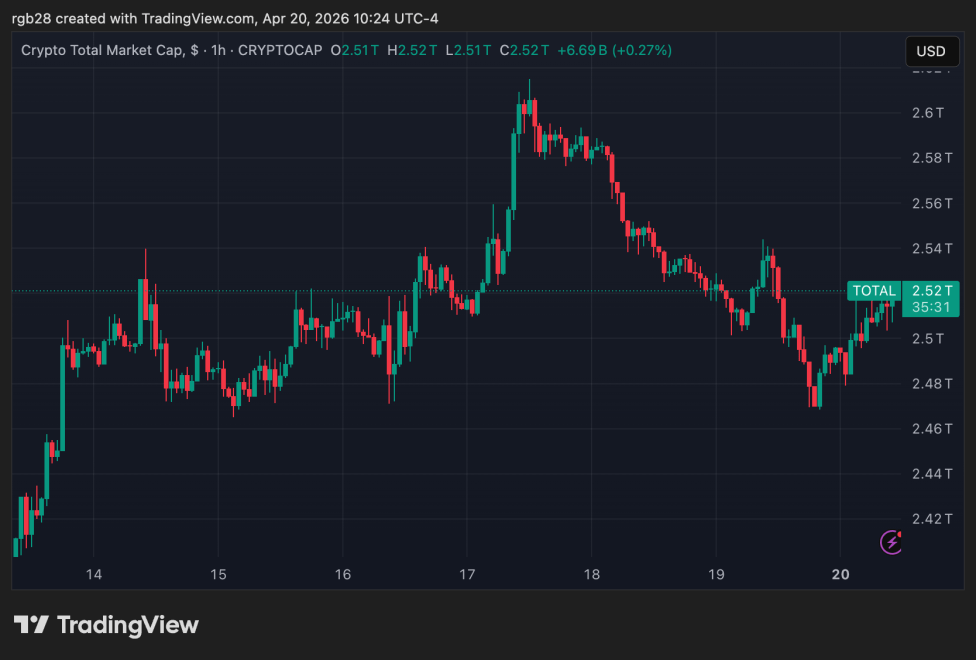
The total crypto market capitalization is at $2.52 trillion in the one-week chart. Source: TOTAL on TradingView


Related Questions

QWhat new service has Coinbase launched for UK users and which cryptocurrencies can be used as collateral?

ACoinbase has launched crypto-backed USDC loans for UK users, allowing them to use Bitcoin (BTC), Ethereum (ETH), and Coinbase Wrapped Staked Ether (cbETH) as collateral.

QWhat is the maximum loan amount a user can borrow for a Bitcoin-backed loan and what determines this amount?

AUsers can borrow up to $5 million in USDC for a Bitcoin-backed loan, with the specific amount depending on the value of the BTC pledged as collateral.

QWhich on-chain protocol powers this new lending service and what happens to the collateral if the loan-to-value ratio is exceeded?

AThe service is powered by the Morpho protocol on the Base network. If the loan-to-value ratio exceeds a certain threshold, the collateral will be liquidated to repay the loan, and a liquidation penalty fee will be charged.

QWhat was the total value of loan originations through Coinbase on Morpho in the US as of April 14, 2026?

AThe total loan originations through Coinbase on Morpho in the US grew to over $2.17 billion USDC as of April 14, 2026.

QWhat recent regulatory approval did Coinbase receive in the article mentions as a crucial milestone for its expansion?

ACoinbase received conditional approval from the Office of the Comptroller of the Currency (OCC) to charter Coinbase National Trust Company, a major step toward becoming a federally regulated crypto custodian.

Related Reads

Huawei Cloud Rejects Token Price War, Zhou Yuefeng Seeks a New Winning Formula for AI Cloud

At the 2026 Huawei Cloud INSPIRE Creator Conference, CEO Zhou Yuefeng outlined Huawei Cloud's distinct strategy in the competitive AI cloud market. Instead of engaging in price wars based on token volume or Maas revenue—a common focus for rivals like Alibaba Cloud and ByteDance's Volcano Engine—Huawei Cloud is shifting the competition towards real-world productivity gains. Zhou highlighted three core differentiators: a fully domestic computing stack (Ascend, Kunpeng), a focus on government and enterprise clients rather than consumer internet, and a deep commitment to open-source ecosystems. To this end, Huawei Cloud launched a suite of new products under the "Agentic Infra" paradigm, including the AICS Lingqu computing cluster, AMS memory storage, and the ModelArts Next platform. These aim to solve enterprise challenges in deploying AI agents, such as latency, memory, scheduling, and security. The strategy further involves creating specialized industry zones ("AI Dream Factories") for sectors like healthcare and embodied intelligence. For example, a smart medical zone developed with Shanghai Ruijin Hospital aims to democratize expert-level diagnostic capabilities. In essence, Huawei Cloud is positioning itself not as a commodity token provider, but as the foundational infrastructure for industrial AI, leveraging its domestic supply chain and hybrid cloud solutions to serve sectors where productivity, not just scale, is the ultimate measure of value.

marsbit1h ago

Huawei Cloud Rejects Token Price War, Zhou Yuefeng Seeks a New Winning Formula for AI Cloud

marsbit1h ago

70% of the Public Opposes AI, Americans Hope the U.S. Loses the AI War

70% of Americans believe AI development is moving too fast, with growing public resistance evolving from online criticism to real-world protests and violence. This widespread anti-AI sentiment stems from fears of job losses, rising utility costs, environmental damage, threats to democracy, and financial instability. Key incidents illustrate the backlash: Google's former CEO Eric Schmidt was loudly booed at a graduation for promoting AI; AI company ads are vandalized; protests and even violent attacks target AI firms and data centers. Polls show deep public pessimism and strong local opposition to data center construction, often surpassing resistance to nuclear power plants. The core grievances are economic and practical: AI is seen as automating jobs, concentrating wealth, and increasing household electricity and water bills due to massive data center resource demands. Environmentalists also oppose AI's high energy use and carbon emissions. This opposition has turned AI into a major political issue in the US. While the Trump administration prioritizes AI innovation for global competition, bipartisan pushback is growing. Democrats and factions within the MAGA movement are forming temporary alliances to support stricter regulations and local bans on new data centers, pressuring the administration to choose between its tech industry backers and its voter base. The situation highlights a profound national divide over AI's future.

marsbit1h ago

70% of the Public Opposes AI, Americans Hope the U.S. Loses the AI War

marsbit1h ago

Trading

Spot
Futures
活动图片




