Coinbase Launches Crypto-Backed USDC Loans For UK Users In Latest Expansion

bitcoinistPublished on 2026-04-21Last updated on 2026-04-21

Abstract

Coinbase has expanded its crypto-backed USDC lending service to UK residents, allowing them to use Bitcoin (BTC), Ethereum (ETH), and Coinbase Wrapped Staked Ether (cbETH) as collateral. Powered by the on-chain protocol Morpho on the Base network, the service enables users to borrow up to $5 million in USDC without selling their crypto holdings. Collateral is locked in a smart contract until the loan is repaid, with liquidation triggered if the loan-to-value ratio exceeds a threshold. This follows the service’s successful US launch, where originations surpassed $2.17 billion. The move is part of Coinbase’s broader expansion in the UK, including savings accounts and DEX trading, and aligns with its efforts to integrate crypto into traditional finance, such as recently offering crypto-backed mortgages.

Building on its US success, crypto exchange Coinbase has rolled out crypto-backed USDC loans for UK residents, using Bitcoin (BTC) and Ethereum (ETH) as collateral. This expands the exchange’s growing suite of financial services in the region.

Crypto-Backed Loans Cross The Pond

On Monday, Coinbase, the largest crypto exchange in the US, announced that it has expanded its Borrow product to UK residents, unlocking more liquidity for users without having to sell their crypto holdings.

UK customers can now instantly borrow USDC using their Bitcoin, Ethereum, and Coinbase Wrapped Staked Ether (cbETH) as collateral, powered by Morpho, an on-chain protocol on the Base network.

Notably, Coinbase users will be able to borrow up to $5 million in USDC for Bitcoin-backed loans, depending on the amount of BTC pledged as collateral, the announcement explained.

The crypto exchange stated that collateral will be locked in a Morpho smart contract until the loan is fully repaid, and there is no fixed repayment schedule. However, it will be liquidated to repay the loan if the loan-to-value ratio exceeds a certain threshold, and Morpho will charge a liquidation penalty fee.

According to the Monday announcement, the launch expands access to the exchange’s crypto-backed lending service, which has seen multi-billion-dollar demand since launch in the US last year.

Providing access to crypto-backed loans in the UK is the first step in Coinbase’s ongoing efforts to expand following the launch of this offering in the US in January 2025. Initial interest in the service in the US has been substantial with total loan originations through Coinbase on Morpho growing to over $2.17B USDC as of April 14, 2026. Coinbase plans to continue expanding access to crypto-backed loans in more countries in the near future.

It also marks another step in Coinbase’s efforts to build a broader lineup of financial products in the country, following its successful registration as a crypto service provider by the Financial Conduct Authority (FCA) in February 2025. The exchange also launched savings accounts in the UK and DEX trading in November 2025 and April 2026, respectively.

Coinbase Expansion Continues

Coinbase’s latest launch also follows the company’s recent push to expand crypto-backed lending in traditional finance use cases. As reported by Bitcoinist, the exchange and Better Home & Finance launched a joint mortgage product for prospective home buyers to use their crypto holdings as collateral to fund their down payments on a Fannie Mae‐backed loan.

Per the announcement, the product aims to create a “direct pathway from digital wealth to homeownership” by allowing users to pledge Bitcoin and USDC held in a Coinbase account to secure a separate loan for their down payment.

Earlier this month, the exchange also achieved a crucial milestone in the US after receiving key approval that may unlock a broader market for the company. On April 2, Coinbase secured conditional approval from the Office of the Comptroller of the Currency (OCC), the main banking regulator, to charter Coinbase National Trust Company.

Although the company will not become a commercial bank and will not take retail deposits or engage in fractional reserve banking, the exchange noted the conditional approval marked a major step toward becoming a federally regulated crypto custodian, as it will allow Coinbase to “build the next chapter of finance,” boosted by the regulatory confidence.
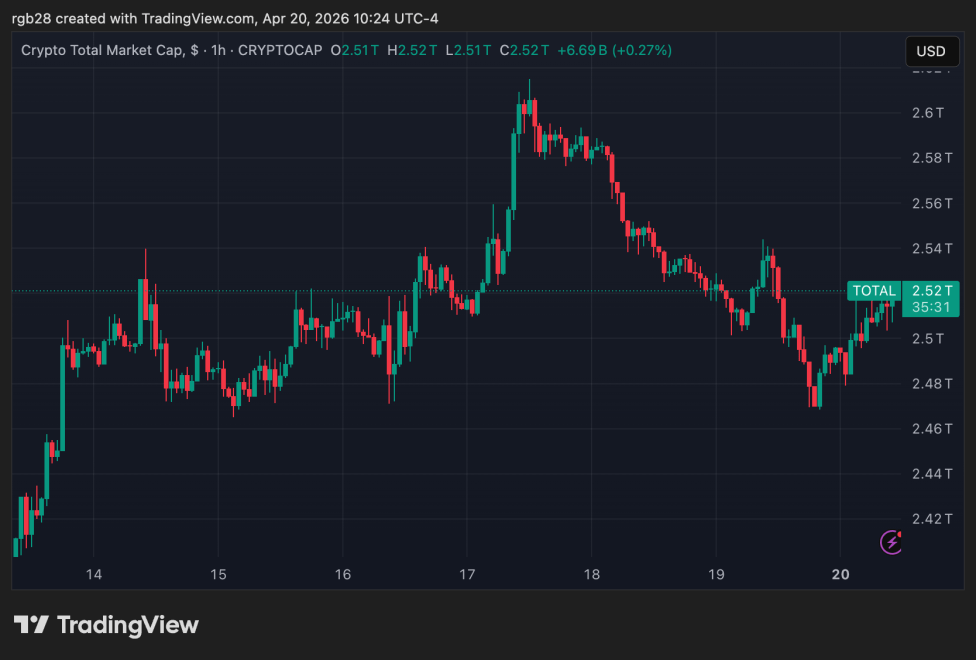
The total crypto market capitalization is at $2.52 trillion in the one-week chart. Source: TOTAL on TradingView


Related Questions

QWhat new service has Coinbase launched for UK users and which cryptocurrencies can be used as collateral?

ACoinbase has launched crypto-backed USDC loans for UK users, allowing them to use Bitcoin (BTC), Ethereum (ETH), and Coinbase Wrapped Staked Ether (cbETH) as collateral.

QWhat is the maximum loan amount a user can borrow for a Bitcoin-backed loan and what determines this amount?

AUsers can borrow up to $5 million in USDC for a Bitcoin-backed loan, with the specific amount depending on the value of the BTC pledged as collateral.

QWhich on-chain protocol powers this new lending service and what happens to the collateral if the loan-to-value ratio is exceeded?

AThe service is powered by the Morpho protocol on the Base network. If the loan-to-value ratio exceeds a certain threshold, the collateral will be liquidated to repay the loan, and a liquidation penalty fee will be charged.

QWhat was the total value of loan originations through Coinbase on Morpho in the US as of April 14, 2026?

AThe total loan originations through Coinbase on Morpho in the US grew to over $2.17 billion USDC as of April 14, 2026.

QWhat recent regulatory approval did Coinbase receive in the article mentions as a crucial milestone for its expansion?

ACoinbase received conditional approval from the Office of the Comptroller of the Currency (OCC) to charter Coinbase National Trust Company, a major step toward becoming a federally regulated crypto custodian.

Related Reads

Why Hasn't the U.S. Seen the Rise of 'Huabei' or 'Jiebei'?

The article explores why the U.S. lacks large-scale consumer credit products like China's "Huabei" and "Jiebei," despite having a developed financial sector. Key reasons include: 1. **Structural Barriers**: A fragmented federal and state regulatory system, reinforced by post-2008 reforms like the Dodd-Frank Act, raises compliance costs and protects traditional banks, stifling fintech innovation. 2. **Credit Card Dominance**: Credit cards, used by 70-80% of adults, form a $1.28 trillion debt market with high APRs (avg. 22.3%). This system cross-subsidizes users who pay in full with those carrying balances, creating a predatory yet entrenched ecosystem. 3. **Data Privacy Laws**: Strict regulations (e.g., FCRA, CCPA) prevent tech giants from leveraging behavioral data for credit scoring, unlike in China where such data fuels fintech models. 4. **Capital Market Disincentives**: Wall Street penalizes tech firms entering finance due to lower valuations associated with heavy regulation and risk, as seen in Apple’s failure with Apple Card. 5. **Banking Oligopoly**: Major banks control consumer lending, leveraging lobbying power and consumer habits to maintain high-cost credit, while alternatives like payday loans (400% APR) or "unbanked" services remain niche or exploitative. Ultimately, regulatory, structural, and corporate interests collectively block the emergence of accessible, low-cost digital lending in the U.S.

Odaily星球日报2m ago

Why Hasn't the U.S. Seen the Rise of 'Huabei' or 'Jiebei'?

Odaily星球日报2m ago

More and More 'Model Supermarkets' Are Opening: ByteDance, Alibaba, and Tencent Compete to Integrate

Chinese tech giants like ByteDance, Alibaba, and Tencent are accelerating the rollout of integrated AI model subscription services—dubbed “model supermarkets”—to provide developers with bundled access to multiple leading domestic large language models (LLMs). ByteDance’s Volcengine recently upgraded its "Coding Plan" by adding newer models like GLM-5.1, Minimax M2.7, and Kimi k2.6, allowing subscribers to use various top models under a single monthly fee starting at ¥40. However, user feedback reveals significant issues, including rapid consumption of usage limits (e.g., hitting caps within hours), frequent server errors (like HTTP 429), and slow response times during peak hours. Complaints about misleading deduction rates—where calls to advanced models consume more quota—are also common. The trend is industry-wide: Alibaba, Tencent, and Baidu have all launched similar multi-model coding plans. While these platforms reduce trial costs for developers, they also expose challenges in balancing affordability with service quality and computational stability. Amid this shift, independent AI companies like Zhipu, MiniMax, and Moonlight Face (Kimi) are developing strategies to avoid becoming mere “pipes” in this ecosystem—focusing on vertical applications, autonomous agents, and long-context models to retain competitiveness. Analysts suggest that, while platform aggregation may pressure model firms in the short term, specialized and vertical AI capabilities will remain differentiated in the long run.

marsbit6m ago

More and More 'Model Supermarkets' Are Opening: ByteDance, Alibaba, and Tencent Compete to Integrate

marsbit6m ago

Trading

Spot
Futures
活动图片