Coinbase + Glassnode: Charting Crypto Q2 2026

insights.glassnodePublished on 2026-05-01Last updated on 2026-05-01

After a volatile start to the year, crypto markets have shifted into a more cautious regime. Risk appetite has cooled, sentiment has deteriorated, and macro developments now overshadow crypto-native drivers in shaping near-term price action.

Produced in collaboration with Coinbase Institutional, the latest Charting Crypto report distills the key market and on-chain trends impacting institutional crypto strategy this quarter. From investor sentiment and stablecoin liquidity to Bitcoin accumulation signals and Ethereum’s evolving market structure, the report offers a data-driven view of a market waiting for clearer direction.

Some of the many highlights in this edition:

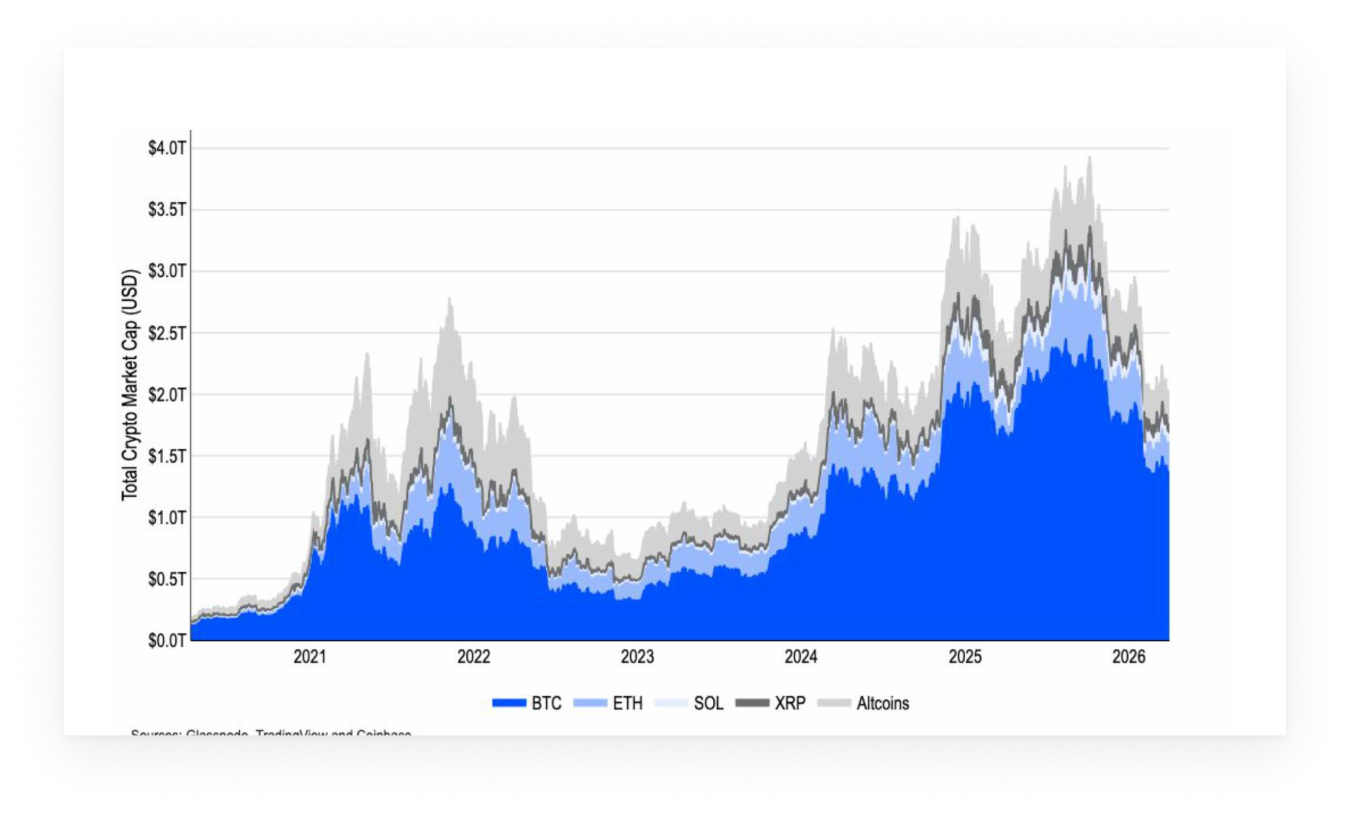
  • Liquidity is rotating into stablecoins rather than exiting the asset class, as total crypto market cap (excluding stablecoins) fell by ~18% in Q1, while stablecoin supply increased from $308B to $318B
  • Past cycle analogues are becoming less useful for timing market inflection points as both Bitcoin and Ethereum cycles continue to diverge from historical patterns
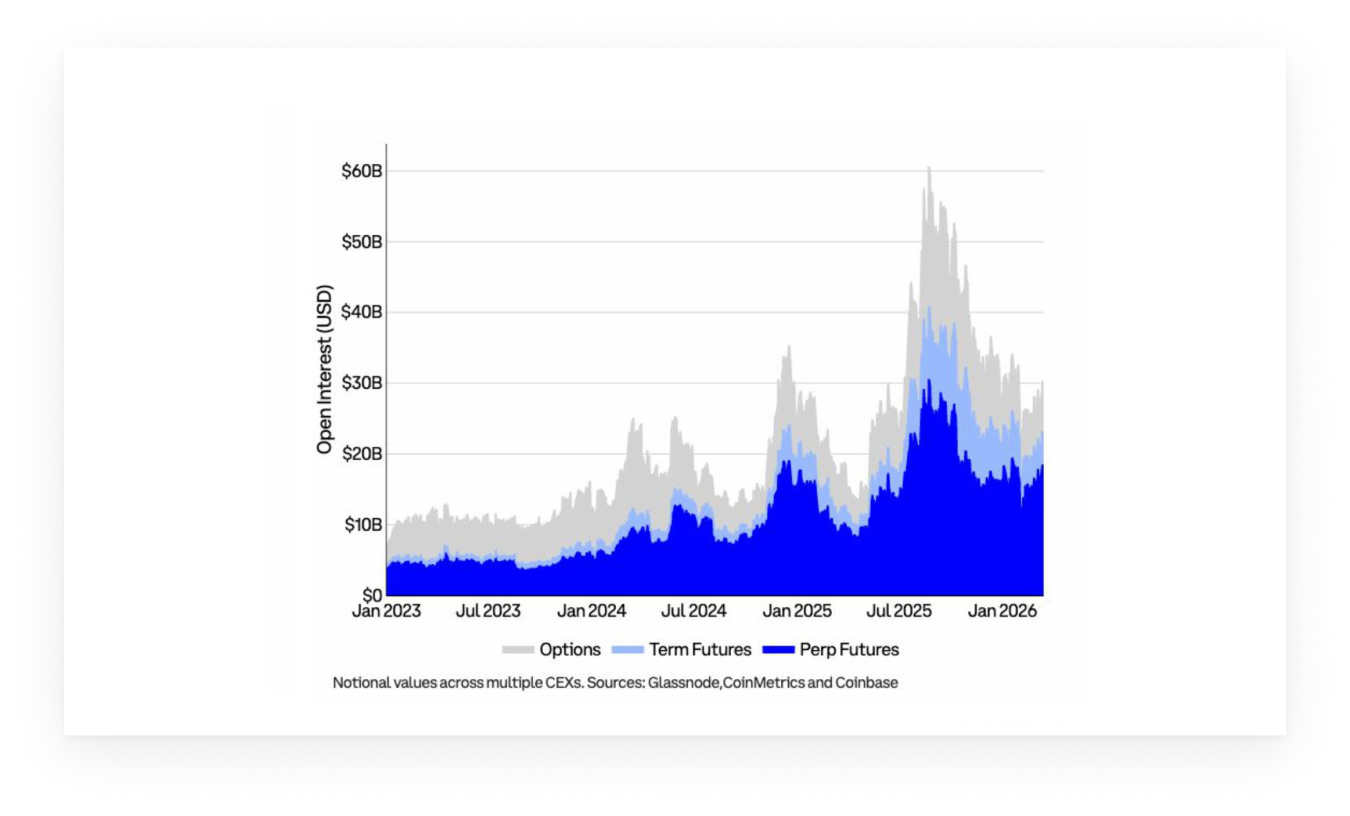
  • Market structure shows signs of normalization, with BTC derivatives open interest recovering (particularly in perpetuals), indicating a rebuilding of risk appetite in leveraged markets
  • 82% of surveyed institutions now place the market in a bear or late-bear phase (up from 31% in December)
  • Ethereum’s ecosystem is becoming more differentiated: Capital concentrates in base-layer use cases as broader activity softens, highlighting a shift toward utility-driven demand over speculative flows.
Liquidity Remains Inside the System

Despite the broad risk-off move in Q1, liquidity dynamics tell a more nuanced story. Total crypto market capitalization (excluding stablecoins) declined by roughly 18%, yet stablecoin supply increased over the same period.

This divergence suggests that capital is not fully leaving crypto markets, but rather rotating into cash-like instruments while awaiting clearer signals. In effect, investors are de-risking without disengaging, preserving optionality for re-entry.
Bitcoin: Sentiment Reset, Supply Tightens

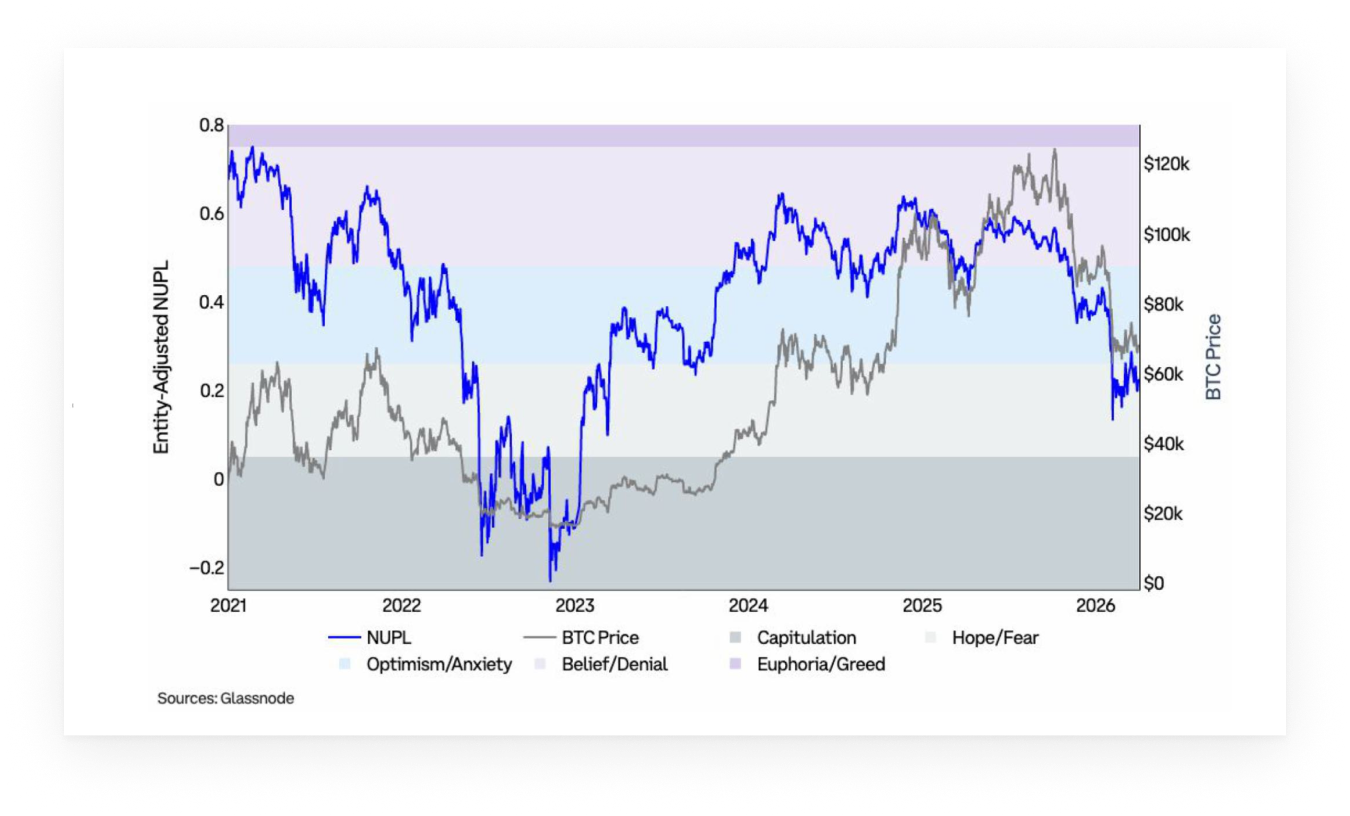
Bitcoin’s February drawdown was reflected in a deterioration in investor sentiment, with Net Unrealized Profit/Loss (NUPL) moving from Anxiety into Fear for the rest of Q1. While sentiment has started to show early signs of improvement in April, it remains closely tied to external developments, suggesting conviction is still fragile.

At the same time, onchain supply dynamics indicate a transfer of coins away from more reactive participants. The contraction in recently active supply, alongside a modest increase in long-term held coins, implies that shorter-term, speculative capital has been reduced.
Ethereum: Capital Concentration at the Base Layer

Ethereum data points to a divergence between activity and capital allocation. Short-term participation declined throughout the first quarter, as reflected in a sharp drop in recently active supply and a prolonged period of depressed sentiment. However, capital flows have remained concentrated on the base layer.

Stablecoin supply on Ethereum continues to expand with positive momentum, and tokenized real-world assets have reached new highs, indicating sustained demand for settlement and collateral use cases. At the same time, ETH has outperformed major L2 tokens since late 2025, suggesting that capital is consolidating at the base layer rather than rotating further out on the risk curve.
To help you navigate the current challenging crypto environment, check out all insights and data from the Glassnode x Coinbase report: download the report here.


Related Reads

Elon Musk Building Terafab: The Largest Chip Factory for AI, Robots, and Space Data Centers

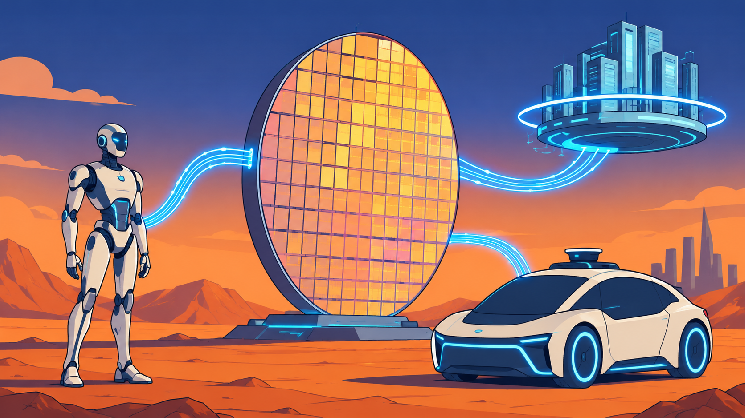
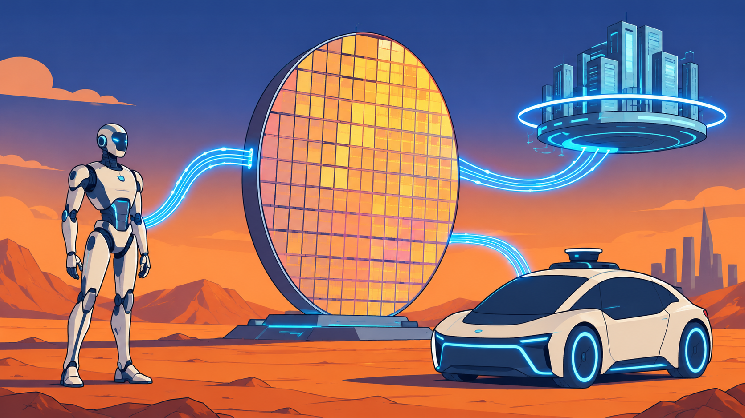
Elon Musk's SpaceX and Tesla have launched the Terafab project to build a massive semiconductor facility in Grimes County, Texas. The plant, exceeding 9.3 million square meters, aims to integrate logic chip manufacturing, memory production, advanced packaging, and testing. The initial phase requires $16.8 billion in capital investment, with a long-term goal of producing over 1 terawatt of computing power annually. This capacity will support Tesla's Optimus robots and Cybercab autonomous vehicles, as well as SpaceX's orbital data centers. Texas Governor Greg Abbott confirmed the project's start in August 2026, highlighting 3,000 new jobs and a $30 million state grant. Elon Musk emphasized the strategic advantage of combining logic, memory, and packaging under one roof. Musk called the future complex the "largest and most valuable building on Earth," with an area roughly 50 times that of the Pentagon. Intel is the key technology partner, with plans to use its 14A process node for chip production. This partnership aims to diversify supply chains currently dominated by TSMC. The project aligns with the U.S. Pax Silica initiative to secure semiconductor supply chains. An AI analysis notes the project's scale and potential challenges, comparing it to delays seen in other U.S. megafab projects like Intel's Ohio facility. It questions whether Terafab can avoid similar pitfalls related to timelines, budgets, workforce, and supply chain stability. The facility's success could significantly shift the global semiconductor balance and strengthen the U.S. position in the tech race.

cryptonews.ru2h ago

Elon Musk Building Terafab: The Largest Chip Factory for AI, Robots, and Space Data Centers

cryptonews.ru2h ago

Elon Musk is Building Terafab: The Largest Chip Plant for AI, Robots, and Space Data Centers

Elon Musk's SpaceX and Tesla have launched the massive Terafab project to build a semiconductor plant in Grimes County, Texas. Spanning over 9.3 million square meters, the facility will integrate logic chip and memory production, advanced packaging, and testing. The initial phase requires $16.8 billion in capital investment, with a long-term goal of producing over 1 terawatt of computing power annually. This output is intended to supply Tesla's Optimus robots and Cybercab autonomous vehicles, as well as SpaceX's orbital data centers. Texas Governor Greg Abbott confirmed the project's start on August 6, 2026, highlighting the creation of 3,000 jobs and a $30 million grant from the Texas Enterprise Fund. Musk emphasized the strategic advantage of combining chip design, memory production, and packaging under one roof to accelerate hardware development. He stated the fully built complex would be "the largest and most valuable building on Earth," about 50 times larger than the Pentagon. An estimated 25% of production is earmarked for Tesla's robotics, with 75% for SpaceX's space-based AI systems. Earlier tax documents suggested a total project cost of up to $119 billion, but this has not been officially confirmed. Intel is the key technology partner, with plans to use its 14A process node for chip manufacturing. This partnership aims to diversify supply chains and reduce dependence on dominant foundries like TSMC. The initiative aligns with the broader U.S. Pax Silica program, which seeks to build secure international semiconductor supply chains with allied nations. An AI-driven analysis notes that megafab projects, such as Intel's delayed Ohio facility, often face schedule and budget overruns. While Terafab represents a significant step toward U.S. semiconductor self-sufficiency and could shift the global tech balance, its success will depend on factors like skilled labor availability, energy supply, and supply chain stability. The final outcome may not be clear until the late 2030s.

cryptonews.ru2h ago

Elon Musk is Building Terafab: The Largest Chip Plant for AI, Robots, and Space Data Centers

cryptonews.ru2h ago

Trading

Spot
活动图片