Code Is Abundant. Trust Is Not. Tea Confirms June 4 TGE and Aerodrome Launch as the Trust Layer for Open Source Goes Live

TheNewsCryptoPublished on 2026-05-13Last updated on 2026-05-13

Abstract

This press release announces that Tea, a decentralized protocol aiming to be a "trust layer" for open-source software, will launch its TGE (Token Generation Event) and list its $TEA token on June 4, 2026, on the Aerodrome decentralized exchange on Base. The announcement frames Tea's launch as a critical response to the rise of AI agents (like Anthropic's Claude Mythos and Google's Gemma) that can autonomously generate and potentially weaponize code. The core argument is that "Code Is Abundant. Trust Is Not," and trust must be established at the source code level. Tea is described as a provenance, attribution, and verification layer that cryptographically attributes and verifies open-source packages, contributions, and dependencies. By launching on Aerodrome, Tea aims to combine its trust infrastructure with deep, transparent, and community-governed on-chain liquidity. Key dates include the opening of Aerodrome voting for the TEA pool on May 28, 2026, followed by the official listing on June 4, 2026. The project positions itself as providing the economic infrastructure and verification needed for the future of open-source software in an agentic AI era.

Aerodrome voting opens May 28. Mainnet Launch: June 4.

This quarter, AI started writing its own exploits. Tea is shipping the trust layer underneath it. Code Is Abundant. Trust Is Not.

In the span of seven days, the ground beneath the software shifted twice. On May 4, The Conversation published the most widely-circulated post-mortem yet of Anthropic’s Claude Mythos Preview, the frontier model Anthropic itself declined to release, because it can autonomously discover zero-days, generate working exploits, and execute multi-step cyber operations with minimal human oversight.

Days later, Google’s Gemma 4 landed inside Android’s AICore and Google AI Edge, putting agentic code generation, function calling, and offline reasoning on every developer’s phone and laptop under an Apache 2.0 license.

The implication is unavoidable. When any device can generate, execute, and weaponize software autonomously, trust cannot live in the binary. It has to live at the source.

Tea: The Value Layer for Open Source

Tea is the provenance, attribution, and verification layer for a world where code is written by agents faster than humans can audit it. Every package, every contribution, every dependency, cryptographically attributed, continuously verified, and economically aligned with the people and systems that built it.

Tea Goes Live on Aerodrom: The Liquidity Engine of Base Meets the Trust Layer of Software

The moment Tea lists on Aerodrome, the two fastest-moving primitives in crypto collide: Base’s deepest liquidity venue and the first on-chain provenance layer built for the agentic AI era. Working with Aerodrome is a statement. It’s known as the place where Base’s most serious assets route. Tea chose Aerodrome because a trust layer for software should launch into the most battle-tested, transparent, community-governed market structure on-chain, not a centralized orderbook pretending to be neutral.

From block one, $TEA liquidity on Aerodrome means: verifiable on-chain routing, deep vote-directed emissions, and a price surface every trader, investor, and builder can see in real time. Aero flywheel + Tea provenance = a launch where the market structure is as credible as the technology’s pricing.

The Moment

“Code is abundant. Trust is not,” said Tim Lewis, leading Tea’s launch. “Mythos showed us AI can write its own exploits. Gemma 4 put that capability in every pocket. The question isn’t whether agents will ship software (because they already are). The value of contribution will be weighed in inference and tokens and whether anyone can verify what they shipped. That’s what Tea is for.”

Key Dates

Voting period: Aerodrome voting for the TEA pool opens May 28, 2026.

Listing: June 4, 2026.

About Tea

Tea is building the software verification layer for the agentic era, a decentralized protocol for provenance, attribution, and trust in open-source software. Validated at the source.

Open source runs everything.

TEA helps people support it.

Verify the work.

Understand the graph.

Govern what matters.

Let agents build with better context.

Economic infrastructure for open source.

  • Media Contact: Avi Pratap | Avi@tea.xyz
  • Project: https://tea.xyz/

Disclaimer: TheNewsCrypto does not endorse any content on this page. The content depicted in this Press Release does not represent any investment advice. TheNewsCrypto recommends our readers to make decisions based on their own research. TheNewsCrypto is not accountable for any damage or loss related to content, products, or services stated in this Press Release.

TagsAerodromePress Release

Related Questions

QWhat is the primary purpose of the Tea protocol according to the article?

ATea is the provenance, attribution, and verification (trust) layer for open-source software, designed for a world where AI agents generate code faster than humans can audit it. It aims to provide cryptographic attribution, continuous verification, and economic alignment for software packages and contributions.

QOn which platform and date is the TEA token scheduled to launch?

AThe TEA token is scheduled to launch on the Aerodrome platform on June 4, 2026.

QWhy does the article argue that 'trust cannot live in the binary' and must 'live at the source'?

AThe article argues this because recent AI developments (like Anthropic's Claude Mythos and Google's Gemma 4) enable autonomous generation, execution, and potential weaponization of software. When any device can do this, simply trusting the final compiled code (the binary) is insufficient; trust must be established at the original source code level through verification and provenance.

QWhat key event related to Aerodrome precedes the TEA token listing on June 4?

AThe Aerodrome voting period for the TEA pool opens on May 28, 2026, which precedes the listing.

QWhat two 'fastest-moving primitives in crypto' are described as colliding with Tea's launch on Aerodrome?

AThe two colliding primitives are Base's deepest liquidity venue (Aerodrome) and the first on-chain provenance layer built for the agentic AI era (Tea).

Related Reads

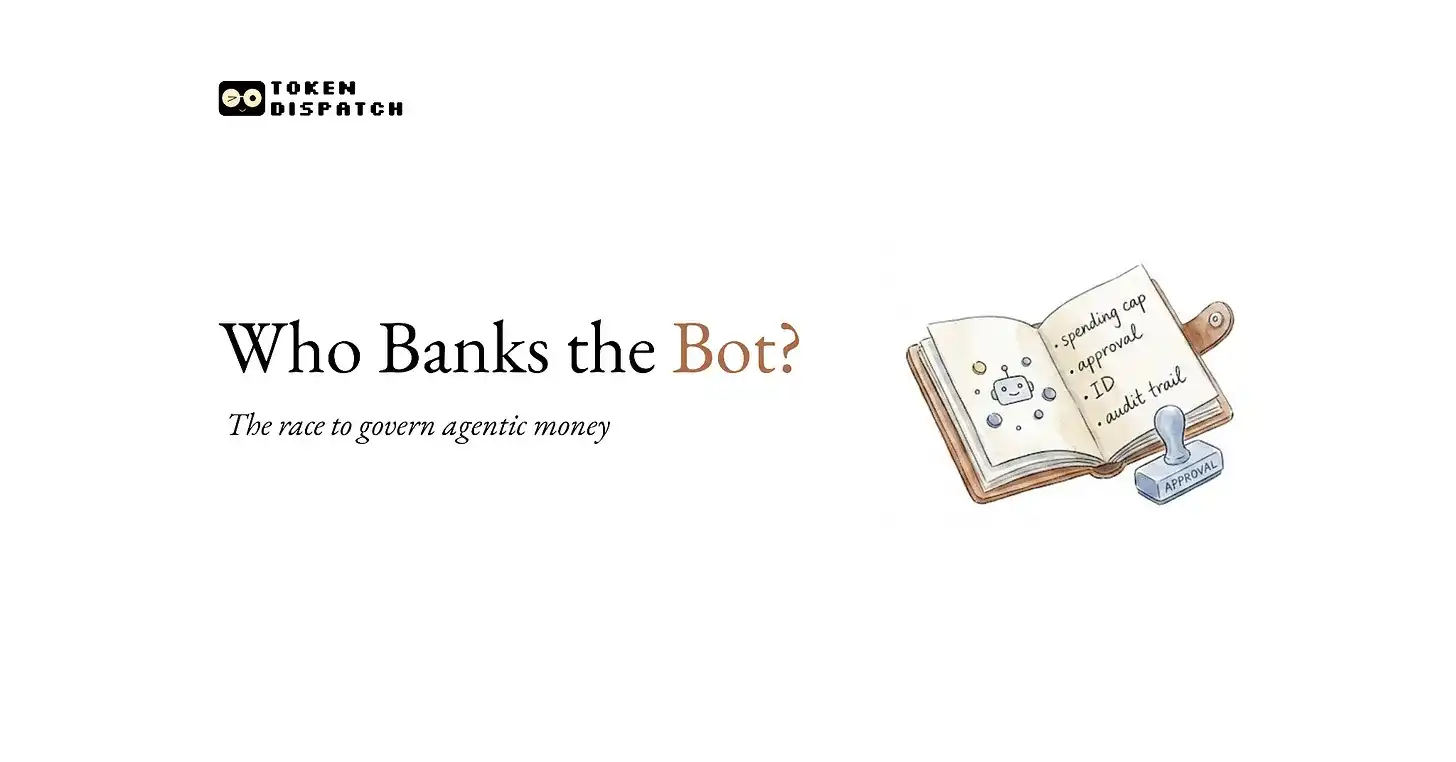
Who Funds the Agents?

**Summary: Who Funds AI Agents?** OpenAI recently shut down a feature allowing AI agents to shop for users, highlighting the challenge of creating a secure and regulated environment for agent-driven transactions. While payment infrastructure exists, a crucial governance layer—defining spending limits, fraud detection, tax handling, and return policies—is largely missing. The potential is enormous: AI agents already processed $73M across 176M transactions last year, with McKinsey forecasting this could grow to $3-5T in global consumer commerce by 2030. The core competition isn't just about processing payments, which can be very cheap (especially with crypto-based settlement), but about controlling the rules that govern agent spending. Key players like Stripe and Coinbase are racing to dominate this governance layer. Stripe's acquisition of wallet provider Privy allows it to set spending policies, identity checks, and human-in-the-loop approvals directly at the wallet level. Similarly, Coinbase's stack, including its x402 protocol and AgentKit, embeds governance rules. This vertical integration across settlement, wallet, and governance layers is becoming the dominant strategy. Control over the governance layer is where significant future value lies. If agents handle trillions in transactions, even a small fee for managing compliance, fraud prevention, and policy enforcement could generate billions in annual revenue. The companies that successfully integrate across the payment stack will capture value from idle agent balances, transaction fees, and governance services, positioning themselves as the foundational banks of the AI agent economy.

marsbit20m ago

Who Funds the Agents?

marsbit20m ago

A Nation Blocks Chips, a Giant Buys a Nuclear Power Plant: Why It's Time to Seriously Consider DeAI

**Title: Great Powers Blockade Chips, Giants Buy Nuclear Plants: Why It's Time to Seriously Consider DeAI** In May 2026, the US closed loopholes for Chinese firms to acquire advanced NVIDIA chips via overseas subsidiaries. That same month, Kenya halted a $1B geothermal data center project involving Microsoft, fearing its immense energy consumption. Meanwhile, Huawei announced mass production of its Ascend AI chip. These disparate events underscore a new reality: the competition for computing power ("compute") has escalated beyond the tech industry, becoming a geopolitical and infrastructural battleground. A new era of oligopoly is forming, with control over the AI stack—from GPU chips (NVIDIA) and cloud platforms (AWS, Azure, Google Cloud) to foundational models (OpenAI, Anthropic)—concentrating in a few Western "AI Octopus" corporations. This centralization creates systemic risks: pricing power and platform lock-in for users, infrastructure fragility, and a widening "compute divide" that threatens to marginalize nations without independent AI capacity. An "AI Iron Curtain" is deepening through export controls. In response, some nations like Saudi Arabia and the UAE are investing heavily to buy compute power, aiming to transition from oil to AI economies. The EU seeks to triple its compute capacity by 2030 to reduce dependency. However, the spending gap is vast, with four US tech giants alone planning ~$750B in AI capex for 2026. The race is increasingly constrained by energy, with AI tasks consuming up to 1000x more power than web searches, pushing firms to even acquire nuclear plants. This landscape is fueling interest in Decentralized AI (DeAI). It proposes a third way: using open protocols to coordinate a global network of idle GPUs, independent developers, and data centers, creating an AI infrastructure without a single controlling entity. Leveraging blockchain and cryptographic verification, DeAI aims to break market concentration, disperse energy demands, reduce geopolitical dependencies, and enhance transparency. While still nascent in performance and stability, DeAI's core promise is not immediate superiority but providing a crucial alternative architecture to resist monopoly, censorship, and centralized power. As specialized AI hardware costs fall and open-source models flourish, the window to build this foundation is open. The very existence of such competition serves as a vital check against the inevitable abuse of concentrated power.

marsbit1h ago

A Nation Blocks Chips, a Giant Buys a Nuclear Power Plant: Why It's Time to Seriously Consider DeAI

marsbit1h ago

Trading

Spot
Futures

Hot Articles

How to Buy 4

Welcome to HTX.com! We've made purchasing 4 (4) simple and convenient. Follow our step-by-step guide to embark on your crypto journey.Step 1: Create Your HTX AccountUse your email or phone number to sign up for a free account on HTX. Experience a hassle-free registration journey and unlock all features.Get My AccountStep 2: Go to Buy Crypto and Choose Your Payment MethodCredit/Debit Card: Use your Visa or Mastercard to buy 4 (4) instantly.Balance: Use funds from your HTX account balance to trade seamlessly.Third Parties: We've added popular payment methods such as Google Pay and Apple Pay to enhance convenience.P2P: Trade directly with other users on HTX.Over-the-Counter (OTC): We offer tailor-made services and competitive exchange rates for traders.Step 3: Store Your 4 (4)After purchasing your 4 (4), store it in your HTX account. Alternatively, you can send it elsewhere via blockchain transfer or use it to trade other cryptocurrencies.Step 4: Trade 4 (4)Easily trade 4 (4) on HTX's spot market. Simply access your account, select your trading pair, execute your trades, and monitor in real-time. We offer a user-friendly experience for both beginners and seasoned traders.

4.2k Total ViewsPublished 2025.10.20Updated 2026.06.02

How to Buy 4

Discussions

Welcome to the HTX Community. Here, you can stay informed about the latest platform developments and gain access to professional market insights. Users' opinions on the price of 4 (4) are presented below.

活动图片