Circle to acquire Interop Labs team and IP as Axelar remains independent

cointelegraphPublished on 2025-12-15Last updated on 2025-12-15

Abstract

Circle has signed an agreement to acquire the Interop Labs team and its proprietary technology, a core contributor to the Axelar Network. The deal, expected to close in early 2026, will integrate Interop’s technology into Circle’s Arc blockchain and Cross-Chain Transfer Protocol (CCTP) to enhance interoperability and developer tools. The Axelar Network, its foundation, and the AXL token will remain independent and community-governed. Another contributor, Common Prefix, will take over Interop’s development duties. Circle, the issuer of the USDC stablecoin, has been expanding through acquisitions, including Hashnote earlier in 2025. The terms of the deal were not disclosed.

Stablecoin issuer Circle has signed an agreement to acquire the Interop Labs team and its proprietary technology, bringing a core contributor to the Axelar Network into its infrastructure business.

The deal, expected to close in early 2026, covers Interop Labs’ personnel and proprietary intellectual property, while the Axelar Network, its foundation and the AXL token will remain independent and governed by the community.

Interop Labs is the initial developer of the Axelar Network, a decentralized interoperability network that supports crosschain messaging and asset transfers between blockchains. Circle said the team’s technology will be integrated into Circle’s Arc blockchain and Cross-Chain Transfer Protocol (CCTP).

Another Axelar contributor, Common Prefix, will take over Interop Labs’ previous development responsibilities to maintain continuity on the open-source network.

According to Circle, the acquisition is expected to speed up interoperability for assets issued on Arc, enhance developer tools for multichain applications, and support the development of Circle-built products. The terms of the deal were not disclosed.

Circle issues USDC (USDC), the second-largest stablecoin by market capitalization, accounting for roughly 25% of the $310 billion global stablecoin market, according to DefiLlama data.
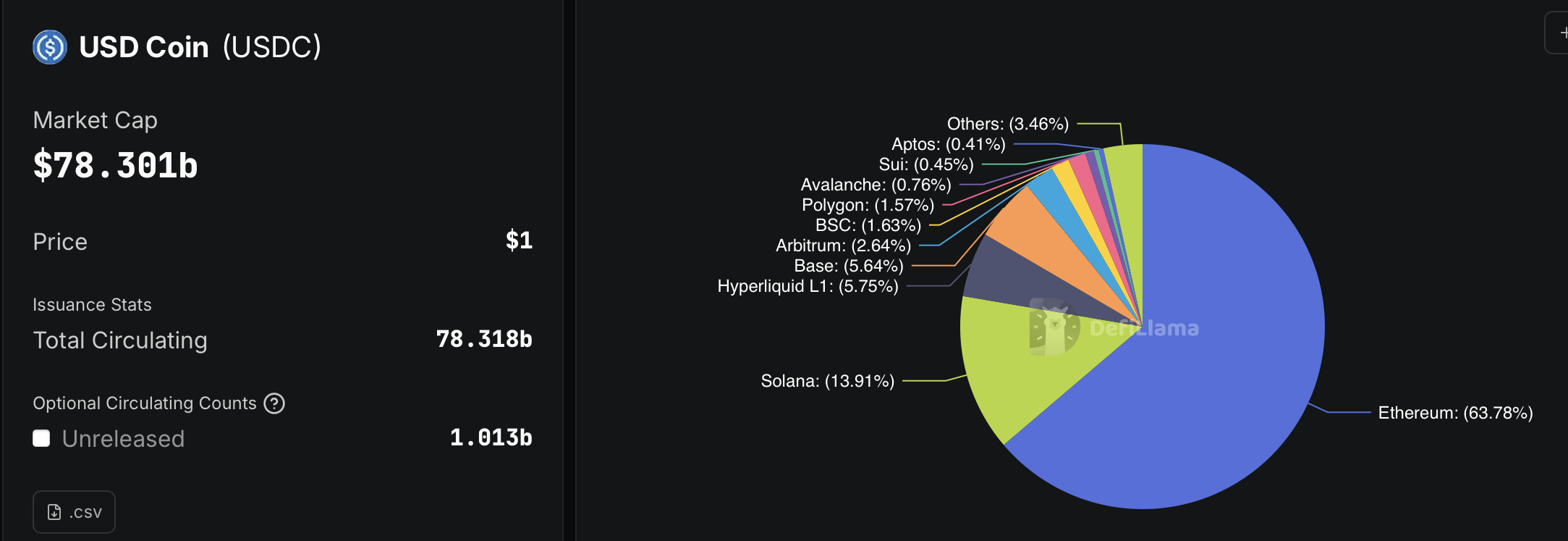
USDC market capitalization and blockchains. Source: DefiLlama

In January, Circle acquired Hashnote, the issuer of the tokenized money market fund US Yield Coin, bringing one of the largest yield-bearing real-world asset products into its stablecoin and infrastructure business.

Related: Paxos, Ripple, Circle and others secure US trust bank approvals

Stablecoin issuers make acquisitions in 2025

Stablecoin issuers have increasingly used acquisitions in 2025 to expand their businesses.

In November, Paxos acquired institutional crypto wallet provider Fordefi in a deal valued at more than $100 million, according to Fortune. Paxos, the issuer of Pax Dollar (USDP) and PayPal’s USD (PYUSD) stablecoin, said the acquisition strengthens its custody and transaction infrastructure for stablecoin issuance, asset tokenization and onchain payments.
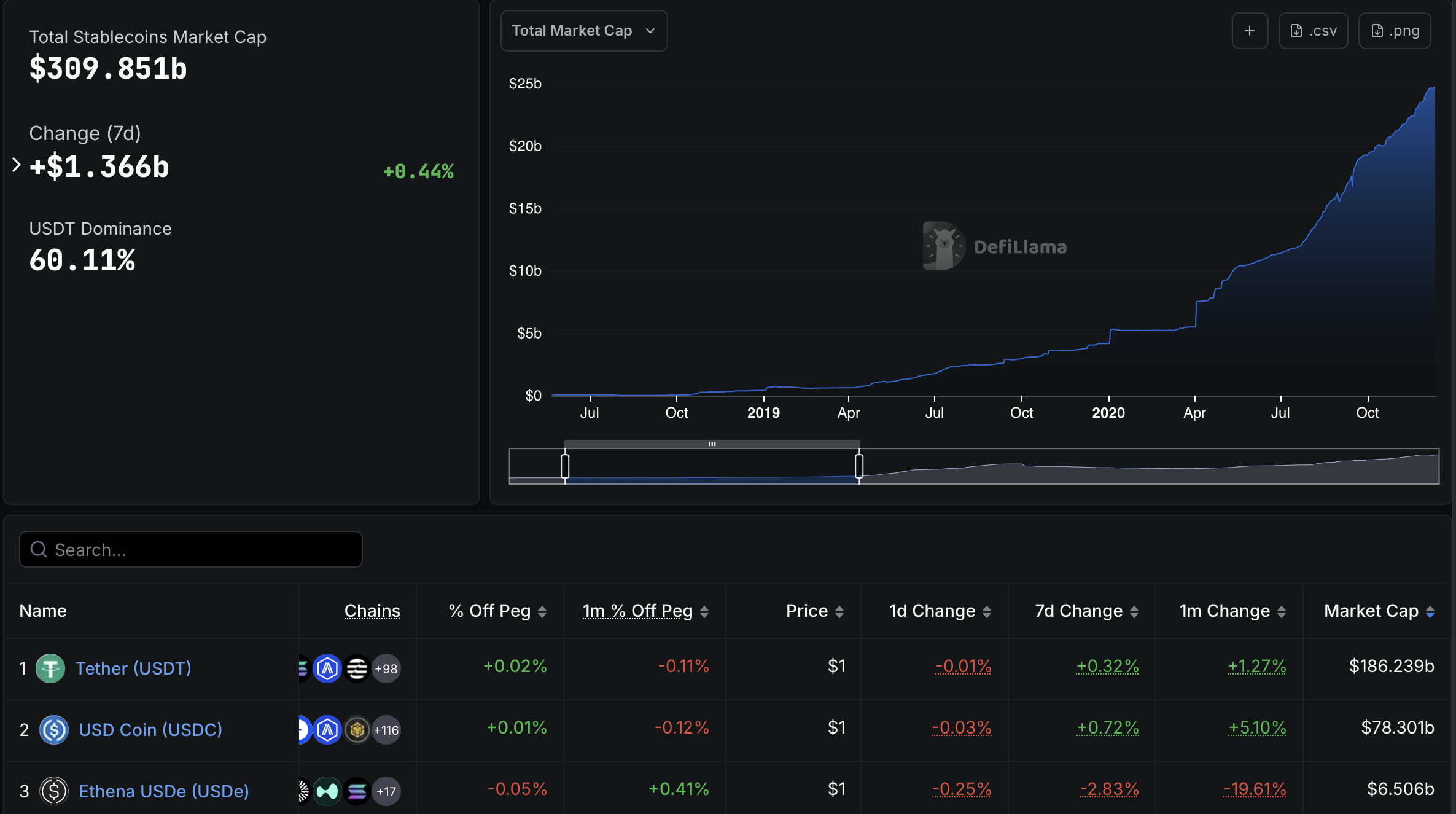
Stablecoin market cap. Source: DefiLlama

Tether, the dominant stablecoin issuer behind the USDt (USDT) token, has used its balance sheet to acquire minority stakes and strategic positions across traditional asset businesses.

In June, it acquired a roughly 32% stake in Canada-listed gold royalty company Elemental Altus Royalties for about $89 million. In November, Tether Investments acquired a minority stake in precious metals company Versamet Royalties, purchasing about 11.8 million common shares through a private agreement with an existing shareholder.

Tether has tried to push beyond finance into sports, submitting a binding all-cash offer on Dec. 12 to acquire Exor’s 65.4% controlling stake in Italy’s Juventus Football Club, a bid that the Agnelli family’s holding company later said its board unanimously rejected.

Magazine: Meet the onchain crypto detectives fighting crime better than the cops

Related Reads

OpenAI Post-Training Engineer Weng Jiayi Proposes a New Paradigm Hypothesis for Agentic AI

OpenAI engineer Weng Jiayi's "Heuristic Learning" experiments propose a new paradigm for Agentic AI, suggesting that intelligent agents can improve not just by training neural networks, but also by autonomously writing and refining code based on environmental feedback. In the experiment, a coding agent (powered by Codex) was tasked with developing and maintaining a programmatic strategy for the Atari game Breakout. Starting from a basic prompt, the agent iteratively wrote code, ran the game, analyzed logs and video replays to identify failures, and then modified the code. Through this engineering loop of "code-run-debug-update," it evolved a pure Python heuristic strategy that achieved a perfect score of 864 in Breakout and performed competitively with deep reinforcement learning (RL) algorithms in MuJoCo control tasks like Ant and HalfCheetah. This approach, termed Heuristic Learning (HL), contrasts with Deep RL. In HL, experience is captured in readable, modifiable code, tests, logs, and configurations—a software system—rather than being encoded solely into opaque neural network weights. This offers potential advantages in explainability, auditability for safety-critical applications, easier integration of regression tests to combat catastrophic forgetting, and more efficient sample use in early learning stages, as demonstrated in broader tests on 57 Atari games. However, the blog acknowledges clear limitations. Programmatic strategies struggle with tasks requiring long-horizon planning or complex perception (e.g., Montezuma's Revenge), areas where neural networks excel. The future vision is a hybrid architecture: specialized neural networks for fast perception (System 1), HL systems for rules, safety, and local recovery (also System 1), and LLM agents providing high-level feedback and learning from the HL system's data (System 2). The core proposition is that in the era of capable coding agents, a significant portion of an AI's learned experience could be maintained as an auditable, evolving software system.

marsbit25m ago

OpenAI Post-Training Engineer Weng Jiayi Proposes a New Paradigm Hypothesis for Agentic AI

marsbit25m ago

Your Claude Will Dream Tonight, Don't Disturb It

This article explores the recent phenomenon of AI companies increasingly using anthropomorphic language—like "thinking," "memory," "hallucination," and now "dreaming"—to describe machine learning processes. Focusing on Anthropic's newly announced "Dreaming" feature for its Claude Agent platform, the piece explains that this function is essentially an automated, offline batch processing of an agent's operational logs. It analyzes past task sessions to identify patterns, optimize future actions, and consolidate learnings into a persistent memory system, akin to a form of reinforcement learning and self-correction. The article draws parallels to similar features in other AI agent systems like Hermes Agent and OpenClaw, which also implement mechanisms for reviewing historical data, extracting reusable "skills," and strengthening long-term memory. It notes a key difference from human dreaming: these AI "dreams" still consume computational resources and user tokens. Further context is provided by discussing the technical challenges of managing AI "memory" or context, highlighting the computational expense of large context windows and innovations like Subquadratic's new model claiming drastically longer contexts. The core critique argues that this strategic use of human-centric vocabulary does more than market products; it subtly reshapes user perception. By framing algorithms with terms associated with consciousness, companies blur the line between tool and autonomous entity. This linguistic shift can influence user expectations, tolerance for errors, and even perceptions of responsibility when systems fail, potentially diverting scrutiny from the companies and engineers behind the technology. The article concludes by speculating that terms like "daydreaming" for predictive task simulation might be next, continuing this trend of embedding the idea of an "inner life" into computational processes.

marsbit27m ago

Your Claude Will Dream Tonight, Don't Disturb It

marsbit27m ago

Trading

Spot
Futures

Hot Articles

What is STORY

Understanding Story Protocol: Pioneering a New Era in Intellectual Property Management Introduction to Story Protocol In the rapidly evolving world of blockchain technology, Story Protocol emerges as an innovative solution aimed at transforming the landscape of intellectual property (IP) management. Designed to empower creators, Story Protocol is paving the way for a digital ecosystem that promotes transparency, creativity, and legal empowerment. The protocol operates on the principles of web3, introducing a decentralized framework that allows creators to not only protect but also monetize their works efficiently. In an age where content can easily be reproduced and shared, Story Protocol aims to establish a mechanism that respects creators’ rights and fosters a culture of collaboration. What is Story Protocol? At its core, Story Protocol is an advanced blockchain-based IP management tool that strives to revolutionize how intellectual property is created, managed, and licensed. The aim of the project is to disrupt traditional methods by leveraging the decentralized nature of blockchain technology. This offers a global and scalable library of intellectual property assets, allowing creators to engage with their audience in a more direct manner. Creators can easily register their works using the platform, setting customizable guidelines for how their content may be used. This process not only protects their legal rights but also facilitates the monetization of their creations in a manner that is both transparent and efficient. As a result, Story Protocol caters to a diverse range of creators—from writers and artists to musicians and programmers—by fostering an inclusive and accessible environment. Who is the Creator of Story Protocol? The vision for Story Protocol is brought to life by Seung Yoon Lee, known as SY Lee, and Jason Zhao. SY Lee serves as the CEO and co-founder, bringing with him a wealth of experience from his background in journalism and entrepreneurship. His previous ventures, including Byline and Radish Fiction—subsequently sold to Kakao—have positioned him as a pioneering figure in digital content platforms. Co-founder Jason Zhao complements SY Lee's vision with his robust technical expertise. A graduate in Computer Science from Stanford University and a former employee of DeepMind, Jason's experience in advanced technologies empowers Story Protocol's capabilities in the digital ecosystem. Who are the Investors of Story Protocol? Story Protocol has garnered substantial financial backing from a range of reputable investors known for their keen eye for transformative technologies. This vital support reflects confidence in the project’s potential to reshape the IP market. Among the notable investors is A16z Crypto, which led both the seed round and Series B financing, further demonstrating its commitment to the future of digital economies. Other significant investors contributing to the project include: Polychain Capital: A recognized leader in blockchain investment that participated in the Series B round. Hashed Endeavor Samsung Next Foresight Ventures Dao5 Insignia Venture Partners Alliance DAO Mirana Ventures The breadth of this investment network not only provides funding but also adds credibility and strategic insight to the platform, positioning Story Protocol as a leader in its field. How Does Story Protocol Work? Story Protocol offers a comprehensive framework that allows creators to manage their intellectual property seamlessly. The platform is underpinned by several unique and innovative features that distinguish it from traditional IP management systems. Key Features: Programmable IP: This feature allows creators to define the terms of how their IP can be utilized, including guidelines for remixing and collaboration. By establishing clear and programmable parameters, creators can ensure their works are used in ways that align with their vision. Decentralized Ecosystem: The protocol enables creators to operate independently, without the need for intermediaries often found in traditional licensing arrangements. This decentralized approach not only empowers creators but also reduces the friction typically associated with IP management. Transparent Licensing: By simplifying the licensing process, Story Protocol makes it easier for creators to track how their works are being used. This manual transparency is essential for establishing trust and fostering collaboration in a digital landscape where IP rights are often contested. Together, these features create a robust environment that encourages innovation, cooperation, and respect for creators’ rights while simplifying the complexities of intellectual property law in the digital age. Timeline of Story Protocol Understanding the developmental milestones of Story Protocol can provide insights into its strategic growth and vision for the future. Below is a timeline highlighting significant events in the project's history: 2021: Foundation laid for the concept of Story Protocol while formulating its objectives. 2023: The project successfully raised $29.3 million in a seed funding round led by A16z Crypto, marking its official entry into the competitive landscape of blockchain innovations. 2024: Following the success of its initial funding, Story Protocol announced an $80 million Series B financing round at a substantial $2.25 billion valuation, further solidifying its position in the market. This timeline illustrates not only the rapid growth of Story Protocol but also the increasing interest and investment it has attracted from prominent players in the industry. The Future of Story Protocol As the digital content landscape continues to evolve, Story Protocol stands at the forefront of a revolution in IP management. By leveraging blockchain technology for creator empowerment and transparency, the protocol offers a compelling vision for a sustainable intellectual property ecosystem. In a world that demands creativity and innovation, Story Protocol enables creators to maintain ownership and control over their assets, ultimately fostering an environment where creativity can flourish. The extensive backing from seasoned investors further underscores the potential for this platform to redefine how intellectual property operates in the rapidly changing digital economy. In conclusion, Story Protocol is not just a project; it is a movement towards a more equitable and accessible IP landscape. As the digital world expands, Story Protocol promises to lead the charge, ensuring that creators are acknowledged and compensated fairly for their contributions to culture and society. The journey has just begun, and the implications of such an initiative are profound—not only for creators but for the future of digital content itself.

428 Total ViewsPublished 2024.04.04Updated 2024.12.03

What is STORY

Discussions

Welcome to the HTX Community. Here, you can stay informed about the latest platform developments and gain access to professional market insights. Users' opinions on the price of IP (IP) are presented below.

活动图片




