Circle moves toward privacy-focused stablecoin with USDCx project

cointelegraphPublished on 2025-12-09Last updated on 2025-12-09

Abstract

Circle is developing a privacy-enhanced version of its USDC stablecoin, called USDCx, in partnership with blockchain firm Aleo. Aimed at banking and enterprise users, USDCx will offer "banking-level privacy" by concealing transaction details onchain, while still allowing compliance with regulatory requests. This addresses a key hurdle for institutional adoption, as many financial firms hesitate to use public blockchains due to transparency concerns. The move comes amid growing corporate interest in stablecoins following the US GENIUS Act, with major players like Citigroup, JPMorgan, and Visa expanding their stablecoin initiatives. USDC and USDT currently dominate the dollar-pegged stablecoin market.

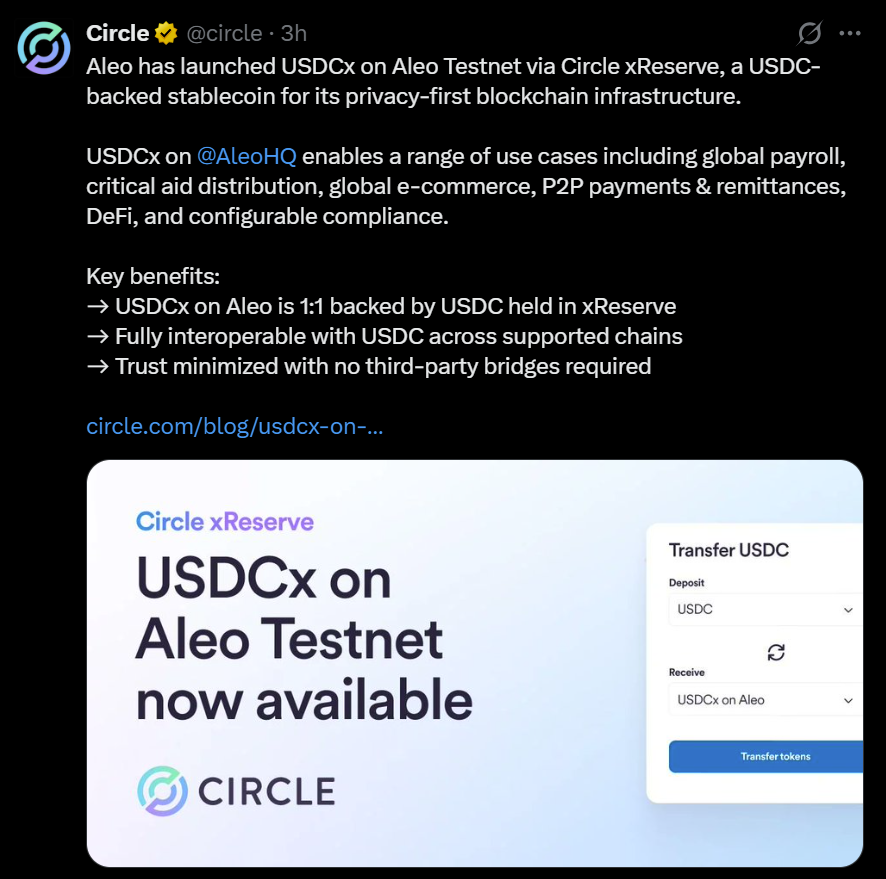
Stablecoin issuer Circle is developing a privacy-enhanced version of its US dollar-pegged USDC token, aiming to spur institutional adoption by offering greater confidentiality than traditional public blockchains allow.

The new stablecoin, called USDCx and targeting banking and enterprise users, is being built in partnership with the privacy-focused blockchain company Aleo, Fortune reported on Tuesday, citing Aleo co-founder Howard Wu.

Unlike most existing stablecoins, which have wallet addresses and transaction details fully visible onchain, USDCx is designed to provide “banking-level privacy.” Circle would still be able to provide a compliance record if law enforcement or regulators request information on specific transactions, according to the report.

The initiative aims to address a key hurdle for major financial institutions, many of which have been hesitant to utilize blockchain-based payment rails because their transaction flows would be publicly visible.
Source: Circle

Aleo has long argued that privacy is essential for the next phase of stablecoin adoption. In a May post, the company wrote that while transparency is often promoted as a core blockchain advantage, “it becomes a liability when dealing with sensitive, confidential payment data.”

Aleo isn’t the only company pushing for privacy in stablecoins. As Cointelegraph reported, digital asset infrastructure provider Taurus has developed a private smart-contract system for stablecoins, designed to enable anonymous transactions. This approach aims to boost the use of stable assets for intracompany payments and employee payrolls.

Related: Bank lobby is ‘panicking’ about yield-bearing stablecoins

Stablecoins take center stage in corporate America

Circle’s move into privacy-focused stable assets comes as more major institutions begin exploring stablecoins in the wake of the US GENIUS Act, the new regulatory framework governing US dollar–pegged tokens.

As Cointelegraph reported, a corporate stablecoin race is emerging in the wake of GENIUS. Citigroup has partnered with Coinbase to test stablecoin-based payment rails for its clients, while other Wall Street companies, including JPMorgan and Bank of America, are reportedly in the early stages of experimenting with similar technologies.

Global remittance provider Western Union is also building a digital asset settlement system on Solana, with plans to introduce a US Dollar Payment Token as part of its infrastructure overhaul. Meanwhile, global payments giant Visa has expanded its stablecoin offerings amid growing competition in the space.
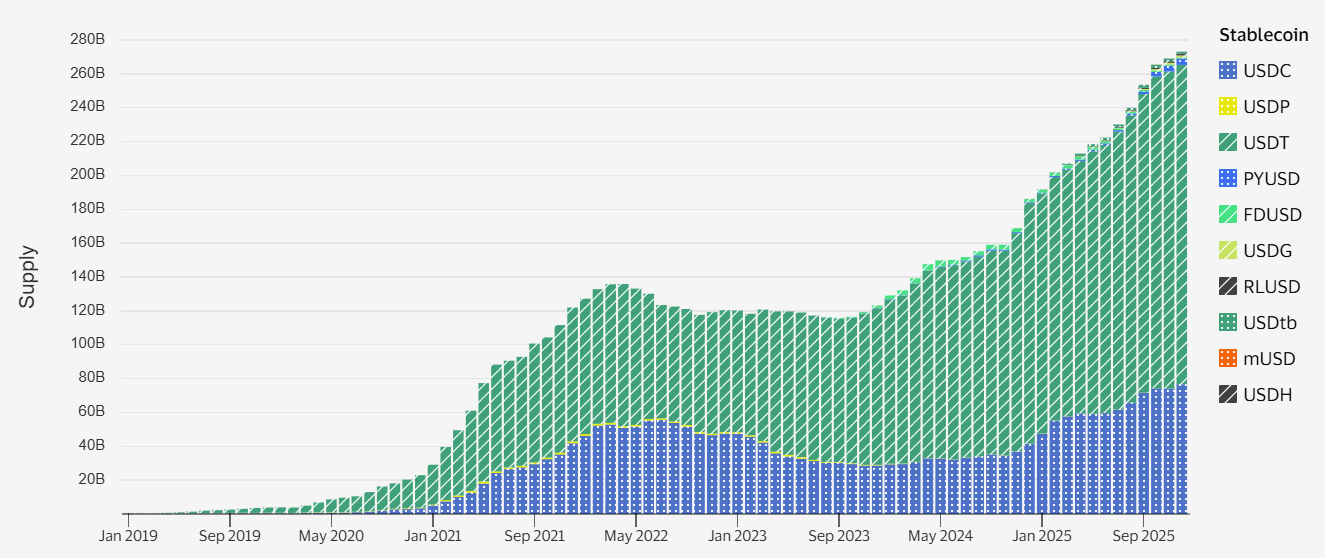
Average stablecoin supply by issuer. Source: Visa Onchain Analytics

The US dollar underpins the vast majority of global stablecoin activity. USDC (USDC) and Tether’s USDt (USDT) together account for roughly 85% of the market, while other dollar-linked tokens, including synthetic dollars and PayPal USD (PYUSD), also rank among the largest.

Related: Crypto Biz: Wall Street giants bet on stablecoins

Related Reads

The AI Agent Era Accelerates Its Arrival: Questflow Defines a New Paradigm of Financial Intelligence with On-Chain AI Brokerage

The AI Agent era is accelerating, with the CB Insights AI 100 list highlighting global investment confidence. The focus has shifted from whether AI works to its speed of deployment and ability to manage complex workflows, with autonomous AI Agents driving this transformation. At the forefront is Questflow, a Singapore-based startup redefining financial intelligence through its on-chain AI brokerage. Unlike tools that merely provide data dashboards, Questflow deploys AI Agents that proactively scan markets, form judgments, and execute trades via a conversational interface—operating 24/7 without requiring manual confirmation for each decision. This embodies the new AI paradigm of agents capable of executing multi-step workflows autonomously. Questflow's mission is to democratize institutional-grade trading intelligence. Historically reserved for the ultra-wealthy, this capability is now accessible starting from just $1 through Questflow's "AI Clone + Copy Trade" model. The platform charges only a 1% execution fee, aligning its incentives directly with users and eliminating traditional management or performance fees. The timing is opportune, aligning with key trends identified by CB Insights: the scalable deployment of AI Agents, accelerated AI adoption in financial services, and the maturation of on-chain infrastructure. With robust liquidity on platforms like Hyperliquid and Polymarket, alongside advancements in AI reasoning and non-custodial wallet security, Questflow is positioned to merge the roles of broker, fund, and exchange into a single, accessible platform for millions.

链捕手44m ago

The AI Agent Era Accelerates Its Arrival: Questflow Defines a New Paradigm of Financial Intelligence with On-Chain AI Brokerage

链捕手44m ago

Why Pricing Social Interactions is Doomed to Fail?

Titled "Why Putting a Price on Social Interaction Is Doomed to Fail," this article critiques attempts to monetize social networks directly through SocialFi models, arguing their inevitable failure stems from a fundamental misunderstanding of media dynamics. Using Marshall McLuhan's theory of "hot" and "cold" media, the author posits that social networks are inherently "cold" media. Their value isn't contained in individual posts but is co-created through user participation, interpretation, and fragmented, ongoing interaction (e.g., replies, shares). This ambiguity and need for user involvement are core to their function. The article asserts that SocialFi projects like Friend.tech failed because introducing real-time, tradable financial pricing (a definitive "hot" signal) into this "cold" environment doesn't add a layer—it replaces the medium's essence. The unambiguous price signal overshadows and nullifies the nuanced, participatory social signal. Users become traders, not participants, and when speculative profits vanish, the underlying social ecosystem—never genuinely cultivated—collapses entirely. This principle extends beyond crypto. The author argues platforms like Twitter have gradually "heated up" through metrics (likes, retweets counts, algorithmically defined value), shifting users from participants to performers and eroding organic engagement. The solution isn't to abandon capital but to manage its entry point. Successful models like Substack, Patreon, or Bandcamp allow capital to "condense" at specific, isolated nodes (e.g., subscriptions, one-time payments) without permeating and "heating" every social interaction. They preserve the core "cold," participatory medium while enabling monetization at designated boundaries. The NFT boom and bust serves as a stark parallel: the ancient "cold" medium of collecting (valued for story, community, gradual accumulation) was rapidly destroyed by platforms that introduced real-time floor prices, rarity scores, and trading dashboards, transforming collectors into speculators and vaporizing cultural value when prices fell. The core lesson: "Liquidity equals heat." Injecting high liquidity and definitive pricing into a "cold" participatory medium doesn't optimize it; it fundamentally alters and destroys its value-creating mechanism. The future lies not in pricing every social gesture but in finding precise, non-invasive points for capital to condense without overheating the entire ecosystem.

marsbit52m ago

Why Pricing Social Interactions is Doomed to Fail?

marsbit52m ago

Trading

Spot
Futures
活动图片




