Chainalysis estimates $457B in taxable crypto activity, says CARF misses most

cointelegraphPublished on 2026-08-26Last updated on 2026-08-26

Abstract

A Chainalysis report estimates that potentially taxable onchain cryptocurrency activity reached at least $457 billion globally in 2025, with the U.S. accounting for $112.6 billion. The Organisation for Economic Co-operation and Development’s (OECD) Crypto-Asset Reporting Framework (CARF), which began data collection in 2026 across 48 jurisdictions, is designed to capture transaction data from crypto intermediaries. However, Chainalysis finds CARF covers only 14% of the identified onchain taxable activity. The remaining 86%, including decentralized exchange trading, peer-to-peer transfers, and onchain income, falls outside CARF's scope as it largely targets centralized service providers. Experts note that decentralized finance (DeFi) activities remain outside the reporting perimeter due to the lack of centralized operators, though this may change as regulators develop new rules.

Potentially taxable onchain crypto activity reached at least $457 billion globally in 2025, while international reporting rules may capture only a fraction of it, according to a new Chainalysis report.

The US accounted for an estimated $112.6 billion of the total, while North America led all regions with $134.6 billion, followed by the European Union at $125.1 billion.

The estimates include realized gains, income from activities such as mining, staking and lending, and crypto-denominated payments across six major blockchains, but exclude trading and other activity conducted within centralized exchanges.

Chainalysis said transactions covered by the Organisation for Economic Co-operation and Development’s (OECD) Crypto-Asset Reporting Framework (CARF) account for just 14% of the onchain taxable activity it identified. The remaining 86% includes activity on decentralized exchanges, peer-to-peer transfers, onchain income streams and payments.

CARF, developed by the OECD in 2022, requires covered crypto service providers to report customer transaction data to tax authorities.
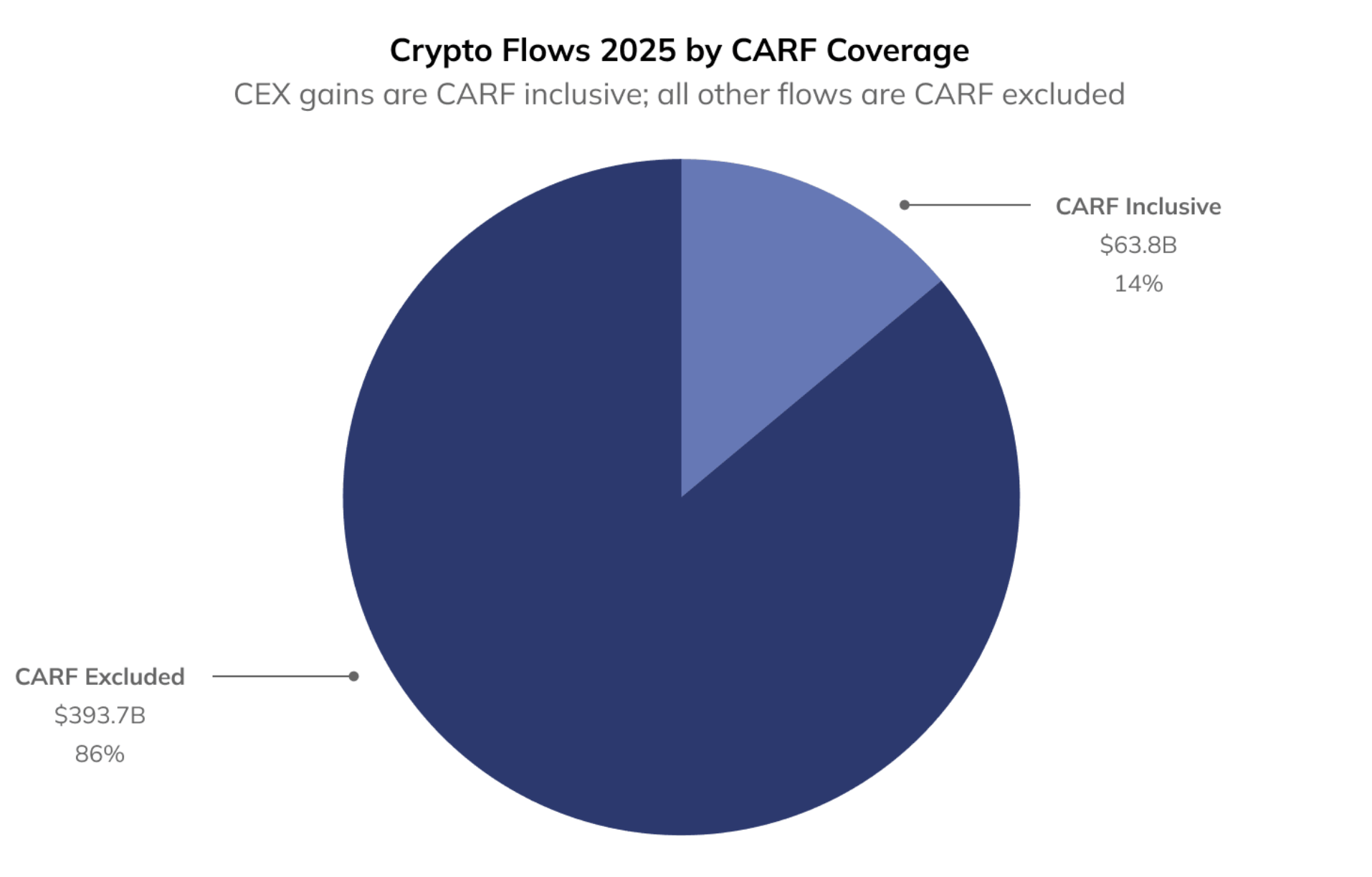
CARF covers only 14% of potentially taxable onchain crypto activity.
Source: Chainalysis

Related: Chainalysis sues US over $95M ICE contract with TRM Labs

CARF’s limits on onchain tax reporting

CARF data collection began on Jan. 1, 2026, in 48 jurisdictions, including the United Kingdom and European Union, requiring covered crypto platforms to collect additional customer and tax residency information.

Under CARF, in-scope crypto providers collect customer and tax residency information and report transaction data to domestic tax authorities, which can then share that information across borders.
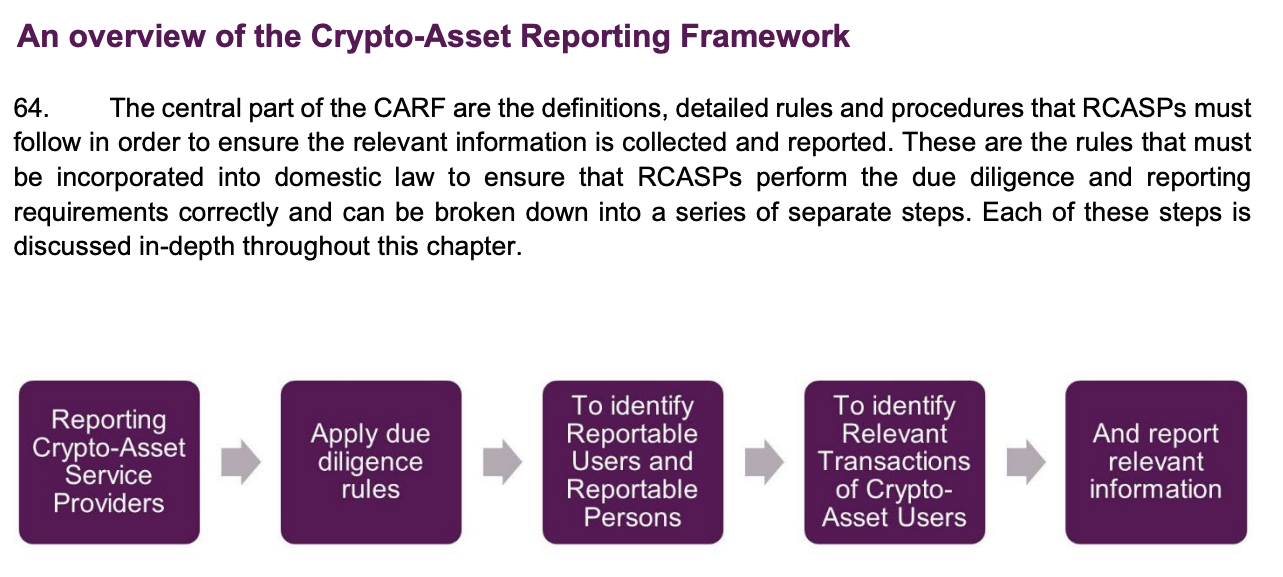
CARF framework. Source: OECD

CARF’s focus on crypto intermediaries also helps explain the gaps highlighted by Chainalysis. Colby Mangels, a former OECD adviser who worked on CARF, told Cointelegraph in January that the framework was designed around intermediaries that facilitate crypto transactions as a business.

Much of decentralized finance therefore remains outside the reporting perimeter, as there may be no centralized operator or custodial relationship on which to impose reporting requirements.

That could change as regulators develop rules for decentralized platforms. Mangels said tax authorities are watching developments in anti-money laundering regulation, including efforts to determine when DeFi platforms or their operators should be treated as regulated crypto service providers.

Magazine: SEC’s proposed crypto rules probably won’t spark new ICO boom

Related Questions

QAccording to the Chainalysis report, how much potentially taxable onchain crypto activity was estimated globally in 2025?

APotentially taxable onchain crypto activity was estimated to be at least $457 billion globally in 2025.

QWhat percentage of the identified onchain taxable activity is covered by the OECD's Crypto-Asset Reporting Framework (CARF)?

AAccording to Chainalysis, the transactions covered by the OECD's Crypto-Asset Reporting Framework (CARF) account for just 14% of the identified onchain taxable activity.

QWhat major categories of taxable activity were included in Chainalysis's $457 billion estimate?

AThe estimates included realized gains, income from activities such as mining, staking and lending, and crypto-denominated payments across six major blockchains. It excluded trading and other activity conducted within centralized exchanges.

QWhich region had the highest estimated amount of potentially taxable onchain crypto activity according to the report?

ANorth America led all regions with an estimated $134.6 billion in potentially taxable onchain crypto activity.

QWhy does much of decentralized finance (DeFi) activity remain outside the reporting perimeter of CARF?

AMuch of decentralized finance (DeFi) remains outside CARF's reporting perimeter because there may be no centralized operator or custodial relationship on which to impose reporting requirements, as the framework is designed around intermediaries that facilitate crypto transactions as a business.

Related Reads

One Vote Could Make SOL's Daily Burn Rate Soar 14 Times

Solana's first formal on-chain governance vote concluded on August 27th, coinciding with SOL hitting a yearly high. Three key proposals aimed at reshaping the network's tokenomics were decided. Solana's core challenge is a massive usage-to-value capture gap. Despite processing 120x more transactions than Ethereum and leading in DEX volume, its fee revenue is significantly lower due to its fee structure. Currently, most fees (priority fees) go to validators, with only a small base fee partially burned. This results in high net inflation (approx. 6k SOL issued vs. ~650 burned daily). The three proposals seek to address this: **SGP-0001** establishes the formal governance framework. **SGP-0002** (Double Deflation Acceleration) proposes doubling the annual reduction rate of new SOL issuance from 15% to 30%, aiming to reach the terminal inflation rate by 2029 instead of 2032, reducing issuance by an estimated 18.9 million SOL. **SGP-0003** (Resource & Entry Fee Restructuring) would split the base fee into a fixed "entry fee" for block producers and a variable, fully burned "resource fee." This could increase daily SOL burns by ~14x to 7,500-9,000. Major stakeholders like Helius, Jupiter, and Jito support the changes. However, opposition exists, notably from Solana Company (HSDT), whose revenue is 99.4% from staking. They argue rapid changes could disrupt institutional adoption. Critics also highlight a potential conflict where validators can vote against reduced staking yields using delegated SOL without explicit voter consent. The outcome of these votes provides a directional mandate. If passed, they represent a significant step towards aligning Solana's immense network activity with tangible economic value for SOL holders.

marsbit12m ago

One Vote Could Make SOL's Daily Burn Rate Soar 14 Times

marsbit12m ago

Chinese Venture Capital Is Shifting from 'Selecting People' to 'Selecting Cities'

Chinese Venture Capital: Shifting from "Picking Founders" to "Picking Cities" The article discusses a significant shift in China's venture capital (VC) landscape. Historically, VC investments heavily focused on the individual founder's vision, track record, and capability, as seen in early internet-era successes like Wang Xing (Meituan), Li Bin (Nio), and Li Xiang (Li Auto). The belief was that betting on exceptional people was the key to success. However, the rise of hard tech startups—in fields like semiconductors, robotics, AI, and biotech—has changed this calculus. These industries depend heavily on deep, localized ecosystems: specialized talent pools, established supply chains, manufacturing bases, and application scenarios. A city's industrial "resume" now significantly impacts a startup's chances. Examples include Shenzhen's dominance in robotics, Beijing's concentration of AI firms, Suzhou's biotech cluster, and Hefei's successful bet on semiconductor giant ChangXin. This shift is further driven by changes in funding sources. Government-guided funds and state-owned capital now dominate VC limited partners (LPs). These "patient capital" investors prioritize local economic development, job creation, and industrial chain growth alongside financial returns. Their early bets signal viability to other investors. Ultimately, the VC logic remains about managing risk and increasing the odds of success. In the hard tech era, a supportive city ecosystem provides crucial resources—talent, suppliers, R&D, and policy stability—that a single founder cannot easily assemble. The investment due diligence process has thus expanded from evaluating just the founder to also evaluating the founder's city. Consequently, capital is concentrating in a few regions with strong, focused industrial foundations, challenging other cities to build compelling, credible ecosystems to attract investment.

marsbit1h ago

Chinese Venture Capital Is Shifting from 'Selecting People' to 'Selecting Cities'

marsbit1h ago

Trading

Spot
活动图片