Cardano Teams Up With Grant Thornton to Launch Comprehensive Financial Audit – Here’s What To Know

bitcoinistPublished on 2026-01-16Last updated on 2026-01-16

Abstract

Cardano Foundation has partnered with global professional services firm Grant Thornton to launch a cryptographically secured, on-chain financial audit using its Virtual LEI (vLEI) technology. Described as a global first for blockchain-based financial trust, this enterprise-grade solution aims to enhance transparency, accountability, and institutional credibility. The move underscores Cardano’s commitment to regulatory-ready standards and attracting long-term enterprise adoption. CEO Frederik Gregaard noted the audit was executed via two on-chain transactions, calling it a step toward a future where "financial trust is native to infrastructure." The announcement follows Google’s recent investment in Cardano’s infrastructure, reflecting growing confidence in the blockchain. Analysts suggest ADA shows bullish potential, with price momentum rising above $0.40.

With the latest move and partnership from Cardano, the financial sector could be set for a major shift. A new financial audit has been launched from the recent partnership that aims at bolstering accountability in the broader finance landscape, which reflects the blockchain’s focus on transparency.

New Audit On Cardano To Boost Financial Oversight

Recently, the Cardano Foundation announced a new partnership with global professional services firm Grant Thornton as they step toward enhancing transparency and institutional credibility. By joining forces, both leading firms have collectively launched a new comprehensive financial audit.

The partnership was disclosed by the Cardano Foundation on their official page on the social media platform X. According to the Foundation, this audit is cryptographically secured and attested directly on-chain using their Virtual LEI (vLEI).

This new audit is being described as a global first for financial trust and transparency in the blockchain industry. Powered by Reeve, this new gold standard is the Cardano Foundation’s enterprise-grade financial data management solution.

By hiring one of the top audit firms in the world, the foundation is demonstrating its dedication to regulatory-ready standards and accountability, which are essential elements for drawing in long-term investors and enterprise adoption. In a world driven by data, trust, and verification, the Foundation claims that accountability is everything, and Cardano is at the forefront of this narrative.

Frederik Gregaard, the Chief Executive Officer (CEO) of the Foundation, stated that this audit was executed in two on-chain transactions. “For me personally, it closes one chapter and opens a much larger one. A future where financial trust is native to infrastructure, not bolted on through intermediaries,” the CEO added.

Institutions Are Choosing The Blockchain

Cardano’s position as a blockchain project focused on rigor and trust is evidenced by its growing adoption on the institutional level. A few days ago, one of the world’s largest companies, Google, took a bold step by investing in the blockchain’s infrastructure.

According to the report from ADA Advocate, the Google Cloud stake pool can now be found on the network and the newly launched Midnight chain. Google’s involvement and recognition of Cardano’s security and stability is a significant advancement in the use of blockchain technology by actual business behemoths.
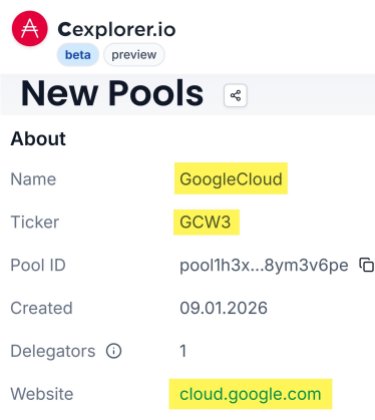
Source: Chart from ADA Advocate on X

Amid the rising demand, the price of Cardano has begun to display bullish momentum, pushing back above $0.4. Market expert and veteran financial trader, Matthew Dixon, highlighted that ADA currently holds tremendous upside potential with 5 waves up from the low, as either an A wave or wave 1.

More than two times the potential is given by even the most cautious interpretation of an A wave, and much more if wave 1. As a result, the expert has placed the altcoin among his favorites for Q1 2026.

ADA trading at $0.40 on the 1D chart | Source: ADAUSDT on Tradingview.com

Related Questions

QWhat is the main purpose of the new financial audit launched by Cardano and Grant Thornton?

AThe main purpose is to bolster accountability and enhance transparency in the broader finance landscape, demonstrating Cardano's dedication to regulatory-ready standards and institutional credibility.

QHow is the new Cardano audit described and what technology powers it?

AIt is described as a global first for financial trust and transparency in the blockchain industry, powered by Reeve, which is Cardano Foundation's enterprise-grade financial data management solution.

QHow was the audit executed technically according to the Cardano Foundation CEO?

AAccording to CEO Frederik Gregaard, the audit was executed in two on-chain transactions, making financial trust native to the infrastructure rather than relying on intermediaries.

QWhat recent institutional adoption of Cardano was mentioned besides the audit partnership?

AGoogle invested in Cardano's infrastructure, with the Google Cloud stake pool now available on the Cardano network and the newly launched Midnight chain.

QWhat is the market outlook for ADA (Cardano's token) according to the expert cited in the article?

AMarket expert Matthew Dixon highlighted that ADA has tremendous upside potential with 5 waves up from the low, and it is among his favorite altcoins for Q1 2026, with even the most cautious interpretation suggesting more than two times the potential.

Related Reads

Aave Is Surrendering the Throne of DeFi Lending Due to Its Own Stupidity

Aave, a leading DeFi lending protocol, is facing a severe crisis and losing its dominant market position due to its poor handling of a recent security incident. The crisis began when Kelp DAO suffered a hack resulting in a loss of $292 million in rsETH. In the aftermath, approximately $17.2 billion in funds flowed out of Aave as user panic escalated. The article criticizes Aave's crisis management as "extremely foolish." Instead of promptly offering reassurance or committing to cover the potential bad debt—estimated between $123.7 million and $230.1 million, which Aave could have afforded—the protocol initially deflected blame, emphasizing that its code was not at fault. This delay and lack of a clear guarantee led to widespread user anxiety, triggering a bank run-like scenario where users withdrew funds or borrowed aggressively from other pools, causing liquidity shortages. Meanwhile, Aave’s competitor Spark—a fork of Aave’s own code—has benefited significantly. Having removed support for rsETH months earlier, Spark avoided any losses from the incident and has since seen its TVL grow by nearly $2 billion, attracting major deposits such as over $1.24 billion from Justin Sun. Spark has actively capitalized on the situation, publicly criticizing Aave’s security reputation. Although Aave’s founder Stani eventually announced a relief plan named "DeFi United" with several partners and a personal donation, the damage to user trust and capital outflows may be irreversible. The article concludes that Aave is losing its throne in DeFi lending to aggressive competitors like Spark, Morpho, and Jupiter Lend.

Odaily星球日报1h ago

Aave Is Surrendering the Throne of DeFi Lending Due to Its Own Stupidity

Odaily星球日报1h ago

Trading

Spot
Futures

Hot Articles

Discussions

Welcome to the HTX Community. Here, you can stay informed about the latest platform developments and gain access to professional market insights. Users' opinions on the price of ADA (ADA) are presented below.

活动图片