Cardano Founder Hoskinson Signals Reset For 2026, Not An Exit

bitcoinistPublished on 2026-01-01Last updated on 2026-01-01

Abstract

Charles Hoskinson, founder of Cardano, has announced a significant shift in his public engagement for 2026, clarifying it is not an exit from the cryptocurrency space. He stated he is stepping back from day-to-day activity on X (Twitter), which he has "outgrown," to reduce the "weaponization" of his persona, which he sees as a liability for Cardano and its privacy-focused protocol, Midnight. Instead, he will focus on long-form writing, AMAs, and new media formats to maintain community connection with less toxicity. Hoskinson emphasized a return to "deep focus" on product development, including working on a zkVM specification, adding privacy to intents, and chain abstraction. His primary goal is to build scalable technology, targeting a billion users and a trillion dollars in transactions on Midnight by 2030. He also cited personal changes, intending to travel less after 260 days on the road in 2025, prioritize health, and spend more time at his ranch. He concluded with a critique on price obsession, stating, "If all you can think about is the price, you’ve already lost."

Charles Hoskinson rang in 2026 from his Wyoming ranch with a message that sounded, at first blush, like an exit. It wasn’t. The Cardano founder said he is “not leaving the cryptocurrency space,” but he is walking away from day-to-day life on X and retooling how he shows up publicly, arguing that his visibility has become a liability for Cardano and Midnight adoption.

Cardano Founder Plans To Move Into The Background

Hoskinson opened the New Year’s livestream titled “Happy New Year and Farewell” with a post-mortem on 2025, framing it as a year in which parts of the industry chased success faster than it built systems capable of delivering on crypto’s broader promises. In his telling, the space “lost our way” by letting incentives and spectacle override first principles.

He was also explicit about what the “farewell” refers to and what it does not. “So, to get this right off the bat, I’m not leaving the cryptocurrency space,” Hoskinson said. “I’m cognizant and aware that every single time I make a live stream or I say something, it gets misconstrued. So, let’s just definitively put that on the table. I’m not going anywhere. I’m not leaving.”

Instead, he described a strategic retreat from hyper-online discourse, claiming that the “weaponization” of his persona creates a barrier for would-be users who might otherwise participate in Cardano or Midnight.

The problem, he argued, is that public perception increasingly substitutes for product evaluation: “We don’t ask what it do. We ask who made it... If we hate them, what that thing is is evil and wrong. If we love them, what that thing is must be good.”

The clearest operational change is his decision to step back from X entirely. “I’ve outgrown X,” he said. “So it’s my farewell to that platform and I’ll turn it over to curators and AI. It’ll go into silent mode for probably a few weeks to a few months as we build up that infrastructure because I have more important things to do, but I’m going to uninstall the app and never think of it again.”

Hoskinson said he plans to focus instead on “long form writing,” AMAs, livestreams, and experimenting with new media formats, floating Twitch as one possible outlet. The goal, as he framed it, is to preserve community connection while reducing the surface area for what he described as increasingly hostile, toxic cycles during down markets.

Beyond the social pivot, Hoskinson emphasized a shift into “deep focus,” saying he has returned to a level of product specificity he hasn’t had “in a very long time.” He cited drafting a “specification for a zkVM,” working on “adding privacy to intents,” and thinking through “chain abstraction” and the roles across “application and permission and solver and settlement” layers.

He repeatedly anchored that renewed focus to scale targets, explicitly tying his 2026 mindset to Midnight’s longer-term arc. “Every day I wake up and I ask, ‘How do I build something a million people can use?’ And then I ask, ‘How do I build something a billion people can use?’” he said, adding that he has been thinking through what it would take for Midnight to reach “a billion users and a trillion dollars of transactions on the platform by 2030.”

Personal Changes For 2026

Hoskinson also made the personal operational changes unusually concrete. He said he traveled “more than 260 days” in 2025, averaged “only five and a half hours of sleep a night,” and described that pace as unsustainable. After Japan and Hong Kong, he said, he intends to travel less and spend more time at his ranch or farm, focusing on health, reading, and calmer reflection.

The closing stretch blended motivation with ecosystem-specific claims about the year ahead: he said “we finally launched Midnight,” pointed to RealFi efforts that “gave out a million loans over the last 18 months” in Uganda and Kenya, and framed 2026 as the year “Leios ships,” “Hydra gets good,” and Cardano’s “decentralized governance becomes hardened” as the community gains “full agency.”

But he also delivered a blunt cultural critique that doubles as a signal to his audience about what he wants his next chapter to optimize for. “If all you can think about is the price, you’ve already lost,” Hoskinson said. “Even if it goes up, you’ve lost. Not just at crypto, but at life.”

At press time, ADA traded at $0.34.
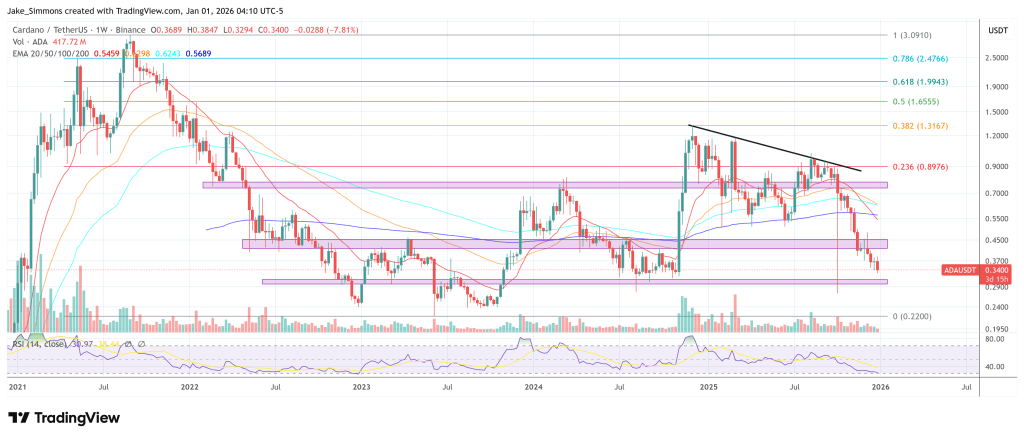
ADA almost lost its entire late-2024 gains, 1-week chart | Source: ADAUSDT on TradingView.com

Related Questions

QWhat did Charles Hoskinson announce regarding his future role in the cryptocurrency space and his presence on social media?

ACharles Hoskinson announced that he is not leaving the cryptocurrency space but is stepping back from day-to-day activity on X (Twitter) and retooling his public presence. He stated that his visibility has become a liability for Cardano and Midnight adoption, and he plans to move into the background.

QWhat specific operational change did Hoskinson mention regarding his use of the platform X?

AHoskinson stated that he is stepping back from X entirely, uninstalling the app, and turning the account over to curators and AI. It will go into silent mode for a few weeks to months while they build the infrastructure, as he has outgrown the platform.

QWhat new focus did Hoskinson outline for his work in 2026?

AHoskinson emphasized a shift into 'deep focus' on product development, including drafting a specification for a zkVM, working on adding privacy to intents, and thinking through chain abstraction and the roles across application, permission, solver, and settlement layers.

QWhat personal changes did Hoskinson say he would make to his lifestyle in 2026?

AHe plans to travel less after being on the road for more than 260 days in 2025, spend more time at his ranch or farm, focus on his health, get more sleep (after averaging only 5.5 hours per night), and engage in reading and calmer reflection.

QWhat large-scale user and transaction goals did Hoskinson set for Midnight by 2030?

AHoskinson stated that he is focused on building something that a billion people can use, with the goal for Midnight to reach 'a billion users and a trillion dollars of transactions on the platform by 2030'.

Related Reads

Stuck Polymarket: The Real Test After Riding the Traffic Boom Has Arrived

Polymarket, a leading prediction market platform, is facing significant technical challenges as its growth outpaces its current infrastructure on Polygon. Users are experiencing laggy transactions, unresponsive orders, and delayed confirmations, severely impacting the trading experience. In response, DeFi Engineering VP Josh Stevens outlined a comprehensive engineering overhaul. The plan includes reducing on-chain data delays, fixing order cancellation issues, rebuilding the central limit order book (CLOB), improving website performance, and developing a unified SDK and API. A major revelation was the ongoing "chain migration," indicating a potential move away from Polygon. The core issue is that Polymarket has evolved from a simple prediction market into a high-frequency trading platform, making Polygon's limitations—such as block space, gas fees, and block time—a ceiling for further growth. The migration is not just a simple chain switch but a fundamental rebuild of its trading system to support more complex products like perpetual contracts (Perps). This announcement has sparked competition among chains like Solana, Sui, and Algorand, all vying to host Polymarket. For Polygon, losing this key application, which contributes significantly to its gas fee revenue, would be a major setback. The real test for Polymarket is no longer attracting users but proving it can provide a stable, reliable trading environment that retains them.

Odaily星球日报21m ago

Stuck Polymarket: The Real Test After Riding the Traffic Boom Has Arrived

Odaily星球日报21m ago

Lowering Expectations for BTC's Next Bull Market

The author, Alex Xu, explains his decision to significantly reduce his Bitcoin holdings (from full to ~30% of his portfolio) during the current bull cycle, citing a lowered long-term outlook for BTC's price appreciation in the next cycle. He outlines six key reasons for this reduced expectation: 1. **Diminished Growth Drivers:** The narrative of exponential user adoption has largely played out with institutional ETF adoption. The next major growth phase—adoption by sovereign national reserves or central banks—seems unlikely in the near future. 2. **Personal Opportunity Cost:** More attractive investment opportunities have emerged in other assets, such as undervalued companies. 3. **Industry-Wide Contraction:** The broader crypto industry is struggling, with most Web3 business models (SocialFi, GameFi, DePIN) failing. This overall萧条 (depression) reduces the fundamental demand and consensus for Bitcoin. 4. **Strain on Major Buyer:** MicroStrategy, a major corporate buyer of BTC, faces rising financing expenses for its debt, which could slow its purchasing rate and create significant marginal pressure on the market. 5. **Increased Competition from Gold:** The emergence of "tokenized gold" has closed the functional gap (portability, divisibility) between physical gold and Bitcoin, offering a strong competitor in the non-sovereign store-of-value space. 6. **Security Budget Concerns:** The block reward halving continues to exacerbate the long-standing issue of funding Bitcoin's network security, with new fee source explorations like Ordinals and L2s largely failing. The author's decision to hold a significant (though reduced) position reflects a cautious, not bearish, outlook. He remains open to increasing his exposure if the fundamental reasons for his skepticism change or if new positive catalysts emerge.

marsbit59m ago

Lowering Expectations for BTC's Next Bull Market

marsbit59m ago

Can Iran 'Control' the Strait of Hormuz?

Iran has announced a comprehensive plan to assert control over the strategic Strait of Hormuz, a critical global oil shipping chokepoint. The proposed measures include requiring all vessels to obtain Iranian permission for passage, imposing fees for security, environmental protection, and navigation management—preferably paid in Iranian rials—and absolutely banning Israeli ships. Vessels from countries deemed hostile by Iran’s top security bodies may also be barred. Analysts suggest Iran’s motives are multifaceted: increasing pressure on the U.S. and Israel by leveraging control over oil transit to influence global prices and inflation; creating a new revenue stream, potentially exceeding $7.7 billion annually, to counter Western sanctions and support postwar reconstruction; and using transit permissions as bargaining chips in future negotiations, notably with the U.S. However, the plan faces significant practical and diplomatic challenges. Enforcing comprehensive interception and fee collection in the busy waterway, patrolled by international military forces, would be difficult. The U.S. has already countering with a blockade of Iranian ports and threats to intercept any ship paying fees, potentially strangling Iran’s oil exports and fee revenue. Broad international opposition, led by European and Gulf states, and legal controversies further complicate implementation. The proposal may ultimately serve more as a negotiating tactic than a feasible policy, with its execution remaining highly uncertain.

marsbit2h ago

Can Iran 'Control' the Strait of Hormuz?

marsbit2h ago

Trading

Spot
Futures

Hot Articles

Discussions

Welcome to the HTX Community. Here, you can stay informed about the latest platform developments and gain access to professional market insights. Users' opinions on the price of ADA (ADA) are presented below.

活动图片