Cardano Founder Explains Why Not Sell ADA For NIGHT

bitcoinistPublished on 2025-12-24Last updated on 2025-12-24

Abstract

Cardano founder Charles Hoskinson addressed questions about whether to sell ADA for the new NIGHT token, explaining that Midnight is designed to complement, not replace, Cardano. He described Midnight as a privacy-focused blockchain that enhances Cardano applications with privacy features, helping them compete in DeFi. Hoskinson argued that Cardano's UTXO model makes it a prime destination for Bitcoin capital seeking yield, and that Midnight's privacy tools could attract flows from other chains like XRP. He emphasized that ADA holders receive preferential access to NIGHT airdrops and that Cardano secures the Midnight network. Hoskinson also discussed a "value leakage" theory where Bitcoin DeFi yield, rather than direct selling, could drive capital to Cardano if it offers institutional-grade yield products.

After the successful Midnight (NIGHT) token airdrop, Cardano founder Charles Hoskinson is getting a familiar question from ADA holders: if NIGHT is the new token tied to Cardano’s privacy network, why not sell ADA and move across? In a Dec. 21 appearance on the Discover Crypto podcast, he argued the premise is flawed because Midnight is designed to extend ADA, not replace it.

Why Not Sell Cardano For NIGHT

“They’re complimentary. They do different things,” Hoskinson said. “Midnight is the ChatGPT of privacy. That’s its job. It’s a blockchain to blockchain infrastructure module. So, what Midnight does is it actually makes Cardano applications have privacy.”

That distinction is central to his pitch: Midnight is positioned less as a liquidity siphon and more as an infrastructure module that gives Cardano-native apps a feature set they can use to differentiate in an increasingly crowded DeFi landscape. Hoskinson argued that early adopters are more likely to be Cardano applications precisely because they need a lever to compete for users, rather than larger incumbents elsewhere that tend to be slower-moving.

“Which ones do you think are going to adopt privacy first? Uniswap and PancakeSwap and all these giant things that are slow moving and they’re very conservative because they have a lot of users of value flow,” he said. “No, it’ll be Cardano applications. Because they need to gain users and so this is how they leapfrog the competition.”

From there, Hoskinson broadened the argument into a cross-chain liquidity thesis, leaning heavily on Bitcoin DeFi as a source of potential inflows. He described Bitcoin as relatively “agnostic” capital that will route to wherever yield, credit, and utility are most accessible, and claimed Cardano’s UTXO model makes it a more natural destination than account-based chains.

“When you look at Bitcoin... it doesn’t care if it goes to Ethereum or Solana or Cardano or other places to get yield,” he said. “It’s going to go to the closest continent and the closest continent is Cardano because it’s a UTXO system and Bitcoin is UTXO system. So through Cardano DeFi in particular upgraded with Midnight suddenly Bitcoin’s going to get privacy preserving yield and credit.”

He added that the same privacy-preserving yield concept could extend beyond Bitcoin. “And it’s the same for XRP and these other things,” Hoskinson said, arguing that Midnight’s privacy tooling is intended to “hybridize” on-chain and off-chain infrastructure rather than “steal TVL or steal luster from other systems.”

In practical terms, Hoskinson also tied the ADA-versus-NIGHT decision to distribution and security. He emphasized that Cardano “launched Midnight,” framing it as evidence the ecosystem can execute large-scale initiatives while positioning ADA holders for preferential participation.

“If you’re an ADA holder, you get first access to all of these things and you get the largest proportion of the airdrop,” he said. “And also, Cardano secures Midnight. So, that means ADA holders get NIGHT tokens.”

How High Can ADA Go?

Hoskinson was also pressed on Cardano price expectations. While he refrained to name any price targets, he used that moment to lay out what he described as a “value leakage” theory tied to Bitcoin’s institutional bid. He said Bitcoin is the only asset he feels comfortable forecasting with any confidence, arguing that large allocators are structurally “stuck” in Bitcoin exposure via ETFs and buy-and-hold mandates, which changes the old cycle mechanic where retail would rotate profits from BTC into alts.

In that setup, he suggested the main route for capital to spill from Bitcoin into other ecosystems is not spot rotation, but Bitcoin DeFi yield: if Cardano can offer yield and credit inside a risk profile that institutional holders can tolerate, demand can “leak” outward from BTC without investors selling BTC outright. That is the basis for his view that chains embracing Bitcoin DeFi could move more in sync with Bitcoin, while others could remain decorrelated, even if Bitcoin continues higher.

The broader message was less about discouraging trading behavior and more about presenting a structural rationale for staying exposed to ADA. In Hoskinson’s framing, Midnight is not meant to displace ADA; it is meant to expand the set of use cases Cardano applications can offer, while keeping ADA holders economically involved through security ties and token distribution.

At press time, ADA traded at $0.36.
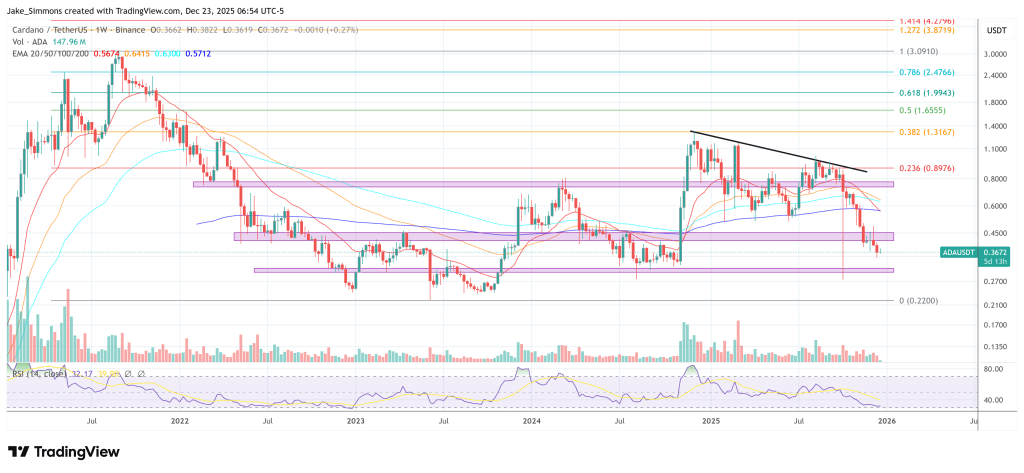
ADA turns support into resistance, 1-week chart | Source: ADAUSDT on TradingView.com

Related Questions

QAccording to Charles Hoskinson, why is it a flawed premise to sell ADA for NIGHT?

AHe argues the premise is flawed because Midnight is designed to extend the Cardano ecosystem, not replace it. They are complimentary systems that do different things, with Midnight acting as a privacy module for Cardano applications.

QWhat analogy does Hoskinson use to describe the Midnight network?

AHoskinson describes Midnight as 'the ChatGPT of privacy,' positioning it as a blockchain-to-blockchain infrastructure module that provides privacy features.

QHow does Hoskinson connect Cardano's UTXO model to attracting Bitcoin capital?

AHe states that Bitcoin's capital is 'agnostic' and will go to wherever yield is most accessible. He claims Cardano is the 'closest continent' for Bitcoin because both use a UTXO model, making it a more natural destination for Bitcoin's yield-seeking capital than account-based chains.

QWhat advantages does Hoskinson say ADA holders have regarding the Midnight (NIGHT) token?

AHe states that ADA holders get first access to all ecosystem initiatives and the largest proportion of the NIGHT airdrop. He also emphasizes that Cardano secures the Midnight network, meaning ADA holders are economically involved and receive NIGHT tokens.

QWhat is Hoskinson's 'value leakage' theory concerning Bitcoin and other cryptocurrencies like ADA?

AHis theory is that large institutional investors are structurally 'stuck' in Bitcoin via ETFs and hold mandates. Therefore, capital spills into other ecosystems not through spot rotation (selling BTC for alts), but through Bitcoin DeFi yield. If Cardano can offer yield in a risk profile institutions tolerate, demand can 'leak' from BTC without investors having to sell their Bitcoin.

Related Reads

After Tokenizing Assets, How to Exit?

After tokenization, a key unresolved issue is providing holders with a reliable exit mechanism, as underlying asset settlement (taking days to months) lags far behind on-chain token settlement. Three primary models for instant liquidity have emerged, differing in their capital structure and efficiency: 1. **Balance Sheet Model (e.g., Grove Basin):** A single, well-capitalized entity (like Sky) provides immediate liquidity from its own reserves. This offers simplicity and deep initial liquidity but is constrained by that single balance sheet's capacity and risk appetite, limiting scalability. 2. **Dedicated Vault Model (e.g., Upshift Clear):** Independent liquidity providers (LPs) fund separate vaults for each supported asset. This decentralizes capital sources but isolates liquidity and capital, which becomes inefficient as the number of tokenized assets grows. 3. **Shared Liquidity Layer Model (Symbiotic Liquid Lane):** Independent capital providers fund shared vaults that can support multiple tokenized assets simultaneously. Capital remains productive between redemptions (e.g., earning yield in DeFi markets). Exits are settled via a competitive RFQ market where market makers bid. The article argues that the shared layer model offers superior capital efficiency and scalability. It transforms exit liquidity from an asset-specific patch into shared market infrastructure, allowing liquidity capacity to grow with overall market participation rather than being fragmented per asset. This is particularly valuable for longer-duration assets like private credit, where reliable T+0 exits can significantly enhance their utility in DeFi.

链捕手3m ago

After Tokenizing Assets, How to Exit?

链捕手3m ago

Anthropic's Triple Moment: Code Leak, Government Confrontation, and Weaponization

This article analyzes Anthropic's recent conflicts and strategic moves following the U.S. government's emergency halt of its new Fable model, citing national security concerns over potential "jailbreaks." The author argues this incident reveals deeper tensions between AI labs, governments, and the software industry. While critics view Anthropic's safety-focused rhetoric as marketing fear, the author suggests it serves as a commercial moat masking the company's core economic imperative: moving closer to end-users and their valuable data to avoid being commoditized. The piece outlines a coming clash between frontier AI labs like Anthropic and established software companies. Labs need real-world usage data for model improvement via reinforcement learning, creating a cycle where better products attract more users and more data. This threatens software firms who, as Microsoft's Satya Nadella warns, risk having their value captured by a few dominant models. Anthropic's controversial policy changes—initially secretly degrading Fable's performance for LLM development and expanding data retention—are framed as assertions of control, justified by its safety narrative. The company's foundational belief that it alone is sufficiently concerned about superintelligent AI dangers legitimizes its actions, from resisting government demands to shaping usage policies. The author concludes that this alignment of mission, talent, and business strategy is powerful but concerning, as it concentrates immense potential power in the hands of those convinced of their own righteous understanding.

marsbit13m ago

Anthropic's Triple Moment: Code Leak, Government Confrontation, and Weaponization

marsbit13m ago

Xpeng and NIO Compete on Computing Power, Li Auto Shifts Architecture

On June 15, 2026, Li Auto unveiled details of its self-developed chip, Mahe M100, for its new L9 Livis model. CTO Xie Yan stated the goal was not just a faster chip, but a fundamentally different one, targeting the chip architecture itself. While competitors like NIO, Xpeng, and Huawei highlight TOPS (computing power) figures for their self-developed chips, Li Auto’s Mahe M100 focuses on redesigning the underlying architecture. It employs a "dynamic data flow architecture" to address memory bandwidth bottlenecks in large model inference, claiming up to 3x the effective computing power of Nvidia's Thor U for its specific workloads and a 40% reduction in latency. The chip's design was peer-reviewed and accepted at ISCA 2026. However, this performance is highly optimized for Li Auto's own VLA2.1 algorithm, meaning it may not generalize as well to other tasks. Li Auto aims to achieve full-stack in-house development with Mahe M100, covering chip, compiler, OS, AI algorithms, and domain controller—a level of vertical integration few competitors match. Beyond the chip, CEO Li Xiang introduced a new strategic narrative: the "embodied intelligent vehicle," defined as an integration of an EV, a professional driver, an AI computer, and a life assistant. This shifts competition from features like large screens to systemic AI capabilities. A key commitment was that Li Auto's Mahe VLA autonomous driving model will match Tesla's FSD V14 by Q4 2026, with specific OTA milestones set for July, September, and December. Financially, Li Auto faces pressure with declining revenue and vehicle gross margins since Q4 2025, while maintaining high R&D investment (approx. ¥12B in 2026, 50% AI-related). Its 2026 sales target is 550,000 vehicles, up from 406,000 in 2025. The new L9 Livis garnered over 10,000 pre-orders in two weeks. The effectiveness of these strategic moves—new products, OTAs, and the novel chip architecture—will begin to show in Q3 2026 financial results, with the year-end FSD V14 benchmark being the ultimate test.

marsbit1h ago

Xpeng and NIO Compete on Computing Power, Li Auto Shifts Architecture

marsbit1h ago

The Year of AI Applications: Saying 'Yes' While Ignoring Risks? A Comprehensive Open Source Log of Software Development's Journey

The Year of AI Applications: Blindly Saying "Yes" While Ignoring Risks? A Software Development Log Goes Fully Open Source. AI-generated code harbors risks hidden within seemingly correct programs, potentially leading to data leaks or asset loss. The open-source project "Narwhal AI Code Risks," from Peking University's Narwhal-Lab, compiles real-world cases, early warning signs, and typical risk pathways. Its goal is to help developers identify potential hazards early and avoid repeating past mistakes. In 2026, code is generated faster than ever but deployed with less scrutiny. The danger often lies not in glaring errors, but in code that appears normal—syntactically correct, passing all checks—yet introduces subtle but critical flaws like non-existent dependencies, excessive permissions, or exposed databases. A stark example is the Moonwell cbETH oracle incident. A configuration file error, where a cryptocurrency price was set to ~$1.12 instead of ~$2,200, slipped through 28 checks and a pull request signed by both AI (Claude, Copilot) and human developers. This "semantic deviation" resulted in a loss of $1.78 million. The risk is that AI can produce functionally valid code that is semantically wrong for the business context. As AI moves beyond simple code completion to modifying configurations, installing dependencies, and operating via autonomous agents, it traverses longer, less traceable paths within software engineering, blurring traditional boundaries and oversight points. The Narwhal AI Code Risks project structures information into three layers: `/cases` for documented real-world incidents, `/inferred` for early warning signals, and `/scenarios` for clear, generalized risk patterns not yet tied to specific events. This aims to create a lasting, public record to prevent collective amnesia about past AI-coding pitfalls. Risks are categorized into seven areas: Software Supply Chain (e.g., recommending fake packages), Code-Level Vulnerabilities (e.g., reintroducing path traversal bugs), Cloud & Infrastructure Misconfiguration (e.g., overly permissive settings), Agent Risks (from autonomous tool execution), Vertical Domain Risks (e.g., in finance, healthcare), Intellectual Property & Compliance issues, and Human Factors (like over-reliance on AI output). The project's core value is transforming isolated incidents into reusable knowledge—a foundational resource for developers to spot similar issues, for security researchers to build upon, for toolmakers to create detection rules, and for the community to contribute new findings. As AI integration accelerates, this open-source "logbook" serves as a crucial navigational aid, charting past errors to help future projects steer clear of the same traps.

marsbit1h ago

The Year of AI Applications: Saying 'Yes' While Ignoring Risks? A Comprehensive Open Source Log of Software Development's Journey

marsbit1h ago

Trading

Spot
Futures

Hot Articles

Discussions

Welcome to the HTX Community. Here, you can stay informed about the latest platform developments and gain access to professional market insights. Users' opinions on the price of ADA (ADA) are presented below.

活动图片