Cardano Founder Calls For Insider Recusal In Liqwid Governance Dispute

bitcoinistPublished on 2026-03-16Last updated on 2026-03-16

Abstract

Cardano founder Charles Hoskinson has intervened in a governance dispute at DeFi protocol Liqwid, urging insiders to recuse themselves from a revote on the distribution of nearly $1 million in NIGHT tokens. The conflict centers on whether the protocol should honor prior public commitments to return all assets deposited in its smart contracts. Hoskinson argued that DAO legitimacy depends on broad participation and trust, not just a vote, especially when insiders could directly benefit from the outcome. He warned that failing to address the perceived breach of trust could severely damage Liqwid's credibility and growth, and recommended a new vote focused solely on whether to honor the original promises.

Cardano founder Charles Hoskinson has weighed in on a governance dispute surrounding Liqwid, arguing that insiders tied to the protocol should step aside from any revote on disputed asset distribution and let token holders decide whether earlier public commitments should be honored. His intervention matters because it cuts to a familiar pressure point in DeFi governance: whether a DAO vote is truly legitimate when founding insiders may be voting on an outcome that benefits them directly.

In a livestream from Wyoming, Hoskinson said he generally avoids involvement in the DeFi layer of the Cardano ecosystem unless there is a broader community mandate. But he said the Liqwid situation had crossed into a more serious issue of trust after October representations that “100% of the assets in the smart contracts” allocated to the protocol would be returned to their “rightful owners.”

The dispute centers on a sizeable pool of Midnight’s NIGHT tokens tied to Liqwid’s ADA market. Public governance materials indicate the allocation totals roughly 18.81 million NIGHT, which at current market prices is worth just under $1 million. That helps explain why the vote has drawn so much attention: the argument is not over a symbolic governance gesture, but over the handling of a seven-figure crypto allocation that users say was supposed to be fully returned.

Cardano Founder Urges Second Liqwid Vote

According to Hoskinson, the team later ran into a governance and legal problem inside the DAO structure itself. “I guess that team did not have, according to the user agreement of their DAO, legal authorization to do so,” he said. “It somehow violated the terms of how they’ve set things up.” Even granting that point, he argued, the more troubling issue was how the matter was then handled.

His proposed fix was straightforward: rerun the vote, but on narrower and cleaner terms. “If you have to go to the DAO for a vote, two things should be done,” Hoskinson said. “First and foremost, those who are insiders should recuse themselves if they’re going to be direct beneficiaries of a governance action of this nature. Second, the question should have been, should we honor our marketing commitments, yes or no?”

That framing goes to the heart of his criticism. In Hoskinson’s telling, users deposited funds into the relevant smart contracts on the understanding that the prior commitments would be respected. “Commitments were already made, people put money into the contracts understanding those terms and conditions and had no reasons to believe that such things would be violated,” he said. “People in a position of trust and people in a position to maintain this type of software, they frankly speaking should be a little bit better.”

Hoskinson repeatedly returned to legitimacy, not just procedure. DAOs, he said, do not derive credibility from the mere existence of a vote. They derive it from broad participation and confidence that the process is not tilted by a small cluster of insiders. “DAOs require legitimacy and the legitimacy comes from participation,” he said. “If the belief is that participation is only controlled by a small group of insiders, there’s no path forward for a DAO to have governance legitimacy.”

His recommendation was for insiders associated with the protocol’s core entities to publicly declare their holdings, recuse themselves, and let holders vote only on whether the October commitments should be honored. If the answer is yes, then the protocol should simply follow through. If the answer is no, then the community could move to a second-stage debate over alternative allocations.

Hoskinson was equally clear about the stakes if that does not happen. He said he has no special powers to reverse the outcome, no control over assets already distributed into smart contracts, and no formal authority over the Cardano ecosystem. But he warned that perception alone could do lasting damage.

“It is my belief that this violation of public trust or at least the perception of it will badly damage the protocol’s ability, Liqwid’s ability to grow and thrive in the future,” he said. “Simply put, if people can’t trust what the core accounts are saying and when votes are taken, people don’t trust those votes, it creates a reality where people will just simply move to other options.”

Overall, if Liqwid wants to restore credibility, he argued, the path is still open. But it runs through disclosure, recusal and a cleaner vote.

At press time, Cardano traded at $0.29.
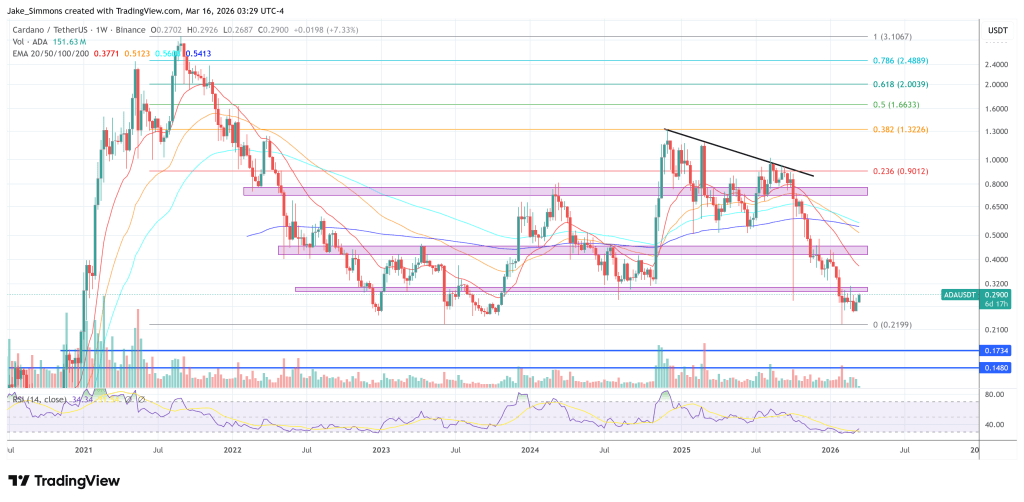
Cardano hovers below key resistance, 1-week chart | Source: ADAUSDT on TradingView.com

Related Questions

QWhat is the core issue in the Liqwid governance dispute that Charles Hoskinson is addressing?

AThe core issue is whether insiders tied to the Liqwid protocol should be allowed to vote on a disputed asset distribution that could directly benefit them, and whether a prior public commitment to return 100% of assets in smart contracts to their rightful owners should be honored.

QWhat specific solution did Charles Hoskinson propose to resolve the Liqwid governance dispute?

AHoskinson proposed rerunning the vote with two key changes: first, insiders who are direct beneficiaries should recuse themselves; second, the vote should ask a clear yes or no question on whether the protocol should honor its prior marketing commitments.

QAccording to Hoskinson, what is the source of a DAO's legitimacy in governance?

AHoskinson stated that a DAO's legitimacy comes from broad participation and the confidence that the process is not controlled or tilted by a small group of insiders, not merely from the existence of a vote.

QWhat is the approximate value of the disputed NIGHT token allocation at the center of this controversy?

AThe disputed allocation is roughly 18.81 million NIGHT tokens, which at current market prices is worth just under $1 million.

QWhat potential consequence did Hoskinson warn about if the trust issue in Liqwid governance is not properly addressed?

AHoskinson warned that the violation of public trust, or even the perception of it, would badly damage Liqwid's ability to grow and thrive in the future, as users would lose trust in core accounts and governance votes, leading them to move to other options.

Related Reads

TechFlow Intelligence: Trump-Linked Companies Transfer $12 Million in Assets Before China Visit, 'The Big Short' Protagonist Warns of Stock Market Bubble Again

The article reports multiple developments across tech, crypto, and finance. In AI, Mozilla used AI for large-scale code review, Google confirmed hackers used AI to find zero-day exploits, and OpenAI deployed GPT-5.5 to find errors in math benchmarks. A court ruled Anthropic's scanning and destroying books for AI training as fair use, while its Claude platform launched on AWS. Google's new video model 'Omni' was leaked. In crypto/Web3, Trump-linked companies transferred $12M in crypto assets before a China visit. BlackRock chose Ethereum for tokenized funds, and a hacker stole $174k via a malicious NFT that tricked an AI. Jack Dorsey's first tweet NFT plummeted from $2.9M to under $5. In chips/hardware, TSMC approved an additional $20B for its Arizona plant. Apple's Tim Cook and Elon Musk will accompany Trump to China, while Nvidia's Jensen Huang is notably absent. For markets, Michael Burry warned of parabolic stock rises and suggested near-total sell-offs, with online discussions comparing current sentiment to the 1999 bubble. Other notes include WTI oil surpassing $100, a 20% price hike for Beijing-Shanghai high-speed rail, and new products like Unitree's $26.9k humanoid robot. The underlying theme suggests AI is becoming infrastructure, creating pressure on old systems while a new order is not yet ready, leaving investors anxious.

marsbit5m ago

TechFlow Intelligence: Trump-Linked Companies Transfer $12 Million in Assets Before China Visit, 'The Big Short' Protagonist Warns of Stock Market Bubble Again

marsbit5m ago

2026 New Policy Interpretation: The "Mutual Pursuit" of Intelligent Agents and AI Terminals, and the Three Major Value Reconstructions in the AIoT Industry

In May 2026, China's national ministries released two pivotal policy documents that jointly establish a strategic "dual-track" framework for the AIoT industry. The "Intelligent Agent Standardized Application and Innovation Development Implementation Opinions" defines the "soul"—positioning intelligent agents as core AI products. The "Artificial Intelligence Terminal Intelligence Grading" national standard defines the "body"—establishing a four-tier capability ladder (L1 to L4) for AI hardware. This synchronized policy approach is globally unique, moving beyond market-led (US) or risk-focused (EU) models. It frames AIoT as a new type of "intelligent infrastructure," comparable to electricity or the internet in historical significance. The core analysis identifies a value evolution from IoT 1.0 (connection) to AIoT 4.0 (collaboration, represented by the forward-looking L4 level). This "L4" signifies a paradigm shift: from users operating tools to delegating tasks to agent-like devices ("Intelligent Action of All Things"). The article outlines three strategic paths for companies: becoming Standard Definers, Scenario Integrators (focusing on 19 specified application areas), or Infrastructure Builders. A critical 18-24 month window is identified for strategic positioning. A "Four Levers" strategy is proposed: leveraging Standards (L-level certification), leveraging Scenarios (deep vertical focus), leveraging Open Source (for cost reduction and ecosystem influence), and leveraging Momentum (engaging in global protocol ecosystems). In conclusion, these policies are a starting gun for a decade-long industrial transformation, shifting the industry narrative from "Intelligent Connection of All Things" to "Intelligent Action of All Things," with companies needing to choose their赛道and execution strategy decisively.

marsbit1h ago

2026 New Policy Interpretation: The "Mutual Pursuit" of Intelligent Agents and AI Terminals, and the Three Major Value Reconstructions in the AIoT Industry

marsbit1h ago

Splashing Out 27 Billion Yuan, OpenAI Establishes New Company to Accelerate AI Deployment

On May 11th, OpenAI announced the formation of a new company, "OpenAI Deployment Company," with an initial investment of over $4 billion (approximately 27.2 billion RMB). This venture aims to help businesses build and deploy AI solutions. OpenAI is also acquiring the AI consulting firm Toromo to rapidly scale the deployment company's capabilities. This new entity, majority-owned by OpenAI, brings together 19 investment, consulting, and system integration partners, led by TPG with co-lead founding partners including Advent International, Bain Capital, and Brookfield. OpenAI's Chief Revenue Officer, Denise Dresser, stated that while AI is becoming increasingly capable, the current challenge lies in integrating these systems into core business infrastructure and workflows. The deployment company is designed to bridge this gap and translate AI capabilities into operational impact. This move comes as OpenAI emphasizes the next competitive phase will depend on the efficiency of deploying AI in real business scenarios. The company reports over 1 million businesses already use its products and APIs. OpenAI is significantly increasing its investments in computing power, with co-founder Greg Brockman stating the company expects to spend $50 billion on compute this year, a dramatic increase from $3 million in 2017. The announcement follows OpenAI's recent completion of a record $122 billion funding round in late March, led by Amazon, Nvidia, and SoftBank, valuing the company at $852 billion post-money. Major strategic investors committed $110 billion as a base for this round. Concurrently, OpenAI is advancing its core model development. It has shifted focus from its Sora video generator to developing advanced robotics and AI models that interact with the physical world. It has also begun allowing select users access to a new model specialized in identifying software vulnerabilities and is reportedly preparing to launch an enhanced image generation model in the coming weeks. According to reports citing founder Sam Altman, OpenAI is considering an IPO as early as 2027, with a potential valuation around $1 trillion.

marsbit1h ago

Splashing Out 27 Billion Yuan, OpenAI Establishes New Company to Accelerate AI Deployment

marsbit1h ago

Trading

Spot
Futures

Hot Articles

Discussions

Welcome to the HTX Community. Here, you can stay informed about the latest platform developments and gain access to professional market insights. Users' opinions on the price of ADA (ADA) are presented below.

活动图片