Cardano Brings Pyth Oracles On-Chain In First Pentad Integration

bitcoinistPublished on 2025-12-12Last updated on 2025-12-12

Abstract

Cardano has announced its first major integration under the new "Pentad" governance structure, bringing Pyth's Lazer oracle to the blockchain by early 2026. This marks a strategic shift from building in-house oracle solutions to adopting established external infrastructure. Pyth provides ultra-low latency, institutional-grade market data across thousands of price feeds, which is used by hundreds of DeFi applications globally. Charles Hoskinson emphasized that this integration connects Cardano to broader cryptocurrency information networks and is just the first of many planned critical integrations—including bridges, stablecoins, and analytics—aimed at making Cardano a more viable DeFi platform. The move signals a focus on execution and infrastructure readiness as Cardano positions itself for growth in 2026.

Cardano is finally doing the unsexy but absolutely necessary plumbing work: getting serious, external oracle infrastructure wired in, with a governance wrapper that looks a lot more like “adult supervision” than the old ad-hoc ecosystem scramble.

On a Dec. 11 livestream, Charles Hoskinson said the ecosystem’s new “Pentad” structure — the coordination bloc spanning Input Output, the Cardano Foundation, EMURGO, the Midnight Foundation, and Intersect — has approved its first major integration under the “critical integrations” framework: bringing Pyth’s Lazer oracle to Cardano, with deployment targeted for early 2026.

Pyth Deal Kicks Off Cardano’s Critical Integrations Push

“This is the appetizer announcement,” Hoskinson said, framing Pyth as the first of what he expects to be a broader menu: bridges, stablecoins, analytics, custodians — the stuff that turns a chain into a DeFi venue people actually build on, not just a community that argues about roadmaps.

Hoskinson didn’t really sugarcoat why this matters. “Oracles are really the first part of major integrations,” he said, because you need reliable data coming in and you need credible pathways to the rest of the industry. He also admitted the in-house approach hasn’t landed the way it should’ve: Cardano “tried to build an indigenous oracle solution and it hasn’t worked out as well as it should.” So [...] Pyth. That’s the pivot.

Pyth, in its own marketing, has been pushing Lazer as an ultra-low latency product designed for speed-sensitive trading use cases — basically, price updates fast enough that perps and other twitchy DeFi apps don’t feel like they’re operating on last cycle’s data. Hoskinson called Pyth “one of the most advanced Oracle solutions on market,” and emphasized the practical angle: lots of feeds, lots of publishers, and broad distribution across chains.

Intersect’s announcement (the one Hoskinson pulled up mid-stream) from X states: “One of the first concrete outcomes of the Critical Cardano Integrations workstream is now in place! The Steering Committee [...] has approved the first major integration under this framework: bringing Pyth Lazer oracle to Cardano. Pyth provides low-latency, institutional-grade market data across thousands of price feeds spanning crypto, equities, FX, commodities and ETFs, already used by hundreds of DeFi applications across 100+ blockchains to power trading, lending and risk management.”

Hoskinson argued, “[Pyth] effectively attaches Cardano now to the information networks of the entire cryptocurrency space.” He said the team is already exploring whether it can switch parts of the ecosystem — including Djed — over to Pyth, and he wants Cardano dapp teams to seriously evaluate the integration once it’s available.

“Pyth is just the appetizer in the Cardano critical integrations,” he said. “There are many more things to come.”

The broader context is that Cardano’s new “Pentad” has been positioning “critical integrations” as a coordinated, treasury-backed effort to “prime Cardano for 2026,” including a budget proposal tied to ecosystem-wide enablers. If Pyth is the first concrete output, it’s also a signal the Pentad model is going to be judged on execution, not vibes.

Hoskinson, closing out, put it in his usual rally language: “Cardano is not an island anymore [...] the cavalry has come.” The market can do what it wants in the short term. But getting credible oracle rails in place is the kind of boring upgrade that tends to matter later — when teams are deciding where to deploy, and where liquidity is willing to live.

At press time, ADA traded at $0.4253.
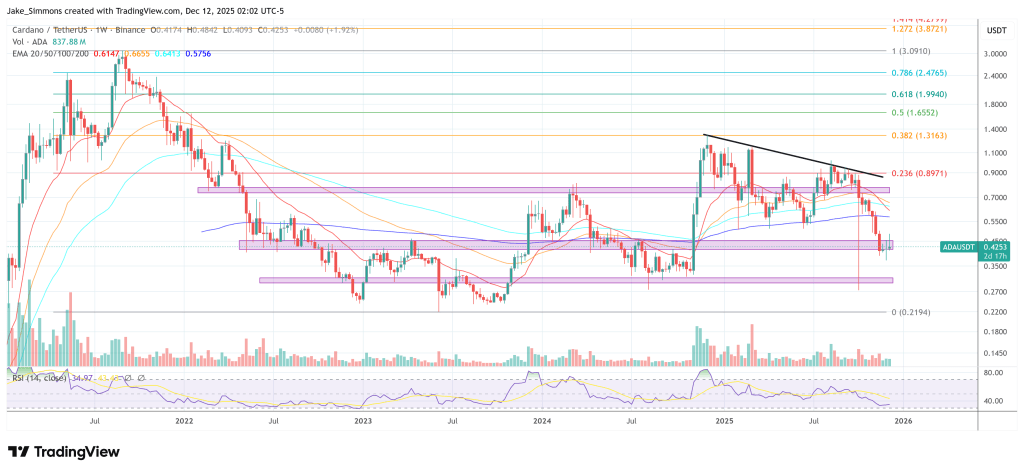
ADA bounces from key support, 1-week chart | Source: ADAUSDT on TradingView.com

Related Reads

Imbalance in Returns Amid High Correlation: Why is Capital Being 'Squeezed Out' of Altcoins?

Over the past year, a stark divergence has emerged between cryptocurrency and U.S. equity markets. While the S&P 500 and Nasdaq 100 have posted significant gains, altcoins have experienced a severe downturn, indicating a structural shift of capital toward higher-quality assets. Major indices like the S&P 500 and Nasdaq 100 rose substantially in 2024 and 2025 with relatively low drawdowns. In contrast, the CoinDesk 80 Index, tracking altcoins outside the top 20 cryptocurrencies, plummeted over 46% in Q1 2025 and was down 38% year-to-date by mid-July. A key driver is the "return imbalance under high correlation." Despite a correlation of 0.9 between major cryptocurrencies (CoinDesk 5 Index) and altcoins (CoinDesk 80), their returns diverged drastically. The former gained 12-13%, while the latter fell nearly 40%. The risk-adjusted return gap is even wider. Altcoin indices showed volatility similar to or higher than equities but delivered deeply negative returns and negative Sharpe ratios. Over five years, a small-cap crypto index returned -8%, while a large-cap index surged 380%. Trading data shows capital is not exiting crypto but flowing up the quality curve. Volume is concentrating in the top 10 altcoins and "institutional-grade" assets like Solana and XRP with regulatory clarity. Bitcoin and Ethereum ETFs are attracting sustained institutional inflows. Consequently, diversification into altcoins has lost its appeal. Their high correlation with major cryptos negates diversification benefits while adding risk. The market's logic has shifted: capital is now focused on regulated, liquid assets, squeezing out lower-quality altcoins.

marsbit12m ago

Imbalance in Returns Amid High Correlation: Why is Capital Being 'Squeezed Out' of Altcoins?

marsbit12m ago

Vision Announces Bitget Listing of VSN Token, Continuing International Expansion

Vision, a Bitpanda-backed protocol focused on bringing Europe into blockchain, has announced that its token VSN will be listed on Bitget. This marks another step in Vision’s international expansion, following its earlier listing on Binance Alpha. The Bitget listing is expected to enhance VSN’s liquidity and visibility in the global spot market, offering users another entry point to participate in the Vision ecosystem and its growing Web3 infrastructure. Florian Klein, Head of Business at Vision, stated that the move reflects the project’s rapid scaling momentum. VSN powers both the Vision and Bitpanda ecosystems, supporting staking, offering fee benefits, and enabling future governance. A portion of ecosystem revenue will be used for buybacks, burns, and staking rewards, allowing token holders to benefit from ecosystem growth. Vision is building a suite of Web3 products tailored to European regulations while remaining globally relevant. Its core offerings include the Bitpanda DeFi Wallet, Vision Protocol, Launchpad, and the upcoming Vision Chain for tokenization and institutional-grade on-chain infrastructure. Looking ahead, Vision plans to introduce governance, expand token utility, launch its chain, and form partnerships in tokenization and regulated digital assets. The Vision Web3 Foundation, based in Zug, Switzerland, oversees the development and governance of the VSN token.

深潮22m ago

Vision Announces Bitget Listing of VSN Token, Continuing International Expansion

深潮22m ago

Trading

Spot
Futures
活动图片