Can RAIN crypto recover as $10M sell-off sparks downside fears?

ambcryptoPublished on 2026-03-28Last updated on 2026-03-28

Abstract

RAIN Protocol (RAIN) experienced a sharp decline of over 17% in 24 hours, significantly underperforming the broader crypto market. Despite support from Enlivex as its Digital Asset Treasury, the token faced heavy selling pressure, including a $10 million sell-off by a large holder. RAIN broke below a key support level at $0.0082, with high volatility and increased sell volume raising concerns of a further drop toward a $3.5 billion market cap. However, a swift recovery followed, and a reclaim of $0.0082—or a break above $0.0092—could invalidate the bearish outlook. Institutional buying contrasted with retail and whale selling, highlighting mixed market sentiment.

Rain Protocol [RAIN], a decentralized prediction markets protocol, has lost more than 17% in the past 24 hours as of writing. This was the case even though the protocol was supported by Enlivex [Nasdaq: ENLV] as the Digital Asset Treasury (DAT), which aided in the shift to capital markets.

Historical performance of RAIN crypto

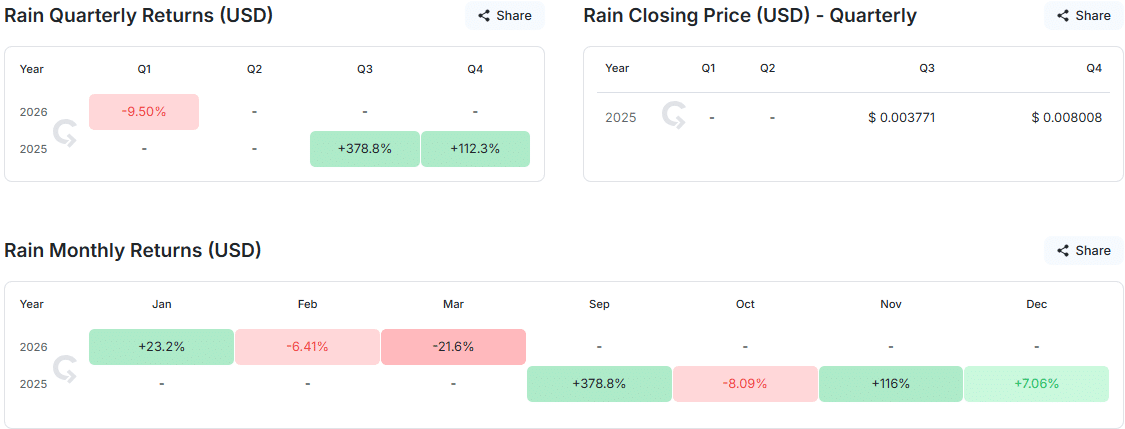
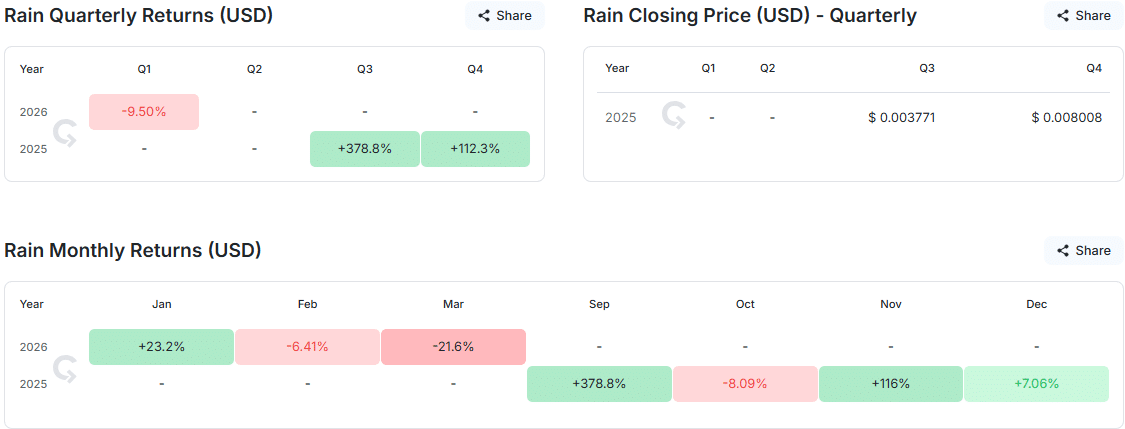
While the overall market fell by around 3%, RAIN fell by double digits. The altcoin fell by 9.5% in Q1 2026, after rising in the third and fourth quarters of 2025.

In Q3, the altcoin rose by more than 378% as Q4 closed 112% higher. For the first quarter of 2026, only January has been bullish, where RAIN recorded 23% in gains, as February and March lost 6.41% and 21.6%, respectively.
Source: CryptoRank

While the altcoin’s price continues to crash, it still commands a significant market cap of around $3.89 billion. Will the market cap continue to fall as sell volume rises to $46 million?

RAIN price loses a KEY support level

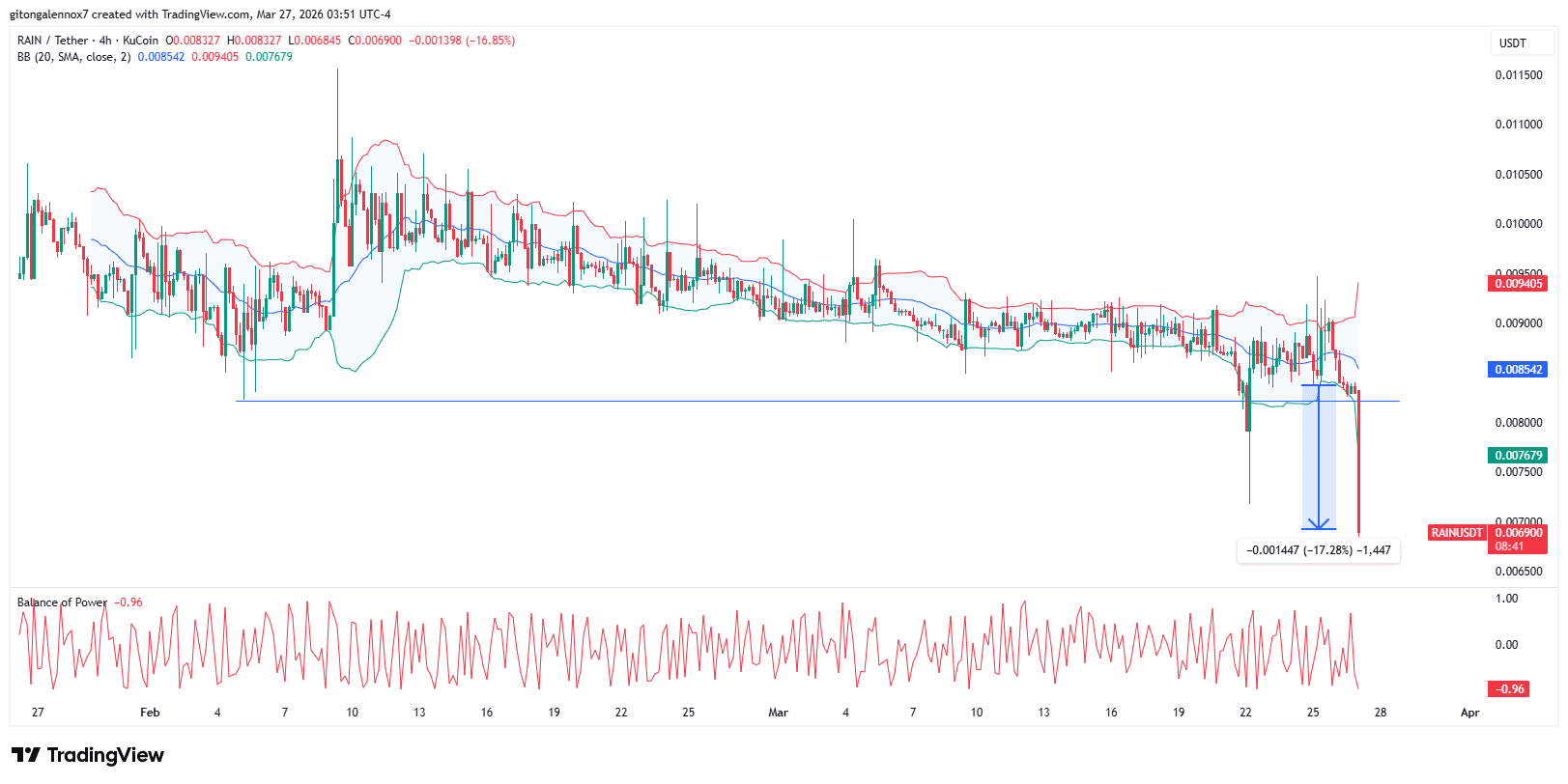
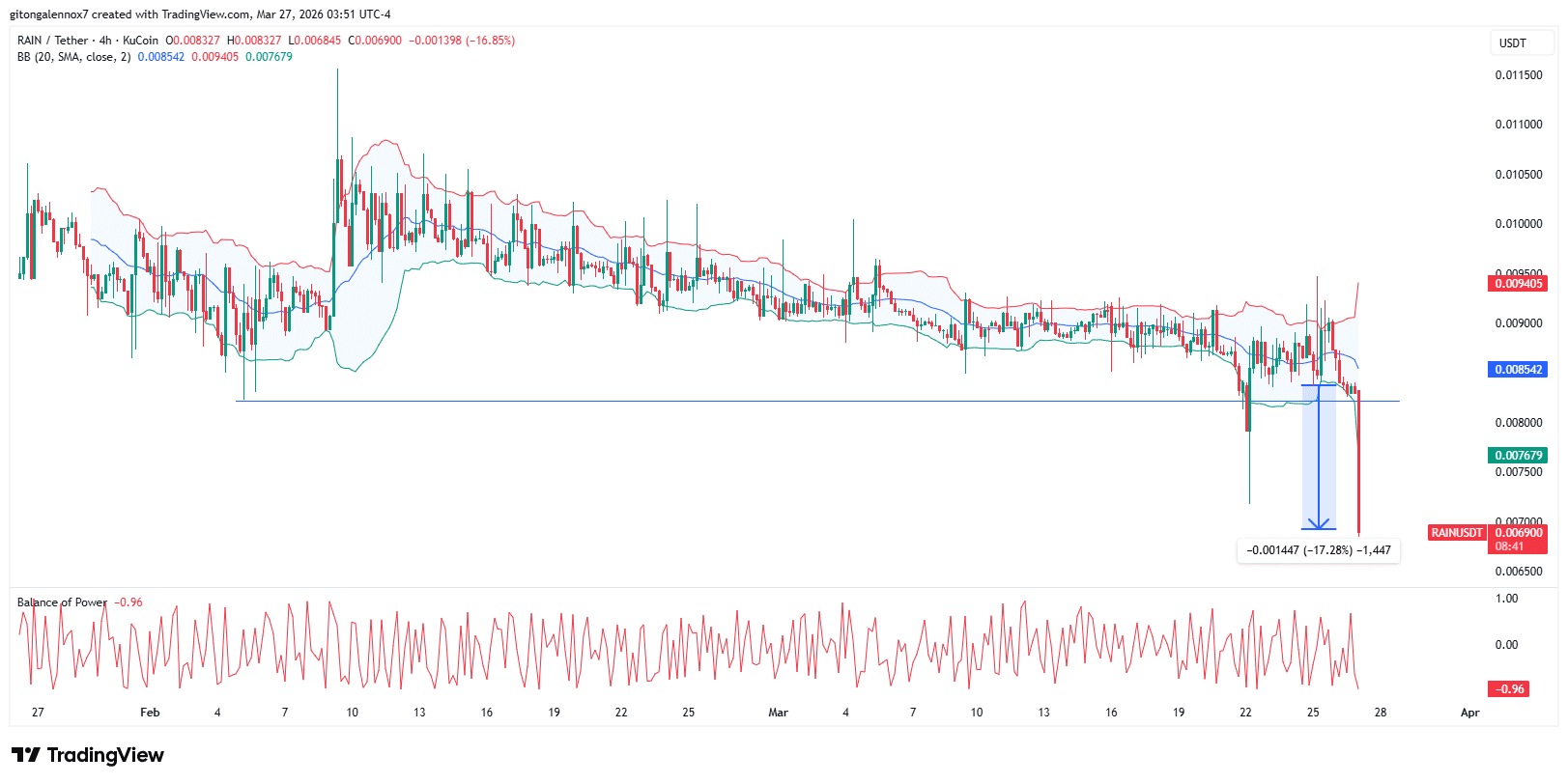
On the charts, the altcoin has been trading inside a consolidation since the beginning of February. The Bollinger Bands (BB) had been tight during this period and expanded upon breakdown below $0.0082.

The Balance of Power indicator was choppy and in the negative territory with a reading of 0.96. This reading was an indication that sellers were the stronger force at the time of writing.

Now, holding below the key support level at $0.0082 while volatility stays high would push the cap toward $3.5 billion.

Conversely, a reclaim of this level alongside the middle band of the BB would invalidate the outlook. Therefore, it would be deemed a fakeout, turning the structure bullish if RAIN breaks above $0.0092.
Source: RAIN/USDT on TradingView

This is because bulls rejected the breakdown, resulting in a strong green candle. However, RAIN had to maintain the rebound momentum to invalidate the structure break.

What accelerated selling pressure?

Meanwhile, it’s worth noting what was behind this sharp drop that was swiftly recovered. For instance, the daily token volume has been rising for the past week, with the high being $28.84 million.

The data showed that the volume came from sellers as the price dropped. For its Total Value Locked (TVL), it remained flat around $4 million since the start of February.
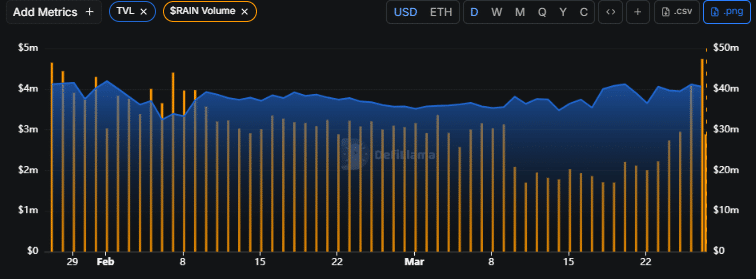
Source: DefiLlama

To be specific, the selling of tokens was driven mainly by the Token Millionaire wallet. As per Nansen AI, more than $10 million in RAIN was offloaded as the portfolio’s valuation dropped from $80 million to $69 million.
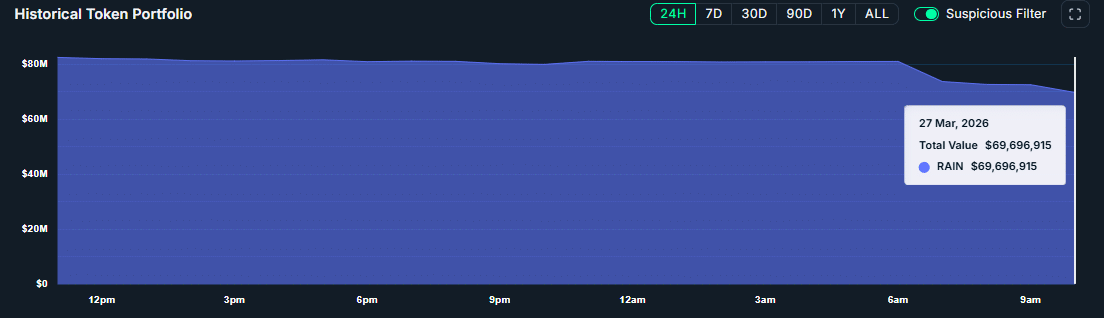
Source: Nansen AI

The volume data showed that the selling pressure came from big holders and retailers. However, institutions like Enlivex were buying, even reporting profits of $1.23 billion following their treasury around the Rain Protocol.


Final Summary

  • RAIN loses 17% of its market cap, but price action recovers swiftly shortly after.
  • The next price move for RAIN depended on its reaction around $0.0082 and $0.0092.

Related Questions

QWhat was the percentage decrease in RAIN crypto's value in the past 24 hours as mentioned in the article?

ARain Protocol [RAIN] lost more than 17% in the past 24 hours.

QAccording to the article, what was the key support level that RAIN's price lost on the charts?

AThe key support level that RAIN lost was $0.0082.

QWhat specific event accelerated the selling pressure, causing a sharp drop in RAIN's price?

AThe selling pressure was accelerated by a Token Millionaire wallet offloading more than $10 million worth of RAIN tokens.

QDespite the sell-off, which institution was reported to be buying RAIN and even making a profit?

AInstitutions like Enlivex were buying RAIN and reported profits of $1.23 billion from their treasury involvement with the Rain Protocol.

QWhat are the two critical price levels that will determine RAIN's next price move, as per the article's analysis?

AThe next price move for RAIN depends on its reaction around the $0.0082 and $0.0092 price levels.

Related Reads

BIT Research: Liquidity is Disappearing, Will Bitcoin Replay the Bottoming Pattern of 2022?

The crypto market is currently in an adjustment phase driven by policy expectations and liquidity shifts. Despite a brief rebound fueled by geopolitical easing and SpaceX's strong IPO performance, unexpectedly hawkish signals from new Fed Chair Kevin Warsh have removed anticipated easing support. Concurrently, stablecoin liquidity is shrinking, with insufficient new capital inflows, pushing the market into a typically quiet summer period. Pricing lacks catalysts for a sustained rally. Daily trading volume has significantly contracted, stablecoin growth has slowed markedly, and the supportive effect of Strategy's (formerly MicroStrategy) STRC preferred stock-financed Bitcoin purchases is fading. Amid policy uncertainty, seasonal weakness, and liquidity contraction, Bitcoin faces near-term downward pressure. Warsh's hawkish pivot and refusal to provide a clear policy outlook have increased risk premiums, historically unfavorable for Bitcoin. Technically, the trend remains bearish below $73,700, with $62,446 as critical support. A break below could accelerate declines, though a prolonged consolidation phase, similar to 2022's bottoming process, is possible. Liquidity is a core constraint. Current daily volume is around $500 billion, roughly 25% of the peak during the July-Oct 2025 rally. The 12-month growth rates for USDT and USDC have fallen to ~20%, with 6-month growth near zero, indicating weak new inflows. Bitcoin ETF and Strategy-driven inflows have also weakened, with a 30-day rolling net outflow. With inflation at 4.2% above the Fed's target, combined hawkish policy, seasonal factors, and liquidity shortages challenge Bitcoin's ability to hold above $60,000. However, this adjustment phase may be forming a cyclical low this summer, potentially setting the stage for the next bull cycle.

marsbit19m ago

BIT Research: Liquidity is Disappearing, Will Bitcoin Replay the Bottoming Pattern of 2022?

marsbit19m ago

Who Makes the Best Use of Claude Code? The Answer Might Not Be Programmers

Claude Code Usage Report Summary (Based on ~400k sessions) Core Finding: In agentic programming with Claude Code, a clear division of labor has emerged: humans primarily decide *what* to build (planning decisions), while Claude decides *how* to build it (execution decisions). Key Insights: 1. **Effectiveness is not limited to programmers.** In code-generation tasks, success rates for users in non-technical fields (law, finance, management, research) are nearing those of software engineers. What matters most is the user's domain expertise and understanding of the problem to be solved. 2. **Domain expertise drives success and efficiency.** Sessions where users exhibited "expert" proficiency in the task's domain saw verified success rates double compared to "novice" sessions. Experts also delegated more work per instruction, with Claude executing more actions and producing more output. 3. **AI is amplifying, not replacing, domain knowledge.** Claude Code lowers the *implementation* barrier, not the *judgment* barrier. The value of knowing the "what" and "why" is increasing relative to just knowing the "how" to code. 4. **Usage is evolving.** Over a 7-month period (Oct '25 - Apr '26), the share of sessions for debugging halved, while use for software operations, data analysis, and non-code writing roughly doubled. The estimated economic value of typical tasks increased by ~25%. Conclusion: The data suggests coding agents are making programming background less critical for completing technical tasks. However, they reward and amplify deep domain understanding. The ability to successfully direct an AI agent stems more from mastery of a specific field than from coding skill itself. The primary gains come from being competent in a domain; deep specialization adds only marginal additional advantage. This may signal a shift where software creation becomes integrated into various professions.

marsbit54m ago

Who Makes the Best Use of Claude Code? The Answer Might Not Be Programmers

marsbit54m ago

Trading

Spot
Futures
活动图片