BYDFi Perpetual Futures Data Now Live on TradingView

TheNewsCryptoPublished on 2026-03-12Last updated on 2026-03-12

Abstract

BYDFi has integrated its perpetual futures market data into TradingView, allowing traders to access real-time pricing and market signals directly within the TradingView charting environment. This integration streamlines workflows by enabling users to monitor price action, volume, and market trends for over 500 perpetual contracts—including BTCUSDT—without switching platforms. BYDFi, which serves over one million users globally and holds regulatory licenses in the U.S. and Canada, emphasizes high-leverage trading (up to 200x), transparency through Proof-of-Reserves, and user protection measures. Traders can now analyze BYDFi derivatives data using TradingView’s technical tools for more informed decision-making.

Victoria, Seychelles, March 12th, 2026, Chainwire

BYDFi announced the integration of its perpetual futures market data into TradingView, enabling traders to access real-time pricing and crypto market signals directly within TradingView charts. The integration supports more efficient workflows by bringing BYDFi derivatives data into a familiar charting environment used by traders worldwide for crypto futures analysis.

Market Signals in View, Strategy in Sync

With BYDFi perpetual futures data available on TradingView, users can monitor price action, volume dynamics, and market structure signals on TradingView while keeping their chart workflow anchored to BYDFi as the data source, ranging from BTCUSDT perpetual futures price action to broader trends across crypto derivatives markets. This reduces context switching for active traders who rely on technical indicators, pattern tools, and multi-timeframe analysis.

BYDFi, Built for Active Derivatives Traders

  • Derivatives Depth and Execution: With a derivatives lineup designed for different risk preferences and trading approaches, BYDFi supports 500 plus perpetual contracts with leverage options up to 200x, backed by advanced execution and risk controls for high leverage crypto trading, helping users approach perpetual contracts trading in a more structured way.
  • Global Scale and Responsible Participation: Founded in 2020, BYDFi serves over 1,000,000 users across 190+ countries and regions. BYDFi holds MSB licenses in the U.S. and Canada and is a member of South Korea’s CODE VASP Alliance, reflecting an ongoing focus on operational transparency and responsible market participation.
  • Support and Safeguards for Users: Maintaining over 1:1 Proof-of-Reserves with periodic public reporting, BYDFi prioritizes transparency alongside an 800 BTC Protection Fund. 24 by 7 multilingual customer support and timely responses across official channels, including social media, reinforce BYDFi’s user first service standard.

How to Access BYDFi Perpetual Futures Data on TradingView

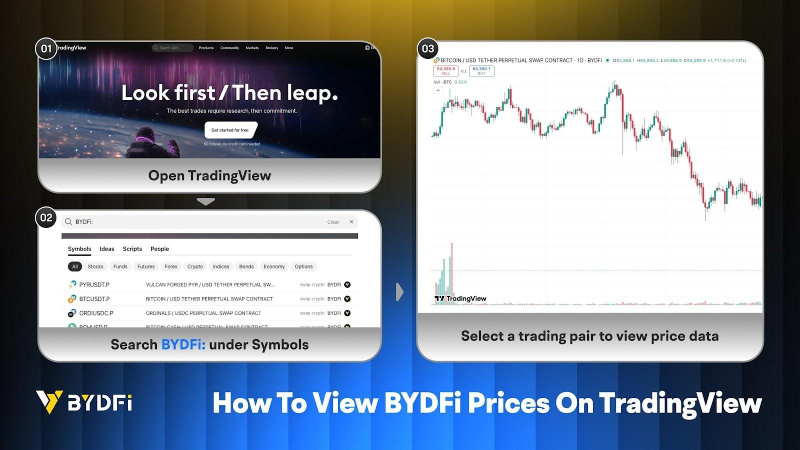
Users can view BYDFi perpetual futures market data on TradingView in a few quick steps:

  1. Open Symbol Search on TradingView and enter BYDFi.
  2. View the full list of available perpetual futures contracts.
  3. Select a trading pair to view live price data and use TradingView’s analysis tools to refine your market view and timing.
Michael, Co-founder and CEO of BYDFi, commented: TradingView is one of the most widely used charting platforms for traders. Bringing BYDFi perpetual futures market data into TradingView helps traders streamline analysis and stay closer to the signals that matter. BYDFi will continue improving infrastructure, product depth, and user protections to support more informed decision making in fast moving markets.

About BYDFi

Established in 2020, BYDFi is a global crypto trading platform that combines the power of a centralized exchange (CEX) with its on-chain trading engine, MoonX. BYDFi is Newcastle United’s Exclusive Official Crypto Exchange Partner. Recognized by Forbes as one of the Best Crypto Exchanges In Canada For 2026, BYDFi offers intuitive, low-fee trading across Spot and Perpetual Contracts to Copy Trading, and Automated Crypto Trading Bots, empowering both new and experienced traders to navigate digital assets with confidence.

BYDFi is dedicated to delivering a world-class crypto trading experience for every user.

BUIDL Your Dream Finance.

  • Website: https://www.bydfi.com
  • Support email: cs@bydfi.com
  • Business partnerships: bd@bydfi.com
  • Media inquiries: media@bydfi.com

Twitter( X ) | LinkedIn | Telegram | YouTube | TikTok | How to Buy on BYDFi

Contact

Senior Marketing Director
Chloe
BYDFi Fintech LTD
chloe@bydfi.com

Related Questions

QWhat is the main announcement in the article regarding BYDFi and TradingView?

ABYDFi has integrated its perpetual futures market data into TradingView, allowing traders to access real-time pricing and crypto market signals directly within the TradingView charting platform.

QWhat are some of the key features BYDFi offers for derivatives traders as mentioned in the article?

ABYDFi offers over 500 perpetual contracts with leverage options up to 200x, advanced execution and risk controls, and is designed to support different risk preferences and trading approaches.

QWhich regulatory licenses and memberships does BYDFi hold according to the article?

ABYDFi holds MSB licenses in the U.S. and Canada and is a member of South Korea’s CODE VASP Alliance.

QHow can a user access BYDFi's perpetual futures data on TradingView?

AUsers can open the Symbol Search on TradingView, enter 'BYDFi', view the list of available perpetual futures contracts, and select a trading pair to see live data and use analysis tools.

QWhat did Michael, the Co-founder and CEO of BYDFi, say about the integration with TradingView?

AMichael stated that TradingView is a widely used platform and that integrating BYDFi's data helps traders streamline analysis and stay closer to important market signals, and that BYDFi will continue to improve its infrastructure and user protections.

Related Reads

Annual Salary of Millions Competing for Electricians, Meta Rushes to Open Its Own Technical School

The AI boom is facing an unexpected bottleneck: a severe shortage of skilled construction workers and electricians. As tech giants like Meta, OpenAI, and Alphabet race to build massive data centers—such as OpenAI's $16 billion "Stargate" project—they are hitting a critical labor wall. The U.S. needs an estimated 130,000 more electricians, 240,000 construction workers, and 150,000 supervisors by 2030 for AI infrastructure alone, but tens of thousands of electrician jobs go unfilled each year. While AI companies offer high premiums, with electricians earning up to $280,000 annually, worker scarcity still causes massive losses—delays on a single project can cost $14.2 million per month. The complexity of building AI data centers, which require immense power (equivalent to powering hundreds of thousands of homes), sophisticated electrical systems, and advanced liquid cooling solutions, demands highly skilled technicians who are in short supply. To combat this, companies are investing heavily in training. Meta has committed $115 million to a free training school offering tuition, housing, and stipends, targeting 5,000 new workers. OpenAI is partnering with unions to secure skilled labor. These efforts are paying off, with a significant rise in Gen Z interest in trade schools over college. However, the power demands are staggering. AI data centers are driving a rapid surge in electricity consumption, projected to account for up to 12% of U.S. power use by 2028 and raising costs for consumers. Furthermore, the construction boom is project-based, leading to a potential future glut of trained workers once building peaks, which could depress wages industry-wide. The race for AI supremacy now depends as much on skilled hands as on advanced chips.

marsbit1h ago

Annual Salary of Millions Competing for Electricians, Meta Rushes to Open Its Own Technical School

marsbit1h ago

OpenAI No Longer Sells Its Most Expensive Model for Profit

OpenAI is shifting its business strategy away from promoting its most expensive, flagship models for every task. Recent price cuts—80% for GPT-5.6 Luna and 20% for Terra—signal a deeper change: the company now actively advises users that many tasks don't require the most powerful model. Instead, OpenAI recommends a tiered approach: use the high-end GPT-5.6 Sol for complex planning and analysis, then delegate execution to cheaper models like Luna. This mirrors moves by Anthropic, which recently launched Claude Opus 5 at half the price of its top model, Fable 5. Both companies are de-emphasizing flagship models as primary revenue drivers, using them instead for brand prestige and technological showcases. The industry is entering a "mass-market" phase, similar to automotive, where high-volume, cost-effective models handle daily operations and drive scale. OpenAI's price reductions are partly enabled by AI models themselves optimizing underlying code and infrastructure, creating a self-reinforcing cycle of efficiency gains and cost reduction. Competition is shifting from "who is smartest" to "who offers the best value." The goal is no longer selling individual models but fostering widespread API adoption and ecosystem lock-in. By making AI calls cheap and ubiquitous, companies like OpenAI aim to become the indispensable, utility-like infrastructure powering automated workflows—the "water and electricity" of software, quietly embedded everywhere.

marsbit1h ago

OpenAI No Longer Sells Its Most Expensive Model for Profit

marsbit1h ago

Trading

Spot
活动图片





