BYDFi Perpetual Futures Data Now Live on TradingView

TheNewsCryptoPublished on 2026-03-12Last updated on 2026-03-12

Abstract

BYDFi has integrated its perpetual futures market data into TradingView, allowing traders to access real-time pricing and market signals directly within the TradingView charting environment. This integration streamlines workflows by enabling users to monitor price action, volume, and market trends for over 500 perpetual contracts—including BTCUSDT—without switching platforms. BYDFi, which serves over one million users globally and holds regulatory licenses in the U.S. and Canada, emphasizes high-leverage trading (up to 200x), transparency through Proof-of-Reserves, and user protection measures. Traders can now analyze BYDFi derivatives data using TradingView’s technical tools for more informed decision-making.

Victoria, Seychelles, March 12th, 2026, Chainwire

BYDFi announced the integration of its perpetual futures market data into TradingView, enabling traders to access real-time pricing and crypto market signals directly within TradingView charts. The integration supports more efficient workflows by bringing BYDFi derivatives data into a familiar charting environment used by traders worldwide for crypto futures analysis.

Market Signals in View, Strategy in Sync

With BYDFi perpetual futures data available on TradingView, users can monitor price action, volume dynamics, and market structure signals on TradingView while keeping their chart workflow anchored to BYDFi as the data source, ranging from BTCUSDT perpetual futures price action to broader trends across crypto derivatives markets. This reduces context switching for active traders who rely on technical indicators, pattern tools, and multi-timeframe analysis.

BYDFi, Built for Active Derivatives Traders

  • Derivatives Depth and Execution: With a derivatives lineup designed for different risk preferences and trading approaches, BYDFi supports 500 plus perpetual contracts with leverage options up to 200x, backed by advanced execution and risk controls for high leverage crypto trading, helping users approach perpetual contracts trading in a more structured way.
  • Global Scale and Responsible Participation: Founded in 2020, BYDFi serves over 1,000,000 users across 190+ countries and regions. BYDFi holds MSB licenses in the U.S. and Canada and is a member of South Korea’s CODE VASP Alliance, reflecting an ongoing focus on operational transparency and responsible market participation.
  • Support and Safeguards for Users: Maintaining over 1:1 Proof-of-Reserves with periodic public reporting, BYDFi prioritizes transparency alongside an 800 BTC Protection Fund. 24 by 7 multilingual customer support and timely responses across official channels, including social media, reinforce BYDFi’s user first service standard.

How to Access BYDFi Perpetual Futures Data on TradingView

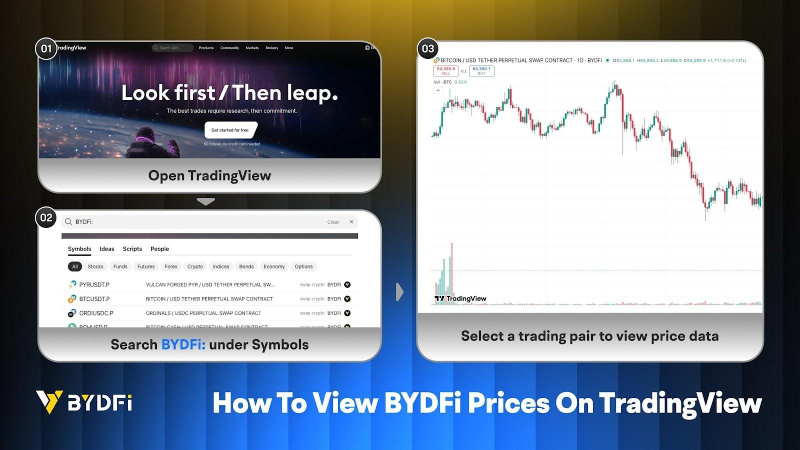
Users can view BYDFi perpetual futures market data on TradingView in a few quick steps:

  1. Open Symbol Search on TradingView and enter BYDFi.
  2. View the full list of available perpetual futures contracts.
  3. Select a trading pair to view live price data and use TradingView’s analysis tools to refine your market view and timing.
Michael, Co-founder and CEO of BYDFi, commented: TradingView is one of the most widely used charting platforms for traders. Bringing BYDFi perpetual futures market data into TradingView helps traders streamline analysis and stay closer to the signals that matter. BYDFi will continue improving infrastructure, product depth, and user protections to support more informed decision making in fast moving markets.

About BYDFi

Established in 2020, BYDFi is a global crypto trading platform that combines the power of a centralized exchange (CEX) with its on-chain trading engine, MoonX. BYDFi is Newcastle United’s Exclusive Official Crypto Exchange Partner. Recognized by Forbes as one of the Best Crypto Exchanges In Canada For 2026, BYDFi offers intuitive, low-fee trading across Spot and Perpetual Contracts to Copy Trading, and Automated Crypto Trading Bots, empowering both new and experienced traders to navigate digital assets with confidence.

BYDFi is dedicated to delivering a world-class crypto trading experience for every user.

BUIDL Your Dream Finance.

  • Website: https://www.bydfi.com
  • Support email: cs@bydfi.com
  • Business partnerships: bd@bydfi.com
  • Media inquiries: media@bydfi.com

Twitter( X ) | LinkedIn | Telegram | YouTube | TikTok | How to Buy on BYDFi

Contact

Senior Marketing Director
Chloe
BYDFi Fintech LTD
chloe@bydfi.com

Related Questions

QWhat is the main announcement in the article regarding BYDFi and TradingView?

ABYDFi has integrated its perpetual futures market data into TradingView, allowing traders to access real-time pricing and crypto market signals directly within the TradingView charting platform.

QWhat are some of the key features BYDFi offers for derivatives traders as mentioned in the article?

ABYDFi offers over 500 perpetual contracts with leverage options up to 200x, advanced execution and risk controls, and is designed to support different risk preferences and trading approaches.

QWhich regulatory licenses and memberships does BYDFi hold according to the article?

ABYDFi holds MSB licenses in the U.S. and Canada and is a member of South Korea’s CODE VASP Alliance.

QHow can a user access BYDFi's perpetual futures data on TradingView?

AUsers can open the Symbol Search on TradingView, enter 'BYDFi', view the list of available perpetual futures contracts, and select a trading pair to see live data and use analysis tools.

QWhat did Michael, the Co-founder and CEO of BYDFi, say about the integration with TradingView?

AMichael stated that TradingView is a widely used platform and that integrating BYDFi's data helps traders streamline analysis and stay closer to important market signals, and that BYDFi will continue to improve its infrastructure and user protections.

Related Reads

Claude's Major New Feature: Screen Recording + Voice, Distilling Your Skills into AI Tasks in One Click

Claude has introduced a major new feature called "Record a Skill," available for Pro, Max, and Team users. This function, found in the Claude desktop app's CoWork menu, allows users to create reusable AI skills simply by recording their screen and providing voice narration while performing a task. Claude then automatically analyzes the recording and generates a functional Skill. A hands-on test confirmed the feature works seamlessly. Users start recording via the Skills manager, perform their workflow while verbally explaining the steps and logic, and avoid including sensitive information. After recording, Claude processes the content and creates the Skill, which can be saved and later invoked with a slash command (/). This eliminates the need for manual adjustments or writing complex instruction files. The innovation goes beyond mere efficiency. Previously, creating a Skill required writing a detailed SKILL.md file in Markdown—a significant barrier for non-technical users. "Record a Skill" bypasses this by directly capturing both actions and the implicit reasoning shared in the narration. This lowers the barrier to knowledge transfer and automation, addressing a core challenge in corporate knowledge management: the difficulty of getting experts to write and maintain documentation. However, the feature also highlights a shift in the nature of work. A case study from March 2026 showed a freelancer whose five-year client relationship was effectively replaced by a hand-coded Claude Skill automating their content workflow. With the even lower barrier of screen recording, the ability to distill personal expertise into automatable skills accelerates this trend. The "moat" for work is moving from simply knowing how to do a task to mastering tasks that are difficult or impossible to automate.

marsbit4m ago

Claude's Major New Feature: Screen Recording + Voice, Distilling Your Skills into AI Tasks in One Click

marsbit4m ago

Feeding AI "Noise" Can Also Boost Scores, This Work Enables Positive Transfer with Noise

Feeding "Noise" to AI Can Improve Performance: A Method Enables Positive Transfer from Noise This work, Semi-Supervised Noise Adaptation (SSNA), introduces a Noise Adaptation Framework (NAF) that challenges traditional transfer learning. Instead of requiring a labeled source domain of real data (e.g., images, text), NAF uses randomly generated Gaussian noise as the source. For a target task with C classes, it constructs C noise clusters by sampling from Gaussian distributions. Although this synthetic noise contains no semantic meaning, NAF trains it to form a discriminative class structure in a shared representation space—clustering same-class noise and separating different classes. The key is aligning this learned structure from the noise domain to the real, sparsely labeled target domain. A small number of target labels are still essential to establish the correspondence between noise clusters and actual classes. The training objective combines: 1) supervised loss on the few labeled target samples, 2) classification loss for the noise to build its structure, and 3) a distribution alignment loss (using Negative Domain Similarity) to minimize the gap between the noise and target domains in the shared space. Experiments show significant gains in few-label settings. With just 4 labels per class, NAF with a ResNet-18 backbone improves accuracy over a standard supervised baseline (ERM) by +12.35% on CIFAR-10, +7.61% on CIFAR-100, +4.38% on DTD-47, and +2.74% on Caltech-101. It also benefits fine-grained datasets and scales to ImageNet-1K (with 100 labels/class) and text classification (AG News). NAF can be integrated into existing semi-supervised methods like FixMatch for further gains. Ablation studies confirm the transferred benefit comes from the discriminative structure of the noise, not randomness itself. Collapsing all noise into a single point causes negative transfer, while increasing separation between noise cluster centers improves performance. The amount of noise per class is less critical once a basic structure forms. In conclusion, this work demonstrates that for positive transfer, the semantic content of source data may not be necessary. What can be effectively transferred is the *organizational structure* of categories within a representation space. This offers a promising alternative for scenarios where real source data is unavailable due to privacy, copyright, or procurement constraints.

marsbit5m ago

Feeding AI "Noise" Can Also Boost Scores, This Work Enables Positive Transfer with Noise

marsbit5m ago

Trading

Spot
活动图片