Brokerage Giant Charles Schwab Rolls Out Spot Crypto Trading To Retail Investors

bitcoinistPublished on 2026-05-14Last updated on 2026-05-14

Abstract

Charles Schwab has officially launched its spot crypto trading platform, Schwab Crypto, to a select group of retail investors in the US, excluding New York and Louisiana. The service allows direct trading of Bitcoin (BTC) and Ethereum (ETH) with a 75-basis-point fee, linked to clients' brokerage accounts. Schwab Premier Bank will serve as custodian, with Paxos handling trade execution. The firm plans to add more assets and transfer capabilities. This move expands Schwab's offerings beyond indirect crypto investment products. It follows a trend of major institutions entering the space, as Morgan Stanley also recently launched a crypto trading pilot on its E*Trade platform with a 50-basis-point fee, aiming for wider rollout later this year.

Brokerage and banking firm Charles Schwab officially began rolling out its crypto trading platform to retail clients in the US, joining the list of traditional financial institutions expanding their digital asset offering.

Schwab Launches Spot Trading For BTC, ETH

On Tuesday, the $11.7 trillion brokerage giant Charles Schwab revealed that it officially launched its spot digital asset trading platform, Schwab Crypto, to a select group of retail customers.

According to the X announcement, the first group of clients can trade Bitcoin (BTC) and Ethereum (ETH) directly on its platform alongside their other digital asset-related investment products.

The crypto trading platform is available in all US states, excluding New York and Louisiana, and will charge a 75-basis-point fee on the dollar value of each trade, which is among the lowest in the industry.

Last month, the firm revealed the platform would be introduced in phases, starting with an internal employee pilot, moving to a client waitlist, and then opening to eligible customers throughout the rest of 2026.

As reported by Bitcoinist, the company explained that Schwab clients will maintain separate accounts under the new platform, which will be linked directly to their brokerage accounts.

Notably, Charles Schwab Premier Bank (CSPB) will serve as the custodian for customers’ assets, handling safekeeping and record-keeping. Meanwhile, blockchain infrastructure provider Paxos will handle trade execution and sub-custody, using a federally overseen trust model and enterprise-grade technology

The brokerage giant also revealed plans to add additional digital assets to the platform and introduce transfer capabilities for both deposits and withdrawals, allowing clients with existing digital asset investments to bring them to Schwab alongside their other accounts.

Jonathan Craig, Head of Retail Investing at Charles Schwab, previously noted that with Schwab Crypto, the firm seeks to allow clients who want direct access to the asset class to benefit from the service, educational resources, and research tools they expect from the company.

Traditional Institutions Expand Crypto Offerings

This move marks a major expansion from Schwab’s previous digital asset-related offerings, which included indirect exposure to investments through spot crypto Exchange-traded products (ETPs), futures, options on spot crypto ETPs, crypto-related ETFs, and mutual funds that invest in the broader digital asset ecosystem. Schwab clients hold approximately 20% of spot crypto ETPs, the firm noted.

Moreover, the launch comes as major banks and brokerages race to add digital‐asset products and integrate crypto into mainstream investing, with several firms expanding retail digital asset offerings in recent years.

Last week, Wall Street behemoth Morgan Stanley also launched a crypto trading pilot on its E*Trade platform to a limited number of users, seeking to challenge major players, including Schwab, with competitive pricing.

The banking giant is charging E*Trade users a 50-basis-point fee on the transaction value, placing its prices below Robinhood’s 95 basis points, Coinbase’s 60 basis points, and Schwab’s 75 basis points.

While the pilot is currently available only to a limited group, Morgan Stanley expects to expand access to all of E*Trade’s 8.6 million clients later this year. The bank’s executives are reportedly preparing an offering to directly convert digital assets into shares of ETPs without selling the assets, and planning to add the ability to trade tokenized equities in the second half of 2026.

Jed Finn, Morgan Stanley’s head of wealth management, affirmed that the launch is “much bigger than trading crypto at a cheaper rate,” explaining that their strategy is “disintermediating the disintermediators.”
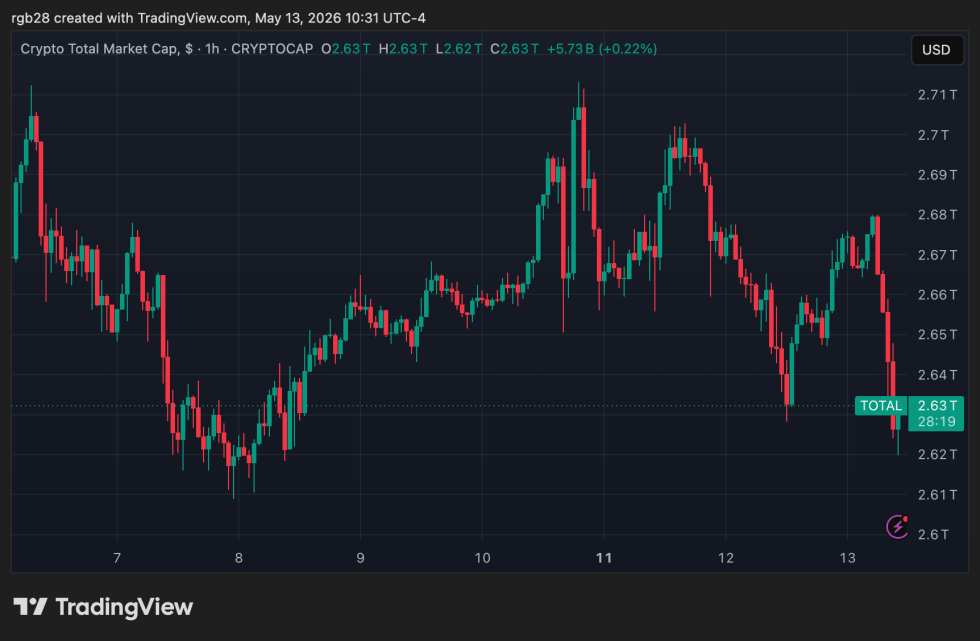
The total crypto market capitalization is at $2.63 trillion in the one-week chart. Source: TOTAL on TradingView


Related Questions

QWhat is the name of the new crypto trading platform launched by Charles Schwab and which two major cryptocurrencies can users trade on it?

AThe new platform is called Schwab Crypto. Users can trade Bitcoin (BTC) and Ethereum (ETH) directly on the platform.

QWhat is the trading fee charged by Charles Schwab on its Schwab Crypto platform, and how does it compare to competitors like Coinbase and Morgan Stanley?

ACharles Schwab charges a 75-basis-point (0.75%) fee on the dollar value of each trade on Schwab Crypto. This is higher than Morgan Stanley's 50 basis points but lower than Coinbase's 60 basis points for its users.

QWhat two US states are currently excluded from accessing the Schwab Crypto platform?

AThe Schwab Crypto platform is available in all US states, excluding New York and Louisiana.

QWhat are the roles of Charles Schwab Premier Bank (CSPB) and Paxos in the operation of the Schwab Crypto platform?

ACharles Schwab Premier Bank (CSPB) serves as the custodian for customers' assets, handling safekeeping and record-keeping. Blockchain infrastructure provider Paxos handles trade execution and sub-custody.

QWhat is the stated strategic goal of Morgan Stanley's crypto launch on E*Trade, according to Jed Finn, its head of wealth management?

AJed Finn stated that the launch is 'much bigger than trading crypto at a cheaper rate,' explaining that their strategy is 'disintermediating the disintermediators.'

Related Reads

The Verdict in Choi Tae-won's Divorce Case: Revealing the Inheritance Undercurrent Behind SK Hynix's Trillion-Won Empire

SK Group Chairman Chey Tae-won's high-profile divorce case, involving a record 1.38 trillion won settlement, has drawn attention to the succession plans for Korea's second-largest conglomerate, especially its crown jewel, SK hynix. Unlike traditional chaebol scripts centered on the eldest son, Chey's three children from his marriage to former President Roh Tae-woo's daughter, Roh Soh-yeong, are carving distinct, non-traditional paths. Eldest daughter Chey Yun-jung (b. 1989) is seen as the most evident successor. With a scientific and consulting background, she holds executive roles at SK bioscience and SK Inc.'s growth support department, focusing on future strategy and biopharma. Her marriage is to an AI infrastructure entrepreneur, not a traditional business alliance. Second daughter Chey Min-jung (b. 1991) took a unique route, voluntarily serving as a South Korean naval officer, including an anti-piracy deployment. She later worked on policy and strategy for SK hynix in Washington D.C. before co-founding an AI-driven healthcare startup. She married a former U.S. Marine Corps officer, connecting her to U.S. defense and policy circles—networks crucial for a global semiconductor giant. The only son, Chey In-geun (b. 1995), who studied physics like his father, worked briefly at SK E&S before joining McKinsey. Despite fitting the traditional "heir" profile as the eldest son, he remains silent and holds no public position or shares in SK, suggesting the old succession playbook is obsolete. As SK hynix's valuation soars, becoming a geopolitical asset in the AI era, the heirs' legitimacy is no longer automatic. They must prove themselves in fields like AI biotech, global policy, and strategic consulting. Their marriages also reflect new elite networks in tech and defense, not old political alliances. Their inheritance is the complex challenge of navigating a globalized, tech-driven world, not just a corporate throne.

marsbit4h ago

The Verdict in Choi Tae-won's Divorce Case: Revealing the Inheritance Undercurrent Behind SK Hynix's Trillion-Won Empire

marsbit4h ago

From OpenSea to OpenRouter: Is Alex Atallah Repeating His 'Exit at the Peak' Playbook?

From OpenSea to OpenRouter: Is Alex Atallah Repeating His "Exit at the Peak" Playbook? According to the Wall Street Journal, payments giant Stripe is in talks to acquire the AI model aggregation platform OpenRouter in a potential deal valuing the company near $100 billion. This would mark founder Alex Atallah's second creation of a company reaching a $100 billion valuation, following his co-founding of NFT marketplace OpenSea. OpenRouter, founded just over three years ago, has grown rapidly by acting as a unified gateway for developers to access over 400 AI models. It currently has about 10 million users and processes over 200 trillion tokens monthly. While the platform's annualized revenue is around $50 million, its valuation has skyrocketed from $1.3 billion in March 2026. The potential acquisition by Stripe, a company OpenRouter's founder once likened it to, represents a major expansion into AI infrastructure for the payments leader. This move echoes Atallah's previous timing with OpenSea, where he departed before the NFT market's significant downturn. For OpenRouter, selling now may be strategic. Despite its scale, its business model—charging a 5-5.5% fee on AI inference calls—faces pressure from competition, open-source models, and potential price wars among model providers, limiting its profitability narrative for an IPO. A key asset for potential acquirers like Stripe is OpenRouter's vast repository of real-world AI usage data, which offers unique insights into model performance and developer preferences that are difficult to replicate. Whether this potential deal signifies a new valuation benchmark for AI infrastructure or another market peak signal remains to be seen.

链捕手5h ago

From OpenSea to OpenRouter: Is Alex Atallah Repeating His 'Exit at the Peak' Playbook?

链捕手5h ago

Trading

Spot
活动图片




