Brian Armstrong Praises ‘Diamond Hands’ as Coinbase Reports Strong Retail Activity

bitcoinistPublished on 2026-02-17Last updated on 2026-02-17

Abstract

Brian Armstrong, CEO of Coinbase, reports that retail investors are displaying "diamond hands" by continuing to accumulate Bitcoin and Ethereum despite recent market volatility. According to Coinbase data, most retail customers now hold equal or greater amounts of these cryptocurrencies in native units compared to December 2025, indicating accumulation during price declines. This behavior contrasts with previous cycles where retail often sold during corrections. Armstrong's comments come amid his own significant stock sales, totaling over $550 million since April 2025 under a prearranged trading plan. Analysts suggest sustained retail buying could stabilize markets, though sentiment remains sensitive to macro conditions and regulatory challenges.

Retail investors appear to be holding their ground through the latest wave of crypto market volatility, according to new data shared by Brian Armstrong, chief executive of Coinbase.

The exchange says many individual users have continued accumulating major cryptocurrencies despite price swings, a trend Armstrong described as evidence of “diamond hands.”

The remarks arrive at a time when digital asset markets remain uncertain, shaped by macroeconomic pressure, regulatory developments, and leveraged trading activity. While prices have fluctuated sharply, Coinbase’s internal metrics suggest retail traders are behaving differently compared to previous downturns.
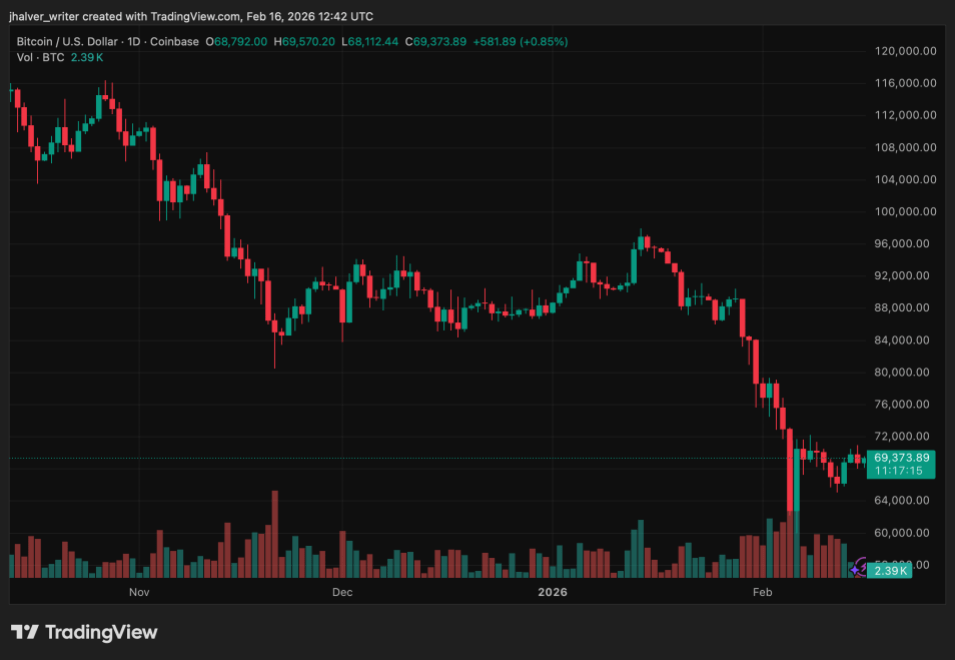
BTC's price trends to the downside on the daily chart. Source: BTCUSD on Tradingview

Retail Investors Buy the Dip During Market Volatility

Armstrong said platform data shows most retail customers now hold equal or greater amounts of Bitcoin and Ethereum than they did in December 2025. The figures track “native units,” meaning the number of coins held rather than their dollar value, indicating accumulation even as prices moved lower.

Bitcoin recently traded near $68,500, while Ethereum hovered around the $2,000 level after a period of declines and rebounds. According to Coinbase, many users responded to the pullback by adding to their positions rather than exiting the market.

The trend contrasts with earlier crypto cycles, when retail investors were often seen selling during sharp corrections. Analysts note that steady spot buying from smaller investors can help counterbalance volatility driven by derivatives markets, where leveraged positions frequently amplify price swings through liquidations.

Coinbase also reported that retail accumulation contributed to renewed activity on the platform, with its stock rising in recent sessions alongside increased trading interest in the two largest cryptocurrencies.

Executive Stock Sales Draw Attention

Armstrong’s praise for retail resilience has coincided with scrutiny over his own share sales. Regulatory filings show the CEO has sold more than $550 million worth of Coinbase stock between April 2025 and January 2026, including transactions exceeding $100 million in recent months.

The sales were executed under a prearranged Rule 10b5-1 trading plan, a mechanism commonly used by public-company executives to schedule stock disposals in advance.

Supporters argue that such plans are standard financial management tools, while critics say the scale of the sales sends mixed signals, encouraging retail investors to hold through volatility.

Similarly, Coinbase continues to navigate broader challenges, including regulatory disputes tied to new product expansions such as prediction markets in several U.S. states.

What Retail Resilience Means for Market Sentiment

Market analysts say sustained retail accumulation could play a stabilizing role if macro conditions improve. Historically, periods where smaller investors continue buying during downturns have sometimes preceded recovery phases in crypto cycles.

However, sentiment remains sensitive to interest rate expectations, geopolitical risks, and institutional flows. For Coinbase, the combination of strong retail engagement and ongoing insider selling highlights the complex balance between leadership messaging, investor perception, and market performance in a volatile environment.

Cover image from ChatGPT, BTCUSD chart from Tradingview

Related Questions

QWhat does Brian Armstrong's praise of 'diamond hands' refer to in the context of Coinbase's recent report?

AIt refers to retail investors holding or accumulating major cryptocurrencies like Bitcoin and Ethereum despite recent market volatility and price declines, rather than selling their positions.

QHow does the current behavior of retail investors on Coinbase differ from previous crypto market downturns?

AUnlike previous cycles where retail investors often sold during sharp corrections, current data shows they are accumulating more coins or holding their ground, demonstrating increased resilience.

QWhat potential market impact does sustained retail accumulation have according to analysts?

AAnalysts suggest that steady spot buying from retail investors can help counterbalance volatility driven by derivatives markets and may play a stabilizing role if macroeconomic conditions improve, sometimes preceding recovery phases.

QWhat controversy has emerged alongside Armstrong's comments about retail investor behavior?

AArmstrong has faced scrutiny for selling over $550 million worth of Coinbase stock between April 2025 and January 2026 through prearranged trading plans, which some say sends mixed signals while encouraging retail investors to hold.

QWhat specific metric does Coinbase use to show retail accumulation despite price declines?

ACoinbase tracks 'native units' - the actual number of coins held by users - rather than dollar value, showing most retail customers hold equal or greater amounts of Bitcoin and Ethereum compared to December 2025 despite lower prices.

Related Reads

a16z: AI's 'Amnesia', Can Continuous Learning Cure It?

The article "a16z: AI's 'Amnesia' – Can Continual Learning Cure It?" explores the limitations of current large language models (LLMs), which, like the protagonist in the film *Memento*, are trapped in a perpetual present—unable to form new memories after training. While methods like in-context learning (ICL), retrieval-augmented generation (RAG), and external scaffolding (e.g., chat history, prompts) provide temporary solutions, they fail to enable true internalization of new knowledge. The authors argue that compression—the core of learning during training—is halted at deployment, preventing models from generalizing, discovering novel solutions (e.g., mathematical proofs), or handling adversarial scenarios. The piece introduces *continual learning* as a critical research direction to address this, categorizing approaches into three paths: 1. **Context**: Scaling external memory via longer context windows, multi-agent systems, and smarter retrieval. 2. **Modules**: Using pluggable adapters or external memory layers for specialization without full retraining. 3. **Weights**: Enabling parameter updates through sparse training, test-time training, meta-learning, distillation, and reinforcement learning from feedback. Challenges include catastrophic forgetting, safety risks, and auditability, but overcoming these could unlock models that learn iteratively from experience. The conclusion emphasizes that while context-based methods are effective, true breakthroughs require models to compress new information into weights post-deployment, moving from mere retrieval to genuine learning.

marsbit1h ago

a16z: AI's 'Amnesia', Can Continuous Learning Cure It?

marsbit1h ago

Can a Hair Dryer Earn $34,000? Deciphering the Reflexivity Paradox in Prediction Markets

An individual manipulated a weather sensor at Paris Charles de Gaulle Airport with a portable heat source, causing a Polymarket weather market to settle at 22°C and earning $34,000. This incident highlights a fundamental issue in prediction markets: when a market aims to reflect reality, it also incentivizes participants to influence that reality. Prediction markets operate on two layers: platform rules (what outcome counts as a win) and data sources (what actually happened). While most focus on rules, the real vulnerability lies in the data source. If reality is recorded through a specific source, influencing that source directly affects market settlement. The article categorizes markets by their vulnerability: 1. **Single-point physical data sources** (e.g., weather stations): Easily manipulated through physical interference. 2. **Insider information markets** (e.g., MrBeast video details): Insiders like team members use non-public information to trade. Kalshi fined a剪辑师 $20,000 for insider trading. 3. **Actor-manipulated markets** (e.g., Andrew Tate’s tweet counts): The subject of the market can control the outcome. Evidence suggests Tate’sociated accounts coordinated to profit. 4. **Individual-action markets** (e.g., WNBA disruptions): A single person can execute an event to profit from their pre-placed bets. Kalshi and Polymarket handle these issues differently. Kalshi enforces strict KYC, publicly penalizes insider trading, and reports to regulators. Polymarket, with its anonymous wallet-based system, has historically been more permissive, arguing that insider information improves market accuracy. However, it cooperated with authorities in the "Van Dyke case," where a user traded on classified government information. The core paradox is reflexivity: prediction markets are designed to discover truth, but their financial incentives can distort reality. The more valuable a prediction becomes, the more likely participants are to influence the event itself. The market ceases to be a mirror of reality and instead shapes it.

marsbit2h ago

Can a Hair Dryer Earn $34,000? Deciphering the Reflexivity Paradox in Prediction Markets

marsbit2h ago

Trading

Spot
Futures
活动图片





