Brian Armstrong Praises ‘Diamond Hands’ as Coinbase Reports Strong Retail Activity

bitcoinistPublished on 2026-02-17Last updated on 2026-02-17

Abstract

Brian Armstrong, CEO of Coinbase, reports that retail investors are displaying "diamond hands" by continuing to accumulate Bitcoin and Ethereum despite recent market volatility. According to Coinbase data, most retail customers now hold equal or greater amounts of these cryptocurrencies in native units compared to December 2025, indicating accumulation during price declines. This behavior contrasts with previous cycles where retail often sold during corrections. Armstrong's comments come amid his own significant stock sales, totaling over $550 million since April 2025 under a prearranged trading plan. Analysts suggest sustained retail buying could stabilize markets, though sentiment remains sensitive to macro conditions and regulatory challenges.

Retail investors appear to be holding their ground through the latest wave of crypto market volatility, according to new data shared by Brian Armstrong, chief executive of Coinbase.

The exchange says many individual users have continued accumulating major cryptocurrencies despite price swings, a trend Armstrong described as evidence of “diamond hands.”

The remarks arrive at a time when digital asset markets remain uncertain, shaped by macroeconomic pressure, regulatory developments, and leveraged trading activity. While prices have fluctuated sharply, Coinbase’s internal metrics suggest retail traders are behaving differently compared to previous downturns.
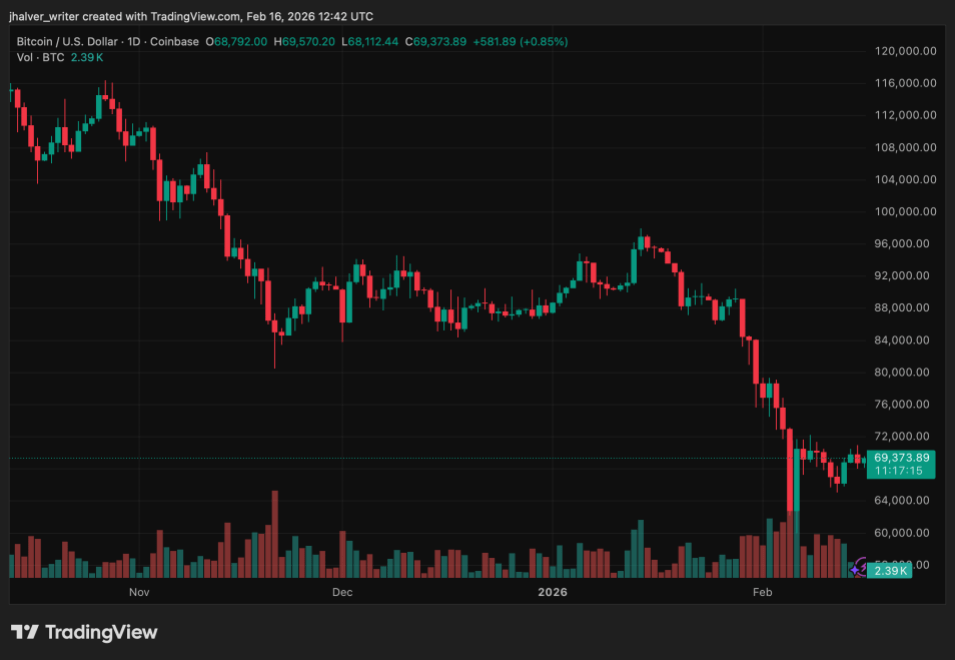
BTC's price trends to the downside on the daily chart. Source: BTCUSD on Tradingview

Retail Investors Buy the Dip During Market Volatility

Armstrong said platform data shows most retail customers now hold equal or greater amounts of Bitcoin and Ethereum than they did in December 2025. The figures track “native units,” meaning the number of coins held rather than their dollar value, indicating accumulation even as prices moved lower.

Bitcoin recently traded near $68,500, while Ethereum hovered around the $2,000 level after a period of declines and rebounds. According to Coinbase, many users responded to the pullback by adding to their positions rather than exiting the market.

The trend contrasts with earlier crypto cycles, when retail investors were often seen selling during sharp corrections. Analysts note that steady spot buying from smaller investors can help counterbalance volatility driven by derivatives markets, where leveraged positions frequently amplify price swings through liquidations.

Coinbase also reported that retail accumulation contributed to renewed activity on the platform, with its stock rising in recent sessions alongside increased trading interest in the two largest cryptocurrencies.

Executive Stock Sales Draw Attention

Armstrong’s praise for retail resilience has coincided with scrutiny over his own share sales. Regulatory filings show the CEO has sold more than $550 million worth of Coinbase stock between April 2025 and January 2026, including transactions exceeding $100 million in recent months.

The sales were executed under a prearranged Rule 10b5-1 trading plan, a mechanism commonly used by public-company executives to schedule stock disposals in advance.

Supporters argue that such plans are standard financial management tools, while critics say the scale of the sales sends mixed signals, encouraging retail investors to hold through volatility.

Similarly, Coinbase continues to navigate broader challenges, including regulatory disputes tied to new product expansions such as prediction markets in several U.S. states.

What Retail Resilience Means for Market Sentiment

Market analysts say sustained retail accumulation could play a stabilizing role if macro conditions improve. Historically, periods where smaller investors continue buying during downturns have sometimes preceded recovery phases in crypto cycles.

However, sentiment remains sensitive to interest rate expectations, geopolitical risks, and institutional flows. For Coinbase, the combination of strong retail engagement and ongoing insider selling highlights the complex balance between leadership messaging, investor perception, and market performance in a volatile environment.

Cover image from ChatGPT, BTCUSD chart from Tradingview

Related Questions

QWhat does Brian Armstrong's praise of 'diamond hands' refer to in the context of Coinbase's recent report?

AIt refers to retail investors holding or accumulating major cryptocurrencies like Bitcoin and Ethereum despite recent market volatility and price declines, rather than selling their positions.

QHow does the current behavior of retail investors on Coinbase differ from previous crypto market downturns?

AUnlike previous cycles where retail investors often sold during sharp corrections, current data shows they are accumulating more coins or holding their ground, demonstrating increased resilience.

QWhat potential market impact does sustained retail accumulation have according to analysts?

AAnalysts suggest that steady spot buying from retail investors can help counterbalance volatility driven by derivatives markets and may play a stabilizing role if macroeconomic conditions improve, sometimes preceding recovery phases.

QWhat controversy has emerged alongside Armstrong's comments about retail investor behavior?

AArmstrong has faced scrutiny for selling over $550 million worth of Coinbase stock between April 2025 and January 2026 through prearranged trading plans, which some say sends mixed signals while encouraging retail investors to hold.

QWhat specific metric does Coinbase use to show retail accumulation despite price declines?

ACoinbase tracks 'native units' - the actual number of coins held by users - rather than dollar value, showing most retail customers hold equal or greater amounts of Bitcoin and Ethereum compared to December 2025 despite lower prices.

Related Reads

Huawei Cloud Rejects Token Price War, Zhou Yuefeng Seeks a New Winning Formula for AI Cloud

At the 2026 Huawei Cloud INSPIRE Creator Conference, CEO Zhou Yuefeng outlined Huawei Cloud's distinct strategy in the competitive AI cloud market. Instead of engaging in price wars based on token volume or Maas revenue—a common focus for rivals like Alibaba Cloud and ByteDance's Volcano Engine—Huawei Cloud is shifting the competition towards real-world productivity gains. Zhou highlighted three core differentiators: a fully domestic computing stack (Ascend, Kunpeng), a focus on government and enterprise clients rather than consumer internet, and a deep commitment to open-source ecosystems. To this end, Huawei Cloud launched a suite of new products under the "Agentic Infra" paradigm, including the AICS Lingqu computing cluster, AMS memory storage, and the ModelArts Next platform. These aim to solve enterprise challenges in deploying AI agents, such as latency, memory, scheduling, and security. The strategy further involves creating specialized industry zones ("AI Dream Factories") for sectors like healthcare and embodied intelligence. For example, a smart medical zone developed with Shanghai Ruijin Hospital aims to democratize expert-level diagnostic capabilities. In essence, Huawei Cloud is positioning itself not as a commodity token provider, but as the foundational infrastructure for industrial AI, leveraging its domestic supply chain and hybrid cloud solutions to serve sectors where productivity, not just scale, is the ultimate measure of value.

marsbitJust now

Huawei Cloud Rejects Token Price War, Zhou Yuefeng Seeks a New Winning Formula for AI Cloud

marsbitJust now

70% of the Public Opposes AI, Americans Hope the U.S. Loses the AI War

70% of Americans believe AI development is moving too fast, with growing public resistance evolving from online criticism to real-world protests and violence. This widespread anti-AI sentiment stems from fears of job losses, rising utility costs, environmental damage, threats to democracy, and financial instability. Key incidents illustrate the backlash: Google's former CEO Eric Schmidt was loudly booed at a graduation for promoting AI; AI company ads are vandalized; protests and even violent attacks target AI firms and data centers. Polls show deep public pessimism and strong local opposition to data center construction, often surpassing resistance to nuclear power plants. The core grievances are economic and practical: AI is seen as automating jobs, concentrating wealth, and increasing household electricity and water bills due to massive data center resource demands. Environmentalists also oppose AI's high energy use and carbon emissions. This opposition has turned AI into a major political issue in the US. While the Trump administration prioritizes AI innovation for global competition, bipartisan pushback is growing. Democrats and factions within the MAGA movement are forming temporary alliances to support stricter regulations and local bans on new data centers, pressuring the administration to choose between its tech industry backers and its voter base. The situation highlights a profound national divide over AI's future.

marsbit33m ago

70% of the Public Opposes AI, Americans Hope the U.S. Loses the AI War

marsbit33m ago

Agents Take Over Traffic Distribution Power: What Are Tencent, ByteDance, and Alibaba Competing For?

In the race to dominate the AI era's entry point, China's tech giants—Tencent, ByteDance, and Alibaba—are aggressively deploying AI Agents to control the future of traffic distribution. Alibaba is pursuing a dual-track "closed loop + openness" strategy. Its Qianwen app is evolving into a super-Agent integrated across its ecosystem (Taobao, Alipay, etc.) to handle complex tasks like travel planning. Concurrently, it is opening its platform to external brands (Luckin Coffee, KFC) and has launched a B2B Agent platform, "Wukong," targeting enterprise automation. Its other flagship, Quark, aims to be an "AI super search box" for information and tasks. ByteDance is executing an omnipresent "sprawl strategy." Its Doubao app boasts over 300 million monthly active users and is evolving into a default AI entry point for daily life, with plans for paid versions and e-commerce integration. Its core weapon is the Kouzi platform, a visual "AI assembly factory" for developers to build custom Agents. ByteDance is also pushing hardware integration, collaborating on AI phones and developing smart glasses to embed Doubao everywhere. Tencent is playing its long-held "ultimate card" by quietly embedding an AI Agent directly into WeChat. This Agent, accessible via a swipe, can understand user commands and automatically execute tasks by calling upon WeChat's millions of mini-programs (e.g., finding and ordering coffee). This leverages WeChat's unparalleled 1.4-billion-user ecosystem to position the app as an AI-powered "service operating system," a move that could dramatically reshape the competitive landscape. The core battleground is shifting from competing for "user screen time" to competing to be the "default execution layer" for user intent. The business model is evolving from an "attention economy" to an "intent economy," where the Agent that can most efficiently fulfill a user's need gains control over service access and token flow. This represents a fundamental change in how users connect with digital services, making the fight for the Agent入口 (entry point) a pivotal moment for redefining industry leadership in the AI age.

marsbit2h ago

Agents Take Over Traffic Distribution Power: What Are Tencent, ByteDance, and Alibaba Competing For?

marsbit2h ago

Trading

Spot
Futures
活动图片





