Breaking: OpenAI Loses Key Figure, Father of Sora Departs, Turmoil Continues on the Eve of IPO

marsbitPublished on 2026-04-18Last updated on 2026-04-18

Abstract

OpenAI is undergoing significant internal turmoil ahead of its planned IPO, marked by high-profile executive departures and strategic shifts. Key figures including Sora project lead Bill Peebles and Chief Product Officer Kevin Weil have announced their exits. The company is consolidating projects, discontinuing standalone products like the research tool Prism and integrating it into Codex, while also halting the video project Sora. Simultaneously, CEO Sam Altman faces renewed allegations of conflicts of interest. Reports reveal he attempted to have OpenAI invest in his personal ventures, such as nuclear fusion company Helion and space firm Stoke Space, raising internal concerns about transparency and governance. These moves come as OpenAI, valued at around $850 billion, shifts from rapid expansion to focusing resources on core priorities like enterprise products and AGI development, under pressure from competitors and the upcoming IPO.

Zhixiandao, April 18th report—Early this morning, OpenAI was hit with a series of changes including executive departures, project scaling back, and questions regarding personal conflicts of interest involving co-founder and CEO Sam Altman. This AI star company, sprinting towards an IPO, is once again facing a storm of personnel and trust issues.

On one hand, multiple executives including Sora core lead Bill Peebles and Chief Product Officer Kevin Weil have successively announced their departures, with projects like the video project Sora and the scientific research tool Prism heading towards shutdown, consolidation, or reorganization.

On the other hand, The Wall Street Journal reported that Sam Altman had previously attempted to push OpenAI to support his personally backed nuclear fusion and space projects. This move has also plunged the company, at the critical juncture of preparing for a listing with a valuation of approximately $850 billion (about RMB 5.8 trillion), into renewed questioning over conflicts of interest.

Sora Architect Departs

OpenAI's Video Division Loses Another Key Player

Early this morning, Sora project core lead Bill Peebles announced his departure on a social platform, sharing a photo of himself working alongside Sam Altman.
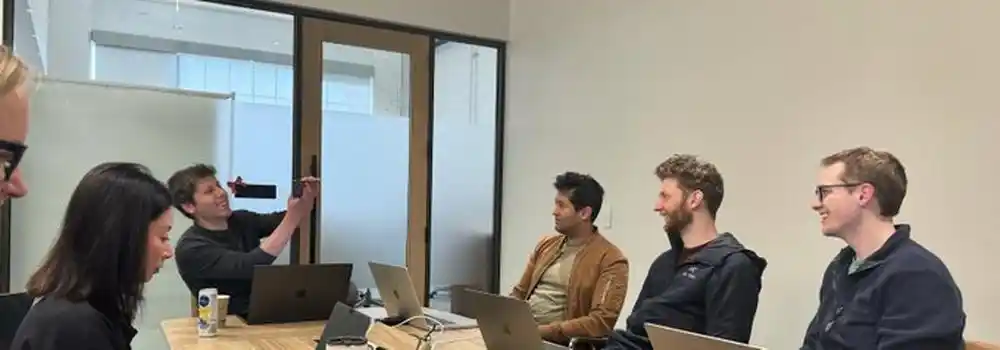
▲ Work photo of Bill Peebles (left 1) with Sam Altman (right 3) (Source: Bill Peebles)

In an open letter, Bill reviewed the development journey of Sora from scratch, calling the experience of building this project with the team the "most honorable and most like an adventure" of his career. He also thanked Sam Altman and others for fostering an inclusive research environment for the team, and stated outright that Sora "could almost certainly not have been born outside of OpenAI".
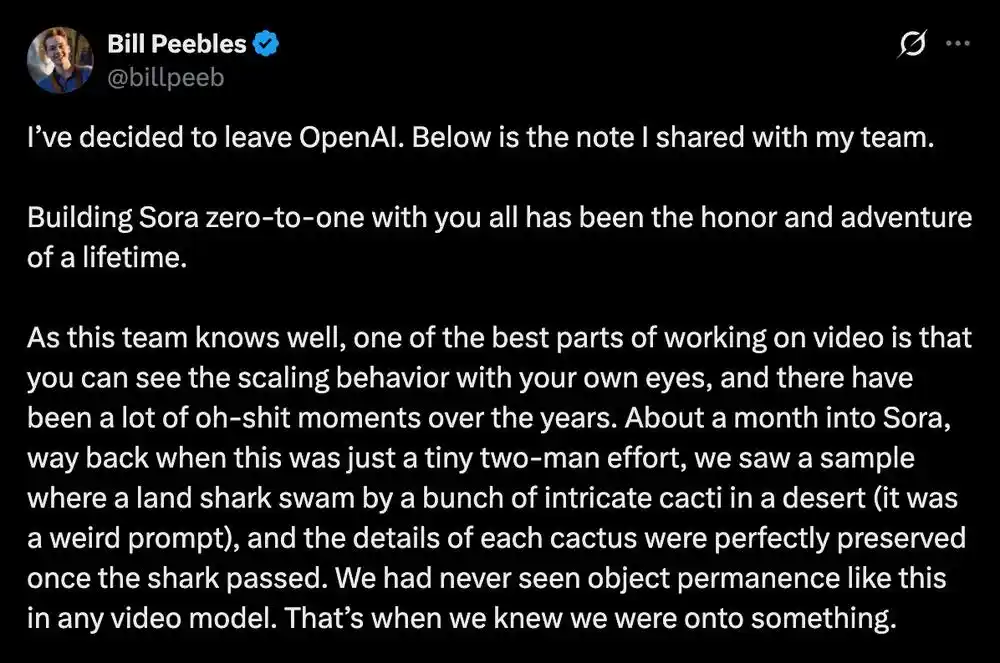
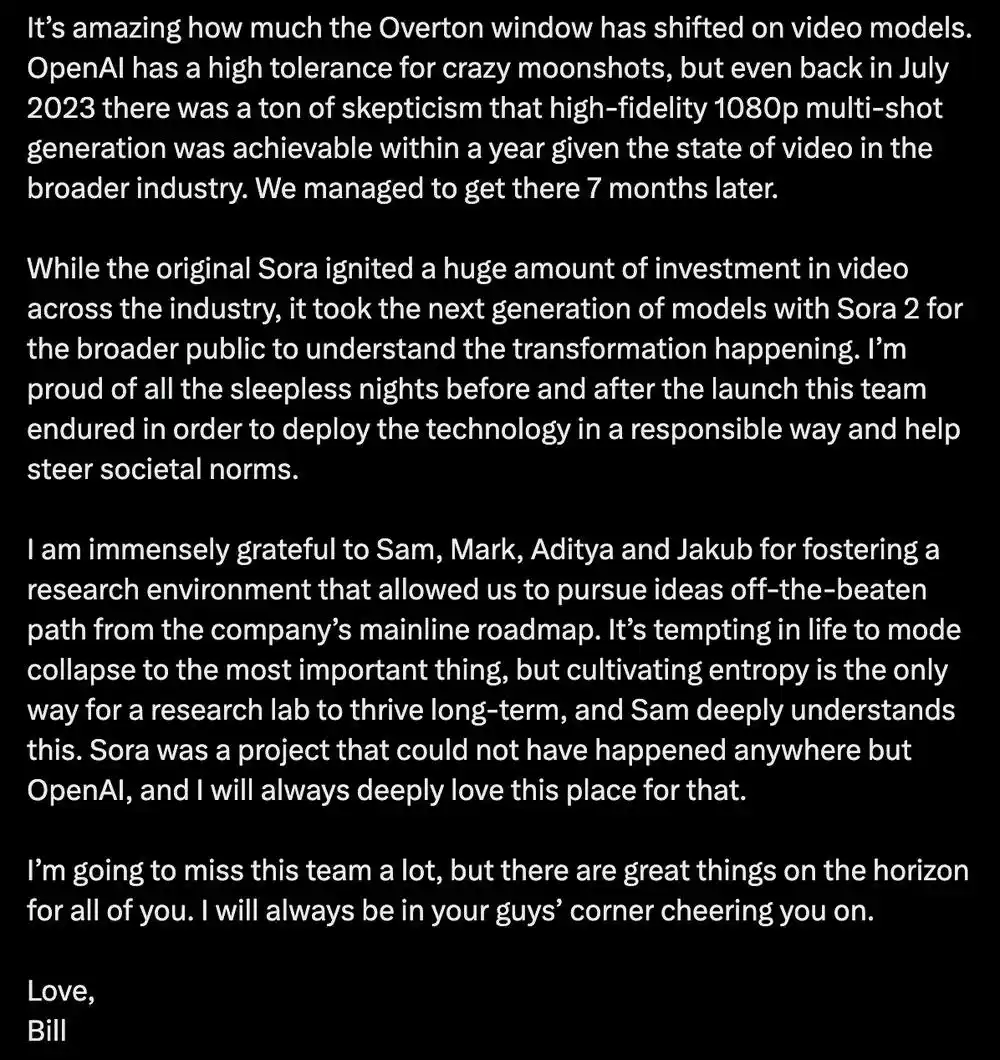
▲ Bill Peebles' resignation letter

Sam Altman later responded in the comments section, "Will miss Bill a lot", stating that his creativity pushed OpenAI and the entire industry to experience AI video in new ways, while also expressing anticipation for his next moves. Bill subsequently replied, "Thanks for everything".
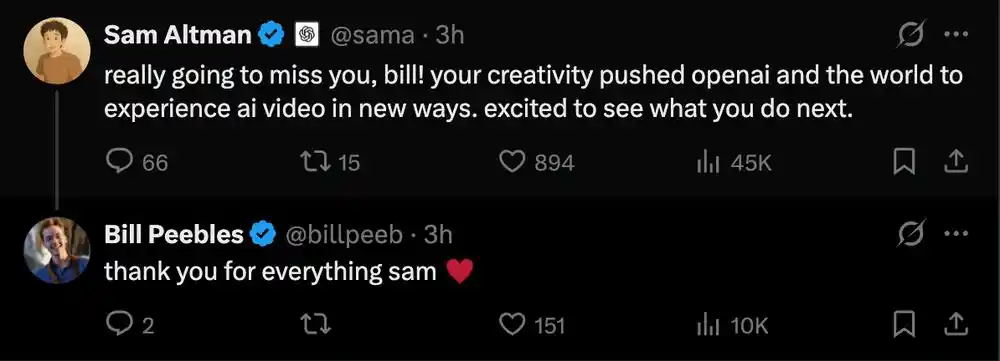
▲ Comments section interaction between Sam Altman and Bill Peebles

Chief Product Officer Departs Same Day

Prism Merged into Codex

On the same day, OpenAI Chief Product Officer, former Instagram executive Kevin Weil, also announced his departure.

He posted that with the "OpenAI for Science" initiative he led being dispersed into other research teams, today would be his last day at the company, emphasizing that accelerating scientific development would be one of the most positive outcomes on the path to AGI.
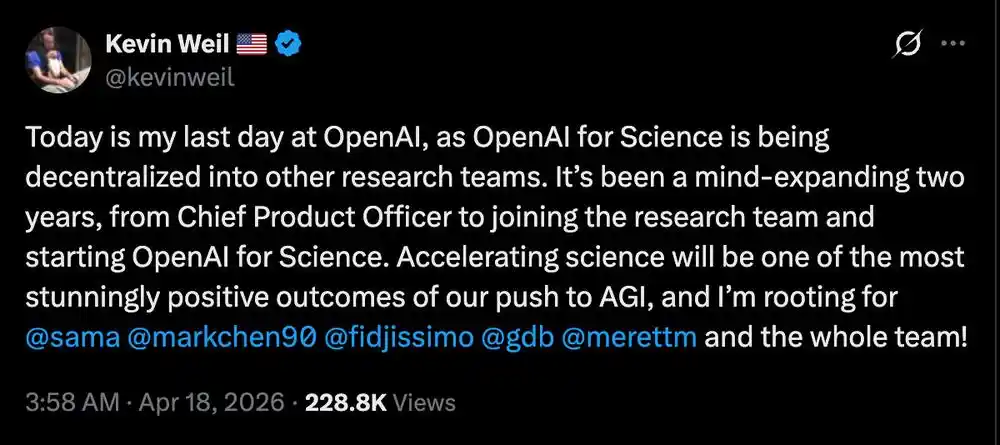
▲ Kevin Weil's resignation letter

ChatGPT product lead Nick Turley subsequently interacted in the thread, thanking Kevin Weil for his guidance and inspiration in building ChatGPT together. Kevin Weil replied that he also enjoyed the process of working together, joking "Keep making ChatGPT better, I'm a DAU (daily active user)".
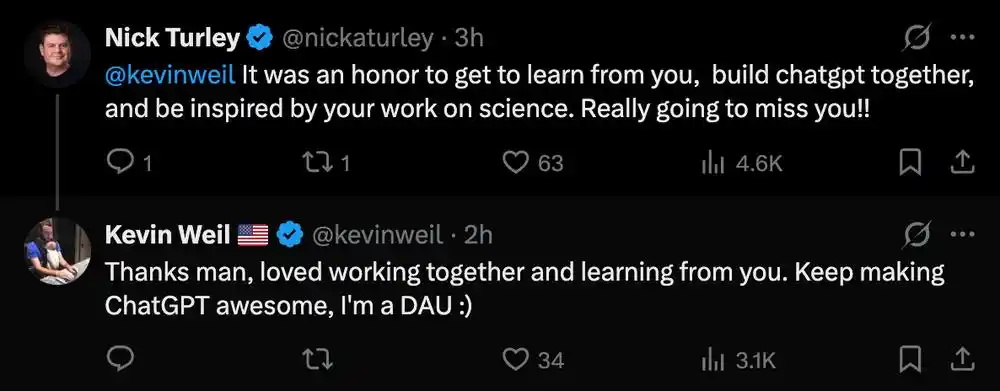
▲ Comments section interaction between Nick Turley and Kevin Weil

According to WIRED, behind Kevin Weil's departure, OpenAI is not just losing a former executive, but also undergoing a reorganization of its scientific application direction.

The report stated that OpenAI has decided to stop independently advancing Prism. Prism was a web application for researchers launched by OpenAI in January this year, originally attempting to provide scientists with AI tools better suited for scientific workflows.

Now, this product and its team of about 10 people will be merged under Thibault Sottiaux, head of Codex, with subsequent related capabilities to be integrated into the desktop version of the Codex application.

According to an OpenAI spokesperson, this change is part of the company's unified business and product strategy. More specifically, OpenAI hopes to further push Codex from a programming tool towards a "super app" direction, with Prism no longer existing as a separate product line.

Kevin Weil joined OpenAI in June 2024 and publicly announced the launch of the OpenAI for Science project in September of the same year. Now, less than two years later, the team members have been dispersed to various departments including product, research, and infrastructure.

Personnel Shake-up Extends Beyond Two

OpenAI is Accelerating Consolidation

The departure of these two individuals is only one aspect of a new round of internal contraction at OpenAI.

According to WIRED, in addition to Kevin Weil and Bill Peebles, OpenAI CTO of Enterprise Applications Srinivas Narayanan has also announced his departure, citing a desire to spend more time with family. Narayanan previously served as OpenAI's VP of Engineering and was an important executive for OpenAI's enterprise product direction.

This series of changes occurs amidst a "major reshuffle" of the executive team. Previously, AGI deployment lead Fidji Simo, who attempted to build a "super app", and Chief Marketing Officer Kate Rouch both took medical leave. President Greg Brockman temporarily took over product management, Chief Operating Officer Brad Lightcap moved to special projects, and the once industry-sensation Sora video application has currently been halted.

As Sam Altman admitted in a blog post published on April 10th, OpenAI is transitioning from "a chaotic but driven startup" to "a large platform that needs to operate in a more predictable way". He wrote that the company's development in recent years has been "extremely high-pressure, chaotic, and intense".
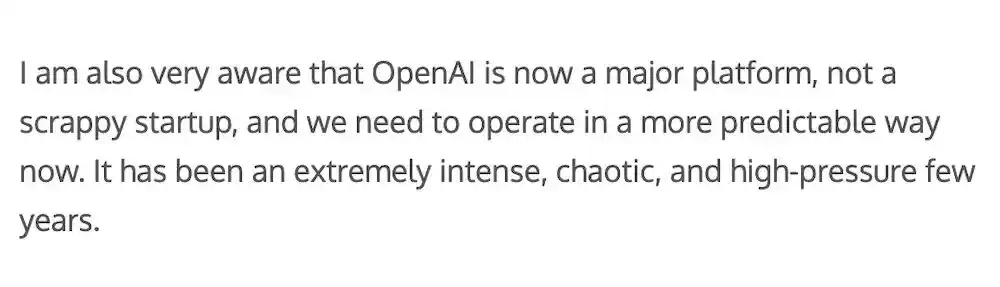
▲ Sam Altman's long response after his residence was firebombed.

Under pressure from competitor Anthropic and with an IPO planned for later this year, OpenAI is internally pushing to simplify its product lines, shifting resources from peripheral projects to areas with higher strategic priority.

In other words, Bill Peebles' departure and Prism's merger into Codex are consecutive actions in OpenAI's shift from "multiple experimental lines" to "consolidating main lines".

Turmoil on the Eve of IPO

Altman Again Embroiled in Conflict of Interest Allegations

As OpenAI accelerates its transformation, the issue of the "opacity" of Sam Altman's personal investment portfolio is being brought to the forefront.

According to The Wall Street Journal, after Sam Altman was briefly ousted and reinstated in 2023, the OpenAI board had promised to strengthen management of his potential conflicts of interest, but this issue has not truly disappeared.

Now, with OpenAI's valuation pushed to around $850 billion, questions about whether "company decisions are for OpenAI or indirectly serving Sam Altman's personal investment portfolio" have become more prominent.

The most typical case is the nuclear fusion company Helion.
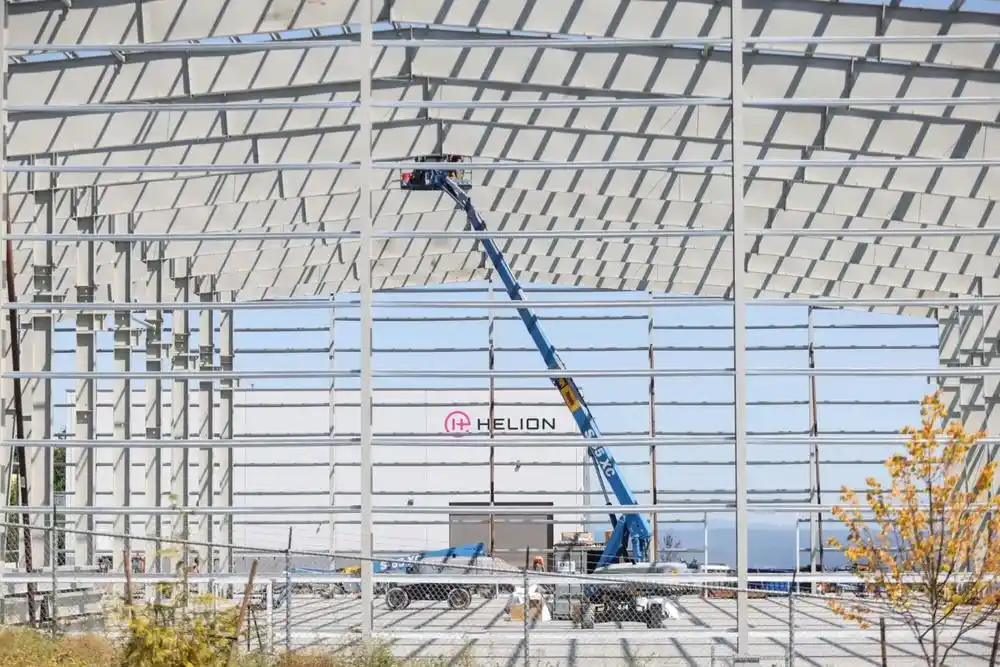
▲ Nuclear fusion company Helion

Sam Altman is a major investor in Helion, with a significant portion of his personal net worth tied to the company. Helion has experienced delays in delivering on its technology and begun facing funding pressures. Subsequently, Sam Altman pushed for OpenAI to lead a new round of financing for Helion, proposing an investment of about $500 million (approx. RMB 3.4 billion), which would have valued Helion at around $35 billion (approx. RMB 238.6 billion) under the proposed plan.

This proposal caused noticeable unease within OpenAI. Some employees believed Sam Altman was asking the company he leads to endorse an enterprise from which he directly benefits, with no immediately obvious business value for OpenAI in the transaction.

Some employees were even concerned that internal Slack discussions might become legal review material in the future, thus avoiding participation in related discussions.

OpenAI ultimately did not participate in this round of investment, but still signed an energy purchase agreement with Helion, agreeing to purchase up to 50 gigawatts of electricity by 2035, equivalent to the output of 25 Hoover Dams. Helion later used this agreement as an important endorsement in communications with investors.

With OpenAI withdrawing from the financing, Helion has now reduced its fundraising target to $250 million (approx. RMB 1.7 billion), with a valuation target lowered to $15 billion (approx. RMB 102.2 billion). Sam Altman resigned from the Helion board last month, explaining on social media that as Helion and OpenAI began exploring large-scale cooperation, it was no longer appropriate for him to sit on both boards.

Besides Helion, The Wall Street Journal also disclosed that Sam Altman had attempted to push for deeper cooperation between OpenAI and rocket company Stoke Space, even exploring having OpenAI acquire or control the company to support ideas like "space data centers".

Sam Altman himself has financial ties to Stoke through his family office, Hydrazine. Although Sam Altman publicly called the idea of "building data centers in space" "ridiculous" in India this February, the report cited informed sources stating that related cooperation discussions actually continued, with some OpenAI board members previously unaware.

Conclusion: Sora Reeled In, Prism Dismantled

What's Left on OpenAI's Main Line?

OpenAI's current situation is quite clear: it is actively compressing non-core businesses, concentrating resources on a few directions that can better support the IPO narrative and commercial returns.

The Wall Street Journal also mentioned that Fidji Simo told employees last month that Anthropic's progress should serve as a "wake-up call", and the company needs to direct more resources towards products for professional work scenarios.

Against this backdrop, some of Sam Altman's past product concepts, which were more personal in color, are gradually being scaled back. Simultaneously, his focus is quietly shifting: from product management to research, financing, and the acquisition of computing resources.

On one side, star employees announce their departures; on the other, product lines are merged. Coupled with multiple controversies on the eve of the IPO, OpenAI is transitioning from an expansion phase of "wanting to do everything" to a contraction phase of "having to succeed in a few things first".

Under the triple pressure of capital markets, competitors, and internal governance, the keyword for OpenAI's next stage is no longer all-out expansion, but concentrated firepower.

Sources: The Wall Street Journal, WIRED, Kevin Weil, Bill Peebles

This article is from the WeChat public account "Zhixiandao" (ID: zhidxcom), author: Jiang Yu

Related Questions

QWho are the key executives that recently left OpenAI, and what were their roles?

ABill Peebles, the core leader of the Sora project, and Kevin Weil, the Chief Product Officer, recently left OpenAI. Additionally, Srinivas Narayanan, the CTO of enterprise applications, also announced his departure.

QWhat projects at OpenAI are being shut down or restructured?

AThe video project Sora is being halted, and the scientific research tool Prism is being discontinued as a standalone product. The Prism team is being merged into the Codex team under Thibault Sottiaux.

QWhat personal利益冲突 issues involving Sam Altman were reported by The Wall Street Journal?

AThe Wall Street Journal reported that Sam Altman attempted to push OpenAI to invest in Helion, a nuclear fusion company he personally backed, and explored deeper cooperation or even control of Stoke Space, a rocket company, both of which involve his personal financial interests.

QWhy is OpenAI undergoing internal restructuring and project consolidation?

AOpenAI is shifting from a 'multi-line experimentation' phase to a 'mainline consolidation' strategy to focus resources on strategic priorities, streamline product lines, and prepare for its upcoming IPO, amid pressure from competitors like Anthropic.

QWhat is the current valuation of OpenAI and what challenges does it face before its IPO?

AOpenAI is valued at approximately $850 billion and faces challenges including executive departures, project restructuring, and concerns over Sam Altman's potential利益冲突, all occurring during its critical IPO preparation phase.

Related Reads

KOL's Perspective: Why Is SOL Set to Rise from This Point?

**Summary: Why SOL is Positioned for Growth at This Level** The article argues that SOL is poised for an upward move from its current price point, citing several key factors. Primarily, SOL has just broken out of a 4-month consolidation phase. This breakout signals a return of risk appetite to the broader crypto market, as SOL is seen as a key indicator of overall crypto health. The token's ownership has reportedly shifted from short-term traders and tourists to long-term accumulators, leading to low volume. Any meaningful increase in trading activity could thus trigger significant upward momentum. Fundamental strengths include strong institutional adoption, integration with DeFi and RWAs (Real-World Assets), and the potential benefits from the Clarity Act. Despite its high volatility—having dropped 70% from its all-time high but still up 12x from its bear market low—SOL is highlighted as one of the few tokens from the last cycle to reach new highs. It boasts a robust ecosystem of applications, users, and protocols. Future catalysts include the expected influx of AI developers following the Miami Accelerate conference, which focused on AI on Solana. Furthermore, Solana is positioned as the premier chain for memecoin activity, a trend expected to continue and drive network usage and fees. The article concludes that recent price action reflects a healthy transfer to long-term holders, setting the stage for growth.

marsbit3m ago

KOL's Perspective: Why Is SOL Set to Rise from This Point?

marsbit3m ago

Those Pre-Bitcoin PoW Protocols Have Recently Been Reimplemented

This article details a recent surge in replicating pre-Bitcoin Proof-of-Work (PoW) protocols, specifically focusing on Hal Finney's 2004 RPOW (Reusable Proofs of Work). Within five days in May 2026, multiple independent builders in the Bitcoin/cypherpunk community launched projects inspired by this early electronic cash proposal. The initiative began with Fred Krueger's `rpow2.com`, a centralized but auditable system that replaced RPOW's original IBM 4758 hardware with Ed25519 signatures. Initially a faithful replica, it later adopted Bitcoin-like features (21M supply cap, difficulty adjustment) and a controversial 5.24% founder allocation. This sparked rapid forks, including `rpow4.com` which incorporated full Bitcoin parameters, a prediction market (`rpowmarket.com`), and a DEX (`rpow2swap.com`). Concurrently, Mike In Space created a prototype of Wei Dai's 1998 b-money proposal (`b-money.replit.app`), pushing the historical exploration even further back. The article contrasts these centralized, server-dependent experiments with Bitcoin's core innovation of decentralized, trustless consensus. It also highlights a parallel development: the `HASH` project on Ethereum, which uses smart contract hooks to enable a purely fair-launch, browser-mineable PoW token with 0% allocations to team or VCs. The collective activity is framed as a meme-driven, educational exploration of cypherpunk history rather than a serious financial movement, with all projects heavily disclaiming any investment value.

marsbit8m ago

Those Pre-Bitcoin PoW Protocols Have Recently Been Reimplemented

marsbit8m ago

South Korean Exchanges 'Battle' Regulators, Challenging the Boundaries of Enforcement and Legislation

South Korea's cryptocurrency industry is engaged in a rare, direct confrontation with regulators. The Financial Intelligence Unit (FIU), the primary anti-money laundering (AML) watchdog, has recently imposed heavy penalties on major exchanges like Upbit and Bithumb for alleged violations involving unregistered overseas VASPs and AML procedures. However, exchanges are now actively challenging these actions in court and through industry associations. In a significant shift, the Seoul Administrative Court ruled in favor of Upbit's operator, Dunamu, overturning part of an FIU-ordered business suspension. The court found the FIU's penalty criteria and justification insufficiently clear. Similarly, the court suspended the enforcement of a six-month business suspension against Bithumb pending a final ruling, citing potential irreversible harm to the exchange. Beyond legal battles, the industry is contesting proposed legislative amendments. The Digital Asset eXchange Alliance (DAXA) strongly opposes a draft rule that would mandate Suspicious Transaction Reports (STRs) for all crypto transfers over 10 million KRW (~$6,800). DAXA argues this "poison pill" clause violates legal principles and would overwhelm the STR system, increasing reports from 63,000 to an estimated 5.45 million annually for major exchanges, thereby crippling effective AML monitoring. This conflict highlights a structural tension in South Korea's crypto governance: comprehensive digital asset laws are still developing, while regulators rely heavily on AML enforcement. The industry's move from passive compliance to active legal and legislative challenges signifies a new phase, pressing for clearer rules and more proportionate enforcement. While short-term disputes may intensify, this clash could ultimately lead to a more mature and sustainable regulatory framework for South Korea's vibrant crypto market.

marsbit1h ago

South Korean Exchanges 'Battle' Regulators, Challenging the Boundaries of Enforcement and Legislation

marsbit1h ago

After 50x Storage Surge, Justin Sun Always Looks to the Next Decade

Sun Yuchen, known for his controversial stunts like a $30 million lunch with Warren Buffett (canceled due to a kidney stone) and eating a $6.2 million duct-taped banana, is often overshadowed by a significant fact: his decade-long track record of spotting major investment trends. In 2016, he famously advised young people to invest in Bitcoin, Nvidia, Tesla, and Tencent instead of buying property. A hypothetical $20,000 investment in Nvidia and Tesla from that list would now be worth over 50 million RMB. His latest major call was on November 6, 2025, predicting a "50x storage opportunity" tied to the AI boom, which materialized with Sandisk's stock surging nearly 50-fold by 2026. Looking ahead, Sun now focuses on the next frontier: Physical AI. He identifies four key areas: 1. **Embodied AI/Robotics**: He sees this reaching its "iPhone moment," with companies like UBTech and Galaxy General leading in commercialization. 2. **Drones**: Viewed as the first commercially viable form of Physical AI, revolutionizing sectors from warfare (e.g., AeroVironment's Switchblade) to logistics. 3. **Spatial Computing**: Beyond VR, it's about AI understanding physical space, a foundational technology for robotics and autonomous systems, exemplified by Apple's Vision Pro. 4. **Space Exploration**: After a 2025 suborbital flight with Blue Origin, Sun advocates for space as the ultimate frontier, discussing blockchain's potential role in space asset management and data transactions. His investment philosophy involves betting on entire, inevitable trends rather than single companies. For robotics, he sees Tesla (the body/manufacturer) and Nvidia (the brain/AI platform) as complementary plays. In defense drones, he highlights companies making tanks obsolete (AeroVironment) and those augmenting fighter jets (Kratos). For space, he participated in Blue Origin's flight and anticipates SpaceX's potential IPO to redefine the sector's valuation. Sun Yuchen's vision frames the next two decades not as a revolution in information flow (like the internet), but in the fundamental operation of the physical world through AI-powered robots, autonomous systems, and spatial intelligence, ultimately extending human and AI activity into space. While many still focus on conventional assets, he continues to look toward the next technological horizon.

marsbit1h ago

After 50x Storage Surge, Justin Sun Always Looks to the Next Decade

marsbit1h ago

Trading

Spot
Futures
活动图片