Breaking Away from Traditional Investment Paths: Cryptocurrency Emerges as the Primary Battlefield for Wealth Among the Younger Generation

比推Published on 2025-12-17Last updated on 2025-12-17

Abstract

Coinbase's latest industry report, in collaboration with Ipsos, reveals a significant generational shift in investment strategies. Younger investors, including Gen Z and millennials, are increasingly moving away from traditional wealth-building paths like buying real estate and investing in stocks. The survey of over 2,000 U.S. investors found that 73% of young people believe it's harder for their generation to build wealth through conventional means compared to their parents' generation. This sentiment is reflected in their portfolios: younger investors allocate 25% of their investments to non-traditional assets like cryptocurrencies, derivatives, and NFTs—three times the allocation of older investors. Nearly half (45%) of young investors already hold cryptocurrency, compared to just 18% of older investors. They view crypto not as a speculative side investment but as a core component for catching up financially, with 80% believing it offers more opportunities outside the traditional financial system. Younger investors are also more active, trade more frequently, and are willing to take higher risks for greater returns. They express strong interest in emerging crypto products like derivatives, prediction markets, and DeFi lending. This trend is pushing the financial industry toward 24/7, multi-asset platforms that better serve this internet-native generation.

Author: Coinbase

Compiled by: Chopper, Foresight News

Original Title: Moving Beyond Home Buying and Stock Trading, the Younger Generation Embraces Cryptocurrency as the Main Arena for Wealth


For decades, the path to wealth accumulation for Americans has remained largely unchanged: secure a good job, purchase property, invest in stocks, and wait for the power of compound interest to yield returns. However, our latest "Cryptocurrency Industry Report" reveals that the younger generation of investors no longer believes in this traditional path and is adjusting their investment strategies accordingly.

To understand how different generations approach the market and the role cryptocurrency plays in their investment portfolios, Coinbase partnered with Ipsos to conduct a specialized survey. The study interviewed 4,350 American adults, including 2,005 investors with investment accounts. The key findings are as follows: Younger investors, such as Gen Z and Millennials, are more inclined to manage their investments actively, more open to non-traditional assets, and more likely to view cryptocurrency as a core component of their financial future.
A Generation Shut Out of the Traditional Wealth Ladder

Younger investors are far more optimistic about the economy than older generations, but they believe the existing financial system is not designed for them. Survey data shows that nearly seven out of ten (73%) young people believe it is more difficult for their generation to accumulate wealth through traditional means compared to their parents' generation. In contrast, only 57% of older generations share this view.

They have witnessed soaring housing costs, overwhelming student debt, and sluggish wage growth. In this context, an increasing number of young people are seeking alternative wealth accumulation methods beyond the traditional model of "home equity + stock portfolio."

Non-Traditional Asset Allocation Three Times Higher Than Older Generations

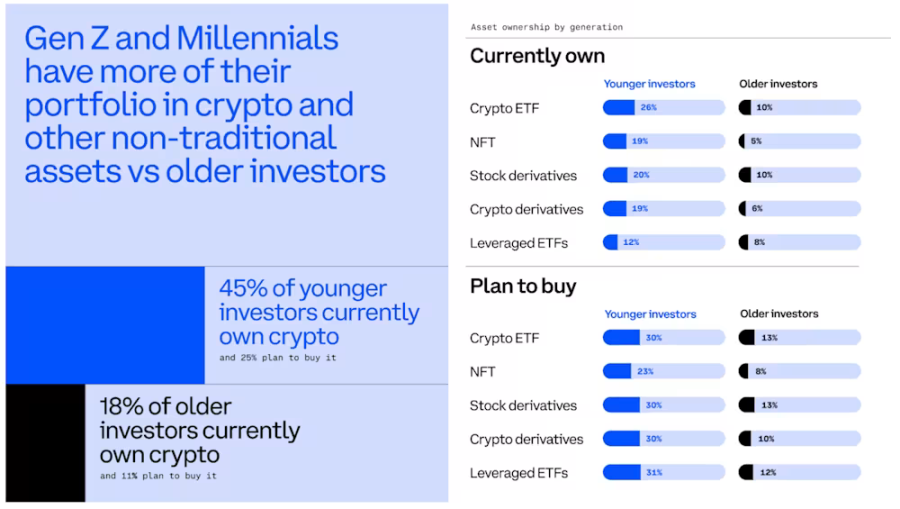
This anxiety is directly reflected in their asset allocation strategies. The survey reveals that younger investors allocate 25% of their investment portfolios to non-traditional asset classes such as cryptocurrencies, financial derivatives, non-fungible tokens (NFTs), and other emerging products. This proportion is three times higher than that of older investors, who allocate only 8% to non-traditional assets.

The proportion of stock holdings is roughly similar across generations, but the key difference lies in the diversification of younger investors' portfolios beyond stocks. They are more actively seeking opportunities for returns beyond traditional stock dividends and are more willing to experiment with new investment tools and emerging markets to narrow the wealth gap.

Cryptocurrency Is Not a Side Hustle but a Core Allocation

This generational shift in investment philosophy is most evident in the acceptance of cryptocurrency. The report shows that 45% of younger investors already hold cryptocurrencies, compared to only 18% of older investors. Additionally, nearly half (47%) of younger investors want to gain early access to new crypto assets before they become mainstream. In contrast, only 16% of older investors express this desire.

For the younger generation, cryptocurrency is not merely a speculative trade but a crucial tool to help them catch up in wealth accumulation. Eighty percent of young people believe that cryptocurrency provides their generation with more financial opportunities outside the traditional financial system. At the same time, another 80% are convinced that cryptocurrency will play a significantly larger role in the future financial system. Among older investors, only about 60% share this view.

The younger generation's enthusiasm for exploring emerging markets extends beyond spot cryptocurrencies; they are also eager to engage with more non-traditional assets. Data shows that 80% of young investors are willing to try new investment opportunities ahead of others, while less than half of older generations share this attitude. Younger investors consistently show strong interest in emerging non-traditional products such as cryptocurrency derivatives, prediction markets, 24/7 stock trading, early token offerings, altcoins, and decentralized finance (DeFi) lending.

Implications of This Trend for Future Markets

The younger generation of investors has already demonstrated distinct characteristics: they trade more frequently, are willing to take greater risks for higher returns, and are shifting a significant portion of their investment portfolios to non-traditional assets, with cryptocurrency at the core. At the same time, they are driving the entire financial industry toward a transformation that better meets the needs of the internet-native generation, creating platforms that operate around the clock and support diverse asset trading.


Twitter: https://twitter.com/BitpushNewsCN

BitPush Telegram Group: https://t.me/BitPushCommunity

BitPush Telegram Subscription: https://t.me/bitpush

Original Link: https://www.bitpush.news/articles/7596437

Related Questions

QWhat is the main finding of the Coinbase and Ipsos research regarding younger investors?

AThe research found that younger investors, such as Gen Z and Millennials, are more likely to actively manage their investments, embrace non-traditional assets, and view cryptocurrency as a core component of their financial future.

QWhy do younger investors feel the traditional wealth-building path is not for them?

AThey believe it is harder to build wealth through traditional means due to rising housing costs, high student debt, and slow wage growth, making alternative paths like cryptocurrency more appealing.

QHow much of their portfolio do younger investors allocate to non-traditional assets compared to older investors?

AYounger investors allocate 25% of their portfolio to non-traditional assets, which is three times the 8% allocated by older investors.

QWhat percentage of younger investors hold cryptocurrency, and how does this compare to older investors?

A45% of younger investors hold cryptocurrency, compared to only 18% of older investors.

QWhat do younger investors believe about the role of cryptocurrency in the future financial system?

A80% of younger investors believe cryptocurrency provides financial opportunities outside the traditional system and that it will play a significantly larger role in the future financial system.

Related Reads

Bitcoin Withdrawals Continue: 8 Years of Storage in a Coldcard Cold Wallet Ended in Zero

Coldcard Hardware Wallet Hacked: Losses Mount Due to Vulnerable Seed Generation A critical vulnerability in Coldcard hardware wallets has led to a continued wave of fund thefts. According to Galaxy Research, the total stolen has reached 1,367.05 BTC (approx. $88.6 million) from 4,585 addresses, a significant increase from the initial 594.5 BTC reported on July 30, 2026. Most of the stolen funds remain on the attackers' addresses. The issue is not with the current firmware, which Coinkite has updated, but with seed phrases generated on vulnerable devices between March 2021 and the release of fixed firmware versions. Due to a programmer error, devices switched from using a hardware random number generator to the software-based Yasmarang generator, which was initialized with publicly accessible data like the chip's serial number. This made the seed phrases predictable through offline brute-force attacks, meaning wallets remain at risk until funds are moved to a new wallet generated with the patched firmware. Affected devices include Mk2/Mk3 with firmware 4.0.1–4.1.9 (and up to 5.0.3), Mk4/Mk5 up to version 5.6.0, and Q models up to 1.5.0Q. The only exceptions are seeds created with a high-entropy method like at least 50 independent dice rolls or a strong unique BIP-39 passphrase. All other owners must generate a new seed on the fixed firmware and transfer their assets. A case highlighting the human impact involves a 39-year-old long-term investor who lost 2 BTC (approx. $130,000) in minutes. He had accumulated the Bitcoin over eight years through physical labor, viewing it as a financial lifeline and a retirement plan in a country suffering from hyperinflation. His story underscores that even conservative "buy and hold in cold storage" strategies can be compromised by such underlying technical flaws. From a technical perspective, this incident echoes historical failures where weak random number generators undermined cryptographic security, challenging the assumption that offline storage is automatically foolproof.

cryptonews.ru1h ago

Bitcoin Withdrawals Continue: 8 Years of Storage in a Coldcard Cold Wallet Ended in Zero

cryptonews.ru1h ago

Trading

Spot
活动图片





