Breaking Away from Traditional Investment Paths: Cryptocurrency Emerges as the Primary Battlefield for Wealth Among the Younger Generation

比推Published on 2025-12-17Last updated on 2025-12-17

Abstract

Coinbase's latest industry report, in collaboration with Ipsos, reveals a significant generational shift in investment strategies. Younger investors, including Gen Z and millennials, are increasingly moving away from traditional wealth-building paths like buying real estate and investing in stocks. The survey of over 2,000 U.S. investors found that 73% of young people believe it's harder for their generation to build wealth through conventional means compared to their parents' generation. This sentiment is reflected in their portfolios: younger investors allocate 25% of their investments to non-traditional assets like cryptocurrencies, derivatives, and NFTs—three times the allocation of older investors. Nearly half (45%) of young investors already hold cryptocurrency, compared to just 18% of older investors. They view crypto not as a speculative side investment but as a core component for catching up financially, with 80% believing it offers more opportunities outside the traditional financial system. Younger investors are also more active, trade more frequently, and are willing to take higher risks for greater returns. They express strong interest in emerging crypto products like derivatives, prediction markets, and DeFi lending. This trend is pushing the financial industry toward 24/7, multi-asset platforms that better serve this internet-native generation.

Author: Coinbase

Compiled by: Chopper, Foresight News

Original Title: Moving Beyond Home Buying and Stock Trading, the Younger Generation Embraces Cryptocurrency as the Main Arena for Wealth


For decades, the path to wealth accumulation for Americans has remained largely unchanged: secure a good job, purchase property, invest in stocks, and wait for the power of compound interest to yield returns. However, our latest "Cryptocurrency Industry Report" reveals that the younger generation of investors no longer believes in this traditional path and is adjusting their investment strategies accordingly.

To understand how different generations approach the market and the role cryptocurrency plays in their investment portfolios, Coinbase partnered with Ipsos to conduct a specialized survey. The study interviewed 4,350 American adults, including 2,005 investors with investment accounts. The key findings are as follows: Younger investors, such as Gen Z and Millennials, are more inclined to manage their investments actively, more open to non-traditional assets, and more likely to view cryptocurrency as a core component of their financial future.
A Generation Shut Out of the Traditional Wealth Ladder

Younger investors are far more optimistic about the economy than older generations, but they believe the existing financial system is not designed for them. Survey data shows that nearly seven out of ten (73%) young people believe it is more difficult for their generation to accumulate wealth through traditional means compared to their parents' generation. In contrast, only 57% of older generations share this view.

They have witnessed soaring housing costs, overwhelming student debt, and sluggish wage growth. In this context, an increasing number of young people are seeking alternative wealth accumulation methods beyond the traditional model of "home equity + stock portfolio."

Non-Traditional Asset Allocation Three Times Higher Than Older Generations

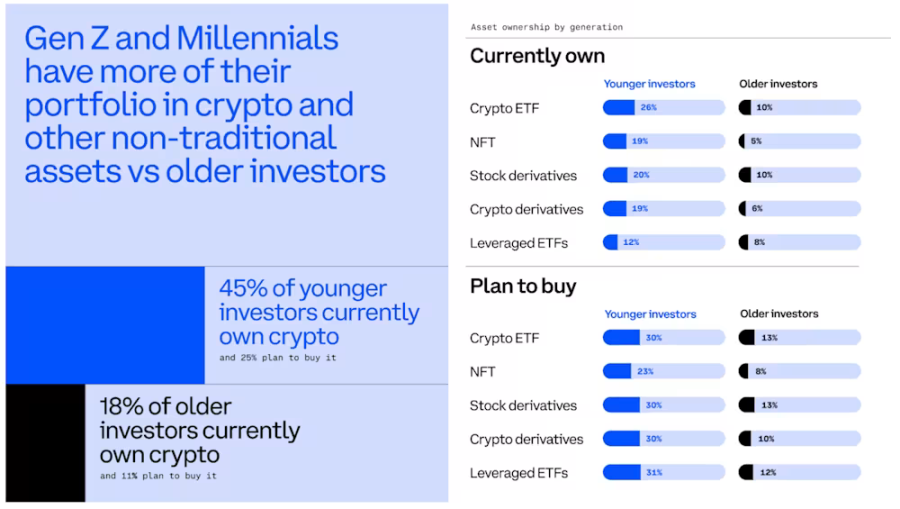
This anxiety is directly reflected in their asset allocation strategies. The survey reveals that younger investors allocate 25% of their investment portfolios to non-traditional asset classes such as cryptocurrencies, financial derivatives, non-fungible tokens (NFTs), and other emerging products. This proportion is three times higher than that of older investors, who allocate only 8% to non-traditional assets.

The proportion of stock holdings is roughly similar across generations, but the key difference lies in the diversification of younger investors' portfolios beyond stocks. They are more actively seeking opportunities for returns beyond traditional stock dividends and are more willing to experiment with new investment tools and emerging markets to narrow the wealth gap.

Cryptocurrency Is Not a Side Hustle but a Core Allocation

This generational shift in investment philosophy is most evident in the acceptance of cryptocurrency. The report shows that 45% of younger investors already hold cryptocurrencies, compared to only 18% of older investors. Additionally, nearly half (47%) of younger investors want to gain early access to new crypto assets before they become mainstream. In contrast, only 16% of older investors express this desire.

For the younger generation, cryptocurrency is not merely a speculative trade but a crucial tool to help them catch up in wealth accumulation. Eighty percent of young people believe that cryptocurrency provides their generation with more financial opportunities outside the traditional financial system. At the same time, another 80% are convinced that cryptocurrency will play a significantly larger role in the future financial system. Among older investors, only about 60% share this view.

The younger generation's enthusiasm for exploring emerging markets extends beyond spot cryptocurrencies; they are also eager to engage with more non-traditional assets. Data shows that 80% of young investors are willing to try new investment opportunities ahead of others, while less than half of older generations share this attitude. Younger investors consistently show strong interest in emerging non-traditional products such as cryptocurrency derivatives, prediction markets, 24/7 stock trading, early token offerings, altcoins, and decentralized finance (DeFi) lending.

Implications of This Trend for Future Markets

The younger generation of investors has already demonstrated distinct characteristics: they trade more frequently, are willing to take greater risks for higher returns, and are shifting a significant portion of their investment portfolios to non-traditional assets, with cryptocurrency at the core. At the same time, they are driving the entire financial industry toward a transformation that better meets the needs of the internet-native generation, creating platforms that operate around the clock and support diverse asset trading.


Twitter: https://twitter.com/BitpushNewsCN

BitPush Telegram Group: https://t.me/BitPushCommunity

BitPush Telegram Subscription: https://t.me/bitpush

Original Link: https://www.bitpush.news/articles/7596437

Related Questions

QWhat is the main finding of the Coinbase and Ipsos research regarding younger investors?

AThe research found that younger investors, such as Gen Z and Millennials, are more likely to actively manage their investments, embrace non-traditional assets, and view cryptocurrency as a core component of their financial future.

QWhy do younger investors feel the traditional wealth-building path is not for them?

AThey believe it is harder to build wealth through traditional means due to rising housing costs, high student debt, and slow wage growth, making alternative paths like cryptocurrency more appealing.

QHow much of their portfolio do younger investors allocate to non-traditional assets compared to older investors?

AYounger investors allocate 25% of their portfolio to non-traditional assets, which is three times the 8% allocated by older investors.

QWhat percentage of younger investors hold cryptocurrency, and how does this compare to older investors?

A45% of younger investors hold cryptocurrency, compared to only 18% of older investors.

QWhat do younger investors believe about the role of cryptocurrency in the future financial system?

A80% of younger investors believe cryptocurrency provides financial opportunities outside the traditional system and that it will play a significantly larger role in the future financial system.

Related Reads

147 Trillion vs 70 Billion: The Rise of On-Chain 'Risk Managers' and the Potential Dawn of a New Era in DeFi Asset Management

"147 Trillion vs 70 Billion: The Rise of On-Chain 'Risk Managers' and the Potential Dawn of a New Era in DeFi Asset Management" Key Points: The role of professional asset managers is emerging in DeFi, ending the era where protocols and governance dictated everything. While early DeFi protocols like Aave and Compound bundled risk management within their code, innovations like Morpho have separated infrastructure from risk judgment. This allows specialized "Risk Managers" to operate independent lending vaults, acting as on-chain asset managers. The market, though early with ~$7B in assets under management (AUM), is rapidly consolidating around top performers like SteakhouseFi (RWA focus), SentoraHQ (AI-driven models), and Gauntlet (crisis management). This modular structure mirrors TradFi's division of labor: distributors (e.g., exchanges) source capital, Risk Managers design strategies and set standards, and underlying protocols handle custody and execution. For traditional asset managers, this familiar structure presents clear entry paths: 1) **Distribution**: Partnering with Risk Managers as a backend service. 2) **Supply**: Bringing real-world assets (RWA) on-chain as collateral. 3) **Operation**: Becoming a Risk Manager themselves (e.g., Bitwise). The core competency required is shifting from coding to traditional risk underwriting and financial expertise—areas where established institutions hold a natural advantage. While the current DeFi market (~$80B) is minuscule compared to global asset management (~$147T), it represents a significant growth runway. The teams that build the trusted standards and rails for risk-managed capital now are poised to define the market's future as institutional capital seeks secure on-ramps.

marsbit6m ago

147 Trillion vs 70 Billion: The Rise of On-Chain 'Risk Managers' and the Potential Dawn of a New Era in DeFi Asset Management

marsbit6m ago

Sui Launches Gasless Stablecoin Transfers, Supported by Fireblocks

Sui has officially launched "Gasless Stablecoin Transfers," a new protocol-level feature enabling users and enterprises to send supported stablecoins on Sui without paying gas fees or needing a separate SUI token balance. As the feature rolls out, stablecoin transfer fees on Sui are now effectively $0. Major stablecoins like USDsui, suiUSDe, AUSD, FDUSD, USDB, USDC, and USDY are already supported. This aims to simplify payments and remove a key barrier to mass adoption: requiring users to hold another token for gas. The enterprise platform Fireblocks, securing over $14 trillion in digital asset transactions, has integrated the feature in advance, enhancing institutional accessibility. Other wallets and custodians are also set to support zero-gas transactions. Sui co-founder Adeniyi Abiodun stated this brings Sui closer to being a global payment rail. Fireblocks' Ran Goldi noted it removes a major friction point for businesses building on-chain payments. This is a permanent structural change to Sui's mainnet, not a subsidy. It positions Sui as low-cost infrastructure for enterprises, traders, and AI agents. Sui's stablecoin transfer volume has surpassed $1 trillion since August 2025, with its architecture supporting high-frequency payments. Recent growth includes three SUI Exchange-Traded Products (ETPs) launching in 2026 and the expansion of major stablecoin projects like USDsui and SuiUSDe on the network. Zero-gas stablecoin transfers are now being gradually deployed on the Sui mainnet.

marsbit7m ago

Sui Launches Gasless Stablecoin Transfers, Supported by Fireblocks

marsbit7m ago

Major AI Collaboration Breakthrough! Stanford and NVIDIA Jointly Eliminate AI Communication Overhead, Boosting Reasoning Speed by 2.4x

Title: AI Collaboration Breakthrough: Stanford & NVIDIA Eliminate Communication Overhead, Boost Reasoning Speed by 2.4x A new approach called RecursiveMAS, developed by UIUC, Stanford, NVIDIA, and MIT, tackles the major bottleneck in multi-agent AI systems: the "language tax." Currently, AI agents collaborate by generating and reading natural language text, a slow, costly, and information-lossy process akin to inefficient radio communication. RecursiveMAS bypasses this by enabling agents to communicate directly through their "thoughts"—latent space vector representations—instead of text. Inspired by recursive language models, it treats each agent like a reusable layer in a recursive loop. A special lightweight module called RecursiveLink passes these high-dimensional, semantic-rich internal states between agents. Only the final agent decodes the last latent representation into human-readable text. This process, described as "telepathic" communication, dramatically cuts the overhead of encoding and decoding text at each step. The system is highly efficient; the core AI model weights remain frozen, and only the small RecursiveLink modules are trained, requiring updates to just 0.31% of total parameters. This reduces training costs by over 50% compared to full fine-tuning. Comprehensive evaluations across math, science, coding, and QA benchmarks show significant improvements: - **Accuracy:** Average increase of 8.3%, with gains up to 18.1% on complex math problems (AIME2025). - **Speed:** End-to-end reasoning is 1.2x to 2.4x faster, with greater speedups as recursive depth increases. - **Cost:** Token usage is reduced by 34.6% to 75.6%. The research suggests a new scaling paradigm for multi-agent systems: deepening recursive collaboration depth rather than merely adding more agents. This could address key production barriers like compute cost, latency, and memory limits. However, challenges remain, including the need for independent verification, compatibility between different AI models (heterogeneous agents), reduced interpretability of the "black-box" latent communication, and adaptation to complex real-world workflows involving tools and human interaction. If validated, RecursiveMAS could fundamentally change how AI agents work together, moving beyond inefficient "textual handoffs" to more seamless and powerful collaborative reasoning.

marsbit1h ago

Major AI Collaboration Breakthrough! Stanford and NVIDIA Jointly Eliminate AI Communication Overhead, Boosting Reasoning Speed by 2.4x

marsbit1h ago

Trading

Spot
Futures
活动图片