Blockchains quietly prepare for quantum threat as Bitcoin debates timeline

cointelegraphPublished on 2025-12-19Last updated on 2025-12-19

Abstract

Blockchains are increasingly preparing for the potential threat of quantum computers, which could eventually break current cryptographic systems. While quantum machines capable of attacking networks like Bitcoin are still years away, several major blockchains—including Aptos and Solana—are proactively testing quantum-resistant upgrades. Ethereum’s Vitalik Buterin has emphasized the importance of early preparation, estimating a 20% chance of relevant quantum computing breakthroughs by 2030. Bitcoin, however, remains divided. Some developers and industry leaders dismiss near-term quantum risks as premature and fear such discussions may cause unnecessary panic or market instability. In contrast, investors and researchers argue that ignoring a low-probability, high-impact risk undermines long-term confidence. The debate reflects broader tensions around how Bitcoin should communicate and prepare for future threats without destabilizing its present security assumptions.

Quantum computers still cannot break Bitcoin, but several major blockchains are preparing for a future in which they might.

In the past week, Aptos proposed post-quantum signature support as Solana tested quantum-resistant transactions. Meanwhile, parts of the Bitcoin community renewed calls to accelerate work on quantum-safe upgrades.

These developments point to a growing anxiety across crypto. Investors argue that dismissal of quantum risk by influential voices is weighing on Bitcoin’s (BTC) price, which has dropped 24% over the past three months.

While altcoin blockchains are experimenting with post-quantum protections through opt-in upgrades and test networks, Bitcoin remains divided over how publicly and urgently it should address quantum risks.
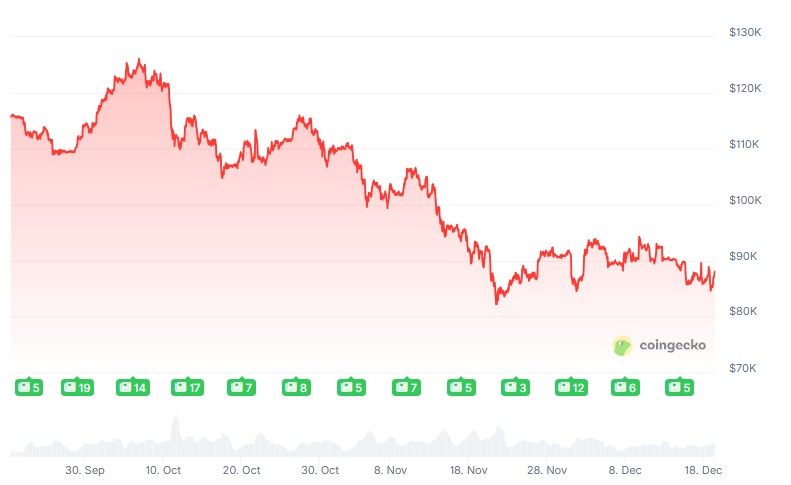
Some investors say dismissing quantum risk is affecting Bitcoin’s price. Source: CoinGecko

How blockchains are preparing without sounding the alarm

Ethereum has been clear about why quantum computing is now being treated as an engineering problem rather than a distant hypothetical.

Ethereum co-founder Vitalik Buterin has argued that even a low-probability outcome demands early preparation when the cost of failure is high and the time required to migrate global systems is measured in years.

Citing forecasting models, he has said there is roughly a 20% chance that quantum computers capable of breaking today’s public-key cryptography could emerge before 2030, with a median estimate closer to 2040. Buterin reportedly said no machines exist today that can break Bitcoin or Ethereum, but waiting for certainty is itself risky, as migrating a global network to post-quantum schemes can take years.
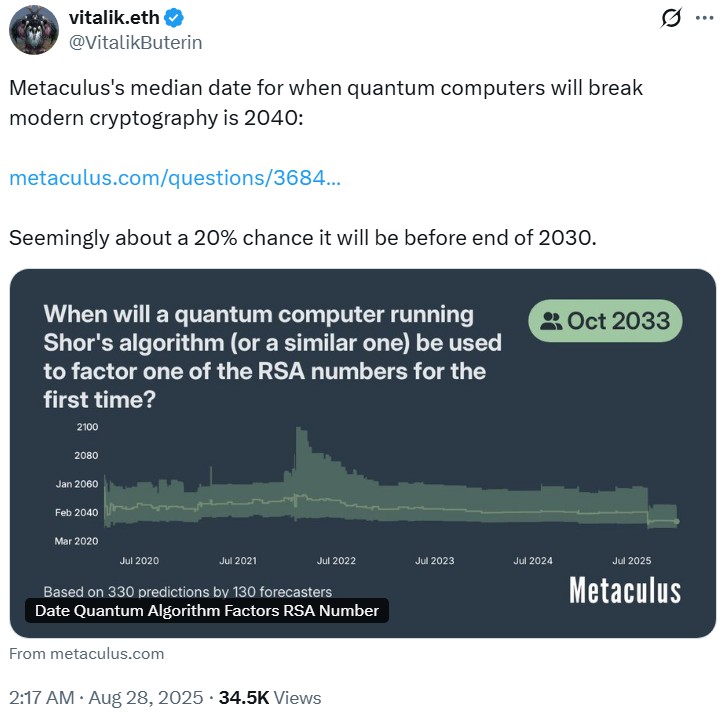
Prediction models forecast a 20% chance that powerful quantum computers are about five years away. Source: Vitalik Buterin

That framing has begun to echo across other major blockchains, particularly those that can experiment without reopening foundational debates.

Aptos has proposed adding post-quantum signature support at the account level through an opt-in upgrade that would leave existing accounts untouched. The proposal relies on a hash-based signature scheme and is positioned as future-proofing rather than a reaction to an imminent threat. Users can adopt the new scheme if they choose, without forcing a network-wide migration.

Related: What if quantum computers already broke Bitcoin?

Solana has taken a similar posture through testing rather than deployment. In partnership with post-quantum security firm Project Eleven, the network recently ran a dedicated testnet using quantum-resistant signatures to assess whether such schemes can be integrated without undermining performance or compatibility.
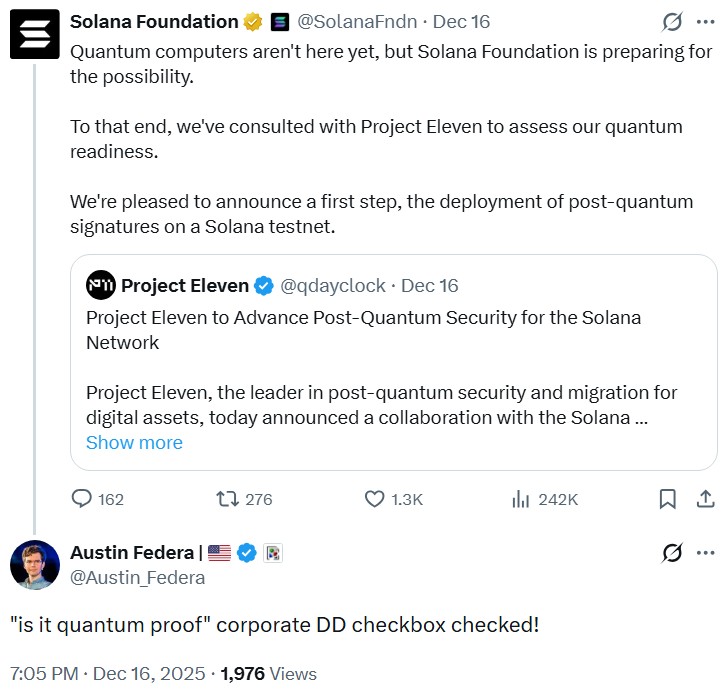
Quantum resistance is increasingly being treated as a due diligence consideration by investors. Source: Solana/Austin Federa

Bitcoin’s quantum debate is really about trust

Bitcoin relies on elliptic curve cryptography to verify ownership. Control over funds is proven through a private key, while only the corresponding public key is revealed onchain.

In theory, a sufficiently powerful quantum computer running Shor’s algorithm could work backwards from a public key to recover the private one, allowing an attacker to spend funds without triggering any obvious signs of theft. From the network’s perspective, those coins would simply move as if their owner had decided to transact.

Even proponents of post-quantum upgrades generally acknowledge that cryptographically relevant machines are still years away. But the dispute in Bitcoin’s community is about how Bitcoin should respond to a risk that is distant, uncertain and difficult to detect once it materializes.

On one side, developers and longtime Bitcoin cryptographers argue that framing quantum computing as an urgent concern does more harm than good.
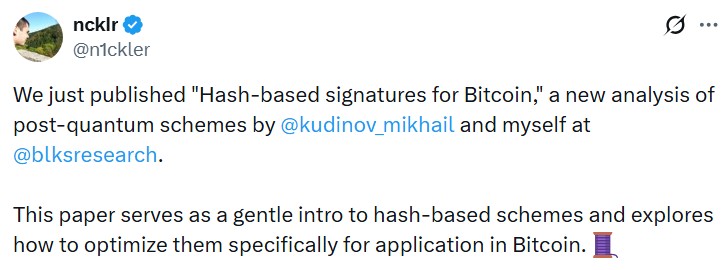
Despite the online debates, Bitcoin researchers are actively studying post-quantum schemes. Source: Jonas Nick

Blockstream CEO Adam Back has repeatedly dismissed near-term quantum fears, stressing that practical quantum attacks remain decades out. He claimed that amplifying quantum risks fuels panic and encourages markets to price in a threat that does not yet exist.

On the other side, investors and researchers argue that even a low-probability outcome matters for an asset whose value depends on long-term confidence. Castle Island Ventures partner Nic Carter has described the outright dismissal of quantum risk by influential developers as bearish.
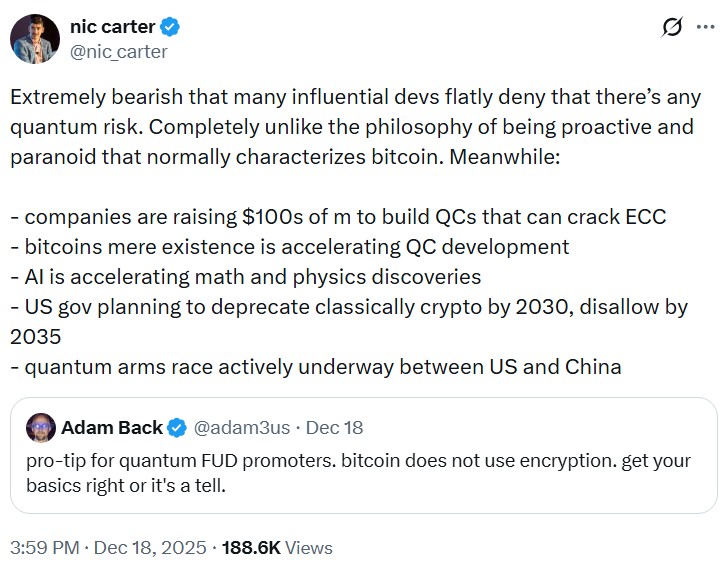
Nic Carter outlines why quantum risks make investors paranoid. Source: Nic Carter

Craig Warmke of the Bitcoin Policy Institute has similarly warned that perceived complacency is pushing some capital to diversify away from Bitcoin regardless of whether the underlying technical fears are precisely articulated.

That tension explains why proposals such as Bitcoin Improvement Proposal 360, which would introduce quantum-resistant signature options, provoke outsized reactions despite their early and tentative status.

Related: Bitcoin decouples from stocks in second half of 2025

Supporters see early work as a way to reduce uncertainty and signal preparedness. Critics see the same discussion as legitimizing a speculative threat and inviting confusion about Bitcoin’s resilience.

Why quantum uncertainty matters differently for Bitcoin

Quantum computers today cannot break Bitcoin or any major blockchain. What is already happening is that uncertainty around quantum risk is influencing how different networks choose to communicate and how investors interpret those choices.

Outside Bitcoin, post-quantum work has been framed as infrastructure. Opt-in upgrades and test networks allow blockchains to signal preparedness without forcing users or markets to reassess present-day security assumptions. That approach limits the reputational cost of early preparation while preserving flexibility if timelines change.

Bitcoin operates under different constraints. Because its value is closely tied to long-term assurances about security and durability, discussions about future-proofing its cryptography tend to attract immediate scrutiny. What might be treated as routine contingency planning elsewhere is more easily read as a comment on Bitcoin’s fundamentals.

Influential voices related to Bitcoin worry that emphasizing distant risks invites misunderstanding and panic. Investors worry that minimizing those risks signals a lack of contingency planning. Both sides are responding to how confidence is shaped in the absence of clear timelines.

The quantum debate suggests that for Bitcoin, managing how long-term risks are discussed may matter as much as managing the risks themselves.

Magazine: Big questions: Would Bitcoin survive a 10-year power outage?

Related Questions

QWhat are some major blockchains that are preparing for the quantum threat, and how are they approaching it?

AAptos has proposed adding post-quantum signature support through an opt-in upgrade at the account level, while Solana has tested quantum-resistant transactions on a dedicated testnet in partnership with Project Eleven. Ethereum's co-founder has also framed it as an engineering problem requiring early preparation.

QAccording to Vitalik Buterin, what is the estimated timeline for the emergence of quantum computers capable of breaking current cryptography?

ACiting forecasting models, Vitalik Buterin has said there is roughly a 20% chance that such quantum computers could emerge before 2030, with a median estimate closer to 2040.

QWhy is the quantum computing debate particularly contentious within the Bitcoin community?

AThe debate is about trust and how to respond to a distant and uncertain risk. Some developers argue that framing it as urgent causes unnecessary panic, while investors and researchers believe dismissing it undermines long-term confidence and affects Bitcoin's price, as its value is tied to security assurances.

QHow could a powerful quantum computer theoretically attack the Bitcoin network?

AA sufficiently powerful quantum computer running Shor's algorithm could work backwards from a public key to recover the corresponding private key. This would allow an attacker to spend funds without triggering obvious signs of theft, as the transaction would appear legitimate.

QHow does the approach to quantum risk differ between Bitcoin and other altcoin blockchains?

AAltcoins like Aptos and Solana treat post-quantum work as infrastructure upgrades, using opt-in features and testnets to signal preparedness without forcing a network-wide reassessment of current security. Bitcoin's discussions are more scrutinized because its value is closely tied to long-term security, making such talks easily misinterpreted as a comment on its fundamentals.

Related Reads

Trading

Spot
Futures

Hot Articles

What is $BITCOIN

DIGITAL GOLD ($BITCOIN): A Comprehensive Analysis Introduction to DIGITAL GOLD ($BITCOIN) DIGITAL GOLD ($BITCOIN) is a blockchain-based project operating on the Solana network, which aims to combine the characteristics of traditional precious metals with the innovation of decentralized technologies. While it shares a name with Bitcoin, often referred to as “digital gold” due to its perception as a store of value, DIGITAL GOLD is a separate token designed to create a unique ecosystem within the Web3 landscape. Its goal is to position itself as a viable alternative digital asset, although specifics regarding its applications and functionalities are still developing. What is DIGITAL GOLD ($BITCOIN)? DIGITAL GOLD ($BITCOIN) is a cryptocurrency token explicitly designed for use on the Solana blockchain. In contrast to Bitcoin, which provides a widely recognized value storage role, this token appears to focus on broader applications and characteristics. Notable aspects include: Blockchain Infrastructure: The token is built on the Solana blockchain, known for its capacity to handle high-speed and low-cost transactions. Supply Dynamics: DIGITAL GOLD has a maximum supply capped at 100 quadrillion tokens (100P $BITCOIN), although details regarding its circulating supply are currently undisclosed. Utility: While precise functionalities are not explicitly outlined, there are indications that the token could be utilized for various applications, potentially involving decentralized applications (dApps) or asset tokenization strategies. Who is the Creator of DIGITAL GOLD ($BITCOIN)? At present, the identity of the creators and development team behind DIGITAL GOLD ($BITCOIN) remains unknown. This situation is typical among many innovative projects within the blockchain space, particularly those aligning with decentralized finance and meme coin phenomena. While such anonymity may foster a community-driven culture, it intensifies concerns about governance and accountability. Who are the Investors of DIGITAL GOLD ($BITCOIN)? The available information indicates that DIGITAL GOLD ($BITCOIN) does not have any known institutional backers or prominent venture capital investments. The project seems to operate on a peer-to-peer model focused on community support and adoption rather than traditional funding routes. Its activity and liquidity are primarily situated on decentralized exchanges (DEXs), such as PumpSwap, rather than established centralized trading platforms, further highlighting its grassroots approach. How DIGITAL GOLD ($BITCOIN) Works The operational mechanics of DIGITAL GOLD ($BITCOIN) can be elaborated on based on its blockchain design and network attributes: Consensus Mechanism: By leveraging Solana’s unique proof-of-history (PoH) combined with a proof-of-stake (PoS) model, the project ensures efficient transaction validation contributing to the network's high performance. Tokenomics: While specific deflationary mechanisms have not been extensively detailed, the vast maximum token supply implies that it may cater to microtransactions or niche use cases that are still to be defined. Interoperability: There exists the potential for integration with Solana’s broader ecosystem, including various decentralized finance (DeFi) platforms. However, the details regarding specific integrations remain unspecified. Timeline of Key Events Here is a timeline that highlights significant milestones concerning DIGITAL GOLD ($BITCOIN): 2023: The initial deployment of the token occurs on the Solana blockchain, marked by its contract address. 2024: DIGITAL GOLD gains visibility as it becomes available for trading on decentralized exchanges like PumpSwap, allowing users to trade it against SOL. 2025: The project witnesses sporadic trading activity and potential interest in community-led engagements, although no noteworthy partnerships or technical advancements have been documented as of yet. Critical Analysis Strengths Scalability: The underlying Solana infrastructure supports high transaction volumes, which could enhance the utility of $BITCOIN in various transaction scenarios. Accessibility: The potential low trading price per token could attract retail investors, facilitating wider participation due to fractional ownership opportunities. Risks Lack of Transparency: The absence of publicly known backers, developers, or an audit process may yield skepticism regarding the project's sustainability and trustworthiness. Market Volatility: The trading activity is heavily reliant on speculative behavior, which can result in significant price volatility and uncertainty for investors. Conclusion DIGITAL GOLD ($BITCOIN) emerges as an intriguing yet ambiguous project within the rapidly evolving Solana ecosystem. While it attempts to leverage the “digital gold” narrative, its departure from Bitcoin's established role as a store of value underscores the need for a clearer differentiation of its intended utility and governance structure. Future acceptance and adoption will likely depend on addressing the current opacity and defining its operational and economic strategies more explicitly. Note: This report encompasses synthesised information available as of October 2023, and developments may have transpired beyond the research period.

363 Total ViewsPublished 2025.05.13Updated 2025.05.13

What is $BITCOIN

Discussions

Welcome to the HTX Community. Here, you can stay informed about the latest platform developments and gain access to professional market insights. Users' opinions on the price of BTC (BTC) are presented below.

活动图片