Blockchain trial on Canton Network tests collateral reuse with tokenized US Treasurys

cointelegraphPublished on 2025-12-09Last updated on 2025-12-09

Abstract

Digital Asset and a group of major financial institutions have successfully conducted a second round of onchain US Treasury financing trials on the Canton Network. The test introduced real-time collateral reuse using tokenized US Treasurys and expanded the use of multiple stablecoins, including USDC, to enhance onchain liquidity. This innovation bypasses traditional operational delays associated with rehypothecation. Participants included Bank of America, Citadel Securities, Cumberland DRW, Virtu Financial, Société Générale, Tradeweb, Circle, Brale, and M1X Global. The Canton Network, a blockchain built for institutional finance, continues to grow in the tokenized real-world assets (RWA) space, with over $370 billion represented onchain, leading the market significantly.

Digital Asset and a group of financial institutions have completed a second round of onchain US Treasury financing on the Canton Network, introducing real-time collateral reuse and expanding the number of stablecoins involved.

Five transactions were executed in the newest phase, building on the July pilot, which first demonstrated that US Treasurys and the USDC (USDC) stablecoin could be combined to finance and settle transactions on the blockchain.

In the latest trial, the companies used multiple stablecoins to finance positions against tokenized US Treasurys, widening the pool of onchain liquidity available for financing transactions.

The trial showed that tokenized US Treasurys could be passed between counterparties and reused as collateral in real-time, sidestepping the operational delays that typically accompany rehypothecation in traditional finance.

The effort brought together Bank of America, Citadel Securities, Cumberland DRW, Virtu Financial, Société Générale, Tradeweb, Circle, Brale and M1X Global, which are all a part of the Canton Network’s Industry Working Group.

Kelly Mathieson, chief business development officer at Digital Asset — the company behind the Canton Network — said in a statement that the test was “part of a thoughtful progression toward a new market model.”

Justin Peterson, chief technology officer of Tradeweb, added that “demonstrating real-time collateral reuse and expanded stablecoin liquidity isn’t just a technical achievement — it’s a blueprint for what the future of institutional finance can look like.”

Related: ‘We refused to do an ICO’: The truth behind Canton’s tokenomics

Canton Network expands footprint in tokenized RWAs

The Canton Network, a layer-1 blockchain built for institutional finance, has been expanding its presence across the tokenization sector this year.

On Dec. 4, its developer Digital Asset secured roughly $50 million in strategic backing from BNY, iCapital, Nasdaq and S&P Global. The new funding followed a $135 million raise earlier this year and is intended to support the network’s scaling efforts.

In October, asset manager Franklin Templeton said it would migrate its Benji Investments platform — which tokenizes shares of the firm’s flagship US money market fund — to the Canton Network.

Data from RWA.xyz also shows the Canton Network now leads the market for tokenized real-world assets by a wide margin, with more than $370 billion represented onchain, far outpacing popular networks such as Ethereum, Polygon, Solana and other public chains.
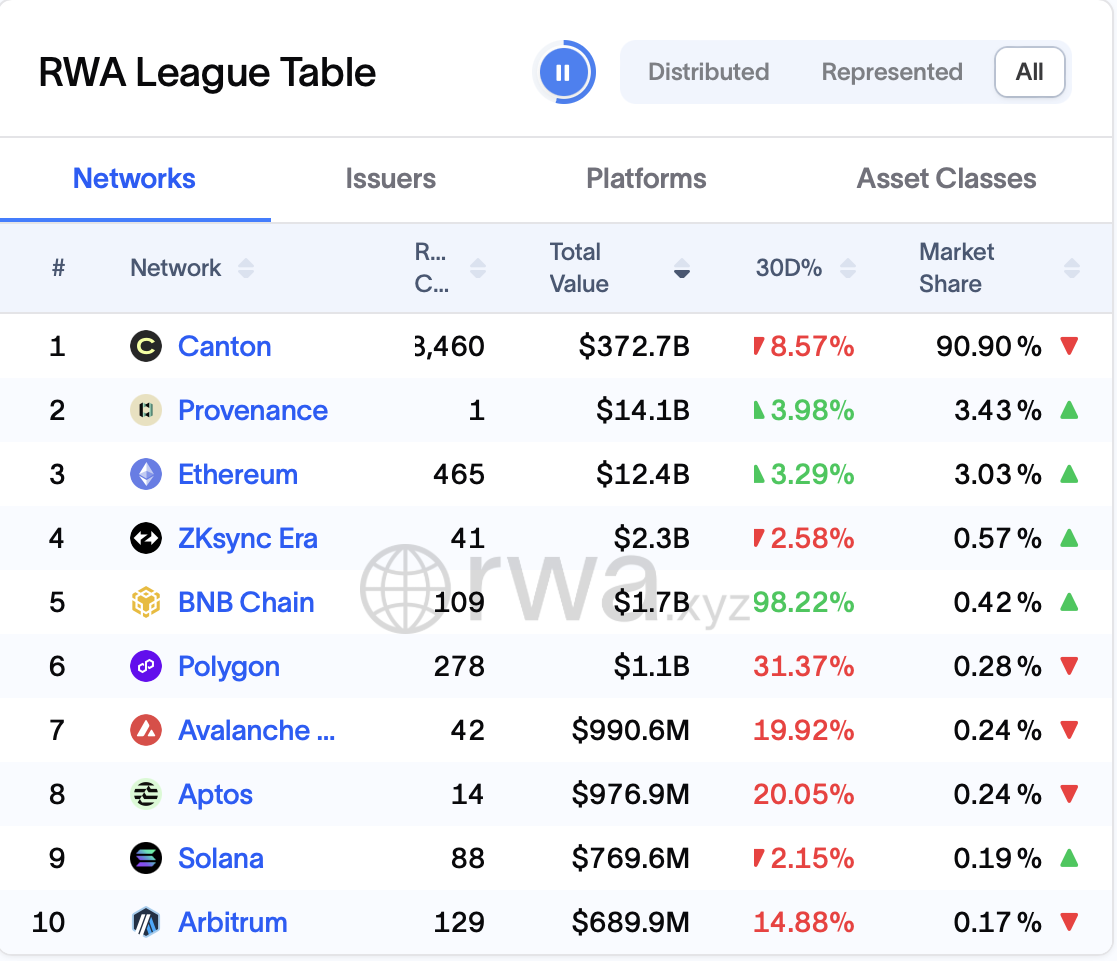
Top blockchains for RWA. Source: RWA.xyz

Magazine: 6 reasons Jack Dorsey is definitely Satoshi... and 5 reasons he’s not

Related Reads

How Many Tokens Away Is Yang Zhilin from the 'Moon Chasing the Light'?

The article explores the intense competition between two leading Chinese AI companies, DeepSeek and Kimi (Moon Dark Side), and the mounting pressure on Yang Zhilin, the founder of Kimi. While DeepSeek re-emerged after 15 months of silence with its powerful V4 model—boasting 1.6 trillion parameters and low-cost, long-context capabilities—Kimi has been focusing on long-context processing and multi-agent systems with its K2.6 model. Yang faces a threefold challenge: technological rivalry, commercialization pressure, and investor expectations. Despite Kimi’s high valuation (reaching $18 billion), its revenue heavily relies on a single product with low paid conversion rates, while DeepSeek’s strategic silence and open-source influence have strengthened its market position and valuation prospects, now targeting over $20 billion. Both companies reflect broader trends in China’s AI ecosystem: Kimi aims for global influence through open-source contributions and agent-based advancements, while DeepSeek prioritizes foundational innovation and hardware independence, notably shifting to Huawei’s chips. Their competition is seen as vital for China’s AI progress, with the gap between top Chinese and U.S. models narrowing to just 2.7% on the Elo rating scale. Ultimately, the article argues that this rivalry, though anxiety-inducing for leaders like Zhilin, is essential for driving innovation and solidifying China’s role in the global AI landscape.

marsbit9h ago

How Many Tokens Away Is Yang Zhilin from the 'Moon Chasing the Light'?

marsbit9h ago

Trading

Spot
Futures
活动图片