BlackRock Converts $5 Billion Worth of Bitcoin into ETF

cryptonews.ruPublished on 2026-08-26Last updated on 2026-08-26

Abstract

Wall Street is streamlining the shift from self-custody to ETFs for crypto investors, allowing direct conversion of digital assets into fund shares without an initial sale. Major issuers are increasingly adopting this in-kind creation model. BlackRock has notably expanded access, lowering the minimum conversion threshold for its iShares Bitcoin Trust (IBIT) from $25 million to $1 million and processing over $5 billion in such conversions so far. Other firms like Bitwise have similarly reduced their minimums, with demand growing steadily. The appeal extends beyond convenience, offering potential tax advantages and reducing reliance on private keys. The trend now includes Ethereum and Solana, with a significant portion of new ETF shares being created via in-kind transactions. While infrastructure challenges remain, the process is becoming more standardized, moving from a bespoke service for large players toward a mainstream component of institutional crypto investing.

Wall Street is making it easier for crypto investors to transition from self-custody to exchange-traded funds without having to sell their digital assets first.

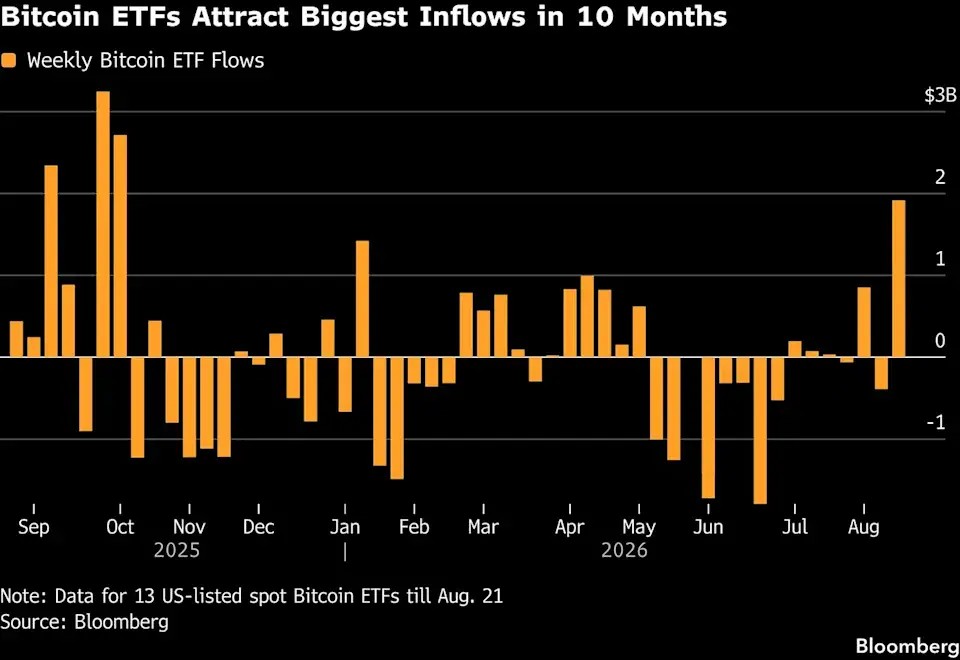
According to Bloomberg, in-kind creation is becoming increasingly common among major issuers, allowing investors to deposit Bitcoin directly into a spot ETF and receive shares in exchange. This mechanism maintains market exposure while transferring asset custody to the traditional financial system.

The most significant change is about access. In July, when this service first became available, BlackRock lowered the minimum threshold for converting Bitcoin into its ETF from $25 million to $1 million. According to Robbie Mitchnick, head of digital assets at BlackRock, his iShares Bitcoin Trust (IBIT) has already processed over $5 billion in such conversions.

"That volume is going to continue to increase as we continue to expand access," Mitchnick told Bloomberg.
Source: Bloomberg

Minimums Drop as the Process Becomes More Routine

Bitwise has followed a similar path.

For its first in-kind Bitcoin conversion, a deal of at least $100 million was required to secure support from authorized participants. That threshold later dropped to $50 million and now stands at $3 million.

Bitwise Chief Investment Officer Matt Hougan noted that while the entire process is still handled individually, it is becoming increasingly standardized.

Other issuers report sustained demand growth. At 21Shares, the average size of completed in-kind Bitcoin deals over the last three months has been around $5 million. Morgan Stanley reported that such conversions account for roughly 5% to 7% of assets in its spot Bitcoin ETF, which has about $560 million in assets under management.

The appeal of these transactions goes beyond mere convenience. Investors can reduce reliance on private keys and wallets, and depending on individual tax situations, exchanging Bitcoin instead of selling it for cash may allow them to avoid immediate taxation.

Ether and Solana Join the In-Kind Conversion Trend

This model is also expanding beyond Bitcoin. Grayscale uses in-kind transactions for its Ether-based products, and Bitwise supports conversions for both Ether and Solana.

At Grayscale, this shift has accelerated sharply. In March, 28% of gross Bitcoin creation and 57% of gross Ether creation were done in-kind. By June, those figures had risen to 62% and 63%, respectively.

The remaining obstacle is infrastructure. Transactions still require authorized participants or market makers willing to handle cryptocurrency, which increases cost and complexity.

Nevertheless, the direction is clear. As minimums drop and more intermediaries enter the market, the direct exchange of Bitcoin, Ether, and Solana for ETF shares is evolving from a private banking-style service for 'whales' into a more standardized component of institutional cryptocurrency investing.

Related Questions

QWhat is the main benefit of the in-kind conversion service for Bitcoin into spot ETFs, as described in the article?

AThe main benefit is that it allows crypto investors to transition from self-custody to exchange-traded funds (ETFs) without having to sell their digital assets first. This preserves their market exposure while moving the asset custody to the traditional financial system.

QAccording to the article, how much in Bitcoin-to-ETF conversions has BlackRock's iShares Bitcoin Trust (IBIT) processed?

ABlackRock's iShares Bitcoin Trust (IBIT) has processed in-kind Bitcoin-to-ETF conversions worth over $5 billion.

QWhat are two specific advantages for investors using in-kind conversions mentioned in the article?

ATwo advantages are: 1) Investors can reduce reliance on private keys and self-custody wallets. 2) Depending on an individual's tax situation, exchanging Bitcoin for ETF shares, rather than selling it for cash, may allow them to avoid immediate taxation.

QBeyond Bitcoin, which other cryptocurrencies are mentioned as being supported for in-kind conversions into ETFs?

ABeyond Bitcoin, the article mentions that Ethereum (ETH) and Solana (SOL) are also supported for in-kind conversions into ETFs by firms like Grayscale and Bitwise.

QWhat is identified as a remaining obstacle for the broader adoption of in-kind conversion transactions?

AThe remaining obstacle is infrastructure. Transactions still require authorized participants or market makers willing to handle the cryptocurrencies, which adds cost and complexity to the process.

Related Reads

Websea's Third Anniversary: The Adjustments and Choices of a Mid-Sized Exchange During an Industry Shakeout Period

Websea, a mid-sized cryptocurrency exchange, celebrated its third anniversary in 2026 amid a period of industry consolidation. While the crypto landscape broadens with TradFi, RWA, and stablecoins, several established exchanges have retreated. This highlights the challenge for mid-tier platforms: growth is not automatic and depends on liquidity, compliance, security, and user retention. Websea has recently focused on strategic product adjustments. Key initiatives include enhancing risk management tools like contract insurance and copy trading, expanding its asset offerings to include TradFi CFDs (gold, silver, indices, forex), launching a Proof of Reserves (PoR) system for transparency, and engaging in regional RWA development through events like a summit in Almaty. The article analyzes these moves. Risk management products aim to improve user experience and retention, but their long-term viability hinges on clear rules and sustainable mechanisms. Offering TradFi CFDs seeks to capture user engagement during crypto market lulls, though it introduces new operational complexities. The PoR report addresses transparency concerns, but its value depends on regular updates. Regional RWA exploration offers potential access to real-world assets but faces significant hurdles in legal structuring and productization. Ultimately, Websea's three-year mark showcases a strategy to compete by broadening tradable assets, strengthening risk and transparency features, and exploring niche opportunities. The critical test will be whether these adjustments translate into sustainable trading volume, lasting user loyalty, and verifiable business growth over time.

marsbit19m ago

Websea's Third Anniversary: The Adjustments and Choices of a Mid-Sized Exchange During an Industry Shakeout Period

marsbit19m ago

iPhone Owners Will Not Be Able to Use the Digital Ruble - Vedomosti

iPhone users in Russia will face obstacles in using the digital ruble, the country's central bank's new digital currency, according to a report by Vedomosti. The Bank of Russia's website states iOS device owners can only use the digital ruble with an updated banking app containing the necessary features. However, banks cannot upload these updated apps to the App Store by the September 1st deadline. The main hurdles are sanctions and technical requirements. Apple blocks apps from sanctioned Russian banks. Furthermore, the Bank of Russia mandates that apps use Russian cryptographic standards, connect to specific central bank domains and APIs. Apple identifies these technical elements as markers of affiliation with the Russian state financial infrastructure, leading to app rejection. Certified solutions already exist for Android. Apple's review process scrutinizes not just code but also the build's origin—including developer accounts, cryptographic keys, and network requests—which can lead to blocks for apps or entire developer accounts. While "guerrilla apps" or clones sometimes appear, they are typically removed from the App Store within days or hours. For iPhone users, some banks offer web-based access to digital ruble functions as an alternative. However, major banks like VTB, RSHB, and "Russia" told Vedomosti the digital ruble is only available in their Android apps. Starting September 1st, 12 systemically important Russian banks, including Sberbank, VTB, and Alfa-Bank, are required to provide access to the digital ruble, which must be integrated as a wallet within their own banking applications, not a separate app. Also from September, all major Russian companies are mandated to begin accepting digital ruble payments, with telecom operators and marketplaces announcing the service's launch.

cryptonews.ru44m ago

iPhone Owners Will Not Be Able to Use the Digital Ruble - Vedomosti

cryptonews.ru44m ago

Trading

Spot
活动图片