Bitwise Seeks to Acquire Chorus One to Dominate Institutional Staking as BMIC Momentum Builds

bitcoinistPublished on 2026-02-04Last updated on 2026-02-04

Abstract

Bitwise, a major asset management firm, is reportedly seeking to acquire Chorus One, a leading European institutional staking provider, signaling a strategic move to dominate the crypto yield infrastructure. This acquisition highlights the growing institutional focus on staking as a key revenue stream. However, this consolidation raises concerns over centralization risks and vulnerabilities, such as potential "Harvest Now, Decrypt Later" quantum attacks. In response, projects like BMIC ($BMIC) are gaining attention for offering a quantum-secure finance stack designed to protect digital assets against future cryptographic threats. BMIC's presale has already raised significant funds, reflecting strong market interest in next-generation security solutions.

The institutional race to capture the crypto yield economy just entered a new, aggressive phase. Reports indicating that asset management giant Bitwise seeks to acquire Chorus One, a leading European institutional staking provider, signal a pivotal shift in market structure.

This isn’t merely about accumulation, it’s a battle for control of the infrastructure itself.

Bitwise (already a heavyweight in the ETF sector) appears to be positioning itself vertically within the crypto stack. By targeting Chorus One, which operates validators for over 60 networks and secures billions in assets, Bitwise is moving beyond simple asset exposure.

They’re aiming to capture the technical ‘yield layer’ of the blockchain ecosystem. Why? Because it validates the thesis that staking, not just trading, is where the next trillion dollars of institutional capital will flow.

With Bitcoin hovering near $76K and Ethereum dominance holding steady, the market appetite for yield-bearing infrastructure is insatiable. But let’s be honest: this consolidation of staking power brings new risks.

As centralized entities amass validator keys, the attack surface for bad actors grows. This centralization paradox is driving capital toward decentralized, next-generation security solutions that can protect assets even as the stakes get higher.

While the giants fight for today’s yields, forward-looking investors are positioning themselves in protocols like BMIC ($BMIC), which addresses the existential threat looming over all digital assets: quantum decryption.

Buy $BMIC here.

The Quantum Threat to Institutional Staking Infrastructure

The potential acquisition of Chorus One by Bitwise underscores a critical reality: digital assets are only as valuable as the cryptography securing them.

As institutions lock up billions in staking contracts, they become prime targets for ‘Harvest Now, Decrypt Later’ (HNDL) attacks. State actors and sophisticated syndicates are already hoarding encrypted data, waiting for quantum computing power to mature enough to shatter current encryption standards like RSA and ECC.

Here is where the narrative shifts from simple accumulation to survival. If the underlying cryptographic signatures of a validator are compromised, the entire stake is at risk. The industry is finally waking up to the fact that legacy wallets and staking mechanisms, regardless of who owns them, are built on math that has an expiration date.

BMIC ($BMIC) tackles this vulnerability head-on.

Unlike traditional wallets that merely store keys, BMIC offers a full quantum-secure finance stack. By integrating ERC-4337 smart accounts with proprietary post-quantum cryptography, the project ensures that user keys are never exposed during transactions or staking activities.

This creates a defensive moat that appeals to both retail users fearing wallet drains and enterprise players looking to future-proof their operations against the inevitability of quantum computing.

Learn more about BMIC here.

BMIC Offers ‘Harvest Now, Decrypt Later’ Protection as Presale Surges

While Bitwise focuses on aggregating current market share, BMIC is engineering the safety rails for the next decade of crypto. The project’s unique value proposition centers on eliminating public key exposure, the primary vector for both current phishing attacks and future quantum breaks.

Through its Quantum Meta-Cloud and AI-enhanced threat detection, the platform creates an ecosystem where users can transact, stake, and govern without the perpetual anxiety of private key management.

The market has responded sharply to this utility. The BMIC presale has already raised over $432K so far, a figure that suggests a significant appetite for security-first infrastructure. With tokens currently priced at $0.049474, early participants are betting on the transition from legacy wallets to quantum-resistant architectures.
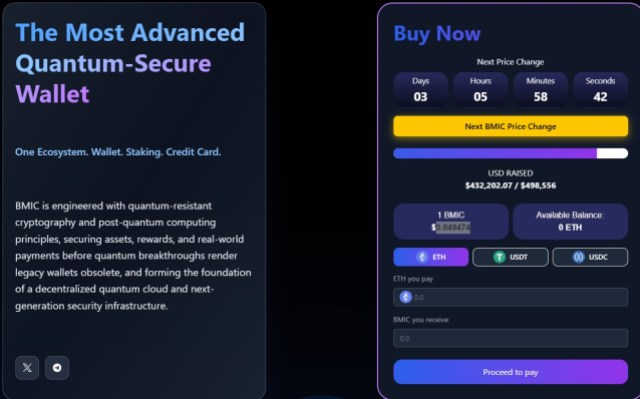
What distinguishes BMIC from standard wallet providers is its recognition of the ‘burn-to-compute’ economy and governance utility. It isn’t just a storage solution; it’s ecosystem fuel designed to power a secure, decentralized computing layer.

As the industry watches giants like Bitwise consolidate the staking layer, the smart money is hedging against the technical debt of that very infrastructure by backing the only platform built to withstand the post-quantum era.

Visit the BMIC presale page.

Disclaimer This article is for informational purposes only and does not constitute financial advice. Cryptocurrency investments carry high risks, including total loss of capital. Always conduct your own due diligence.


Related Questions

QWhat is the main strategic move by Bitwise discussed in the article, and what is its significance?

AThe article discusses Bitwise's move to acquire Chorus One, a leading European institutional staking provider. This signifies a pivotal shift in market structure, representing a vertical integration into the crypto stack and a battle for control of the yield infrastructure itself, not just asset accumulation.

QAccording to the article, what is the 'Quantum Threat' to institutional staking infrastructure?

AThe 'Quantum Threat' refers to 'Harvest Now, Decrypt Later' (HNDL) attacks, where state actors or sophisticated syndicates hoard encrypted data, waiting for quantum computing to mature enough to break current encryption standards like RSA and ECC, thereby compromising validator signatures and putting entire stakes at risk.

QHow does the BMIC ($BMIC) protocol claim to address the vulnerabilities of traditional staking and wallets?

ABMIC offers a full quantum-secure finance stack by integrating ERC-4337 smart accounts with proprietary post-quantum cryptography. This ensures user keys are never exposed during transactions or staking, creating a defensive moat against both current threats and future quantum decryption.

QWhat market response is cited as evidence of appetite for BMIC's solution?

AThe article cites that the BMIC presale has raised over $432K, suggesting a significant market appetite for its security-first infrastructure, with investors betting on the transition from legacy wallets to quantum-resistant architectures.

QWhat centralization risk does the article associate with the consolidation of staking power by entities like Bitwise?

AThe article states that as centralized entities amass validator keys, the attack surface for bad actors grows. This centralization paradox increases risk and is driving capital toward decentralized, next-generation security solutions.

Related Reads

Gensyn AI: Don't Let AI Repeat the Mistakes of the Internet

In recent months, the rapid growth of the AI industry has attracted significant talent from the crypto sector. A persistent question among researchers intersecting both fields is whether blockchain can become a foundational part of AI infrastructure. While many previous AI and Crypto projects focused on application layers (like AI Agents, on-chain reasoning, data markets, and compute rentals), few achieved viable commercial models. Gensyn differentiates itself by targeting the most critical and expensive layer of AI: model training. Gensyn aims to organize globally distributed GPU resources into an open AI training network. Developers can submit training tasks, nodes provide computational power, and the network verifies results while distributing incentives. The core issue addressed is not decentralization for its own sake, but the increasing centralization of compute power among tech giants. In the era of large models, access to GPUs (like the H100) has become a decisive bottleneck, dictating the pace of AI development. Major AI companies are heavily dependent on large cloud providers for compute resources. Gensyn's approach is significant for several reasons: 1) It operates at the core infrastructure layer (model training), the most resource-intensive and technically demanding part of the AI value chain. 2) It proposes a more open, collaborative model for compute, potentially increasing resource utilization by dynamically pooling idle GPUs, similar to early cloud computing logic. 3) Its technical moat lies in solving complex challenges like verifying training results, ensuring node honesty, and maintaining reliability in a distributed environment—making it more of a deep-tech infrastructure company. 4) It targets a validated, high-growth market with genuine demand, rather than pursuing blockchain integration without purpose. Ultimately, the boundaries between Crypto and AI are blurring. AI requires global resource coordination, incentive mechanisms, and collaborative systems—areas where crypto-native solutions excel. Gensyn represents a step toward making advanced training capabilities more accessible and collaborative, moving beyond a niche controlled by a few giants. If successful, it could evolve into a fundamental piece of AI infrastructure, where the most enduring value in the AI era is often created.

marsbit13h ago

Gensyn AI: Don't Let AI Repeat the Mistakes of the Internet

marsbit13h ago

Why is China's AI Developing So Fast? The Answer Lies Inside the Labs

A US researcher's visit to China's top AI labs reveals distinct cultural and organizational factors driving China's rapid AI development. While talent, data, and compute are similar to the West, Chinese labs excel through a pragmatic, execution-focused culture: less emphasis on individual stardom and conceptual debate, and more on teamwork, engineering optimization, and mastering the full tech stack. A key advantage is the integration of young students and researchers who approach model-building with fresh perspectives and low ego, prioritizing collective progress over personal credit. This contrasts with the US culture of self-promotion and "star scientist" narratives. Chinese labs also exhibit a strong "build, don't buy" mentality, preferring to develop core capabilities—like data pipelines and environments—in-house rather than relying on external services. The ecosystem feels more collaborative than tribal, with mutual respect among labs. While government support exists, its scale is unclear, and technical decisions appear driven by labs, not state mandates. Chinese companies across sectors, from platforms to consumer tech, are building their own foundational models to control their tech destiny, reflecting a broader cultural drive for technological sovereignty. Demand for AI is emerging, with spending patterns potentially mirroring cloud infrastructure more than traditional SaaS. Despite challenges like a less mature data industry and GPU shortages, Chinese labs are propelled by vast talent, rapid iteration, and deep integration with the open-source community. The competition is evolving beyond a pure model race into a contest of organizational execution, developer ecosystems, and industrial pragmatism.

marsbit14h ago

Why is China's AI Developing So Fast? The Answer Lies Inside the Labs

marsbit14h ago

3 Years, 5 Times: The Rebirth of a Century-Old Glass Factory

Corning, a 175-year-old glass company, is experiencing a dramatic revival as a key player in AI infrastructure, driven by surging demand for high-performance optical fiber in data centers. AI data centers require vastly more fiber than traditional ones—5 to 10 times as much per rack—to handle high-speed data transmission between GPUs. This structural demand shift, coupled with supply constraints from the lengthy expansion cycle for fiber preforms, has created a significant supply-demand gap. Nvidia has invested in Corning, along with Lumentum and Coherent, in a $4.5 billion total commitment to secure the optical supply chain for AI. Corning's competitive edge lies in its expertise in producing ultra-low-loss, high-density, and bend-resistant specialty fiber, which is critical for 800G+ and future 1.6T data rates. Its deep involvement in co-packaged optics (CPO) with partners like Nvidia further solidifies its position. While not the largest fiber manufacturer globally, Corning's revenue from enterprise/data center clients now exceeds 40% of its optical communications sales, and it has secured multi-year supply agreements with major hyperscalers including Meta and Nvidia. Financially, Corning's optical communications revenue has surged, doubling from $1.3 billion in 2023 to over $3 billion in 2025. Its stock price has risen nearly 6-fold since late 2023. Key future catalysts include the rollout of Nvidia's CPO products and the scale of undisclosed customer agreements. However, risks include high current valuations and potential disruption from next-generation technologies like hollow-core fiber. The company's long-term bet on light over electricity, maintained even through the telecom bubble crash, is now being validated by the AI boom.

marsbit15h ago

3 Years, 5 Times: The Rebirth of a Century-Old Glass Factory

marsbit15h ago

Trading

Spot
Futures

Hot Articles

How to Buy ONE

Welcome to HTX.com! We've made purchasing Harmony (ONE) simple and convenient. Follow our step-by-step guide to embark on your crypto journey.Step 1: Create Your HTX AccountUse your email or phone number to sign up for a free account on HTX. Experience a hassle-free registration journey and unlock all features.Get My AccountStep 2: Go to Buy Crypto and Choose Your Payment MethodCredit/Debit Card: Use your Visa or Mastercard to buy Harmony (ONE) instantly.Balance: Use funds from your HTX account balance to trade seamlessly.Third Parties: We've added popular payment methods such as Google Pay and Apple Pay to enhance convenience.P2P: Trade directly with other users on HTX.Over-the-Counter (OTC): We offer tailor-made services and competitive exchange rates for traders.Step 3: Store Your Harmony (ONE)After purchasing your Harmony (ONE), store it in your HTX account. Alternatively, you can send it elsewhere via blockchain transfer or use it to trade other cryptocurrencies.Step 4: Trade Harmony (ONE)Easily trade Harmony (ONE) on HTX's spot market. Simply access your account, select your trading pair, execute your trades, and monitor in real-time. We offer a user-friendly experience for both beginners and seasoned traders.

3.4k Total ViewsPublished 2024.03.29Updated 2025.06.04

How to Buy ONE

Discussions

Welcome to the HTX Community. Here, you can stay informed about the latest platform developments and gain access to professional market insights. Users' opinions on the price of ONE (ONE) are presented below.

活动图片