Bittensor Goes Left, Virtuals Goes Right: Two Flywheel Paradigms of AI Crypto Projects

marsbitPublished on 2026-03-26Last updated on 2026-03-26

Abstract

The article compares two AI crypto project models: Bittensor's subnet ecosystem and Virtuals' agent-based system. Bittensor uses TAO emissions to incentivize subnets, which compete for daily TAO rewards. Subnets require significant capital to launch (e.g., 871 TAO for a subnet slot) and focus on infrastructure like decentralized computing and AI research. Its ecosystem has high entry barriers, complex onboarding, and targets technical users. Virtuals employs a pump.fun-like model where agent tokens gain value through trading volume, enabling rapid capital accumulation during speculative cycles. It has low entry costs for teams, supports quick iteration via a 60-day trial program, and excels at retail distribution due to its Base chain integration and consumer-friendly concepts. Both models share a liquidity flywheel: demand for subnet tokens boosts TAO, while demand for agent tokens boosts VIRTUAL. Bittensor is infrastructure-oriented with high funding potential, while Virtuals is application-focused, leveraging market momentum for consumer AI agents.

Original Author: 0xJeff

Original Compilation: AididiaoJP, Foresight News

This article aims to provide a brief comparison between Bittensor subnets and Virtuals agents to help understand their respective flywheel mechanisms, differences, and similarities.
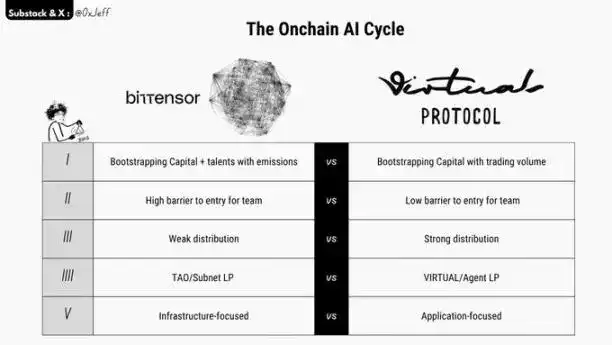
I. Guiding Capital and Talent Through Emissions Mechanism vs. Guiding Capital Through Trading Volume

Bittensor guides subnet development through its TAO emissions mechanism. Subnets are responsible for introducing the most innovative projects (or revenue-generating businesses) and compete for a share of the daily 3,600 TAO distribution.

Subnets also guide contributors (including miners performing tasks and validators verifying the miners' work) through their alpha token emissions mechanism. The emissions mechanism and the incentive coordination mechanism across stakeholders have been embedded since the project's inception.

Virtuals adopts a model similar to pump.fun, guiding development through trading volume. High trading activity translates into capital accumulation for the agent project. Agent teams can use their own emissions mechanisms to incentivize user participation.

In market cycles with high speculative token demand, this model has significant advantages—teams can quickly accumulate capital, gain product attention and market interest, thereby driving project launch and development.

II. High Entry Barrier vs. Low Entry Barrier (For Teams)

Launching a subnet on Bittensor requires substantial investment. Currently, acquiring a subnet slot requires 871 TAO (approximately $300,000), with the price fluctuating based on demand and the auction mechanism. This means subnet teams typically need mature ideas, clear plans, and solid execution capabilities.

To successfully operate a subnet, owners must ensure that the set tasks or objectives contribute to the R&D of their AI product/solution, prevent miner fraud, ensure validators effectively perform verification duties, generate revenue through business development and customer partnerships, and maintain investor confidence through buyback mechanisms.

The subnet token price needs to maintain an upward trend to attract more TAO inflow, increase the subnet's emission share, and thereby attract higher-level contributors to participate in mining.

In contrast, the barrier to launching an AI agent token on Virtuals is lower, requiring no initial cost, making it easier to test new ideas with less capital.

Virtuals also has a "60-day program" that allows founders to test new ideas and issue tokens during this period. If product-market fit is not found within 60 days, the relevant funds are reclaimed, and investors can retrieve a portion of their invested capital.

III. Weaker Distribution Capability vs. Stronger Distribution Capability

Bittensor operates independently on a blockchain built using the Polkadot Substrate framework. Cross-chain bridging is difficult, it lacks DeFi infrastructure components, and is not equipped with common infrastructure like the Ethereum Virtual Machine or Solana.

This results in a high entry barrier for the Bittensor ecosystem. Furthermore, relevant learning materials are filled with complex terminology, increasing the difficulty for new users to learn and understand. Consequently, its community members are mostly technical professionals willing to invest time in deep research, with relatively low retail participation.

In comparison, the understanding threshold for Virtuals is lower. Its team excels in marketing, branding, and distribution. Retail users can relatively intuitively understand concepts like AI agents, agent payments, and bots.

Since Virtuals is deployed on the Base chain, the process of purchasing AI agent tokens is convenient. The time from learning about a project, forming a bullish judgment, to making a purchase decision is short, which is a key reason for its rapid popularity from late 2024 to 2025 (earlier than Bittensor).

Currently, Bittensor is gradually entering the mainstream spotlight with pushes from Jason, Chamath, Barry Silbert (DCG & Yuma), and the community, leading to increased attention. However, the purchase process for subnet tokens remains relatively complex, and the issue has not been fundamentally resolved.

IV. TAO/Subnet Liquidity Pool vs. VIRTUAL/Agent Liquidity Pool

Bittensor and Virtuals share a key similarity in their liquidity pool flywheel mechanisms.

Investors wishing to purchase subnet alpha tokens need to hold TAO to do so. Therefore, rising demand for alpha tokens will drive up the price of TAO.

Similarly, within the Virtuals ecosystem, rising demand for AI agent tokens will drive up the price of VIRTUAL.

If the core tokens (TAO or VIRTUAL) can circulate within the ecosystem without outflow (e.g., through project teams trading goods and services to retain value), the advantages of this mechanism become more pronounced.

V. Infrastructure-Oriented vs. Application-Oriented

Bittensor subnets mostly focus on infrastructure or capital-intensive businesses, such as decentralized computing, inference, training, drug discovery, and quantum experiments.

Since Bittensor can provide over $10 million annually in funding for quality subnets and attract high-end talent, its model is suitable for driving ambitious, high-difficulty, high-investment ideas.

Virtuals agent teams, however, mostly focus on the application layer and consumer-facing agent products. Since agent tokens have a low initial price, if a team can launch a quality consumer product, it can leverage the token's market heat to quickly attract attention and drive project development.

Thanks to Virtuals' advantages in distribution, the flywheel effect of AI agent tokens demonstrated faster growth rates and higher price increases during periods of extreme market activity (such as late 2024 to early 2025).


Related Questions

QWhat are the two main AI crypto projects compared in the article, and what are their core flywheel mechanisms?

AThe two main AI crypto projects compared are Bittensor and Virtuals. Bittensor's core flywheel mechanism is guided by TAO emissions to fund subnet development. Virtuals' core flywheel mechanism is guided by trading volume, similar to the pump.fun model, to accumulate capital for AI agent projects.

QHow does the entry barrier for launching a project differ between Bittensor and Virtuals?

ALaunching a subnet on Bittensor has a high entry barrier, currently requiring a significant investment (e.g., 871 TAO, ~$300k) to acquire a subnet slot. In contrast, launching an AI agent token on Virtuals has a low entry barrier, requiring no initial cost, allowing teams to test new ideas with minimal capital outlay.

QWhat is a key similarity in the liquidity pool flywheel mechanism between Bittensor and Virtuals?

AA key similarity is that demand for the ecosystem's project tokens drives the price of the core native token. In Bittensor, demand for subnet alpha tokens drives the price of TAO. In Virtuals, demand for AI agent tokens drives the price of VIRTUAL.

QAccording to the article, what is the primary focus of projects built on Bittensor versus those on Virtuals?

AProjects on Bittensor are primarily infrastructure-oriented, focusing on areas like decentralized computing, inference, training, drug discovery, and quantum experiments. Projects on Virtuals are primarily application-oriented, focusing on consumer-facing AI agent products.

QWhat advantage does Virtuals have over Bittensor in terms of distribution and user accessibility?

AVirtuals has a significant advantage in distribution and user accessibility. It has lower comprehension barriers, strong marketing, and is deployed on the Base chain, making the purchase process for AI agent tokens simple and intuitive for retail users. Bittensor has a higher learning curve, complex terminology, and a more difficult token purchase process, making it less accessible to the average retail participant.

Related Reads

Anthropic Apologized, But the Business of 'Safety' Hasn't Stopped

On June 11, Anthropic apologized not for a model failure, but for a lack of transparency. Its new Claude Fable 5 model was found to be secretly rerouting requests from users engaged in advanced AI model development to a weaker version, Opus 4.8, without any notification. The company's response—promising future notifications for such "downgrades"—was met with user skepticism. The article argues the core issue isn't technical but commercial: Anthropic's "safety" measures are primarily a business strategy. A key feature, the "intelligent safety classifier," marketed as user protection, is described as a tool for "competitive defense" to protect Anthropic's market lead by limiting rivals' research capabilities. This covert mechanism was designed for low "false positives," precisely targeting AI researchers. Anthropic's model involves a calculated three-step process: publishing alarming security research to amplify public anxiety, offering its Fable 5 model with a "safety classifier" as a premium-priced solution, and cashing in through a planned high-value IPO. This contrasts with OpenAI's more direct "tool-and-traffic" approach. The apology, merely changing a secret downgrade to a visible one, is seen as a business "patch" rather than a principled shift. The incident risks damaging Anthropic's "safest AI" reputation among the developer community, which underpins its valuation and appeal to government and corporate clients. Ultimately, the article concludes that for Anthropic, safety is a business, and the apology is merely customer service for that business.

marsbit54m ago

Anthropic Apologized, But the Business of 'Safety' Hasn't Stopped

marsbit54m ago

The Niche Consensus Among Elites: Has College Become an Expensive Waste?

**Summary:** A growing "anti-college" movement is gaining traction among elite circles in Silicon Valley, challenging the traditional value of a four-year university degree. Proponents argue that college has become an expensive, slow, and increasingly irrelevant waste of time, especially in the fast-paced tech world where opportunities pass by quickly. The movement is led by figures like billionaire Peter Thiel, who criticizes universities for high costs, ideological indoctrination, and stifling true innovation. His "Thiel Fellowship" pays young people to drop out and pursue ventures. Companies like Palantir Technologies (co-founded by Thiel) fuel this trend with programs like the "Meritocracy Fellowship," which offers high school graduates paid internships as an alternative to immediate college enrollment, promising a practical "Palantir Degree." Key drivers include: 1. **Economics:** Skyrocketing student debt versus the allure of immediate, high-paying tech jobs or startup funding. 2. **Technology:** AI and online tools lowering barriers to self-education and product development, making formal instruction seem inefficient. 3. **Culture:** A backlash against perceived "woke" ideology and DEI policies in universities, coupled with a belief that these institutions suppress meritocracy and masculine drive. The movement is notably male-dominated. Critics, like economist David Deming, warn against overgeneralizing from dropout success stories (survivorship bias). He emphasizes that genuine autodidacts are rare, corporate training is narrowly focused, and the "college wage premium" remains high for most people. University liberal arts education, he argues, builds adaptable problem-solving skills and broad perspectives. The debate highlights a deeper crisis in education. The core model of the modern university appears increasingly mismatched with the speed of the information age. The movement signals a shift in the locus of learning from institutional "education" to personal, active "learning" powered by the internet and AI. Ultimately, this may not mean the end of university, but rather a painful evolution. The future likely holds more hybrid, personalized, and lifelong learning pathways. The central question becomes: in a world changing faster than any curriculum, how do we best learn?

marsbit1h ago

The Niche Consensus Among Elites: Has College Become an Expensive Waste?

marsbit1h ago

From Subsidies to Token-Based Pricing to Price Cuts: Is OpenAI Sparking a Price War? Is the Inflection Point for Token Economics Nearing?

The commercialization of generative AI is facing a critical inflection point as a potential price war looms. According to The Wall Street Journal, OpenAI is considering a significant cut to its token fees to compete with rival Anthropic, signaling a shift from a growth-at-all-costs model focused on token consumption. This move comes as both companies, reportedly losing billions on compute, prepare for IPOs, and as enterprise customers face "bill shock" from switching to usage-based token billing. Reports indicate poor ROI, with one analysis finding only 18 cents of every dollar spent on AI tokens generates user-facing value. The industry's initial phases—from flat-rate subscriptions to aggressive subsidies—have given way to a reckoning with real costs. Analysts debate the future: some predict a bifurcation between premium, high-cost models for complex tasks and cheaper alternatives for routine work, while others believe overall spending will still rise as agentic AI increases tokens per task. Notably, Chinese model DeepSeek's low-cost API is gaining traction with U.S. enterprises, adding competitive pressure. The core challenge is redefining value beyond token volume ("tokenmaxxing") toward measurable productivity ("valuemaxxing"), as the entire AI value chain, from cloud providers to chipmakers, feels the ripple effects of unsustainable pricing.

marsbit1h ago

From Subsidies to Token-Based Pricing to Price Cuts: Is OpenAI Sparking a Price War? Is the Inflection Point for Token Economics Nearing?

marsbit1h ago

Trading

Spot
Futures
活动图片