Bithumb Issues Statement Over Reward Payment Error – Details

bitcoinistPublished on 2026-02-07Last updated on 2026-02-07

Abstract

South Korean cryptocurrency exchange Bithumb has addressed a significant internal error that resulted in the accidental distribution of 620,000 BTC (worth billions) to 695 users during a promotional event, instead of the intended 2,000 KRW reward. The mistake caused a flash crash of approximately 10% on the exchange as some recipients immediately sold the Bitcoin. Bithumb responded by freezing affected accounts within 35 minutes and has since recovered 99.7% of the overpaid BTC. The exchange confirmed the incident was an operational error, not a security breach, and assured users that all customer assets remain safe. The broader crypto market is also noted to have recovered slightly, with its total capitalization rising to $2.34 trillion.

Korean exchange Bithumb has cleared the air over an internal error that credited certain user wallets with a “concerning” amount of BTC. Notably, this mishap resulted in significant price volatility on the exchange, drawing attention from observing crypto enthusiasts.

Bithumb Moves To Wrap Up Recovery After Overpayment Error

On February 6, Lookonchain, among many crypto commentary accounts, shared that Bithumb had accidentally transferred 2,000 BTC ($134 million) each to users, instead of 2000 KRW ($1.34) in a reward payout. Some recipients immediately sold, causing a 10% flash crash on the Korean exchange, pushing prices briefly to around $55,000.

In a blog post, Bithumb explained the incident as an overpayment that occurred during a promotional event process involving 695 recipients. The exchange stated it had mistakenly transferred 620,000 BTC to these wallets, an error that was immediately noticed, resulting in a swift ban on withdrawals for all affected wallets within 35 minutes of the transaction.
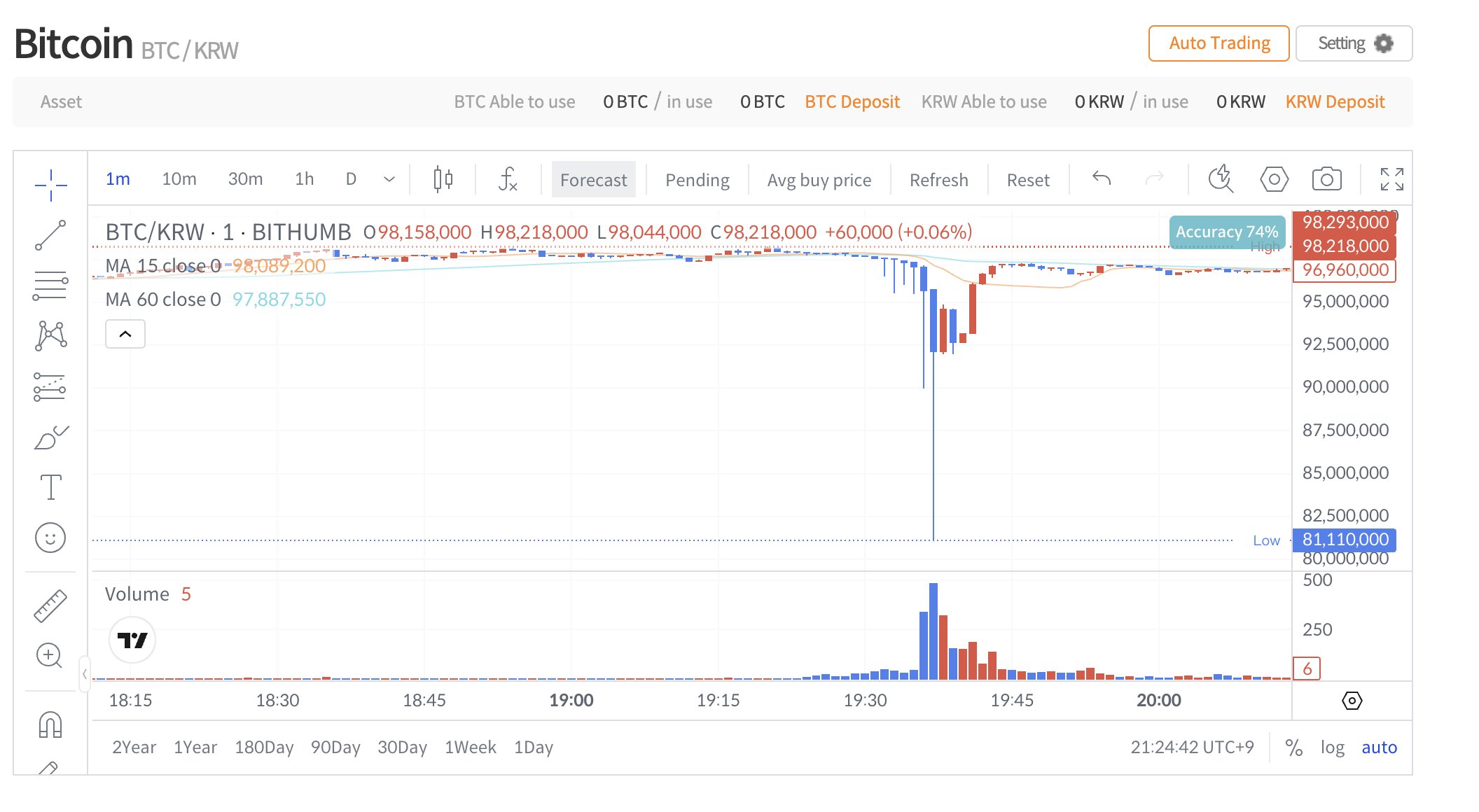
Source: @lookonchain on X

Notably, Bithumb sharply recovered 618,212 BTC, representing 99.7% of the total overpayment amount. Meanwhile, 93% of the 1788 BTC already sold have also been recovered in KRW and other digital assets. According to the exchange, the remaining sold amount that hasn’t been recovered will be covered using company assets. Meanwhile, efforts are underway to ensure such operational errors never recur.

A statement from the exchange said:

Bithumb takes this incident very seriously and will do its utmost to prevent recurrence by redesigning the entire asset payment process and enhancing the internal control system.

Bithumb also kicked against suspicion of external or malicious interference, assuring users that their system remains uncompromised:

They said:

We want to make it clear that this incident is unrelated to any external hacking or security breach, and does not pose any issues with system security or customer asset management. Customer assets are being safely managed as before, and transactions and deposits/withdrawals are currently operating normally.

Crypto Market Overview

In other news, the total crypto market cap has now climbed to $2.34 trillion after a 5.68% gain in the past day. This follows an earlier bloodbath in the week, during which the market cap fell to around $2.19 trillion.

Despite the recent recovery, data from CoinMarketCap shows the digital asset market remains about 45% away from its present cycle all-time high at $4.28 trillion. Market sentiment also continues to reflect caution, with the Crypto Fear and Greed Index currently reading 8, signaling extreme fear among investors.

Total crypto market cap valued at $2.31 trillion on the daily chart | Source: TOTAL chart on Tradingview.com

Featured image from Blocktempo, chart from Tradingview

Related Questions

QWhat was the nature of the error that occurred on the Bithumb exchange?

ABithumb accidentally transferred 2,000 BTC (worth $134 million) to 695 users instead of the intended 2,000 KRW (worth $1.34) as part of a reward payout.

QWhat immediate action did Bithumb take after discovering the overpayment error?

ABithumb swiftly banned withdrawals for all affected wallets within 35 minutes of the transaction to prevent further loss of funds.

QHow much of the overpaid BTC has Bithumb successfully recovered?

ABithumb has recovered 618,212 BTC, which is 99.7% of the total overpayment amount. Additionally, 93% of the 1,788 BTC that were already sold have been recovered in KRW and other digital assets.

QDid Bithumb confirm if this incident was a result of a hack or security breach?

ANo, Bithumb explicitly stated that the incident was unrelated to any external hacking or security breach and that it does not pose any issues with system security or customer asset management.

QWhat was the impact of the error on the price of Bitcoin on the Bithumb exchange?

AThe error caused a 10% flash crash on the exchange, briefly pushing Bitcoin prices down to around $55,000 as some recipients immediately sold the BTC they received.

Related Reads

China's First Embodied Data Compliance Outbound: How Does Paxini Become a Game-Changer for Industry Development?

"Embodied Intelligence Data Compliance Goes Global: A Breakthrough Moment. At the 2026 World Intelligent Industry Expo, Paxini, the sole Chinese company authorized for cross-border embodied data transfer, launched a pioneering project in Tianjin. This marks the first officially approved case of its kind in China, resolving a major industry bottleneck for compliant international data flow. As the ultimate direction of AI evolution, embodied intelligence relies on vast, multi-modal physical world interaction data. Despite booming global demand, stringent compliance had previously trapped the domestic industry. Paxini's breakthrough establishes a formal compliance framework, setting a benchmark for standardized development. The core of Paxini's success lies in its industry-leading data infrastructure and compliant security architecture, aligning with national data strategy. It operates a large-scale 'data collection factory' for high-quality, multi-modal data and has established a full-chain compliant pathway from 'collection-processing-certification-outbound transfer'. This dual advantage in data scale/quality and compliance secures its leadership. Beyond immediate commercial impact, the project signifies long-term strategic value: international market validation from top-tier financial institutions and the compounding benefits of ecosystem building. High-quality physical world data possesses enduring value. By solving fundamental infrastructure and compliance challenges, Paxini not only contributes a 'Chinese model' to the global embodied intelligence industry but also solidifies a key competitive moat for the long haul. This enables safe, efficient global flow of China's quality embodied data, amplifying its influence in the intelligent manufacturing landscape."

marsbit1m ago

China's First Embodied Data Compliance Outbound: How Does Paxini Become a Game-Changer for Industry Development?

marsbit1m ago

Macroeconomic Origins of the African Payments Market Structure

Africa’s payment landscape exhibits the world’s highest mobile money penetration and fastest cryptocurrency adoption. This is not a market anomaly but a macroeconomic inevitability driven by deep structural factors: a vast, young population, heavy reliance on commodity exports and remittances generating massive cross‑border payment needs, and a chronically underdeveloped formal banking system plagued by de‑risking, high inflation, and currency instability. This vacuum has allowed mobile money (e.g., M‑Pesa) to become the primary payment channel domestically, while cryptocurrencies—particularly stablecoins—serve as a store of value against local‑currency depreciation and a lower‑cost cross‑border medium. The key divide is the Sahara: North Africa integrates with the MENA oil‑centric financial system, while Sub‑Saharan Africa, facing acute dollar shortages and fragmented currencies, is the epicenter of this fintech surge. Structural reliance on dollars, driven by trade deficits and weak local currency credibility, creates persistent dollar scarcity, which crypto and mobile payments effectively address. Efforts like the Pan‑African Payment and Settlement System (PAPSS) aim at de‑dollarization, but these alternatives will remain essential as long as underlying economic constraints—commodity dependence, limited industrialization, and financial exclusion—persist.

marsbit13m ago

Macroeconomic Origins of the African Payments Market Structure

marsbit13m ago

AAOI Defies Trend with Over 10% Surge, 'New Stock God' Serenity Predicts Potential to Double Again

On June 4th, despite a significant sell-off in the broader AI and semiconductor sector triggered by Broadcom's disappointing guidance, Applied Optoelectronics (AAOI) surged over 11%, showcasing a sharp divergence in market sentiment. Broadcom's warning about potential supply chain diversification by key customer Google and a weaker-than-expected outlook punctured the high-flying AI valuation narrative. This led to heavy selling in names like Broadcom (-12.6%) and Micron (-7%), with funds rotating into traditional industrial stocks. AAOI defied this trend. The stock has experienced high volatility recently, driven by bullish analyst coverage, notably from Rosenblatt which raised its price target to $220. Key catalysts include initial 800G optical module revenue from Amazon, potential certification from Oracle, and strong demand across its product portfolio. The company has reported cumulative orders for 800G/1.6T modules exceeding $324 million and is aggressively expanding manufacturing capacity in Texas, targeting an annualized run-rate of $1.4 billion for its module business by Q3 2027. However, AAOI's fundamentals present a mixed picture. Its Q1 2026 results missed expectations, showing a GAAP net loss, and Q2 guidance points to merely breakeven adjusted EPS. Risks include a delayed 800G production ramp to the second half of the year and high dependence on a few key cloud customers. Recent stock sales by company executives near price highs also noted. The article suggests AAOI's rally reflects a market beginning to differentiate within the AI ecosystem. While Broadcom's issues prompted a reassessment of custom ASIC and customer concentration risks, funds flowing into AAOI indicate a belief that the "physical bottleneck" narrative for optical connectivity—where supply remains tight—remains intact and is somewhat decoupled from the current sector weakness. The sustainability of AAOI's premium valuation now hinges on the successful execution of its production plans and upcoming quarterly results.

marsbit20m ago

AAOI Defies Trend with Over 10% Surge, 'New Stock God' Serenity Predicts Potential to Double Again

marsbit20m ago

Trading

Spot
Futures
活动图片





