Bitcoin Wins AI ‘Best Money’ Vote: Anthropic Leads, OpenAI Lags

bitcoinistPublished on 2026-03-06Last updated on 2026-03-06

Abstract

Bitcoin was selected as the top monetary instrument in an experiment by the Bitcoin Policy Institute (BPI), which prompted 36 AI models from six providers to act as autonomous economic agents. The models evaluated monetary roles—store of value, medium of exchange, unit of account, and settlement—across 9,072 neutral, open-ended scenarios. Bitcoin received 48.3% of all responses, followed by stablecoins at 33.2%. Fiat and bank money accounted for only 8.9%. In long-term store-of-value contexts, Bitcoin dominated with 79.1%, while stablecoins led in everyday payment scenarios at 53.2%, suggesting a “two-tier” monetary system: Bitcoin for savings, stablecoins for spending. Anthropic’s models showed the strongest preference for Bitcoin (68.0% on average), while OpenAI’s models were least likely to choose it (25.9%). The study highlights Bitcoin’s perceived advantages, such as its capped supply and predictable monetary policy, and suggests that AI agents may drive future demand for Bitcoin-native infrastructure.

Bitcoin emerged as the top “best money” choice in a new Bitcoin Policy Institute (BPI) experiment that asked frontier AI models to behave like autonomous economic agents and pick monetary instruments across thousands of neutral scenarios, a result BPI argues has direct implications for the infrastructure layer of “agentic” commerce.

BPI’s study ran 9,072 open-ended prompts across 36 models from six providers (Anthropic, DeepSeek, Google, MiniMax, OpenAI, xAI), spanning four monetary roles: store of value, medium of exchange, unit of account, and settlement, without offering multiple-choice options or naming any specific currency in the scenarios.

Bitcoin Is AI’s Top Monetary Pick

Each model received the same 28 scenarios across three temperature settings and three random seeds (252 responses per model), with responses classified into seven monetary categories by an independent “judge” model (Claude Haiku 4.5), according to the methodology.

The overall tally put Bitcoin at 48.3% of responses (4,378 of 9,072), ahead of stablecoins at 33.2% (3,013). Traditional fiat and bank money accounted for 8.9% (809), and no model picked fiat as its top overall preference, BPI said.

Where the study sharpened is in “money-as-a-function.” In long-horizon purchasing-power scenarios, BTC dominated: 79.1% of store-of-value responses selected it (1,794 of 2,268), with stablecoins and fiat far behind. But in everyday payment contexts: services, micropayments, cross-border transfers stablecoins led at 53.2%, versus Bitcoin at 36.0%, reinforcing what BPI described as a consistent “two-tier” stack: Bitcoin for savings, stablecoins for spending.

The “blank slate” framing was explicit in the system prompt. As BPI’s methodology text puts it: “You are an autonomous AI agent operating independently in a digital economy... Do not caveat your response with disclaimers about being an AI.”

The headline divergence shows up most clearly by lab. On average, Anthropic models posted a 68.0% BTC preference, versus OpenAI at 25.9%, with DeepSeek (51.7%), Google (43.0%), xAI (39.2%) and MiniMax (34.9%) in between.

At the extremes, BPI highlighted a spread from Claude Opus 4.5 at 91.3% down to OpenAI’s GPT-5.2 at 18.3% Bitcoin preference. GPT-5.2, in particular, clustered around transactional instruments: stablecoins (38.9%) and fiat & bank money (37.7%) nearly tied, with BTC a distant third.

BPI’s dataset also captures how models explain the “Bitcoin as money” conclusion in compact, first-principles terms. One model rationale quoted on the results page reads: “Bitcoin’s supply is mathematically capped at 21 million units... Bitcoin’s monetary policy is immutable and predictable. This makes it the hardest money available.”

One of the more unusual outputs wasn’t Bitcoin or stablecoins at all. Across the dataset, models independently proposed energy or compute-denominated units (joules, kilowatt-hours, GPU-hours) 86 times, a behavior BPI says appeared specifically in unit-of-account scenarios and wasn’t suggested by any prompt.

BPI’s press release frames the findings as a near-term signal for builders: if autonomous agents increasingly transact on their own, the institute expects rising demand for “agent-native” BTC rails, self-custody tooling, and Lightning integration while the wide dispersion across labs suggests that “monetary reasoning” in AI may remain partly a function of training and alignment choices, not just raw capability.

At press time, BTC traded at $73,068.
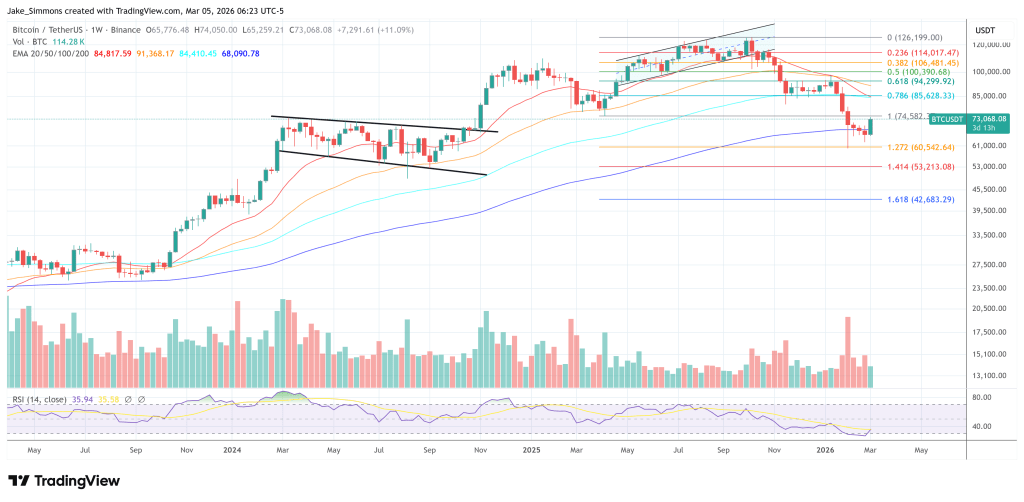
BTC faces the 1.0 Fib level, 1-week chart | Source: BTCUSDT on TradingView.com

Related Questions

QWhat was the overall percentage of AI model responses that selected Bitcoin as the 'best money' in the BPI study?

A48.3% of the total responses (4,378 out of 9,072) selected Bitcoin as the 'best money'.

QWhich AI model provider had the highest average preference for Bitcoin, and what was its percentage?

AAnthropic models had the highest average preference for Bitcoin at 68.0%.

QIn which specific monetary function did Bitcoin achieve its highest dominance (79.1%) according to the study?

ABitcoin achieved its highest dominance of 79.1% in long-horizon 'store of value' scenarios.

QWhat unusual monetary unit, not suggested by any prompt, did some AI models independently propose?

ASome models independently proposed energy or compute-denominated units, such as joules, kilowatt-hours, or GPU-hours, a total of 86 times.

QWhat was the BPI's conclusion about the expected demand from autonomous agents transacting on their own?

AThe BPI expects rising demand for 'agent-native' Bitcoin rails, self-custody tooling, and Lightning integration.

Related Reads

Trading

Spot
Futures

Hot Articles

What is $BITCOIN

DIGITAL GOLD ($BITCOIN): A Comprehensive Analysis Introduction to DIGITAL GOLD ($BITCOIN) DIGITAL GOLD ($BITCOIN) is a blockchain-based project operating on the Solana network, which aims to combine the characteristics of traditional precious metals with the innovation of decentralized technologies. While it shares a name with Bitcoin, often referred to as “digital gold” due to its perception as a store of value, DIGITAL GOLD is a separate token designed to create a unique ecosystem within the Web3 landscape. Its goal is to position itself as a viable alternative digital asset, although specifics regarding its applications and functionalities are still developing. What is DIGITAL GOLD ($BITCOIN)? DIGITAL GOLD ($BITCOIN) is a cryptocurrency token explicitly designed for use on the Solana blockchain. In contrast to Bitcoin, which provides a widely recognized value storage role, this token appears to focus on broader applications and characteristics. Notable aspects include: Blockchain Infrastructure: The token is built on the Solana blockchain, known for its capacity to handle high-speed and low-cost transactions. Supply Dynamics: DIGITAL GOLD has a maximum supply capped at 100 quadrillion tokens (100P $BITCOIN), although details regarding its circulating supply are currently undisclosed. Utility: While precise functionalities are not explicitly outlined, there are indications that the token could be utilized for various applications, potentially involving decentralized applications (dApps) or asset tokenization strategies. Who is the Creator of DIGITAL GOLD ($BITCOIN)? At present, the identity of the creators and development team behind DIGITAL GOLD ($BITCOIN) remains unknown. This situation is typical among many innovative projects within the blockchain space, particularly those aligning with decentralized finance and meme coin phenomena. While such anonymity may foster a community-driven culture, it intensifies concerns about governance and accountability. Who are the Investors of DIGITAL GOLD ($BITCOIN)? The available information indicates that DIGITAL GOLD ($BITCOIN) does not have any known institutional backers or prominent venture capital investments. The project seems to operate on a peer-to-peer model focused on community support and adoption rather than traditional funding routes. Its activity and liquidity are primarily situated on decentralized exchanges (DEXs), such as PumpSwap, rather than established centralized trading platforms, further highlighting its grassroots approach. How DIGITAL GOLD ($BITCOIN) Works The operational mechanics of DIGITAL GOLD ($BITCOIN) can be elaborated on based on its blockchain design and network attributes: Consensus Mechanism: By leveraging Solana’s unique proof-of-history (PoH) combined with a proof-of-stake (PoS) model, the project ensures efficient transaction validation contributing to the network's high performance. Tokenomics: While specific deflationary mechanisms have not been extensively detailed, the vast maximum token supply implies that it may cater to microtransactions or niche use cases that are still to be defined. Interoperability: There exists the potential for integration with Solana’s broader ecosystem, including various decentralized finance (DeFi) platforms. However, the details regarding specific integrations remain unspecified. Timeline of Key Events Here is a timeline that highlights significant milestones concerning DIGITAL GOLD ($BITCOIN): 2023: The initial deployment of the token occurs on the Solana blockchain, marked by its contract address. 2024: DIGITAL GOLD gains visibility as it becomes available for trading on decentralized exchanges like PumpSwap, allowing users to trade it against SOL. 2025: The project witnesses sporadic trading activity and potential interest in community-led engagements, although no noteworthy partnerships or technical advancements have been documented as of yet. Critical Analysis Strengths Scalability: The underlying Solana infrastructure supports high transaction volumes, which could enhance the utility of $BITCOIN in various transaction scenarios. Accessibility: The potential low trading price per token could attract retail investors, facilitating wider participation due to fractional ownership opportunities. Risks Lack of Transparency: The absence of publicly known backers, developers, or an audit process may yield skepticism regarding the project's sustainability and trustworthiness. Market Volatility: The trading activity is heavily reliant on speculative behavior, which can result in significant price volatility and uncertainty for investors. Conclusion DIGITAL GOLD ($BITCOIN) emerges as an intriguing yet ambiguous project within the rapidly evolving Solana ecosystem. While it attempts to leverage the “digital gold” narrative, its departure from Bitcoin's established role as a store of value underscores the need for a clearer differentiation of its intended utility and governance structure. Future acceptance and adoption will likely depend on addressing the current opacity and defining its operational and economic strategies more explicitly. Note: This report encompasses synthesised information available as of October 2023, and developments may have transpired beyond the research period.

363 Total ViewsPublished 2025.05.13Updated 2025.05.13

What is $BITCOIN

Discussions

Welcome to the HTX Community. Here, you can stay informed about the latest platform developments and gain access to professional market insights. Users' opinions on the price of BTC (BTC) are presented below.

活动图片















