Bitcoin treasuries stall in Q4, but largest holders keep stacking sats

cointelegraphPublished on 2025-12-11Last updated on 2025-12-11

Abstract

The adoption of Bitcoin treasuries slowed sharply in Q4 2025, with only nine new companies adding BTC to their balance sheets compared to 53 in the previous quarter. While 117 companies adopted Bitcoin in 2025, most hold relatively small amounts. However, the largest corporate holders, such as Strategy, continued accumulating Bitcoin, with Strategy purchasing $962 million worth in a single day. Overall, public companies hold over 1 million BTC ($90.2B), representing 4.7% of the total supply, while spot Bitcoin ETFs hold an additional 1.49 million BTC. Some firms, like Metaplanet, paused purchases, and others, like Satsuma Technology, sold portions of their holdings. Ether treasury investments also declined, with cumulative ETH acquisitions falling 81% over three months.

Bitcoin treasury adoption slowed sharply in the fourth quarter of 2025, even as the biggest corporate holders continued to quietly add to their stacks while smaller players stepped back.

The number of new Bitcoin (BTC) treasury companies declined from its peak of 53 new companies in the third quarter to just nine companies adding Bitcoin to their balance sheet in the fourth quarter of 2025 so far, with a total of 117 new companies adopting Bitcoin this year, according to blockchain data platform CryptoQuant.

“Despite the growth in numbers during 2025, most Bitcoin Treasury companies hold relatively small amounts,” CryptoQuant wrote in a Thursday X post.

Still, the accumulation data shows that the most well-funded corporate treasuries continue to scoop up the Bitcoin supply despite a decline in buying by smaller companies and retail participants.
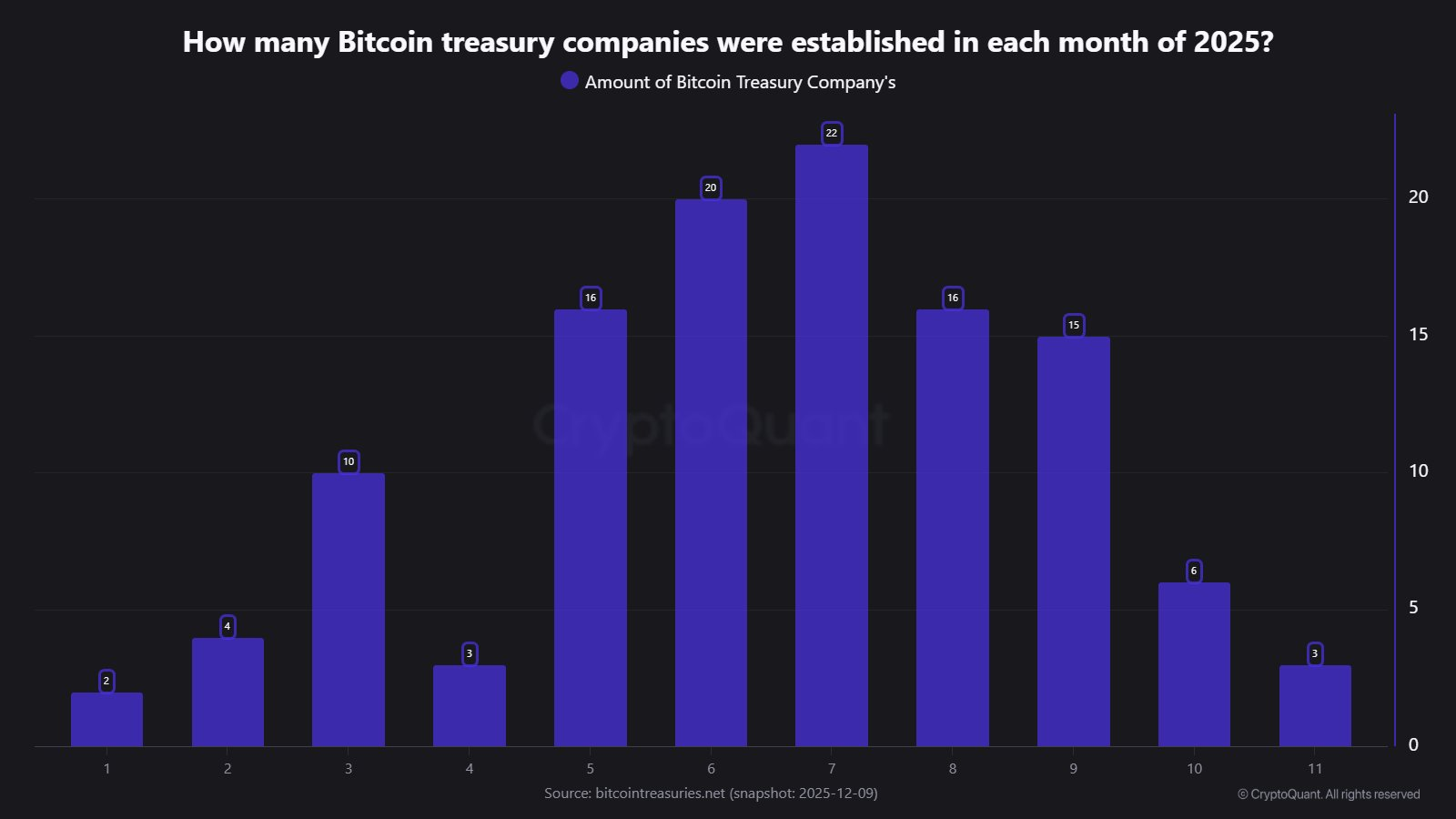
New Bitcoin treasury companies per month, 2025 year-to-date chart. Source: CryptoQuant

Some Bitcoin treasury firms have stopped accumulating this quarter. Japanese investment company Metaplanet, for instance, hasn’t purchased any Bitcoin in over two months.

Some companies are even selling their Bitcoin stacks. United Kingdom-based, Bitcoin-focused tech company Satsuma Technology sold 579 Bitcoin for around $53 million, leaving the company with 620 Bitcoin on its balance sheet, according to a Wednesday announcement.

Related: Bitcoin treads water at $90K as whales eat the Ethereum dip: Finance Redefined

Largest corporate holders continue their quiet Bitcoin accumulation

Despite the broader slowdown, some of the largest corporations continue to scoop up more of the Bitcoin supply.

Strategy, the largest corporate Bitcoin holder, purchased $962 million of BTC on Monday, in its biggest purchase since July. The company is now just $500 million shy of matching the $21.97 billion worth of Bitcoin it acquired in 2024, according to CryptoQuant.
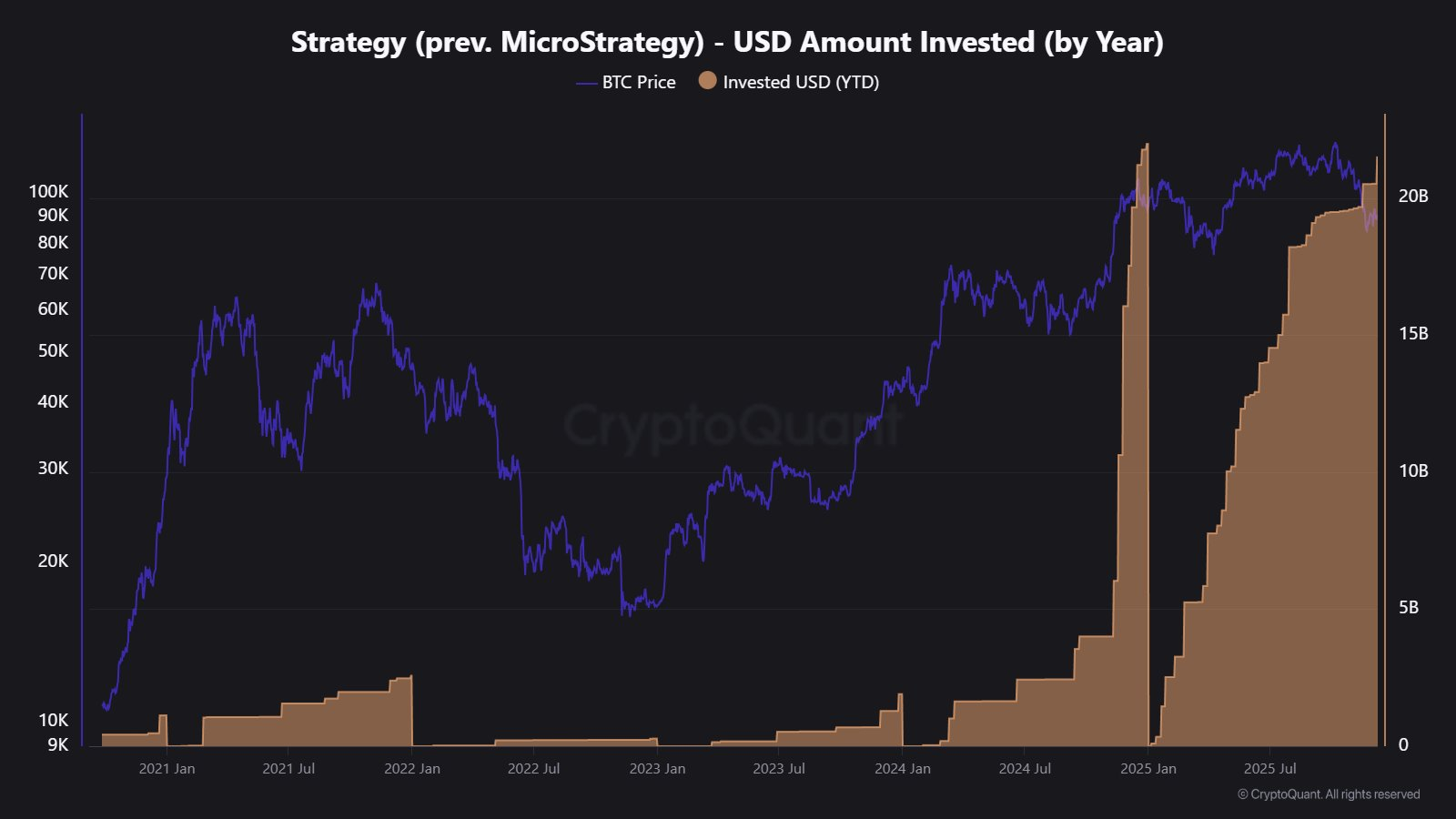
Strategy, US dollar amount invested. Source: CryptoQuant

Over 1 million Bitcoin worth $90.2 billion is already held in public company treasuries, representing 4.7% of the total supply, according to data from BitcoinTreasuries.NET.

An additional 1.49 million Bitcoin, or 7% of the supply, is held by spot Bitcoin exchange-traded funds.
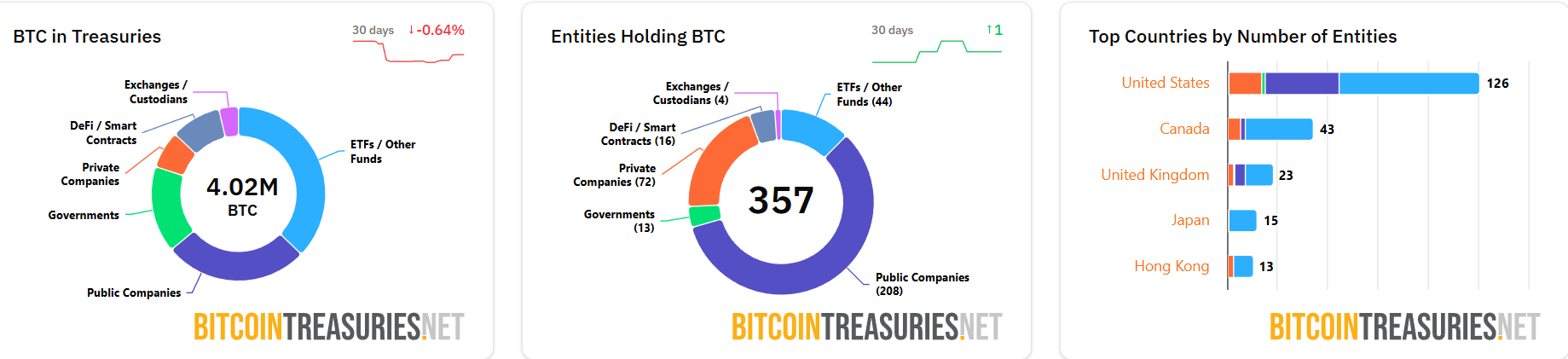
Bitcoin holdings in treasuries. Source: BitcoinTreasuries.NET

Related: Silk Road-linked Bitcoin wallets move $3M to new address

DATs slow crypto purchases as Ether treasury investments fall 81%

Digital asset treasury (DAT) acquisitions are also slowing down. Ripple-backed Evernorth Holdings has been inactive since the end of October, when it acquired $950 million XRP (XRP) tokens.

Evernorth’s XRP holdings were facing nearly $80 million in unrealized losses weeks after the purchases amid the market decline and growing pressure on DATs.

BitMine Immersion Technologies, the largest corporate Ether (ETH) holder, has also slowed its Ether acquisitions in recent months from a peak of $2.6 billion in July to just $296 million of ETH in December.

Cumulative investments from Ether treasury firms fell by 81% in the past three months, from 1.97 million ETH acquired in August to 370,000 ETH in November.

Magazine: Mysterious Mr Nakamoto author — Finding Satoshi would hurt Bitcoin

Related Reads

a16z: AI's 'Amnesia', Can Continuous Learning Cure It?

The article "a16z: AI's 'Amnesia' – Can Continual Learning Cure It?" explores the limitations of current large language models (LLMs), which, like the protagonist in the film *Memento*, are trapped in a perpetual present—unable to form new memories after training. While methods like in-context learning (ICL), retrieval-augmented generation (RAG), and external scaffolding (e.g., chat history, prompts) provide temporary solutions, they fail to enable true internalization of new knowledge. The authors argue that compression—the core of learning during training—is halted at deployment, preventing models from generalizing, discovering novel solutions (e.g., mathematical proofs), or handling adversarial scenarios. The piece introduces *continual learning* as a critical research direction to address this, categorizing approaches into three paths: 1. **Context**: Scaling external memory via longer context windows, multi-agent systems, and smarter retrieval. 2. **Modules**: Using pluggable adapters or external memory layers for specialization without full retraining. 3. **Weights**: Enabling parameter updates through sparse training, test-time training, meta-learning, distillation, and reinforcement learning from feedback. Challenges include catastrophic forgetting, safety risks, and auditability, but overcoming these could unlock models that learn iteratively from experience. The conclusion emphasizes that while context-based methods are effective, true breakthroughs require models to compress new information into weights post-deployment, moving from mere retrieval to genuine learning.

marsbit34m ago

a16z: AI's 'Amnesia', Can Continuous Learning Cure It?

marsbit34m ago

Can a Hair Dryer Earn $34,000? Deciphering the Reflexivity Paradox in Prediction Markets

An individual manipulated a weather sensor at Paris Charles de Gaulle Airport with a portable heat source, causing a Polymarket weather market to settle at 22°C and earning $34,000. This incident highlights a fundamental issue in prediction markets: when a market aims to reflect reality, it also incentivizes participants to influence that reality. Prediction markets operate on two layers: platform rules (what outcome counts as a win) and data sources (what actually happened). While most focus on rules, the real vulnerability lies in the data source. If reality is recorded through a specific source, influencing that source directly affects market settlement. The article categorizes markets by their vulnerability: 1. **Single-point physical data sources** (e.g., weather stations): Easily manipulated through physical interference. 2. **Insider information markets** (e.g., MrBeast video details): Insiders like team members use non-public information to trade. Kalshi fined a剪辑师 $20,000 for insider trading. 3. **Actor-manipulated markets** (e.g., Andrew Tate’s tweet counts): The subject of the market can control the outcome. Evidence suggests Tate’sociated accounts coordinated to profit. 4. **Individual-action markets** (e.g., WNBA disruptions): A single person can execute an event to profit from their pre-placed bets. Kalshi and Polymarket handle these issues differently. Kalshi enforces strict KYC, publicly penalizes insider trading, and reports to regulators. Polymarket, with its anonymous wallet-based system, has historically been more permissive, arguing that insider information improves market accuracy. However, it cooperated with authorities in the "Van Dyke case," where a user traded on classified government information. The core paradox is reflexivity: prediction markets are designed to discover truth, but their financial incentives can distort reality. The more valuable a prediction becomes, the more likely participants are to influence the event itself. The market ceases to be a mirror of reality and instead shapes it.

marsbit1h ago

Can a Hair Dryer Earn $34,000? Deciphering the Reflexivity Paradox in Prediction Markets

marsbit1h ago

Trading

Spot
Futures

Hot Articles

How to Buy SATS

Welcome to HTX.com! We've made purchasing SATS(SATS) (SATS) simple and convenient. Follow our step-by-step guide to embark on your crypto journey.Step 1: Create Your HTX AccountUse your email or phone number to sign up for a free account on HTX. Experience a hassle-free registration journey and unlock all features.Get My AccountStep 2: Go to Buy Crypto and Choose Your Payment MethodCredit/Debit Card: Use your Visa or Mastercard to buy SATS(SATS) (SATS) instantly.Balance: Use funds from your HTX account balance to trade seamlessly.Third Parties: We've added popular payment methods such as Google Pay and Apple Pay to enhance convenience.P2P: Trade directly with other users on HTX.Over-the-Counter (OTC): We offer tailor-made services and competitive exchange rates for traders.Step 3: Store Your SATS(SATS) (SATS)After purchasing your SATS(SATS) (SATS), store it in your HTX account. Alternatively, you can send it elsewhere via blockchain transfer or use it to trade other cryptocurrencies.Step 4: Trade SATS(SATS) (SATS)Easily trade SATS(SATS) (SATS) on HTX's spot market. Simply access your account, select your trading pair, execute your trades, and monitor in real-time. We offer a user-friendly experience for both beginners and seasoned traders.

3.4k Total ViewsPublished 2024.03.29Updated 2025.03.21

How to Buy SATS

Discussions

Welcome to the HTX Community. Here, you can stay informed about the latest platform developments and gain access to professional market insights. Users' opinions on the price of SATS (SATS) are presented below.

活动图片