Bitcoin Surges Then Retreats, CLARITY Act Rally Quickly Fizzles Out: What's Next to Watch?

marsbitPublished on 2026-05-18Last updated on 2026-05-18

Abstract

Bitcoin's price surge following the U.S. Senate Banking Committee's advancement of the CLARITY Act was short-lived, with gains in crypto-related stocks like Coinbase and Bitcoin itself quickly erasing. The primary driver was a dominating macro environment, where rising 10-year Treasury yields (hitting a one-year high of 4.59%) and tightening financial conditions overshadowed the regulatory catalyst. This demonstrates that for sustained positive price action, legislative progress must coincide with favorable macro conditions. The article argues that if passed, the CLARITY Act could most significantly benefit "AI utility tokens"—digital assets tied to sufficiently decentralized networks with real-world use cases, such as those in decentralized computing or verifiable AI data layers. However, it cautions that many projects use "AI" as a marketing label without substantial utility. Looking ahead, key factors to monitor include: the trajectory of the 10-year Treasury yield, ongoing political negotiations (like ethics compromises for the bill's passage), betting market odds on Polymarket for the bill's likelihood, and sustained inflows into spot Bitcoin ETFs to gauge genuine institutional conviction beyond headline-driven trading. The bill still faces a long legislative path before potentially becoming law.

Written by: HeySorinAI

Compiled by: AididiaoJP, Foresight News

It has been a few days since the Senate Banking Committee advanced the CLARITY Act. Cryptocurrency-related stocks (such as Coinbase, MicroStrategy, and Robinhood) rose 6-9% on the day, only to give back most of those gains later, while Bitcoin briefly touched $82,000 before sliding to $76,890. Here’s why the rally faded so quickly and what's truly driving prices right now.

Why the Macro Environment is Dominating for Now

The CLARITY Act vote triggered a clean one-day rally on May 14th, followed by an equally clean reversal on May 15th. Bitcoin surged from $80,000 to $82,000 on the news of the vote and has been sliding ever since, currently at $76,890. ETH reached a high of $2,310 and is now at $2,118. Coinbase rose 9% on the voting day, gave it all back the next day, and fell another 2.8% overnight to $189. MicroStrategy surged 8% and is down 5.4% this week. Robinhood performed slightly better but remains below its post-vote high.

Net performance over the past 5 days: HOOD +0.1%, COIN -2.9%, BTC -4.5%, MSTR -5.4%, ETH -8%. Stocks performed slightly better than tokens, but not by much. The dominant story is: everything "surged and then retreated."

One major reason is that the 10-year Treasury yield jumped to 4.59% on Friday, a one-year high, following hotter-than-expected CPI and PPI data the week before. The S&P 500 retreated 1.24% from its all-time high, the Nasdaq fell 1.54%, and the VIX rose to 18.4. This move overwhelmed any regulatory positivity for crypto and related stocks.

Coinbase and MicroStrategy are highly reliant on U.S. institutional capital, which retreats when financial conditions tighten. Bitcoin relies on dollar liquidity, which contracts when real yields (yields adjusted for inflation) rise. Moreover, crypto is far more volatile than most risk assets, so when large-cap stocks pull back, crypto tends to fall harder. The CLARITY Act catalyst pushed in one direction, rising rates pushed in the other, and ultimately, rates won.

This price action also tells us how the market is currently pricing legislation. Sustained gains are unlikely to appear until a bill gets much closer to being signed into law, and even then, it must compete with the macro environment of the time.

AI Utility Tokens Are the Real Long-Term Winners

Once the CLARITY Act becomes law, AI utility tokens remain the category most likely to see significant gains. The bill would grant "digital commodity" status to tokens tied to sufficiently decentralized networks whose value derives from genuine network usage. Decentralized computing, agent networks, and verifiable model and data layers are the most aligned areas.

style="text-align: start;">However, "AI" has become a marketing label whose significance is as important as the actual category. Many tokens carry an AI label with little substantive action behind them. The structural winners are projects with usable products, tokens that possess real utility, and actual user support.

What to Watch Next

The committee vote is just one of several hurdles a bill must clear. It still needs to be merged with a parallel version from the Senate Agriculture Committee, then pass the full Senate with 60 out of 100 votes. After that, it must be reconciled with the House version passed in July 2025, before finally being signed by the President. Once signed, the SEC and CFTC would have 360 days to write specific rules. The White House target is July 4th, and Polymarket places the odds of passage by 2026 at 62-73%.

  • 10-Year Treasury Yield: Until it retreats from its current one-year high near 4.6%, any regulatory catalyst is likely to be diluted by macro pressures. This is one of the most important variables for crypto pricing right now.
  • Ethics Compromise Text: Democrats want statutory limits on government officials holding interests in crypto businesses. No agreement has been reached yet; without a compromise, the 60-vote threshold for the full vote cannot be met.
  • Polymarket Odds: Odds above 80% would suggest the math for the full vote is coming together; odds below 50% would indicate the bill is in trouble ahead of the Senate's August recess.
  • Spot Bitcoin ETF Flows: Thursday saw $131 million in net inflows, reversing a previous $863 million net outflow streak. Sustained daily inflows above $300 million would indicate institutions are positioning based on the regulatory thesis, not just trading the headlines.


Related Questions

QAccording to the article, what is the main reason the price bounce following the CLARITY Act vote quickly faded?

AThe main reason is the dominance of adverse macroeconomic conditions, specifically the jump in the 10-year Treasury yield to a one-year high of 4.59%. This tightened financial conditions, which overshadowed the regulatory catalyst.

QWhat are the key future steps and probabilities mentioned for the CLARITY Act to become law?

AIt must merge with a parallel bill from the Senate Agriculture Committee, pass a full Senate vote (requiring 60 of 100 votes), be reconciled with the already-passed House version, and be signed by the President. The article notes the White House aims for July 4th, and Polymarket currently puts the probability of passage by 2026 at 62-73%.

QWhich asset class does the article identify as the most likely to see significant gains if the CLARITY Act passes?

AAI utility tokens are identified as the most likely category for significant gains. The article specifies that tokens tied to sufficiently decentralized networks where value derives from real usage, such as in decentralized computing, agent networks, and verifiable model/data layers, are the best fit.

QWhat are two specific indicators or variables the article suggests investors should watch closely in the near term?

AThe article suggests watching the 10-year Treasury yield and the flow of funds into spot Bitcoin ETFs. Sustained daily inflows over $300 million into ETFs would indicate institutions are positioning based on the regulatory thesis, not just trading headlines.

QHow did Bitcoin and related stocks like Coinbase perform in net terms over the 5 days following the CLARITY Act committee vote?

AOver the 5-day period, the net performance was negative: HOOD +0.1%, COIN -2.9%, BTC -4.5%, MSTR -5.4%, and ETH -8%. The dominant story was that all assets experienced a 'sell the news' or 'fade the rally' reaction.

Related Reads

Blocked Its Own Treasure, WeChat AI Steps Up

Tencent's stock surged over 10% on June 2nd amid reports that WeChat, with 1.43 billion monthly users, is finalizing tests for a native AI Agent. The reported feature, accessible by swiping right from the main interface, allows users to issue commands in natural language. The AI then decomposes tasks and automatically calls upon relevant Mini Programs within WeChat to complete actions like ordering food, booking tickets, or making payments, creating a closed-loop service execution system. This strategic shift follows the internal conflict and subsequent "blocking" of Tencent's standalone AI app, Yuanbao, by WeChat for violating sharing rules during a 2026 Spring Festival promotion. The incident highlighted a lack of internal consensus and exposed the weakness of competing in the standalone AI assistant arena against rivals like ByteDance's Doubao (345M MAU) and Alibaba's Qianwen. The new WeChat AI Agent aims to leverage WeChat's unique assets—its massive user base, standardized Mini Program APIs, WeChat Pay, and identity system—to move from simple content generation to actual task execution. Analysts note this changes the competitive landscape from model benchmarks to which AI can connect to more real-world services. However, success depends on key variables: the capability of Tencent's underlying Hunyuan model, managing massive inference costs, and redesigning incentives for Mini Program developers whose traffic might be bypassed. The move is seen as an attempt to keep user service intent within WeChat's ecosystem as AI begins to redefine how users access services.

marsbit55m ago

Blocked Its Own Treasure, WeChat AI Steps Up

marsbit55m ago

ByteDance Adopts Arm CPUs, Jensen Huang: So Sad I Didn't Buy Arm

**Summary:** At Computex 2026, Arm CEO Rene Haas announced that ByteDance and Oracle have adopted Arm's self-designed Arm AGI data center CPU. The company expects significant revenue growth from this product, projecting $20 billion in demand for the 2027/2028 fiscal years. Haas noted that restricting AI-capable CPUs from the US to China is nearly impossible due to their widespread applications. Arm's stock has surged dramatically this year, notably rising 16% after NVIDIA's Arm-based Vera CPU and RTX Spark announcements. A highlight was the informal, humorous on-stage conversation between Haas and NVIDIA CEO Jensen Huang. Huang joked about NVIDIA's failed attempt to acquire Arm and playfully lamented selling his Arm shares. Both executives showed a clear sense of camaraderie and shared regret over the missed merger. Key technical topics were discussed: 1. **AI PC Design:** Huang explained NVIDIA's RTX Spark superchip (with a 20-core Arm CPU) is designed for future AI agents that will autonomously run and use tools on PCs, blending local and cloud processing. 2. **Agent vs. OS:** Huang emphasized the operating system remains crucial, as AI agents rely on its APIs and tools to function. 3. **Growth Constraints:** He identified the shift to "useful AI" that generates profitable tokens as a primary driver for immense, almost limitless, computational demand. Haas outlined Arm's strategy across PC and data centers. For PCs, Arm collaborates with partners like NVIDIA and MediaTek, offering its compute subsystem (CSS) for custom SoCs. In data centers, its Arm AGI CPU (built on TSMC's 3nm process) has gained major partners including OpenAI, Meta, and now ByteDance and Oracle. Arm presented a multi-year roadmap for its in-house CPU line. The article concludes that while GPUs dominated the AI training race, the explosion of AI agents is shifting significant focus to CPUs for inference, state management, and tool orchestration. The industry is trending towards vertical integration, with companies like cloud providers designing chips and chip/IP firms offering full solutions, all competing to deliver more efficient computing per watt.

marsbit1h ago

ByteDance Adopts Arm CPUs, Jensen Huang: So Sad I Didn't Buy Arm

marsbit1h ago

New Wall Street Play: Yen Shorts Still Adding, But Japan Stocks Don't Rely on Carry Trade Unwinding

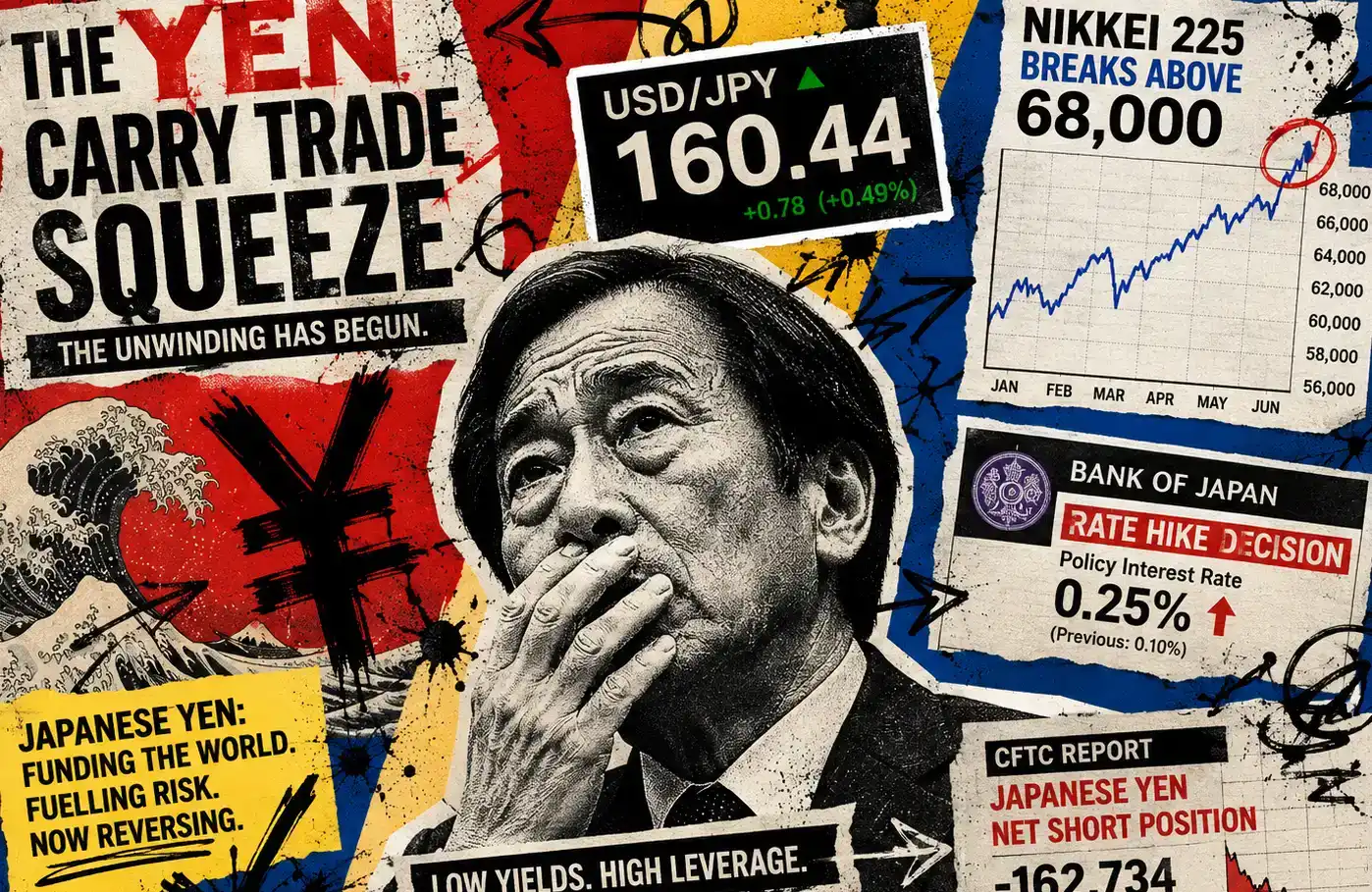
On June 3rd, USD/JPY hit 160.44, its highest level since July 2024, while the Nikkei 225 surged past 68,000 points. Contrary to popular narratives of an imminent "carry trade unwind" akin to August 2024, data reveals a more complex picture. Speculative net short positions in yen futures have actually increased, reaching -114,667 contracts by late May, suggesting traders are doubling down rather than retreating. Meanwhile, Japan's Finance Ministry conducted its largest-ever single-round FX intervention (11.73 trillion yen) in April-May but failed to hold the 160 yen line. The Nikkei's rally is not driven by carry trade dynamics. Foreign investors are aggressively buying Japanese stocks, with net purchases in 2026 running nearly 16 times higher than 2025 levels. This inflow is concentrated in AI and semiconductor-related stocks like SoftBank and Socionext, fueled by positive sector outlooks, rather than being a flight from unwinding yen shorts. Furthermore, the Nikkei has continued climbing despite the Bank of Japan's (BOJ) rate hikes to 0.75%. This disconnect exists because the current equity boom is fueled by AI-driven foreign investment, not reliant on cheap yen funding. However, this relationship remains fragile. Should the BOJ hike rates further (e.g., to 1.0%) while dollar weakness increases carry trade costs, the trajectories of the yen and Japanese stocks could reconverge, potentially triggering volatility.

marsbit1h ago

New Wall Street Play: Yen Shorts Still Adding, But Japan Stocks Don't Rely on Carry Trade Unwinding

marsbit1h ago

Broadcom's Q3 Guidance Misses Expectations by $12 Billion, After-Hours Trading Plummets Over 13%, AI Narrative "Cooling"?

On June 3, Broadcom released record Q2 FY26 results with revenue of $22.19B, up 48% YoY, and AI chip sales of $10.8B, up 143%. Adjusted EPS of $2.44 beat estimates. However, its Q3 AI semiconductor revenue guidance of $16B, while up over 200% YoY, fell roughly $1.2B (7%) short of analyst consensus expectations of $17.2B. This miss, coupled with slightly weaker-than-expected software revenue, triggered a severe market reaction. CEO Hock Tan maintained the FY26 AI revenue outlook of over $100B but did not raise it, disappointing investors who had priced in more robust growth. The stock plummeted over 13% in after-hours trading, erasing roughly $270B in market cap. The sell-off extended to peers like Marvell. A key concern for markets, particularly for Chinese optical module suppliers, was Tan's comment that the contribution of AI networking (e.g., Ethernet switches, optical interconnect chips) to AI revenue, currently near 40%, is expected to normalize to around 30% over time, signaling a potential peak in growth for that segment. Despite the guidance shortfall, Tan reiterated that AI demand remains "insatiable" and reaffirmed the long-term target of exceeding $100B in AI revenue by FY27. The reaction highlights the heightened sensitivity and premium valuation placed on AI-exposed stocks, where anything less than stellar guidance can prompt significant profit-taking. The broader question is whether this represents a cooling AI narrative or a correction in overstretched valuations.

marsbit1h ago

Broadcom's Q3 Guidance Misses Expectations by $12 Billion, After-Hours Trading Plummets Over 13%, AI Narrative "Cooling"?

marsbit1h ago

Trading

Spot
Futures

Hot Articles

What is $BITCOIN

DIGITAL GOLD ($BITCOIN): A Comprehensive Analysis Introduction to DIGITAL GOLD ($BITCOIN) DIGITAL GOLD ($BITCOIN) is a blockchain-based project operating on the Solana network, which aims to combine the characteristics of traditional precious metals with the innovation of decentralized technologies. While it shares a name with Bitcoin, often referred to as “digital gold” due to its perception as a store of value, DIGITAL GOLD is a separate token designed to create a unique ecosystem within the Web3 landscape. Its goal is to position itself as a viable alternative digital asset, although specifics regarding its applications and functionalities are still developing. What is DIGITAL GOLD ($BITCOIN)? DIGITAL GOLD ($BITCOIN) is a cryptocurrency token explicitly designed for use on the Solana blockchain. In contrast to Bitcoin, which provides a widely recognized value storage role, this token appears to focus on broader applications and characteristics. Notable aspects include: Blockchain Infrastructure: The token is built on the Solana blockchain, known for its capacity to handle high-speed and low-cost transactions. Supply Dynamics: DIGITAL GOLD has a maximum supply capped at 100 quadrillion tokens (100P $BITCOIN), although details regarding its circulating supply are currently undisclosed. Utility: While precise functionalities are not explicitly outlined, there are indications that the token could be utilized for various applications, potentially involving decentralized applications (dApps) or asset tokenization strategies. Who is the Creator of DIGITAL GOLD ($BITCOIN)? At present, the identity of the creators and development team behind DIGITAL GOLD ($BITCOIN) remains unknown. This situation is typical among many innovative projects within the blockchain space, particularly those aligning with decentralized finance and meme coin phenomena. While such anonymity may foster a community-driven culture, it intensifies concerns about governance and accountability. Who are the Investors of DIGITAL GOLD ($BITCOIN)? The available information indicates that DIGITAL GOLD ($BITCOIN) does not have any known institutional backers or prominent venture capital investments. The project seems to operate on a peer-to-peer model focused on community support and adoption rather than traditional funding routes. Its activity and liquidity are primarily situated on decentralized exchanges (DEXs), such as PumpSwap, rather than established centralized trading platforms, further highlighting its grassroots approach. How DIGITAL GOLD ($BITCOIN) Works The operational mechanics of DIGITAL GOLD ($BITCOIN) can be elaborated on based on its blockchain design and network attributes: Consensus Mechanism: By leveraging Solana’s unique proof-of-history (PoH) combined with a proof-of-stake (PoS) model, the project ensures efficient transaction validation contributing to the network's high performance. Tokenomics: While specific deflationary mechanisms have not been extensively detailed, the vast maximum token supply implies that it may cater to microtransactions or niche use cases that are still to be defined. Interoperability: There exists the potential for integration with Solana’s broader ecosystem, including various decentralized finance (DeFi) platforms. However, the details regarding specific integrations remain unspecified. Timeline of Key Events Here is a timeline that highlights significant milestones concerning DIGITAL GOLD ($BITCOIN): 2023: The initial deployment of the token occurs on the Solana blockchain, marked by its contract address. 2024: DIGITAL GOLD gains visibility as it becomes available for trading on decentralized exchanges like PumpSwap, allowing users to trade it against SOL. 2025: The project witnesses sporadic trading activity and potential interest in community-led engagements, although no noteworthy partnerships or technical advancements have been documented as of yet. Critical Analysis Strengths Scalability: The underlying Solana infrastructure supports high transaction volumes, which could enhance the utility of $BITCOIN in various transaction scenarios. Accessibility: The potential low trading price per token could attract retail investors, facilitating wider participation due to fractional ownership opportunities. Risks Lack of Transparency: The absence of publicly known backers, developers, or an audit process may yield skepticism regarding the project's sustainability and trustworthiness. Market Volatility: The trading activity is heavily reliant on speculative behavior, which can result in significant price volatility and uncertainty for investors. Conclusion DIGITAL GOLD ($BITCOIN) emerges as an intriguing yet ambiguous project within the rapidly evolving Solana ecosystem. While it attempts to leverage the “digital gold” narrative, its departure from Bitcoin's established role as a store of value underscores the need for a clearer differentiation of its intended utility and governance structure. Future acceptance and adoption will likely depend on addressing the current opacity and defining its operational and economic strategies more explicitly. Note: This report encompasses synthesised information available as of October 2023, and developments may have transpired beyond the research period.

363 Total ViewsPublished 2025.05.13Updated 2025.05.13

What is $BITCOIN

Discussions

Welcome to the HTX Community. Here, you can stay informed about the latest platform developments and gain access to professional market insights. Users' opinions on the price of BTC (BTC) are presented below.

活动图片