Bitcoin Shutdown Price in a Volatile Market

marsbitPublished on 2026-02-20Last updated on 2026-02-20

Abstract

In a volatile market with Bitcoin's recent price correction, discussions have shifted from growth expectations to survival, focusing on miners' operational status and the frequently mentioned "miner shutdown price." However, this concept is often misunderstood—it is not a uniform threshold but a theoretical model based on assumptions like standardized electricity costs and equipment efficiency. In reality, mining costs vary significantly due to factors such as miner models (e.g., Antminer S23 Hyd at 9.5 J/T vs. older units at energy rates (from $0.03/kWh to over $0.12/kWh), and operational efficiencies. As prices approach cost thresholds, the industry undergoes structural adjustment rather than systemic collapse. Inefficient miners with high costs may scale back, leading to a decline in network hash rate, which triggers a difficulty adjustment. This self-correcting mechanism allows efficient miners to benefit from increased rewards, maintaining network security and promoting industry maturation. Historical cycles (e.g., 2019, 2022) show that such phases lead to efficiency gains and consolidation. Companies like BitFuFu emphasize long-term strategies, deploying high-efficiency hardware, diversifying energy sources, and optimizing operations to sustain stability during downturns. The key takeaway is Bitcoin mining's resilience and adaptive evolution through market cycles, where efficiency and cost management define enduring value.

Recently, Bitcoin's price has experienced a pullback, while assets like gold and silver have also shown significant volatility. Macroeconomic uncertainty has notably increased, putting overall pressure on risk assets. Against this backdrop, market sentiment has turned cautious, with discussions around crypto assets gradually shifting from growth expectations to survival capabilities. Among these, the operational status of miners has become a focal point, and the concept of the "miner shutdown price" is frequently mentioned.

This concern is not unfounded. Under the dual pressures of price declines and tightening macro liquidity, the profitability of the mining industry indeed faces periodic challenges. The market attempts to use the "shutdown price" as an indicator to assess whether miners might be forced to exit on a large scale, thereby affecting network security and asset prospects. This attention itself reflects market participation. However, if this concept alone is used as the core basis for judging industry risks, it often overlooks key differences and self-regulating characteristics within Bitcoin's mining operation mechanism. In practice, the "shutdown price" is not a simple, uniform price threshold.

Shutdown Price is Often Misunderstood

From an industry perspective, there is no single "miner shutdown price" that applies to all miners. The so-called "shutdown price" is more of a theoretical result derived from model calculations under specific assumed conditions, typically assuming uniform electricity costs, equipment efficiency, and operational cost structures. However, in reality, the cost structure of the mining industry is highly fragmented. Different miner models exhibit significant differences in energy efficiency performance; the unit hash rate cost of new-generation high-efficiency miners is not comparable to that of older equipment. For example, among current mainstream models, the Antminer S23 Hyd (approx. 580 TH/s, 5510W) has an efficiency of about 9.5 J/T, the Antminer S21 (approx. 480 TH/s, 5280W) about 11 J/T, and the Canaan Avalon A16XP-300T about 12.8 J/T. Every 1–2 J/T improvement in unit efficiency significantly changes the breakeven range at the same electricity price.
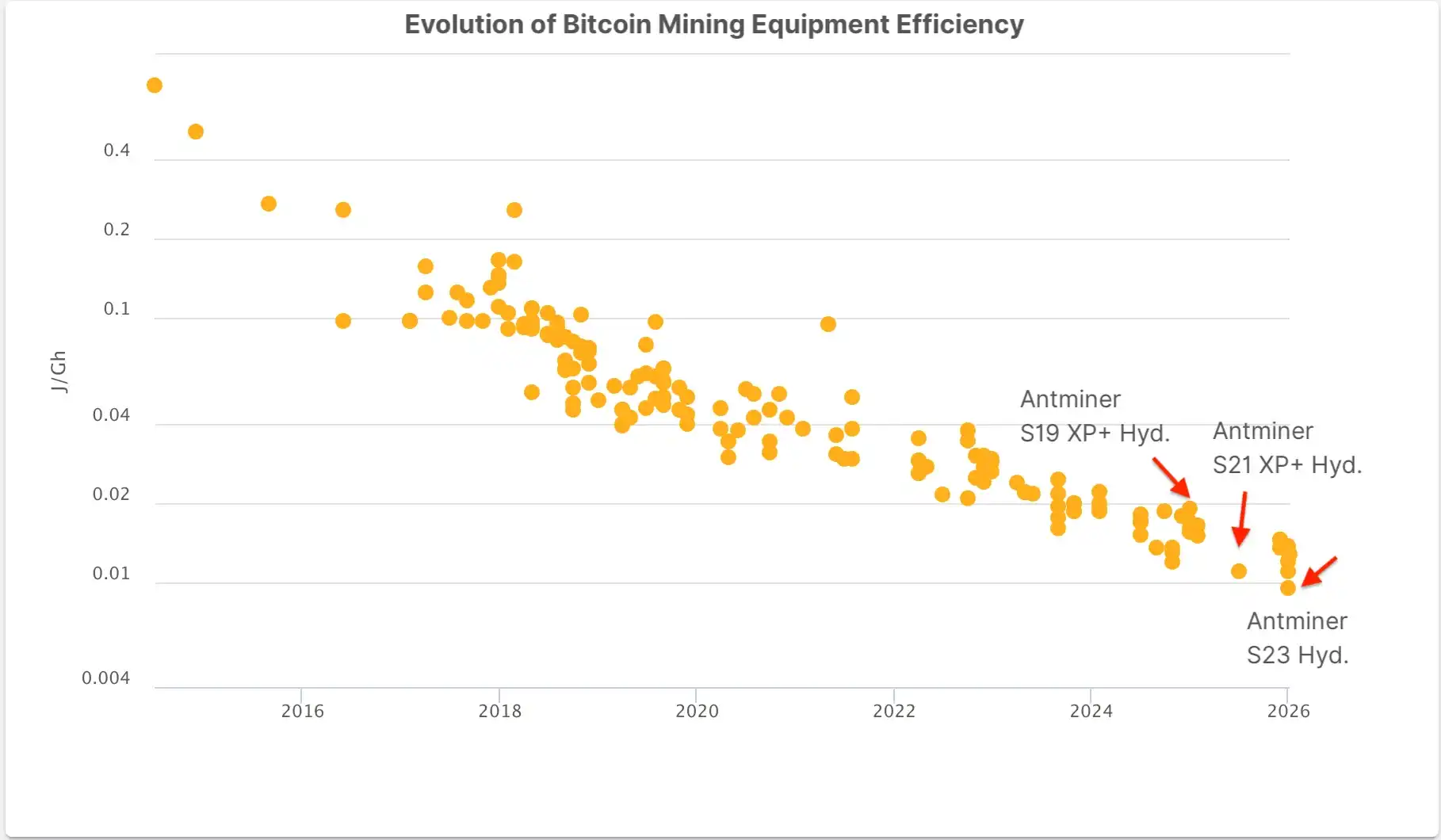
Source: Cambridge Bitcoin Electricity Consumption Index (CBECI), Cambridge Centre for Alternative Finance (CCAF), accessed February 12, 2026

Energy environments and contracted electricity prices also vary significantly between mining facilities, from hydropower and wind power to thermal power. Different energy mixes directly determine marginal cost levels. Large mining farms in regions abundant with hydropower resources, such as parts of North America, can secure long-term contract rates as low as $0.03–0.05/kWh, while commercial electricity prices in some regions with higher energy costs can reach $0.08–0.12/kWh. The operational pressure for the same miner model therefore differs significantly across different electricity price environments. Additionally, differences in operational efficiency, management costs, capital structure, and risk management strategies among miners also affect their ability to withstand price fluctuations.

Precisely because of these variations in miner models, electricity cost structures, and operational efficiencies, there is no uniform "miner shutdown price" across the industry. The actual situation depends on the mining facility conditions and equipment configuration. Treating a model result based on average assumptions as the industry's "survival line" itself tends to amplify market sentiment.

When the Bitcoin price gradually approaches some cost ranges amid fluctuations, the real change occurring in the industry is often more akin to a structural adjustment rather than a concentrated outbreak of systemic risk. During phases of price pressure and relatively high mining difficulty, the overall profit margin of the industry narrows. Adjustment first appears in marginal hash rate with higher costs and lower efficiency. Some smaller-scale miners, those with higher energy costs, or those using older equipment may choose to gradually shut down equipment, reduce hash rate, or adjust their asset structure to alleviate operational pressure.

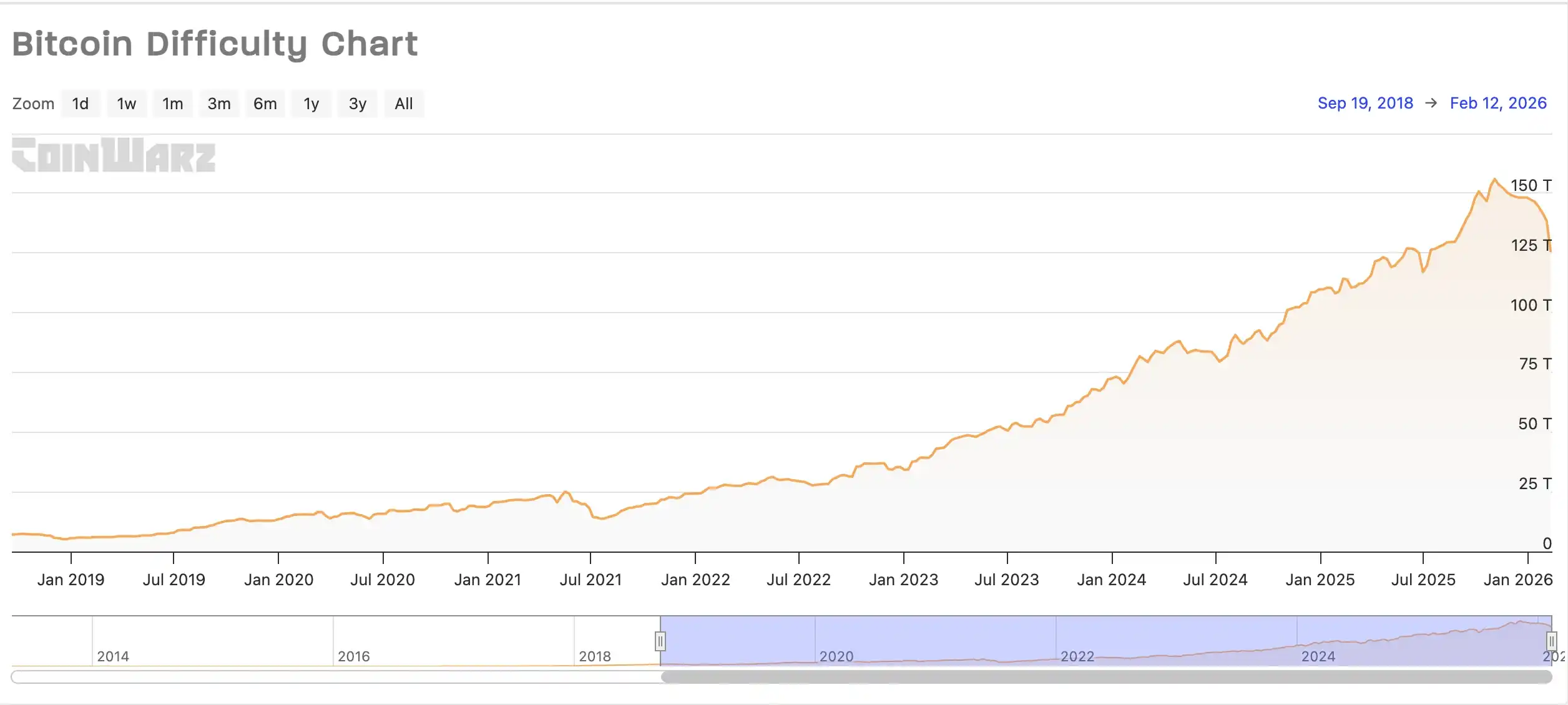
This process is often reflected in macro data as a periodic decline in the network's total hash rate. A drop in hash rate does not mean network security is compromised; it more reflects natural clearing and metabolism within the industry. In fact, such cyclical changes often accelerate the concentration of hash rate towards entities with scaled operations and cost advantages, thereby improving the overall operational efficiency of the industry.
Market Screening and Self-Adaptation

At a deeper level, the "shutdown price" is not an absolute price floor but更像是一个动态调节中的参考区间 (more like a reference range in dynamic adjustment). During market volatility, miners with high costs and low energy efficiency may choose to temporarily shut down equipment or adjust their operational strategies. The Bitcoin network itself possesses mature self-adjusting mechanisms. When some hash power exits, the network's mining difficulty subsequently adjusts downward. The remaining, more efficient hash power then gains a larger share of rewards, pushing the network gradually towards a new equilibrium. It is this self-regulating capability that allows the Bitcoin mining ecosystem to continue operating through multiple cycles and brings improved unit hash rate output and operational environment for the efficient miners who remain running.

Extending the timeline makes this pattern clearer. In past cycles, the industry has experienced phases where the price fell below the production cost range for some miners. In periods like 2019 and 2022, the Bitcoin price也曾低于当时大部分矿机的生产成本区间 (also fell below the production cost range of most miners at the time). However, following adjustments in hash rate, changes in difficulty, and market repair, it gradually converged towards new equilibrium ranges. Each cyclical adjustment pushes the industry towards lower energy costs, higher hash rate efficiency, and a more professionalized and scaled direction. Clearing out outdated capacity is itself an important sign of industry maturation.
How to Move Forward Amid Volatility

Returning to the enterprise level, the key to coping with industry volatility lies not in short-term price judgments but in long-term preparation and operational resilience. Taking BitFuFu as an example, the company has long focused on mining infrastructure construction and operational efficiency optimization, continuously deploying new generations of high-efficiency miners. Through scaled operations and refined energy cost management, it constantly improves overall hash rate quality. The company has also deployed diversified energy cooperation, building a competitive electricity cost structure. Benefiting from comprehensive advantages in equipment efficiency, energy structure, and operational systems, its current hash rate remains stable, enabling the company to maintain relatively stable output performance and a healthy asset structure during industry adjustment phases.

Short-term market volatility is inevitable, but what the Bitcoin network and mining industry have demonstrated through cycles is strong self-adaptive capability and continuous evolutionary progress. Behind the discussion of the "shutdown price," what is truly worth attention is how the industry completes efficiency leaps amidst volatility, and those enterprises that consistently focus on long-term development and continuously build moats of cost and efficiency.

Winter screens vitality, cycles temper true value. The industry is experiencing not an exit, but a deeper consolidation and upgrade. We are always here, focused, steady, moving forward together with the network.


Related Questions

QWhat is the common misconception about the 'Bitcoin miner shutdown price' discussed in the article?

AThe common misconception is that there is a single, unified 'shutdown price' for all Bitcoin miners. In reality, it is a theoretical concept based on model assumptions, and actual costs vary significantly due to differences in miner efficiency, electricity rates, and operational structures.

QHow do differences in mining equipment efficiency impact the shutdown price threshold?

AMining equipment efficiency, measured in joules per terahash (J/T), directly affects energy consumption and costs. More efficient miners (e.g., lower J/T) have lower operational costs, allowing them to remain profitable at lower Bitcoin prices, while less efficient miners face higher shutdown risks.

QWhat role does the Bitcoin network's self-adjusting mechanism play during market volatility?

AThe Bitcoin network adjusts mining difficulty based on total computational power (hashrate). When high-cost miners shut down, hashrate decreases, leading to a reduction in mining difficulty. This allows remaining efficient miners to gain higher rewards per unit of hashrate, stabilizing the network.

QHow have historical Bitcoin market cycles demonstrated the industry's adaptability?

AHistorical cycles (e.g., 2019, 2022) show that when prices fell below production costs for some miners, the industry underwent structural adjustments: inefficient miners exited, hashrate consolidated toward more efficient operations, and overall network efficiency improved, leading to recovery and maturation.

QWhat strategies do resilient mining companies employ to withstand market fluctuations?

AResilient mining companies focus on long-term strategies such as deploying high-efficiency miners, securing low-cost power contracts (e.g., through diversified energy partnerships), optimizing operational management, and maintaining scalable infrastructure to sustain stability during price volatility.

Related Reads

Trading

Spot
Futures

Hot Articles

What is $BITCOIN

DIGITAL GOLD ($BITCOIN): A Comprehensive Analysis Introduction to DIGITAL GOLD ($BITCOIN) DIGITAL GOLD ($BITCOIN) is a blockchain-based project operating on the Solana network, which aims to combine the characteristics of traditional precious metals with the innovation of decentralized technologies. While it shares a name with Bitcoin, often referred to as “digital gold” due to its perception as a store of value, DIGITAL GOLD is a separate token designed to create a unique ecosystem within the Web3 landscape. Its goal is to position itself as a viable alternative digital asset, although specifics regarding its applications and functionalities are still developing. What is DIGITAL GOLD ($BITCOIN)? DIGITAL GOLD ($BITCOIN) is a cryptocurrency token explicitly designed for use on the Solana blockchain. In contrast to Bitcoin, which provides a widely recognized value storage role, this token appears to focus on broader applications and characteristics. Notable aspects include: Blockchain Infrastructure: The token is built on the Solana blockchain, known for its capacity to handle high-speed and low-cost transactions. Supply Dynamics: DIGITAL GOLD has a maximum supply capped at 100 quadrillion tokens (100P $BITCOIN), although details regarding its circulating supply are currently undisclosed. Utility: While precise functionalities are not explicitly outlined, there are indications that the token could be utilized for various applications, potentially involving decentralized applications (dApps) or asset tokenization strategies. Who is the Creator of DIGITAL GOLD ($BITCOIN)? At present, the identity of the creators and development team behind DIGITAL GOLD ($BITCOIN) remains unknown. This situation is typical among many innovative projects within the blockchain space, particularly those aligning with decentralized finance and meme coin phenomena. While such anonymity may foster a community-driven culture, it intensifies concerns about governance and accountability. Who are the Investors of DIGITAL GOLD ($BITCOIN)? The available information indicates that DIGITAL GOLD ($BITCOIN) does not have any known institutional backers or prominent venture capital investments. The project seems to operate on a peer-to-peer model focused on community support and adoption rather than traditional funding routes. Its activity and liquidity are primarily situated on decentralized exchanges (DEXs), such as PumpSwap, rather than established centralized trading platforms, further highlighting its grassroots approach. How DIGITAL GOLD ($BITCOIN) Works The operational mechanics of DIGITAL GOLD ($BITCOIN) can be elaborated on based on its blockchain design and network attributes: Consensus Mechanism: By leveraging Solana’s unique proof-of-history (PoH) combined with a proof-of-stake (PoS) model, the project ensures efficient transaction validation contributing to the network's high performance. Tokenomics: While specific deflationary mechanisms have not been extensively detailed, the vast maximum token supply implies that it may cater to microtransactions or niche use cases that are still to be defined. Interoperability: There exists the potential for integration with Solana’s broader ecosystem, including various decentralized finance (DeFi) platforms. However, the details regarding specific integrations remain unspecified. Timeline of Key Events Here is a timeline that highlights significant milestones concerning DIGITAL GOLD ($BITCOIN): 2023: The initial deployment of the token occurs on the Solana blockchain, marked by its contract address. 2024: DIGITAL GOLD gains visibility as it becomes available for trading on decentralized exchanges like PumpSwap, allowing users to trade it against SOL. 2025: The project witnesses sporadic trading activity and potential interest in community-led engagements, although no noteworthy partnerships or technical advancements have been documented as of yet. Critical Analysis Strengths Scalability: The underlying Solana infrastructure supports high transaction volumes, which could enhance the utility of $BITCOIN in various transaction scenarios. Accessibility: The potential low trading price per token could attract retail investors, facilitating wider participation due to fractional ownership opportunities. Risks Lack of Transparency: The absence of publicly known backers, developers, or an audit process may yield skepticism regarding the project's sustainability and trustworthiness. Market Volatility: The trading activity is heavily reliant on speculative behavior, which can result in significant price volatility and uncertainty for investors. Conclusion DIGITAL GOLD ($BITCOIN) emerges as an intriguing yet ambiguous project within the rapidly evolving Solana ecosystem. While it attempts to leverage the “digital gold” narrative, its departure from Bitcoin's established role as a store of value underscores the need for a clearer differentiation of its intended utility and governance structure. Future acceptance and adoption will likely depend on addressing the current opacity and defining its operational and economic strategies more explicitly. Note: This report encompasses synthesised information available as of October 2023, and developments may have transpired beyond the research period.

363 Total ViewsPublished 2025.05.13Updated 2025.05.13

What is $BITCOIN

Discussions

Welcome to the HTX Community. Here, you can stay informed about the latest platform developments and gain access to professional market insights. Users' opinions on the price of BTC (BTC) are presented below.

活动图片














