Bitcoin Quantum Panic Flares As Nic Carter And Developer Matt Corallo Clash

bitcoinistPublished on 2026-02-04Last updated on 2026-02-04

A fresh bout of “quantum panic” broke out across Bitcoin X on Tuesday after Castle Island’s Nic Carter and longtime Bitcoin developer Matt Corallo sparred over whether the ecosystem is treating post-quantum security as an urgent protocol priority or a speculative distraction. The exchange landed on a familiar Bitcoin fault line: decentralized development culture versus the market’s appetite for visible coordination and timelines.

The flare-up began with a prompt from Kellan Grenier, who said he wished a “Tier 1 custodian” would partner with Castle Island to “spin up a Quantum Resistance BTC dev tiger team,” arguing there’s a “building wall of worry” that needs to be addressed “head on by reputable forces.” Corallo shot back that prominent Bitcoin developers have been “hard at work on QC for a while,” rejecting the premise that the space is asleep at the wheel.

Post-Quantum Bitcoin Plan Debate Heats Up

Carter disagreed sharply, arguing that scattered individual efforts don’t address the core bottleneck in Bitcoin upgrades: social consensus among the small set of developers and institutions who typically “set pace” for changes that actually ship and get adopted.

He pointed to Bitcoin’s historical upgrade cadence, saying the last two major upgrades took “7–8 years from first proposal to meaningful adoption on chain,” and added that the only named Bitcoin Improvement Proposal he cited as “pertaining to quantum,” BIP360, “has not been co-signed by any major dev,” describing it as “only a first of many, many steps that need to be made.”

Carter’s central claim was that Bitcoin can’t afford to wait for cryptographically relevant quantum computers to be demonstrably real before mobilizing, because the migration burden is asymmetric and slow. “And no, you cannot just ‘wait until CRQCs are real’ to act,” he wrote. “You need to act with a 5–10 year lead time. So if you think QCs might exist in 2035, you need to start acting now.”

He framed the risk in operational terms: custodians, exchanges, and individual holders would need to rotate keys across the entire network within a finite window or face catastrophic loss. He repeatedly linked to his essays arguing quantum timelines are accelerating and that Bitcoin developers should treat the threat proactively.

Corallo rejected both the tone and the factual framing, accusing Carter of manufacturing fear and ignoring ongoing institutional work. “Man you seriously need to stop talking out of your ass,” Corallo wrote, disputing the characterization of post-quantum work as “minuscule” and “scattered.”

He argued that “the top two Bitcoin developer institutions (Blockstream Research and Chaincode) each [have] several people working hard on what a post-quantum Bitcoin upgrade should look like,” and said he has not heard influential developers dismiss quantum as “only driven by investors” or “hype.”

Sleepwalking Or FUD?

The argument also rewound to 2021 debates around Taproot. Carter claimed quantum concerns were raised then and dismissed, calling the risk “far more urgent since.” Corallo countered that Carter was misrepresenting the earlier discussion: “The concern that was dismissed is that taproot made it materially worse, not that there was no risk and that there would never be any risk,” he wrote, adding that he still believes that narrower claim is correct.

As the thread escalated, Carter argued that Bitcoin’s culture of obscured influence and informal governance makes accountability difficult even when the stakes are existential. “There has been turnover in core dev, there has been a deliberate attempt to disguise who is a core dev for liability reasons, and because the most influential bitcoin devs try to keep their importance obscure,” he wrote, suggesting that outsiders can’t easily verify where “consensus” actually sits.

Corallo’s rebuttal was that the work exists, even if it doesn’t present as a public campaign. “That is what it looks like when devs take a problem seriously — research into available options, new cryptographic primitives that are better for Bitcoin than available standard PQC options,” he wrote, arguing that absence of conference-stage messaging is not evidence of inactivity.

A key technical disagreement surfaced late in the exchange: whether post-quantum safety would require essentially every user to migrate. After Carter told another developer it was “a lot more complicated than a simple patch” because “every user individually” would need to migrate “in a finite period of time,” Corallo responded: “No it doesn’t. If you have a wallet derived from a seedphrase, that is actually fine (assuming unsafe spend paths are disabled).”

Christine D. Kim, founder of Protocol Watch, jumped in to argue that Carter’s comparisons to councils and roadmaps in other ecosystems miss Bitcoin’s structure. Bitcoin “isn’t a company,” she wrote, and post-quantum discussions already occur through the usual venues — “the mailing list, IRC meetings, delving bitcoin”, adding that what Carter cited elsewhere can be “marketing... it’s just more centralized.”

At press time, BTC traded at $76,268.
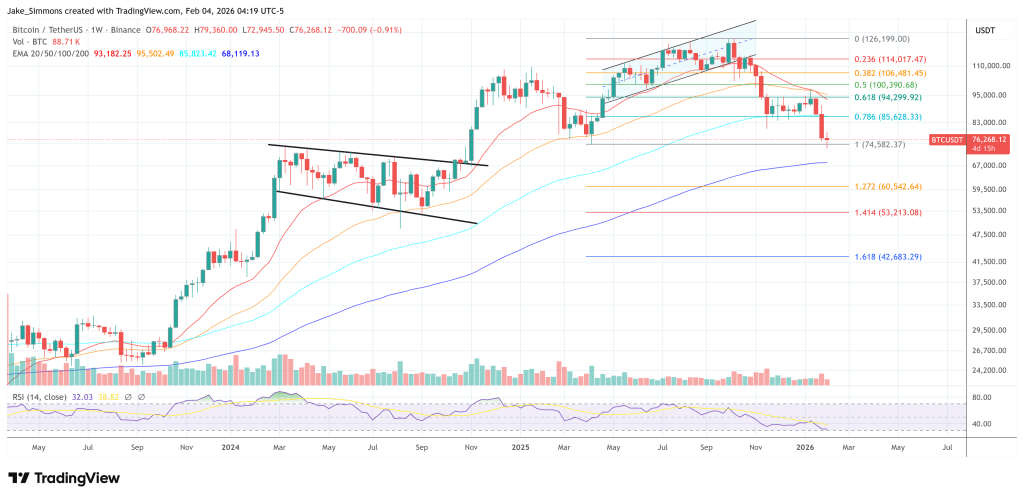
BTC remains above the 1.0 Fib, 1-week chart | Source: BTCUSDT on TradingView.com

Related Reads

Trading

Spot
Futures

Hot Articles

What is $BITCOIN

DIGITAL GOLD ($BITCOIN): A Comprehensive Analysis Introduction to DIGITAL GOLD ($BITCOIN) DIGITAL GOLD ($BITCOIN) is a blockchain-based project operating on the Solana network, which aims to combine the characteristics of traditional precious metals with the innovation of decentralized technologies. While it shares a name with Bitcoin, often referred to as “digital gold” due to its perception as a store of value, DIGITAL GOLD is a separate token designed to create a unique ecosystem within the Web3 landscape. Its goal is to position itself as a viable alternative digital asset, although specifics regarding its applications and functionalities are still developing. What is DIGITAL GOLD ($BITCOIN)? DIGITAL GOLD ($BITCOIN) is a cryptocurrency token explicitly designed for use on the Solana blockchain. In contrast to Bitcoin, which provides a widely recognized value storage role, this token appears to focus on broader applications and characteristics. Notable aspects include: Blockchain Infrastructure: The token is built on the Solana blockchain, known for its capacity to handle high-speed and low-cost transactions. Supply Dynamics: DIGITAL GOLD has a maximum supply capped at 100 quadrillion tokens (100P $BITCOIN), although details regarding its circulating supply are currently undisclosed. Utility: While precise functionalities are not explicitly outlined, there are indications that the token could be utilized for various applications, potentially involving decentralized applications (dApps) or asset tokenization strategies. Who is the Creator of DIGITAL GOLD ($BITCOIN)? At present, the identity of the creators and development team behind DIGITAL GOLD ($BITCOIN) remains unknown. This situation is typical among many innovative projects within the blockchain space, particularly those aligning with decentralized finance and meme coin phenomena. While such anonymity may foster a community-driven culture, it intensifies concerns about governance and accountability. Who are the Investors of DIGITAL GOLD ($BITCOIN)? The available information indicates that DIGITAL GOLD ($BITCOIN) does not have any known institutional backers or prominent venture capital investments. The project seems to operate on a peer-to-peer model focused on community support and adoption rather than traditional funding routes. Its activity and liquidity are primarily situated on decentralized exchanges (DEXs), such as PumpSwap, rather than established centralized trading platforms, further highlighting its grassroots approach. How DIGITAL GOLD ($BITCOIN) Works The operational mechanics of DIGITAL GOLD ($BITCOIN) can be elaborated on based on its blockchain design and network attributes: Consensus Mechanism: By leveraging Solana’s unique proof-of-history (PoH) combined with a proof-of-stake (PoS) model, the project ensures efficient transaction validation contributing to the network's high performance. Tokenomics: While specific deflationary mechanisms have not been extensively detailed, the vast maximum token supply implies that it may cater to microtransactions or niche use cases that are still to be defined. Interoperability: There exists the potential for integration with Solana’s broader ecosystem, including various decentralized finance (DeFi) platforms. However, the details regarding specific integrations remain unspecified. Timeline of Key Events Here is a timeline that highlights significant milestones concerning DIGITAL GOLD ($BITCOIN): 2023: The initial deployment of the token occurs on the Solana blockchain, marked by its contract address. 2024: DIGITAL GOLD gains visibility as it becomes available for trading on decentralized exchanges like PumpSwap, allowing users to trade it against SOL. 2025: The project witnesses sporadic trading activity and potential interest in community-led engagements, although no noteworthy partnerships or technical advancements have been documented as of yet. Critical Analysis Strengths Scalability: The underlying Solana infrastructure supports high transaction volumes, which could enhance the utility of $BITCOIN in various transaction scenarios. Accessibility: The potential low trading price per token could attract retail investors, facilitating wider participation due to fractional ownership opportunities. Risks Lack of Transparency: The absence of publicly known backers, developers, or an audit process may yield skepticism regarding the project's sustainability and trustworthiness. Market Volatility: The trading activity is heavily reliant on speculative behavior, which can result in significant price volatility and uncertainty for investors. Conclusion DIGITAL GOLD ($BITCOIN) emerges as an intriguing yet ambiguous project within the rapidly evolving Solana ecosystem. While it attempts to leverage the “digital gold” narrative, its departure from Bitcoin's established role as a store of value underscores the need for a clearer differentiation of its intended utility and governance structure. Future acceptance and adoption will likely depend on addressing the current opacity and defining its operational and economic strategies more explicitly. Note: This report encompasses synthesised information available as of October 2023, and developments may have transpired beyond the research period.

363 Total ViewsPublished 2025.05.13Updated 2025.05.13

What is $BITCOIN

Discussions

Welcome to the HTX Community. Here, you can stay informed about the latest platform developments and gain access to professional market insights. Users' opinions on the price of BTC (BTC) are presented below.

活动图片