Bitcoin Price Bottom Could Be Around $40,000, On-Chain Data Shows

bitcoinistPublished on 2026-02-22Last updated on 2026-02-22

Abstract

Based on on-chain data analysis by Ali Martinez, the Bitcoin price bottom in the current bear market could be around $40,000. This projection hinges on the cost basis of long-term holders (LTH), investors who have held their coins for over 155 days. Historically, this level acts as a strong support during downturns, as these investors are less likely to sell and often increase their buying when the price approaches their average acquisition cost, which is currently approximately $40,363. If selling pressure does not overwhelm this renewed buying activity, this cost basis could mark the market bottom. Currently, Bitcoin is trading near $68,330, down over 45% from its all-time high.

The biggest question so far in the bear phase has been when and where the Bitcoin price will bounce back. According to the latest on-chain data, there might be a fresh answer as to where the price bottom will be in the current bear market.

Here’s Why $40,000 Could Be Pivotal To The Bear Market

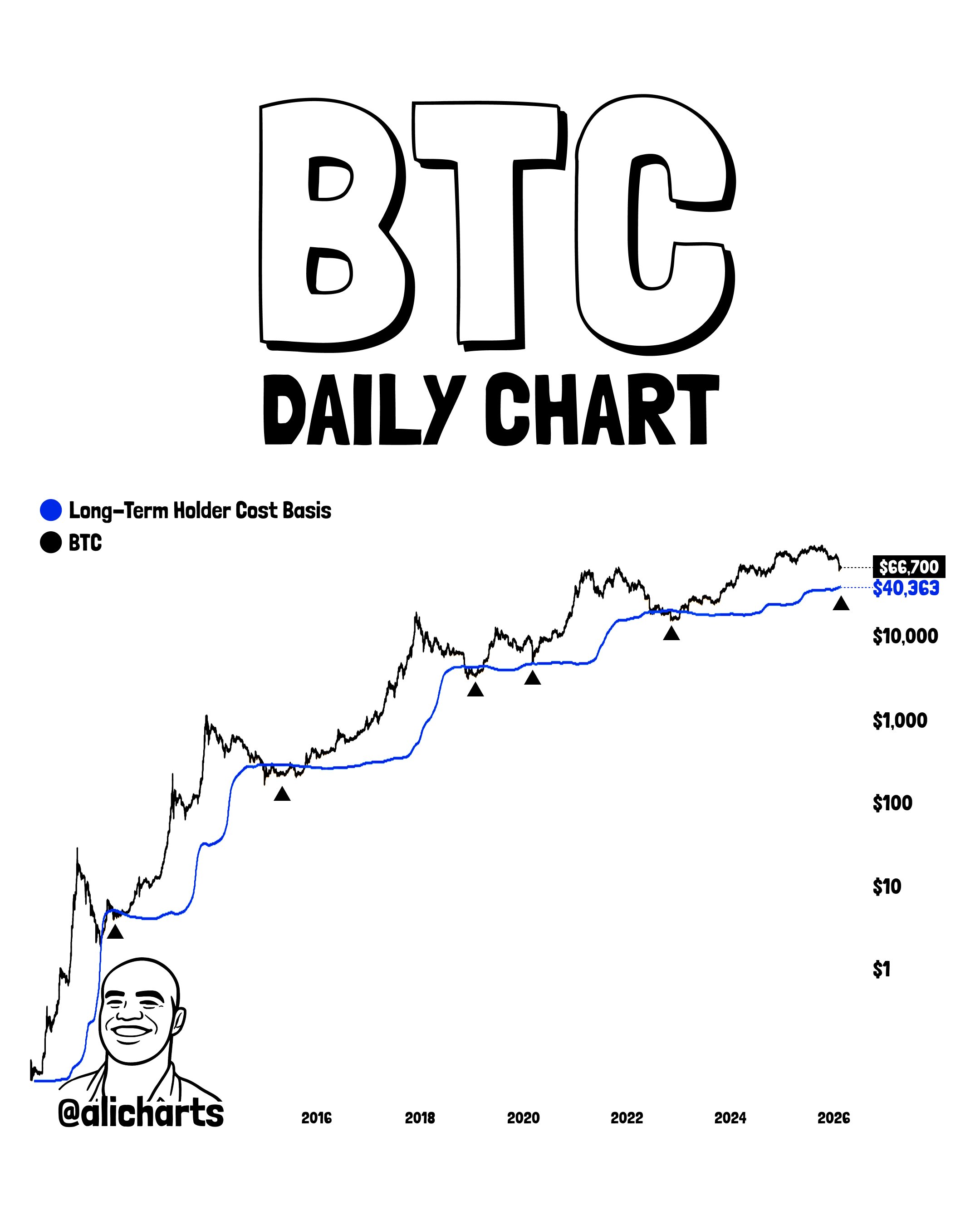
In a recent post on the X platform, crypto analyst Ali Martinez identified the $40,000 level as a potential bottom for the Bitcoin price in the current market phase. This projection is based on the cost basis of an old investor cohort known as the long-term holders (LTH)

For context, the cost basis of long-term holders refers to the average price at which Bitcoin investors (who have held their coins for 155 days or more) acquired their coins. This price level is often relevant because long-term investors are often referred to as diamond hands, who are less likely to sell during periods of downside volatility.

Moreover, the LTH cost basis tends to act as the ultimate support level during bear markets, as most long-term investors are usually still in profit even in the thick of the bear market. Hence, when the Bitcoin price falls to this support, the long-term holders double down on their positions.
Source: @ali_charts on X

This renewed buying activity by the long-term holders would prop up the price of the premier cryptocurrency above their cost basis, as observed in the chart above. According to the highlighted data, the LTH cost basis is currently around $40,363, about 40% from the current price point.

If the Bitcoin price were to face further downside pressure and approach this cost basis, there is a likelihood it would receive support from the long-term investors’ increased reaccumulation. Hence, this cost basis could become the bottom for the current bear market.

On the flip side, the Bitcoin market could face an even deeper correction if the selling pressure overwhelms the long-term holders’ reaccumulation spree.

Bitcoin Price Overview

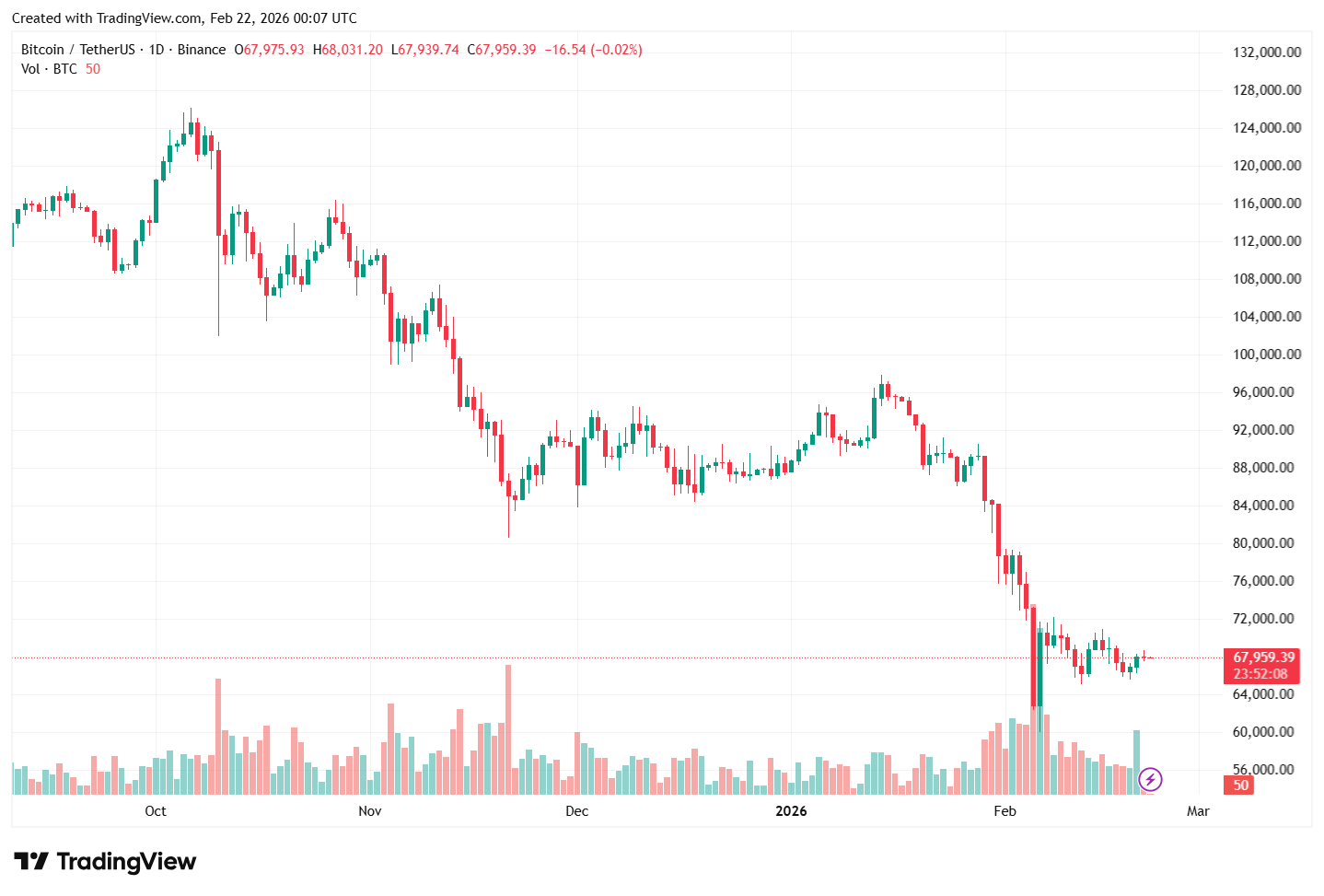
As of this writing, the price of BTC stands at around $68,330, reflecting a nearly 1% increase in the past 24 hours. However, this mild single-day action does little to correct the over 2% price decline witnessed by the premier cryptocurrency over the past week. According to data from CoinGecko, the Bitcoin price is currently down from its all-time high by more than 45%.
The price of BTC on the daily timeframe | Source: BTCUSDT chart on TradingView


Related Questions

QWhat is the on-chain data suggesting about the potential price bottom for Bitcoin in the current bear market?

AThe on-chain data suggests that the price bottom for Bitcoin could be around $40,000, based on the cost basis of long-term holders.

QWho are the 'long-term holders' (LTH) mentioned in the analysis, and why is their cost basis significant?

ALong-term holders are investors who have held their Bitcoin for 155 days or more. Their cost basis is significant because it often acts as a strong support level during bear markets, as these investors are less likely to sell and may even buy more when the price approaches their average purchase price.

QWhat is the specific cost basis for long-term holders that is cited as a potential support level?

AThe specific cost basis for long-term holders is currently around $40,363.

QWhat could happen if the selling pressure in the market overpowers the buying activity of long-term holders?

AIf the selling pressure overwhelms the long-term holders' reaccumulation, the Bitcoin market could experience an even deeper correction beyond the $40,000 support level.

QWhat was the price of Bitcoin and its performance at the time of writing, according to the article?

AAt the time of writing, the price of Bitcoin was around $68,330, reflecting a nearly 1% increase in the past 24 hours, but it was still down over 2% for the week and more than 45% from its all-time high.

Related Reads

From Theft to Re-entry: How Was $292 Million "Laundered"?

A sophisticated crypto laundering operation was executed following the $292 million hack of Kelp DAO on April 18. The attack, attributed to the North Korean Lazarus group, began with anonymous infrastructure preparation using Tornado Cash to fund wallets untraceably. The hacker exploited a vulnerability in Kelp’s cross-chain bridge, stealing 116,500 rsETH. To avoid crashing the market, the attacker used Aave and Compound as laundering tools—depositing the stolen rsETH as collateral to borrow $190 million in clean, liquid ETH. This move triggered a bank run on Aave, causing an $8 billion drop in TVL. After consolidating funds, the attacker fragmented them across hundreds of wallets to evade detection. A major breakpoint was THORChain, where over $460 million in volume—30 times its usual activity—was processed in 24 hours, converting ETH into Bitcoin. This shift to Bitcoin’s UTXO model exponentially increased tracing complexity by shattering funds into countless untraceable fragments. The final destination was Tron-based USDT, the primary channel for illicit crypto flows. From there, funds were cashed out via OTC brokers in China and Southeast Asia, using unlicensed underground banks and UnionPay networks outside Western sanctions scope. Ultimately, the laundered money supports North Korea’s weapons programs, which rely heavily on crypto hacking for foreign currency. The incident underscores structural challenges in DeFi: its openness, composability, and lack of central control make such laundering not just possible, but inherently difficult to prevent.

marsbit1h ago

From Theft to Re-entry: How Was $292 Million "Laundered"?

marsbit1h ago

Google and Amazon Simultaneously Invest Heavily in a Competitor: The Most Absurd Business Logic of the AI Era Is Becoming Reality

In a span of four days, Amazon announced an additional $25 billion investment, and Google pledged up to $40 billion—both direct competitors pouring over $65 billion into the same AI startup, Anthropic. Rather than a typical venture capital move, this signals the latest escalation in the cloud wars. The core of the deal is not equity but compute pre-orders: Anthropic must spend the majority of these funds on AWS and Google Cloud services and chips, effectively locking in massive future compute consumption. This reflects a shift in cloud market dynamics—enterprises now choose cloud providers based on which hosts the best AI models, not just price or stability. With OpenAI deeply tied to Microsoft, Anthropic’s Claude has become the only viable strategic asset for Google and Amazon to remain competitive. Anthropic’s annualized revenue has surged to $30 billion, and it is expanding into verticals like biotech, positioning itself as a cross-industry AI infrastructure layer. However, this funding comes with constraints: Anthropic’s independence is challenged as it balances two rival investors, its safety-first narrative faces pressure from regulatory scrutiny, and its path to IPO introduces new financial pressures. Globally, this accelerates a "tri-polar" closed-loop structure in AI infrastructure, with Microsoft-OpenAI, Google-Anthropic, and Amazon-Anthropic forming exclusive model-cloud alliances. In contrast, China’s landscape differs—investments like Alibaba and Tencent backing open-source model firm DeepSeek reflect a more decoupled approach, though closed-source models from major cloud providers still dominate. The $65 billion bet is ultimately about securing a seat at the table in an AI-defined future—where missing the model layer means losing the cloud war.

marsbit7h ago

Google and Amazon Simultaneously Invest Heavily in a Competitor: The Most Absurd Business Logic of the AI Era Is Becoming Reality

marsbit7h ago

Trading

Spot
Futures
活动图片




