Bitcoin Network Activity Index Keeps Declining: Demand Still Weak?

bitcoinistPublished on 2026-03-26Last updated on 2026-03-26

Abstract

CryptoQuant's Bitcoin Network Activity Index, which combines metrics like active addresses and transaction counts, continues to decline, indicating weak on-chain demand. Despite Bitcoin's price rally to new all-time highs in 2025, the index has remained below its 365-day moving average—a bearish signal similar to patterns observed in late 2021. Concurrently, Glassnode's Accumulation Trend Score shows recent neutral or distribution-focused behavior across investor cohorts, contrasting with brief accumulation after February's price drop. Bitcoin currently trades around $70,900, up over 2% in 24 hours, but underlying network activity suggests persistent weak demand.

CryptoQuant’s Network Activity Index for Bitcoin has been locked in a downtrend, suggesting that demand for using the blockchain remains weak.

CryptoQuant’s Bitcoin Network Activity Index Has Been Cooling Off

As highlighted by CryptoQuant community analyst Maartunn in an X post, Bitcoin on-chain activity has been cooling off recently. The indicator of relevance here is the “Network Activity Index” from analytics firm CryptoQuant, which combines several activity-related metrics to showcase the overall situation on the blockchain.

The indicators referred to by the index include active addresses (both receiving and sending), transactions (total and per block), UTXO count, and bytes per block.

Now, here is the chart shared by Maartunn that shows how the CryptoQuant Network Activity Index has changed for Bitcoin over its history:
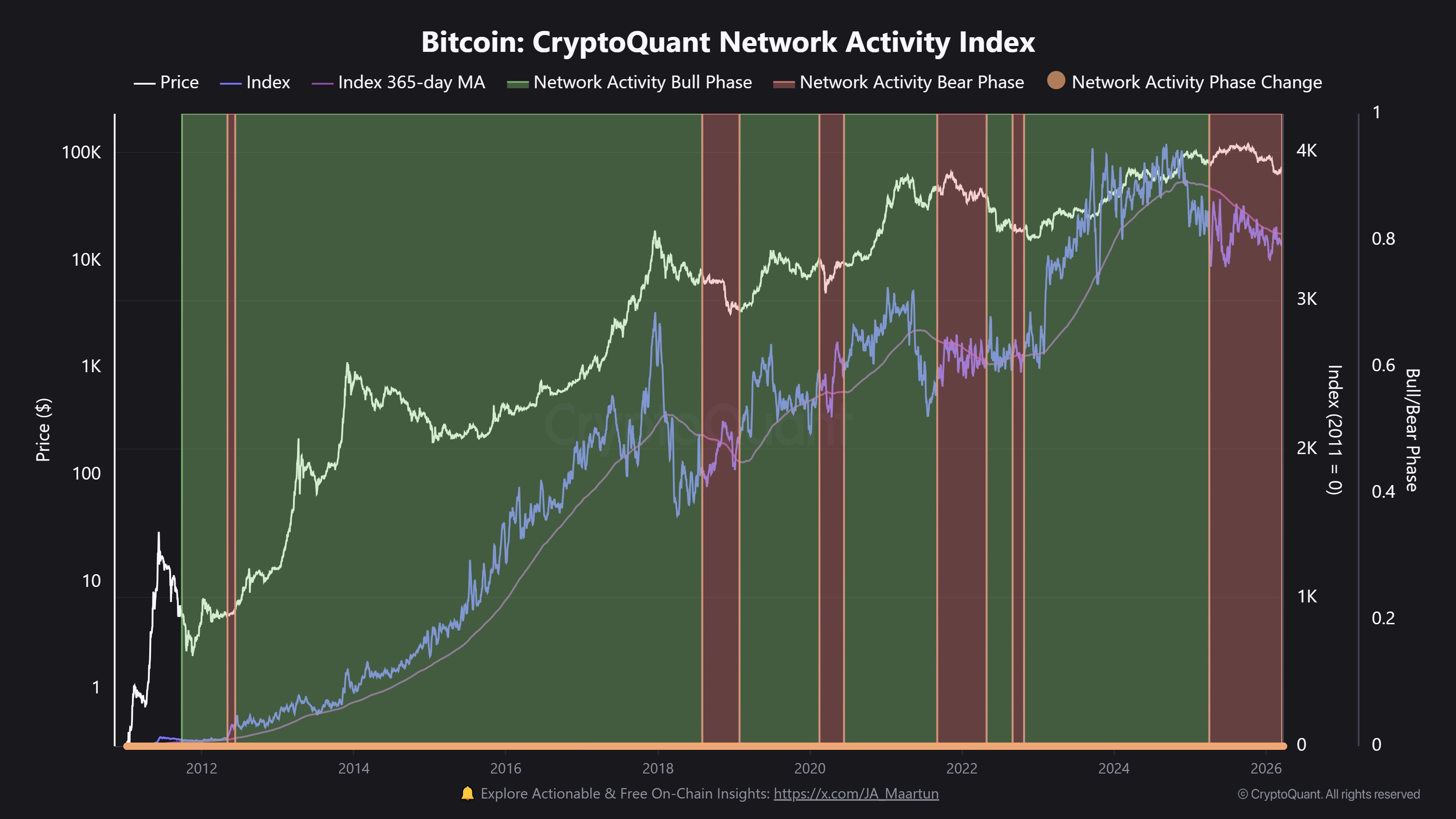
Looks like the value of the metric has steadily been going down in recent months | Source: @JA_Maartun on X

As displayed in the above graph, the Bitcoin Network Activity Index has been following a downward trajectory recently, a sign that transaction activity on the blockchain has been waning.

Alongside this decline, the indicator has been stuck in the region below its 365-day moving average (MA), something that tends to correspond to bearish phases.

Interestingly, the red signal in the indicator has actually maintained since before the shift of winds that the market saw in the last quarter of 2025. This means that even though BTC observed a rally to new all-time highs (ATHs) during the year, the network activity was still in a state of decline. From the chart, it’s visible that this pattern was also witnessed during 2021; the second half of that year’s bull run saw the metric flash a bearish signal.

Given that the Bitcoin Network Activity Index has continued to be in a red zone recently, it would appear that demand for using the network has remained weak. It now only remains to be seen how long it will take before the indicator observes a reversal.

In some other news, on-chain analytics firm Glassnode has shared the data of its new indicator, the Accumulation Trend Score by Wallet Cohort, in an X post. This metric tells us about the 30-day accumulation behavior of the various Bitcoin investor groups.

As the below chart shows, the Accumulation Trend Score has been at neutral or red values across the market recently.
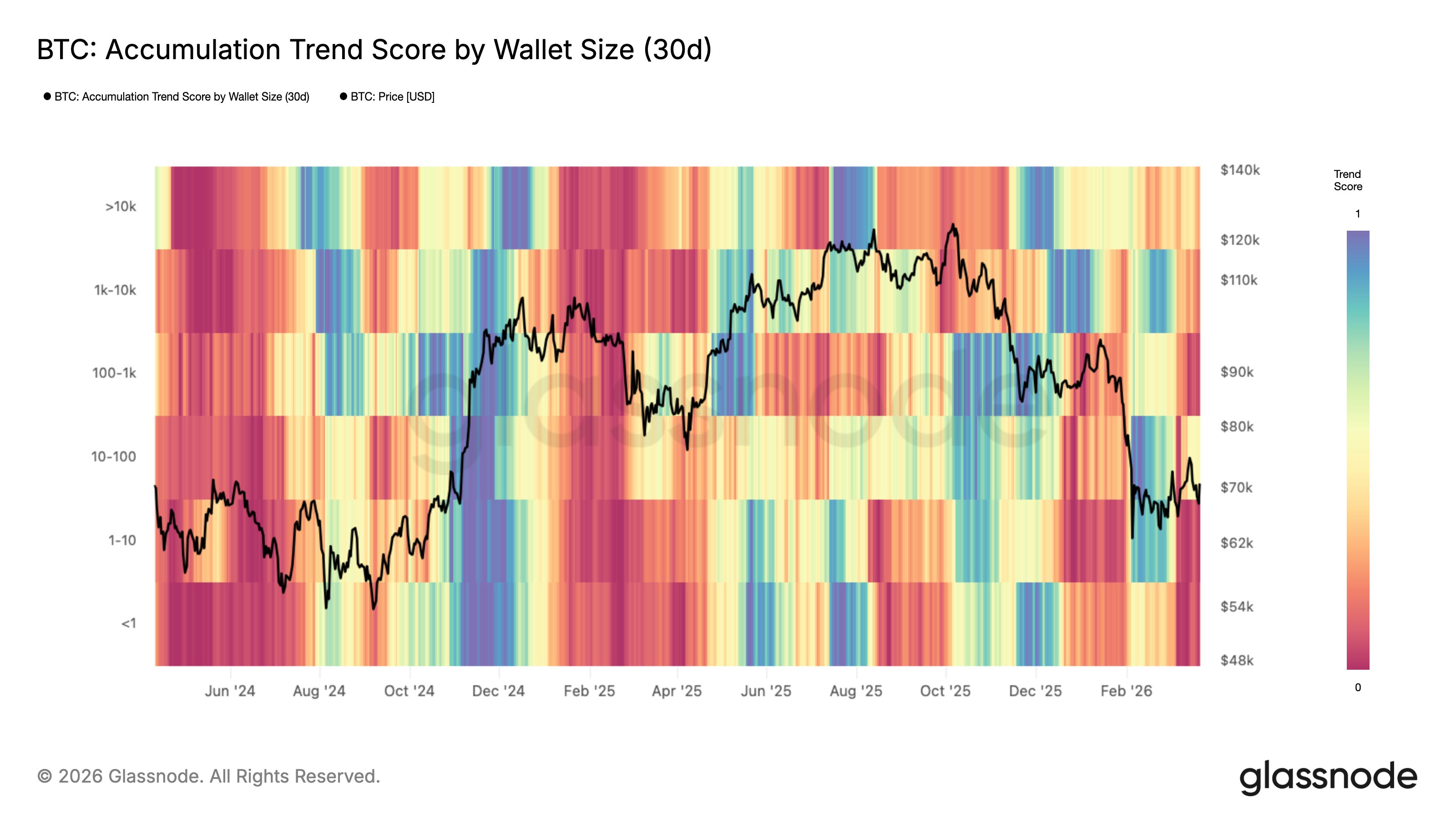
The value of the metric seems to have been red for most of the groups in recent days | Source: Glassnode on X

The orange-red levels for all Bitcoin groups indicate that investor behavior has leaned toward distribution recently. In contrast, some cohorts were participating in accumulation following the price crash in February.

BTC Price

At the time of writing, Bitcoin is floating around $70,900, up more than 2% over the last 24 hours.

The trend in the price of the coin over the last five days | Source: BTCUSDT on TradingView


Related Questions

QWhat is the current trend of CryptoQuant's Bitcoin Network Activity Index and what does it suggest?

ACryptoQuant's Bitcoin Network Activity Index has been in a steady downtrend and is stuck below its 365-day moving average, suggesting that demand for using the Bitcoin blockchain remains weak and that the market is in a bearish phase.

QWhich specific on-chain metrics are combined to form CryptoQuant's Network Activity Index?

AThe index combines several activity-related metrics, including active addresses (both receiving and sending), transactions (total and per block), UTXO count, and bytes per block.

QWhat does the Accumulation Trend Score by Wallet Cohort from Glassnode indicate about recent investor behavior?

AGlassnode's Accumulation Trend Score has been at neutral or red values across all Bitcoin investor groups recently, indicating that investor behavior has leaned toward distribution rather than accumulation.

QDespite the declining network activity, what was notable about Bitcoin's price performance in 2025?

ADespite the declining network activity, Bitcoin observed a rally to new all-time highs (ATHs) during 2025.

QWhat is the current price of Bitcoin mentioned in the article?

AAt the time of writing, Bitcoin is floating around $70,900, up more than 2% over the last 24 hours.

Related Reads

Will the Fed Still Cut Interest Rates? Tonight's Data Is Crucial

The core debate surrounding the Federal Reserve's potential interest rate cuts is intensifying amid geopolitical conflict and rebounding inflation. The key question is whether high energy prices will cause persistent inflation or weaken consumer demand enough to force the Fed to cut rates. Citigroup presents a bullish case for cuts, arguing that oil supply disruptions from the Strait of Hormuz are temporary and will not lead to lasting inflationary pressure. They point to receding bond yields and oil prices as evidence the market is pricing in a short-lived shock. Citi's data also shows tightening financial conditions, a stabilizing labor market, and healthy tax returns, supporting their view that the path to lower rates remains open. Conversely, Deutsche Bank offers a starkly contrasting, more hawkish outlook. They argue the Fed's current policy is already neutral and expect rates to remain unchanged indefinitely. Their view is based on stalled disinflation progress and a shift toward more hawkish rhetoric from key Fed officials like Waller, who cited risks from prolonged Middle East conflict and tariffs. Other officials, including Williams and Hammack, signaled rates would likely stay on hold for a "considerable time." The market pricing has shifted dramatically, now forecasting zero cuts in 2026. The imminent release of the March retail sales "control group" data is highlighted as a critical test. This metric, which excludes gas station sales, will reveal if high gasoline prices are eroding consumer spending in other areas. A weak reading could support the case for imminent rate cuts, while a strong one would bolster the argument for the Fed to hold steady. This data is pivotal for determining the near-term policy path.

marsbit21m ago

Will the Fed Still Cut Interest Rates? Tonight's Data Is Crucial

marsbit21m ago

The Second Half of Macro Influencer Fu Peng's Career

Fu Peng, a prominent Chinese macroeconomist and former chief economist of Northeast Securities, has joined Hong Kong-based digital asset management firm Bitfire Group (formerly New Huo Group) as its chief economist. This move, announced in April 2026, triggered an 11% surge in Bitfire's stock price. Fu, known for his accessible macroeconomic commentary and large social media following, will focus on integrating digital assets into global asset allocation frameworks, particularly combining FICC (fixed income, currencies, and commodities) with cryptocurrencies for institutional clients. His career includes roles at Lehman Brothers and Solomon International, with significant influence gained through public communication. However, in late 2024, Fu faced temporary social media bans after a controversial private speech at HSBC on China's economic challenges, though he denied regulatory sanctions. He later left Northeast Securities citing health reasons. Bitfire, a licensed virtual asset manager serving high-net-worth clients, seeks to build trust and attract traditional capital through Fu’s expertise and credibility. The partnership represents a strategic shift for both: Fu enters the crypto sector after a traditional finance peak, while Bitfire aims to leverage his macro framework for institutional adoption. Outcomes remain uncertain regarding capital inflows and compatibility within corporate structure.

marsbit1h ago

The Second Half of Macro Influencer Fu Peng's Career

marsbit1h ago

Trading

Spot
Futures

Hot Articles

What is $BITCOIN

DIGITAL GOLD ($BITCOIN): A Comprehensive Analysis Introduction to DIGITAL GOLD ($BITCOIN) DIGITAL GOLD ($BITCOIN) is a blockchain-based project operating on the Solana network, which aims to combine the characteristics of traditional precious metals with the innovation of decentralized technologies. While it shares a name with Bitcoin, often referred to as “digital gold” due to its perception as a store of value, DIGITAL GOLD is a separate token designed to create a unique ecosystem within the Web3 landscape. Its goal is to position itself as a viable alternative digital asset, although specifics regarding its applications and functionalities are still developing. What is DIGITAL GOLD ($BITCOIN)? DIGITAL GOLD ($BITCOIN) is a cryptocurrency token explicitly designed for use on the Solana blockchain. In contrast to Bitcoin, which provides a widely recognized value storage role, this token appears to focus on broader applications and characteristics. Notable aspects include: Blockchain Infrastructure: The token is built on the Solana blockchain, known for its capacity to handle high-speed and low-cost transactions. Supply Dynamics: DIGITAL GOLD has a maximum supply capped at 100 quadrillion tokens (100P $BITCOIN), although details regarding its circulating supply are currently undisclosed. Utility: While precise functionalities are not explicitly outlined, there are indications that the token could be utilized for various applications, potentially involving decentralized applications (dApps) or asset tokenization strategies. Who is the Creator of DIGITAL GOLD ($BITCOIN)? At present, the identity of the creators and development team behind DIGITAL GOLD ($BITCOIN) remains unknown. This situation is typical among many innovative projects within the blockchain space, particularly those aligning with decentralized finance and meme coin phenomena. While such anonymity may foster a community-driven culture, it intensifies concerns about governance and accountability. Who are the Investors of DIGITAL GOLD ($BITCOIN)? The available information indicates that DIGITAL GOLD ($BITCOIN) does not have any known institutional backers or prominent venture capital investments. The project seems to operate on a peer-to-peer model focused on community support and adoption rather than traditional funding routes. Its activity and liquidity are primarily situated on decentralized exchanges (DEXs), such as PumpSwap, rather than established centralized trading platforms, further highlighting its grassroots approach. How DIGITAL GOLD ($BITCOIN) Works The operational mechanics of DIGITAL GOLD ($BITCOIN) can be elaborated on based on its blockchain design and network attributes: Consensus Mechanism: By leveraging Solana’s unique proof-of-history (PoH) combined with a proof-of-stake (PoS) model, the project ensures efficient transaction validation contributing to the network's high performance. Tokenomics: While specific deflationary mechanisms have not been extensively detailed, the vast maximum token supply implies that it may cater to microtransactions or niche use cases that are still to be defined. Interoperability: There exists the potential for integration with Solana’s broader ecosystem, including various decentralized finance (DeFi) platforms. However, the details regarding specific integrations remain unspecified. Timeline of Key Events Here is a timeline that highlights significant milestones concerning DIGITAL GOLD ($BITCOIN): 2023: The initial deployment of the token occurs on the Solana blockchain, marked by its contract address. 2024: DIGITAL GOLD gains visibility as it becomes available for trading on decentralized exchanges like PumpSwap, allowing users to trade it against SOL. 2025: The project witnesses sporadic trading activity and potential interest in community-led engagements, although no noteworthy partnerships or technical advancements have been documented as of yet. Critical Analysis Strengths Scalability: The underlying Solana infrastructure supports high transaction volumes, which could enhance the utility of $BITCOIN in various transaction scenarios. Accessibility: The potential low trading price per token could attract retail investors, facilitating wider participation due to fractional ownership opportunities. Risks Lack of Transparency: The absence of publicly known backers, developers, or an audit process may yield skepticism regarding the project's sustainability and trustworthiness. Market Volatility: The trading activity is heavily reliant on speculative behavior, which can result in significant price volatility and uncertainty for investors. Conclusion DIGITAL GOLD ($BITCOIN) emerges as an intriguing yet ambiguous project within the rapidly evolving Solana ecosystem. While it attempts to leverage the “digital gold” narrative, its departure from Bitcoin's established role as a store of value underscores the need for a clearer differentiation of its intended utility and governance structure. Future acceptance and adoption will likely depend on addressing the current opacity and defining its operational and economic strategies more explicitly. Note: This report encompasses synthesised information available as of October 2023, and developments may have transpired beyond the research period.

363 Total ViewsPublished 2025.05.13Updated 2025.05.13

What is $BITCOIN

Discussions

Welcome to the HTX Community. Here, you can stay informed about the latest platform developments and gain access to professional market insights. Users' opinions on the price of BTC (BTC) are presented below.

活动图片














