Bitcoin Needs Only 2 Steps To Become Quantum-Resistant, Core Dev Says

bitcoinistPublished on 2026-02-23Last updated on 2026-02-23

Abstract

Bitcoin core developer Matt Corallo refutes claims that developers are ignoring quantum threats, proposing a two-step roadmap for quantum resistance. First, enable post-quantum key commitments using hash-based signatures, a step with growing consensus. Second, decide later when to disable vulnerable legacy spend paths, a more politically challenging move. Corallo argues most wallets already have quantum-safe features at the derivation layer, reducing migration complexity. He emphasizes ongoing work is active, citing research at Blockstream and Chaincode Labs, and disputes the narrative that quantum risk is being neglected. The goal is a low-cost upgrade path that prepares Bitcoin without immediate fee increases.

Bitcoin open-source engineer Matt Corallo pushed back on claims that Bitcoin developers are “sleepwalking” on quantum risk, arguing instead that a practical post-quantum roadmap is already taking shape and may be simpler than critics suggest. Speaking on the Unchained podcast episode published Feb. 22, Corallo said the key work can be framed in two main steps: enable post-quantum key commitments first, then decide later when to disable vulnerable legacy spend paths.

Corallo’s appearance was a direct response to criticism popularized by Castle Island Ventures’ Nick Carter, who has argued Bitcoin developers are not treating the quantum threat with sufficient urgency. Corallo said that characterization misses both the amount of ongoing work and an important technical point about how many Bitcoin wallets already function.

He argued that most wallets using seed phrases already have a quantum-safe anchor at the wallet-derivation layer, even if the on-chain public key and signature scheme remain vulnerable to a future cryptographically relevant quantum computer. In his telling, that meaningfully changes the migration problem and could reduce how much disruption is required if the threat becomes urgent.

Corallo’s 2-Step Roadmap For Bitcoin

Corallo repeatedly returned to what he called the core sequence for Bitcoin’s quantum preparation. “There are only two steps,” he said. “The first relevant step is just adding the ability to commit to a postquantum public key. I think that should be done soon.”

He added that this first phase is increasingly converging around hash-based signatures, with current discussion focused less on whether to do it and more on exact implementation details. Corallo said he sees “pretty strong consensus” around hash-based approaches and pointed to work tied to BIP 360, while also noting debate continues on the precise format.

The second step, in his framing, is the politically harder one: deciding when legacy, quantum-vulnerable spend paths should no longer be accepted. That is the point where old coins that have not migrated — including lost or abandoned coins — become part of a market-driven fork decision, in his view.

Corallo’s argument for moving early on the first step but delaying the enforcement switch rests on cost and wallet behavior. He said wallets can start committing to post-quantum public keys now without immediately paying the size and fee overhead of using large post-quantum signatures on-chain.

“You really want an upgrade path that is free for now,” Corallo said. “The wallets know how to spend it. They know how to build these keys, how to sign with these keys. They just don’t have to use it yet.”

He argued this avoids a scenario where wallets postpone upgrades because post-quantum transactions are larger and more expensive, while still preparing the system for a future enforcement moment.

The ‘Nobody Is Working On It’ Narrative

Corallo also disputed the idea that Bitcoin development circles are ignoring the issue. He pointed to research and engineering work at organizations including Blockstream Research and Chaincode Labs, cited Ethan Heilman and co-authors working on BIP 360, and said post-quantum discussion on the Bitcoin developer mailing list has grown steadily.

At one point, he said mailing-list discussion has risen to “30 or 40%” of posts, describing that as evidence of sustained attention rather than neglect.

Corallo did not argue the problem is trivial. He acknowledged migration of active wallets could take years and said critics are right that the social and market consequences of disabling insecure spend paths would be contentious. But his central claim was narrower: Bitcoin does not need a fully finalized end-state today to begin meaningful preparation now.

At press time, BTC traded at $65,953.
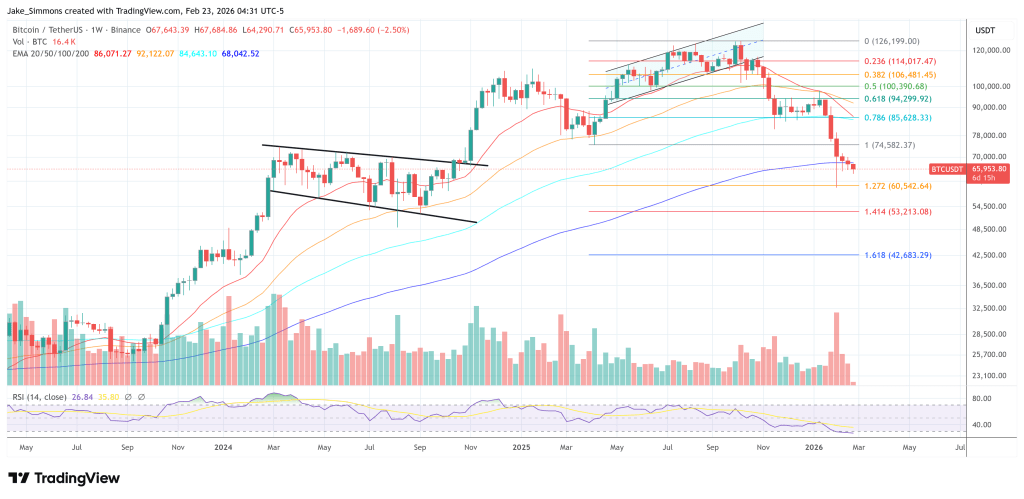
Bitcoin must reclaim the 200-week EMA, 1-week chart | Source: BTCUSDT on TradingView.com

Related Questions

QWhat are the two main steps in Matt Corallo's roadmap to make Bitcoin quantum-resistant?

AThe two main steps are: 1. Enable post-quantum key commitments, and 2. Decide when to disable vulnerable legacy spend paths.

QAccording to Corallo, why is the second step of disabling legacy spend paths considered politically harder?

AIt is politically harder because it involves a contentious decision on when to stop accepting old, quantum-vulnerable transactions, which would affect un-migrated coins and create a market-driven fork.

QWhat type of post-quantum signature scheme is gaining consensus among Bitcoin developers, as mentioned by Corallo?

AThere is 'pretty strong consensus' around hash-based signature schemes, with ongoing work related to BIP 360.

QHow does Corallo counter the narrative that Bitcoin developers are ignoring the quantum threat?

AHe points to increased discussion on the Bitcoin developer mailing list (up to '30 or 40%' of posts) and research work at organizations like Blockstream Research and Chaincode Labs, including efforts on BIP 360.

QWhat practical advantage does Corallo see in enabling post-quantum key commitments first, without immediately using large signatures?

AIt provides a 'free for now' upgrade path, allowing wallets to prepare for the future without incurring the immediate cost and size overhead of large post-quantum signatures, thus avoiding upgrade delays.

Related Reads

Cook's Curtain Call and Ternus Takes the Helm: The Disruption and Reboot of Apple's 4 Trillion Dollar Empire

Tim Cook has officially announced he will step down as CEO of Apple in September, transitioning to executive chairman after a 15-year tenure during which he grew the company’s market value from around $350 billion to nearly $4 trillion. He will be succeeded by John Ternus, a 50-year-old hardware engineering veteran who has been groomed for the role through increasing public visibility and internal responsibility. Ternus’s appointment signals a strategic shift toward hardware and engineering leadership, with Johny Srouji—head of Apple Silicon—taking on an expanded role as Chief Hardware Officer. This consolidation aims to strengthen Apple’s core technological capabilities. However, Cook’s departure highlights a significant unresolved issue: Apple’s delayed and fragmented approach to artificial intelligence. Despite early efforts, such as hiring John Giannandrea from Google in 2018, Apple’s AI initiatives—particularly around Siri—have struggled with internal restructuring and reliance on external partnerships, including with Google. The transition comes at a critical moment as Apple faces paradigm shifts with the rise of artificial general intelligence (ASI). The company’s closed ecosystem of hardware, software, and services—once a major advantage—now presents challenges in adapting to an AI-centric world where intelligence may matter more than the device itself. Ternus must quickly articulate a clear AI strategy, possibly starting at WWDC, to reassure markets and redefine Apple’s role in a new technological era. His task is not only to maintain Apple’s operational excellence but also to reinvigorate its capacity to innovate and lead in the age of AI.

marsbit7m ago

Cook's Curtain Call and Ternus Takes the Helm: The Disruption and Reboot of Apple's 4 Trillion Dollar Empire

marsbit7m ago

Trading

Spot
Futures

Hot Articles

What is $BITCOIN

DIGITAL GOLD ($BITCOIN): A Comprehensive Analysis Introduction to DIGITAL GOLD ($BITCOIN) DIGITAL GOLD ($BITCOIN) is a blockchain-based project operating on the Solana network, which aims to combine the characteristics of traditional precious metals with the innovation of decentralized technologies. While it shares a name with Bitcoin, often referred to as “digital gold” due to its perception as a store of value, DIGITAL GOLD is a separate token designed to create a unique ecosystem within the Web3 landscape. Its goal is to position itself as a viable alternative digital asset, although specifics regarding its applications and functionalities are still developing. What is DIGITAL GOLD ($BITCOIN)? DIGITAL GOLD ($BITCOIN) is a cryptocurrency token explicitly designed for use on the Solana blockchain. In contrast to Bitcoin, which provides a widely recognized value storage role, this token appears to focus on broader applications and characteristics. Notable aspects include: Blockchain Infrastructure: The token is built on the Solana blockchain, known for its capacity to handle high-speed and low-cost transactions. Supply Dynamics: DIGITAL GOLD has a maximum supply capped at 100 quadrillion tokens (100P $BITCOIN), although details regarding its circulating supply are currently undisclosed. Utility: While precise functionalities are not explicitly outlined, there are indications that the token could be utilized for various applications, potentially involving decentralized applications (dApps) or asset tokenization strategies. Who is the Creator of DIGITAL GOLD ($BITCOIN)? At present, the identity of the creators and development team behind DIGITAL GOLD ($BITCOIN) remains unknown. This situation is typical among many innovative projects within the blockchain space, particularly those aligning with decentralized finance and meme coin phenomena. While such anonymity may foster a community-driven culture, it intensifies concerns about governance and accountability. Who are the Investors of DIGITAL GOLD ($BITCOIN)? The available information indicates that DIGITAL GOLD ($BITCOIN) does not have any known institutional backers or prominent venture capital investments. The project seems to operate on a peer-to-peer model focused on community support and adoption rather than traditional funding routes. Its activity and liquidity are primarily situated on decentralized exchanges (DEXs), such as PumpSwap, rather than established centralized trading platforms, further highlighting its grassroots approach. How DIGITAL GOLD ($BITCOIN) Works The operational mechanics of DIGITAL GOLD ($BITCOIN) can be elaborated on based on its blockchain design and network attributes: Consensus Mechanism: By leveraging Solana’s unique proof-of-history (PoH) combined with a proof-of-stake (PoS) model, the project ensures efficient transaction validation contributing to the network's high performance. Tokenomics: While specific deflationary mechanisms have not been extensively detailed, the vast maximum token supply implies that it may cater to microtransactions or niche use cases that are still to be defined. Interoperability: There exists the potential for integration with Solana’s broader ecosystem, including various decentralized finance (DeFi) platforms. However, the details regarding specific integrations remain unspecified. Timeline of Key Events Here is a timeline that highlights significant milestones concerning DIGITAL GOLD ($BITCOIN): 2023: The initial deployment of the token occurs on the Solana blockchain, marked by its contract address. 2024: DIGITAL GOLD gains visibility as it becomes available for trading on decentralized exchanges like PumpSwap, allowing users to trade it against SOL. 2025: The project witnesses sporadic trading activity and potential interest in community-led engagements, although no noteworthy partnerships or technical advancements have been documented as of yet. Critical Analysis Strengths Scalability: The underlying Solana infrastructure supports high transaction volumes, which could enhance the utility of $BITCOIN in various transaction scenarios. Accessibility: The potential low trading price per token could attract retail investors, facilitating wider participation due to fractional ownership opportunities. Risks Lack of Transparency: The absence of publicly known backers, developers, or an audit process may yield skepticism regarding the project's sustainability and trustworthiness. Market Volatility: The trading activity is heavily reliant on speculative behavior, which can result in significant price volatility and uncertainty for investors. Conclusion DIGITAL GOLD ($BITCOIN) emerges as an intriguing yet ambiguous project within the rapidly evolving Solana ecosystem. While it attempts to leverage the “digital gold” narrative, its departure from Bitcoin's established role as a store of value underscores the need for a clearer differentiation of its intended utility and governance structure. Future acceptance and adoption will likely depend on addressing the current opacity and defining its operational and economic strategies more explicitly. Note: This report encompasses synthesised information available as of October 2023, and developments may have transpired beyond the research period.

363 Total ViewsPublished 2025.05.13Updated 2025.05.13

What is $BITCOIN

Discussions

Welcome to the HTX Community. Here, you can stay informed about the latest platform developments and gain access to professional market insights. Users' opinions on the price of BTC (BTC) are presented below.

活动图片















