Bitcoin Mining Difficulty Erases Frost-Driven Dips With A Sharp Rebound – What This Means For BTC
bitcoinistPublished on 2026-02-25Last updated on 2026-02-25
Abstract
Bitcoin mining difficulty has sharply rebounded after a brief weather-related decline, signaling renewed miner participation and network resilience. Despite Bitcoin's price pressure and consolidation near $63,000—well below its recent $70,000 level—the difficulty recovery indicates sustained miner confidence. The temporary dip was caused by severe winter storms disrupting energy supplies in key mining regions, forcing some hashrate offline. However, miners quickly restored operations, pushing difficulty back to new highs. This rebound reinforces strong network fundamentals but may increase cost pressures on less efficient miners if BTC remains range-bound. Technically, Bitcoin shows weakened momentum, trading below key moving averages, with $60,000–$63,000 acting as critical support. A break below could lead to deeper retracement, while reclaiming $70,000 is necessary for a bullish shift.
Trusted Editorial content, reviewed by leading industry experts and seasoned editors. Ad Disclosure
Bitcoin has remained under sustained pressure since losing the $70,000 level, entering a corrective phase that has gradually pushed price lower while defining a consolidation range just above the $63,000 zone. Momentum has weakened noticeably, with buyers struggling to regain control and volatility compressing as the market searches for direction. This range-bound behavior reflects a transitional phase rather than a confirmed trend reversal, as traders weigh macro uncertainty, liquidity conditions, and broader risk sentiment across digital assets.
Related Reading: Every Ethereum Whale Cohort Now Underwater: ETH Capitulation Marking The Final Bottom?
Amid this backdrop, Bitcoin mining difficulty has recently rebounded following a brief dip. Mining difficulty adjusts roughly every two weeks to maintain consistent block production timing. When difficulty rises, it typically signals that more computational power — or hashrate — has returned to the network. Temporary drops can occur when external factors, such as weather disruptions, energy constraints, or operational shutdowns, force some miners offline.
The recent rebound, therefore, suggests renewed miner participation and sustained network resilience. Greater difficulty often indicates confidence among miners in Bitcoin’s long-term viability, as maintaining operations becomes more competitive and capital-intensive. However, it can also increase cost pressure on less efficient miners, potentially influencing short-term supply dynamics if some are forced to liquidate holdings to cover expenses.
The recent dip in mining difficulty was largely weather-driven rather than structurally bearish. Severe winter storms temporarily disrupted energy supply in key mining regions, forcing portions of the network’s hashrate offline. As a result, the previous difficulty adjustment registered a short-lived decline, reflecting reduced computational power securing the network at that moment.
Bitcoin Difficulty | Source: CryptoQuant
However, the disruption proved brief. According to on-chain data, the latest adjustment reversed the drop and pushed difficulty back to new highs, confirming that miners rapidly restored operations. Network hashrate has rebounded toward its prior range, signaling that the infrastructure impact was temporary rather than systemic. Block production times, which had briefly slowed, normalized quickly as computational power returned.
This rebound carries structural implications. Mining difficulty rising after a shock indicates that capital remains committed to the network despite price weakness below $70,000. It also suggests that the broader mining ecosystem retains operational resilience, even under adverse conditions.
At the same time, greater difficulty increases production costs, particularly for less efficient operators. If Bitcoin’s price remains compressed near the $63,000–$65,000 range, margin pressure could intensify for high-cost miners. Nonetheless, the swift recovery in difficulty reinforces the view that network fundamentals remain intact despite short-term volatility.
Related Reading: Bitcoin’s Decay Signals the Most Severe Bearish Pivot Since the LUNA Collapse – A 2022 Echo
Bitcoin Tests Key Support As Downtrend Pressure Persists
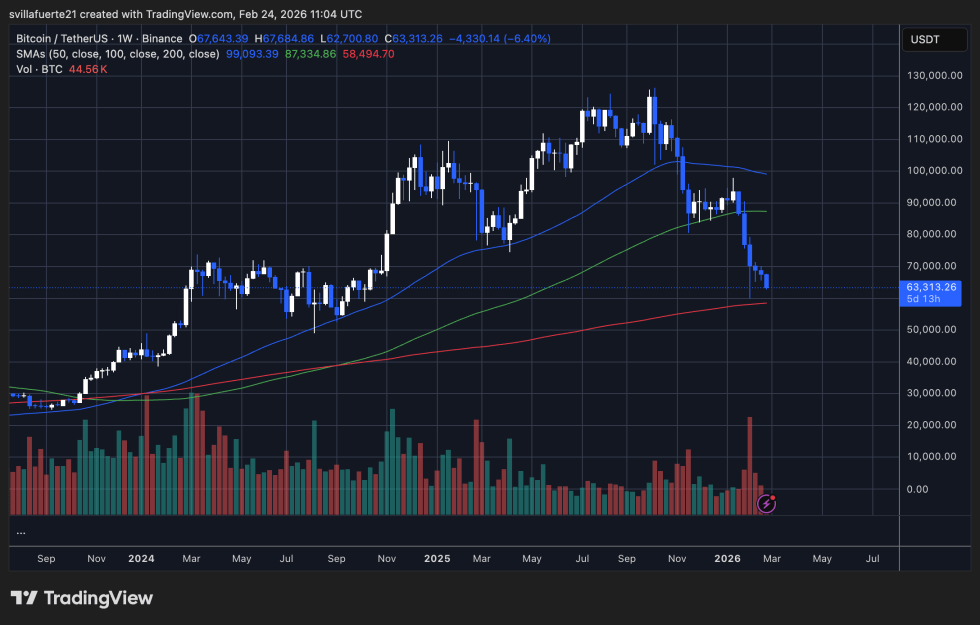
Bitcoin’s weekly chart shows a clear deterioration in momentum after losing the $70,000 level, with price now consolidating near the $63,000 zone. The structure reflects a sequence of lower highs since the late-2025 peak above $120,000, indicating that sellers remain dominant despite intermittent stabilization attempts.
Bitcoin testing key demand | Source: BTCUSDT chart on TradingView
Technically, Bitcoin is trading below the 50-week and 100-week moving averages, both of which have shifted from support into dynamic resistance. This configuration typically signals a transitional or corrective phase rather than a confirmed bullish continuation. Meanwhile, the 200-week moving average — currently much lower — remains the long-term structural support reference.
Related Reading: Every Ethereum Whale Cohort Now Underwater: ETH Capitulation Marking The Final Bottom?
Volume patterns also suggest caution. Selling activity increased during the latest decline, pointing to distribution rather than simple low-liquidity drift. However, recent candles show some compression in volatility, implying that the market may be attempting to establish a short-term base around current levels.
From a structural perspective, the $60,000–$63,000 region now acts as immediate support. A sustained break below it could expose deeper retracement zones toward the mid-$50,000 area. Conversely, reclaiming the $70,000 threshold would be necessary to restore bullish momentum and shift sentiment toward recovery.
Featured image from ChatGPT, chart from TradingView.com
Editorial Process for bitcoinist is centered on delivering thoroughly researched, accurate, and unbiased content. We uphold strict sourcing standards, and each page undergoes diligent review by our team of top technology experts and seasoned editors. This process ensures the integrity, relevance, and value of our content for our readers.
ShareTweetShareShare
Sign Up for Our Newsletter!
For updates and exclusive offers enter your email.
Sebastian Villafuerte
Follow
Sebastian's journey into the world of crypto began four years ago, driven by a fascination with the potential of blockchain technology to revolutionize financial systems. His initial exploration focused on understanding the intricacies of various crypto projects, particularly those focused on building innovative financial solutions. Through countless hours of research and learning, Sebastian developed a deep understanding of the underlying technologies, market dynamics, and potential applications of cryptocurrencies.
As his knowledge grew, Sebastian felt compelled to share his insights with others. He began actively contributing to online discussions on platforms like X and LinkedIn, focusing on fintech and crypto-related content. His goal was to expose valuable trends and insights to a wider audience, fostering a deeper understanding of the rapidly evolving crypto landscape. Sebastian's contributions quickly gained recognition, and he became a trusted voice in the online crypto community.
To further enhance his expertise, Sebastian pursued a UC Berkeley Fintech: Frameworks, Applications, and Strategies certification. This rigorous program equipped him with valuable skills and knowledge regarding Financial Technology, bridging the gap between traditional finance (TradFi) and decentralized finance (DeFi). The certification deepened his understanding of the broader financial landscape and its intersection with blockchain technology.
Sebastian's passion for finance and writing is evident in his work. He enjoys delving into financial research, analyzing market trends, and exploring the latest developments in the crypto space. In his spare time, Sebastian can often be found immersed in charts, studying 10-K forms, or engaging in thought-provoking discussions about the future of finance.
Sebastian's journey as a crypto analyst and investor has been marked by a relentless pursuit of knowledge and a dedication to sharing his insights. His ability to navigate the complex world of crypto, combined with his passion for financial research and communication, makes him a valuable asset to the industry. As the crypto landscape continues to evolve, Sebastian remains at the forefront, providing valuable insights and contributing to the growth of this revolutionary technology.
Full Profile
Related Posts
BIP-110 Could Split Bitcoin In New Soft Fork Fight, Jameson Lopp Warns
1 hour ago
Bitcoin Sees “Most Aggressive” Institutional Selling Ever, Analyst Says
4 hours ago
Expert Trader Shares How Many Days Are Left Until Bitcoin Reaches A Bottom
5 hours ago
State-Backed French Energy Giant Engie Eyes Bitcoin Mining
15 hours ago
Bitcoin Dominance To Experience Major Crash? Pundit Shares What This Would Mean
17 hours ago
Bitcoin prueba los 63.000 dólares: ¿se vienen más caídas?
20 hours ago
Related Questions
QWhat does the recent rebound in Bitcoin mining difficulty indicate about the network's health?
AThe recent rebound in Bitcoin mining difficulty indicates renewed miner participation and sustained network resilience, signaling that the temporary, weather-driven disruption was overcome and that capital remains committed to the network despite price weakness.
QWhat was the primary cause of the previous short-lived dip in Bitcoin mining difficulty?
AThe previous dip in mining difficulty was primarily caused by severe winter storms that temporarily disrupted energy supply in key mining regions, forcing portions of the network's hashrate offline.
QWhat are the potential implications of increased mining difficulty for less efficient miners?
AIncreased mining difficulty raises production costs, which could intensify margin pressure for less efficient or high-cost miners, potentially forcing some to liquidate Bitcoin holdings to cover operational expenses if the price remains compressed.
QWhat key price level is Bitcoin currently testing as support according to the technical analysis?
AAccording to the technical analysis, Bitcoin is currently testing the $60,000–$63,000 region as a key immediate support level.
QWhat would need to happen for Bitcoin to restore bullish momentum according to the article?
ATo restore bullish momentum, Bitcoin would need to reclaim the $70,000 threshold, which would help shift market sentiment toward recovery.
DIGITAL GOLD ($BITCOIN): A Comprehensive Analysis Introduction to DIGITAL GOLD ($BITCOIN) DIGITAL GOLD ($BITCOIN) is a blockchain-based project operating on the Solana network, which aims to combine the characteristics of traditional precious metals with the innovation of decentralized technologies. While it shares a name with Bitcoin, often referred to as “digital gold” due to its perception as a store of value, DIGITAL GOLD is a separate token designed to create a unique ecosystem within the Web3 landscape. Its goal is to position itself as a viable alternative digital asset, although specifics regarding its applications and functionalities are still developing. What is DIGITAL GOLD ($BITCOIN)? DIGITAL GOLD ($BITCOIN) is a cryptocurrency token explicitly designed for use on the Solana blockchain. In contrast to Bitcoin, which provides a widely recognized value storage role, this token appears to focus on broader applications and characteristics. Notable aspects include: Blockchain Infrastructure: The token is built on the Solana blockchain, known for its capacity to handle high-speed and low-cost transactions. Supply Dynamics: DIGITAL GOLD has a maximum supply capped at 100 quadrillion tokens (100P $BITCOIN), although details regarding its circulating supply are currently undisclosed. Utility: While precise functionalities are not explicitly outlined, there are indications that the token could be utilized for various applications, potentially involving decentralized applications (dApps) or asset tokenization strategies. Who is the Creator of DIGITAL GOLD ($BITCOIN)? At present, the identity of the creators and development team behind DIGITAL GOLD ($BITCOIN) remains unknown. This situation is typical among many innovative projects within the blockchain space, particularly those aligning with decentralized finance and meme coin phenomena. While such anonymity may foster a community-driven culture, it intensifies concerns about governance and accountability. Who are the Investors of DIGITAL GOLD ($BITCOIN)? The available information indicates that DIGITAL GOLD ($BITCOIN) does not have any known institutional backers or prominent venture capital investments. The project seems to operate on a peer-to-peer model focused on community support and adoption rather than traditional funding routes. Its activity and liquidity are primarily situated on decentralized exchanges (DEXs), such as PumpSwap, rather than established centralized trading platforms, further highlighting its grassroots approach. How DIGITAL GOLD ($BITCOIN) Works The operational mechanics of DIGITAL GOLD ($BITCOIN) can be elaborated on based on its blockchain design and network attributes: Consensus Mechanism: By leveraging Solana’s unique proof-of-history (PoH) combined with a proof-of-stake (PoS) model, the project ensures efficient transaction validation contributing to the network's high performance. Tokenomics: While specific deflationary mechanisms have not been extensively detailed, the vast maximum token supply implies that it may cater to microtransactions or niche use cases that are still to be defined. Interoperability: There exists the potential for integration with Solana’s broader ecosystem, including various decentralized finance (DeFi) platforms. However, the details regarding specific integrations remain unspecified. Timeline of Key Events Here is a timeline that highlights significant milestones concerning DIGITAL GOLD ($BITCOIN): 2023: The initial deployment of the token occurs on the Solana blockchain, marked by its contract address. 2024: DIGITAL GOLD gains visibility as it becomes available for trading on decentralized exchanges like PumpSwap, allowing users to trade it against SOL. 2025: The project witnesses sporadic trading activity and potential interest in community-led engagements, although no noteworthy partnerships or technical advancements have been documented as of yet. Critical Analysis Strengths Scalability: The underlying Solana infrastructure supports high transaction volumes, which could enhance the utility of $BITCOIN in various transaction scenarios. Accessibility: The potential low trading price per token could attract retail investors, facilitating wider participation due to fractional ownership opportunities. Risks Lack of Transparency: The absence of publicly known backers, developers, or an audit process may yield skepticism regarding the project's sustainability and trustworthiness. Market Volatility: The trading activity is heavily reliant on speculative behavior, which can result in significant price volatility and uncertainty for investors. Conclusion DIGITAL GOLD ($BITCOIN) emerges as an intriguing yet ambiguous project within the rapidly evolving Solana ecosystem. While it attempts to leverage the “digital gold” narrative, its departure from Bitcoin's established role as a store of value underscores the need for a clearer differentiation of its intended utility and governance structure. Future acceptance and adoption will likely depend on addressing the current opacity and defining its operational and economic strategies more explicitly. Note: This report encompasses synthesised information available as of October 2023, and developments may have transpired beyond the research period.
363 Total ViewsPublished 2025.05.13Updated 2025.05.13
Fractal Bitcoin is a Layer-1 scalability solution built on the Bitcoin core code, enabling infinite scalability through a recursive approach.
47.3k Total ViewsPublished 2025.06.30Updated 2025.06.30
Discussions
Welcome to the HTX Community. Here, you can stay informed about the latest platform developments and gain access to professional market insights. Users' opinions on the price of BTC (BTC) are presented below.